



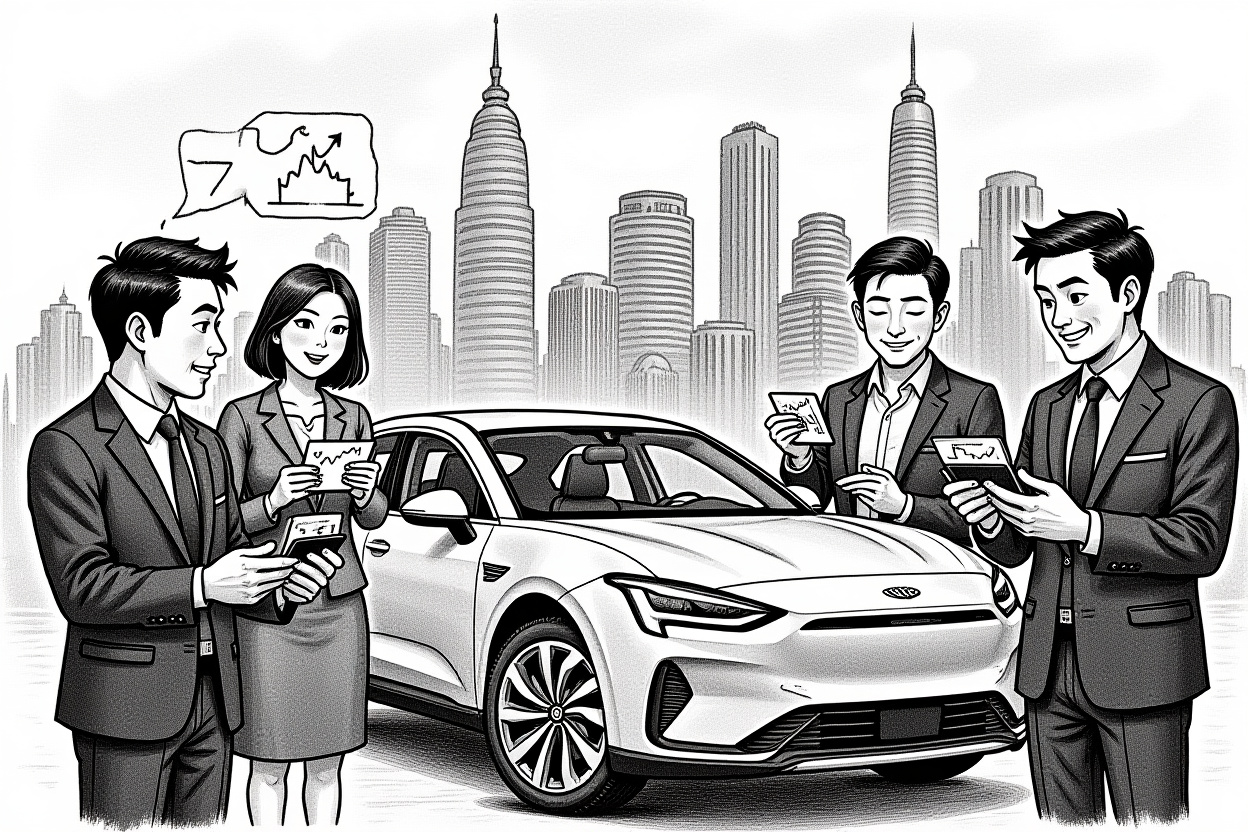
The Japanese automotive market, long dominated by homegrown giants like 丰田 (Toyota) and 本田 (Honda), is bracing for a new wave of competition as Chinese electric vehicle makers set their sights on expansion. This strategic shift represents a pivotal moment in the global EV landscape, with 广汽集团 (GAC Group) announcing its entry into Japan, marking another chapter in the ongoing Chinese EV expansion in Japan. For international investors and industry watchers, this move signals both disruption and opportunity in one of the world’s most established auto markets.
Executive Summary
The impending arrival of GAC’s Aion brand in Japan underscores a significant realignment in Asian automotive trade flows and competitive dynamics. Key takeaways include: – GAC Group will launch its 埃安 (Aion) EV brand in Japan in summer 2026, initially targeting corporate clients with two models. – This international foray coincides with GAC’s domestic struggles, including falling sales and net losses, highlighting a strategic pivot. – Japanese automakers are not standing idle; 丰田汽车 (Toyota Motor) and 日产汽车 (Nissan Motor) are rapidly enhancing their EV lineups to counter the threat. – The broader trend of Chinese EV expansion in Japan could reshape market share, accelerate electrification, and influence regional supply chains.
GAC Group’s Strategic Entry into the Japanese EV Market
广汽集团 (GAC Group) has formally detailed its plans to penetrate the Japanese automotive sector, a market historically resistant to foreign brands. According to Japanese media reports, the state-owned automaker will commence sales in the summer of 2026, leveraging a local partner for distribution. This initiative is a clear example of the accelerating Chinese EV expansion in Japan, following similar moves by 比亚迪 (BYD) and 吉利 (Geely).
Sales Targets and Distribution Model
GAC’s approach is methodical and scaled for gradual market penetration. The company has appointed M Mobility Japan, based in Tokyo’s Nakano ward, as its exclusive sales agent. The initial phase will focus solely on business-to-business (B2B) clients, such as companies with corporate fleet needs. The sales targets are modest but indicative of a long-term strategy: – 2026 Goal: Secure 200 vehicle orders. – 2027 Goal: Increase orders to 2,000 units. This phased rollout allows GAC to test consumer response, establish after-sales service networks, and build brand recognition without the immense upfront costs of a consumer-facing launch.
Analyzing GAC’s Domestic Challenges and International Ambitions
GAC’s push into Japan cannot be viewed in isolation; it is inextricably linked to its performance at home. The company’s decision to expand internationally comes at a time when its domestic business is facing significant headwinds, making this move a strategic imperative for growth and survival.
Financial and Sales Performance in China
Recent financial disclosures paint a challenging picture for GAC in its home market. For the first three quarters of this year, the group reported: – Total Vehicle Sales: 1.18 million units, an 11% year-over-year decline. – 埃安 (Aion) Brand Sales: 180,000 units, a sharp 20% decrease compared to the same period last year. – Revenue: 669.29 billion yuan, down 10.45%. – Net Loss: 4.312 billion yuan, equating to a loss of approximately 3,643 yuan per vehicle sold. This trend of deteriorating profitability is not new. GAC’s net profit has fallen for two consecutive years, dropping 45.08% in 2023 and a further 81.40% in 2024. In this context, the Japanese market represents a crucial new frontier for revenue diversification and a test bed for its EV technology on a global stage.
Product Portfolio and Competitive Pricing for Japan
To succeed in Japan, GAC is tailoring its product offering to local market specifications and consumer expectations. The initial lineup will feature two models from its Aion brand, both designed to offer value and compatibility.
Model Specifications and Market Positioning
The company will introduce the 埃安UT (Aion UT), a compact car, and the AION V, an SUV. Key details include: – Aion UT Starting Price: 330万日元 (approximately 149,800 yuan). – AION V Starting Price: 500万日元 (approximately 227,000 yuan). – Charging Standard: Both models will support Japan’s predominant fast-charging protocol, CHAdeMO, ensuring infrastructure compatibility—a critical factor for adoption. By pricing these models competitively against equivalent Japanese EVs, GAC aims to undercut rivals on value, offering advanced features and smart technology that have become hallmarks of the Chinese EV expansion in Japan.
Japanese Automakers Launch Counteroffensive Strategies
The arrival of Chinese competitors has triggered a swift and determined response from Japan’s automotive incumbents. Rather than ceding ground, companies like Toyota and Nissan are doubling down on their own electrification roadmaps, setting the stage for a fierce market battle. This defensive maneuver is a direct reaction to the perceived threat of Chinese EV expansion in Japan.
Enhanced EV Lineups and Sales Push
Japanese manufacturers are moving quickly to refresh their offerings and reclaim narrative control in the EV space. Recent and upcoming actions include: – 丰田汽车 (Toyota Motor): In October, it introduced a partially revamped version of its bZ4X SUV. This effort paid immediate dividends, with Toyota claiming the top spot in Japan’s monthly EV sales rankings for November—a significant psychological victory. – 日产汽车 (Nissan Motor): Scheduled to launch a next-generation 聆风 (Leaf) in January, updating its iconic but aging model. – 铃木 (Suzuki): Plans to debut its first fully electric model, the e-Vitara, signaling the entry of another major player into the domestic EV fray. These developments indicate that Japanese firms are treating the Chinese incursion with utmost seriousness, investing in product improvements and marketing to protect their home turf.
The Broader Landscape: Other Chinese Players and Market Implications
GAC is not alone in its ambitions. The potential for Chinese EV expansion in Japan is drawing interest from multiple automakers, suggesting a sustained competitive pressure that could reshape the industry’s fundamentals.
Xiaomi’s Foray and the Collective Challenge
小米 (Xiaomi), the Chinese electronics giant that recently entered the automotive sector, has also signaled its interest in Japan. In September, its Japanese subsidiary publicly displayed the SU7 sedan and expressed a clear intent to sell in the market in the future. This indicates that the competitive front is widening beyond traditional automakers to include tech-focused newcomers. The collective push poses several implications for the market: – Acceleration of Electrification: Increased competition will likely spur faster adoption of EVs among Japanese consumers and corporations. – Price Pressure: The value proposition offered by Chinese brands could force Japanese automakers to reconsider pricing strategies, potentially compressing margins. – Technology Transfer: Japanese firms may accelerate partnerships or sourcing of Chinese battery and software technology to remain competitive.
Forward-Looking Analysis and Strategic Guidance
The entry of GAC Aion into Japan marks a inflection point with far-reaching consequences for investors and industry executives. The success of this Chinese EV expansion in Japan will hinge on several key factors over the next 24-36 months. First, execution on the ground will be paramount. GAC must ensure reliable vehicle quality, robust after-sales support, and effective brand building to overcome inherent skepticism toward foreign automakers in Japan. Second, the response from Japanese consumers and corporate fleet managers will be closely watched. Initial sales figures to business clients will serve as a leading indicator of broader market acceptance. Third, regulatory and trade dynamics remain a wildcard. Any shift in policies or tariffs could impact the cost structure and market access for Chinese imports. For global investors, this evolving scenario presents both risks and opportunities. Monitoring the quarterly sales reports of GAC in Japan, alongside the EV sales volumes of Toyota, Nissan, and Honda, will provide critical data on market share shifts. Additionally, paying attention to supply chain developments, particularly in batteries and semiconductors, will be essential as competition intensifies. The strategic playbook for Japanese automakers will involve not just defending the home market but also accelerating their own offensive moves in China and other global markets. In conclusion, the automotive rivalry between China and Japan is entering a new, electrified phase. GAC’s planned launch is a bold test of whether Chinese EV prowess can translate into success in a mature, innovation-driven market like Japan. The countermeasures from Japanese giants confirm that this is a battle neither side can afford to lose. For market participants worldwide, staying informed on these developments is crucial for making timely investment decisions and strategic partnerships in the fast-evolving Asian automotive sector. The road ahead promises to be one of intense competition, rapid innovation, and significant market realignment.