



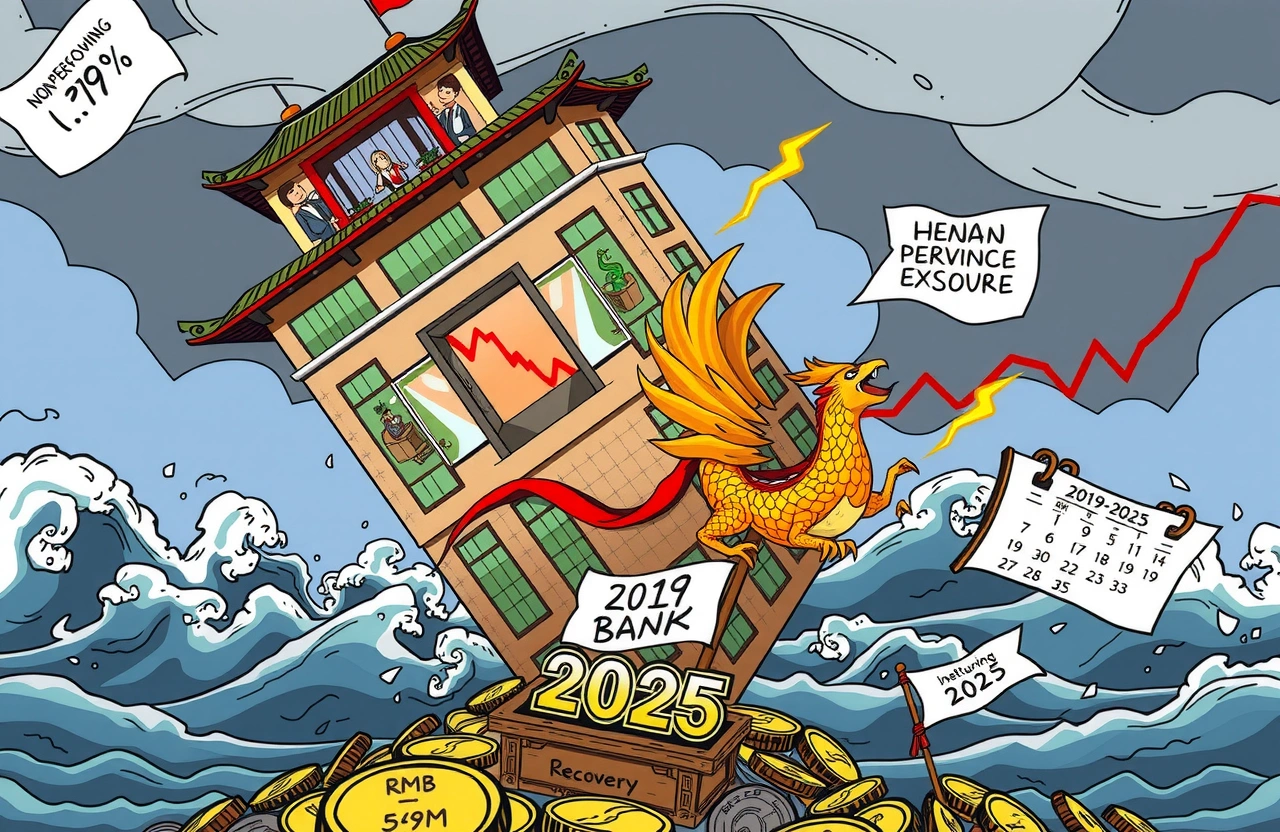
Market Anomaly in China’s Banking Sector
In the first half of 2025, China’s banking sector witnessed a remarkable anomaly. While 41 publicly traded banks saw their share prices rise significantly during this period, Zhengzhou Bank stood alone as the sole declining banking stock. Despite recent gains, Zhengzhou Bank recorded a 1.9% decline as of June 30th against an industry where competitors like SPD Bank soared nearly 40%. This divergence highlights fundamental challenges facing Henan province’s largest local bank amid broader market strength.
Zhengzhou Bank’s Troubling Stock Performance
Year-to-date performance reveals concerning patterns:
– 37 banking stocks delivered double-digit growth
– Only Zhengzhou Bank recorded negative returns (-1.9%) at mid-year
– Three consecutive trading days of gains in July barely returned the stock to positive territory year-to-date
The 3.81% YTD gains as of July 8th represents China’s lowest banking sector performance. Market analysts attribute recent volatility largely to Hong Kong market connections – Zhengzhou Bank’s HK-listed shares had reached nine-month highs prior to A-share movements. Materially, substantial ownership changes occurred as Hongkang Life Insurance increased its stake to 6.68%, acquiring 39 million additional shares.
Dividend Dilemma: Lowest Payout in Sector
Shareholder Reward Concerns Emerge
Compounding investor disappointment is Zhengzhou Bank’s dividend policy. With China’s banking sector averaging 25-30% payout ratios, Zhengzhou Bank’s 9.69% dividend rate positions it as the industry’s lowest contributor to shareholder returns. Distribution amounted to just RMB 0.20 per share – totaling RMB 182 million for shareholders.
Comparative Dividend Analysis:
– Suzhou Rural Commercial Bank: Minimum 16.98% payout among peers
– Changshu Rural Commercial Bank: 19.77%
– Xi’an Bank: 17.37%
– Industry leaders: Over 30% payout ratios across 14 banking stocks
In justifying the constrained dividend approach, Zhengzhou Bank cited:
1. Interest margin compression impacting revenue
2. Increased focus on non-performing loan disposal
3. Retained earnings strengthening capital adequacy
4. Limited external capital channels requiring internal accumulation
The 2025 distribution marks Zhengzhou Bank’s first payout since 2019, ending a five-year withholding period during which preceding distributions reached RMB 592 million.
Asset Quality Challenges Mount
Non-Performing Loan Pressures
Zhengzhou Bank’s financial disclosures revealed persistent asset quality concerns:
– NPL ratio of 1.79% significantly exceeds industry-average 1.50%
– Ranked second-highest among 42 listed banks (exceeded only by Lanzhou Bank)
– Concentrated exposures: Real estate (9.55%), wholesale/retail (2.43%)
2024 witnessed particularly alarming deterioration:
– Real estate NPLs spiked over 300 basis points annually
– Mid-to-long term loan defaults increased 0.35 percentage points
– Provisions declined to 182.99% coverage ratio
Operational Performance Metrics
Financial statements indicate fundamental challenges:
– Q1 2025 revenue improved marginally (2.22% YoY growth)
– Profit growth reached 4.98% but failed to exceed inflation
– Capital adequacy ratios deteriorated:
Core Tier 1: ↓3bps to 8.73%
Tier 1 Capital: ↓5bps to 10.76%
Management Turbulence at Zhengzhou Bank
Executive leadership witnessed unprecedented turnover in early 2025:
– January 24: Deputy President Fu Chunqiao resigned concurrently with promotion of new President Li Hong
– February 12: Assistant President Liu Jiuqing departed
– March 27-28: Three simultaneous departures:
Deputy President Guo Zhibin
Assistant Presidents Li Lei and Sun Haigang
Within 90 days, six senior executives exited Zhengzhou Bank. Li Hong assumed leadership following her 16-year tenure at Postal Savings Bank of China’s Beijing branch, bringing extensive credit management experience. Responding to investor concerns regarding departures, Zhengzhou Bank attributed changes to “market-based selection adjustments” optimizing governance frameworks.
Compliance Improvement Amid Challenges
The institution’s sole bright spot emerged in regulatory relations:
– Zero administrative penalties during 2025
– Major year-over-year improvement from 2024:
Total RMB 2.8 million across six branch penalties
Puyang/Shangqiu/Pingdingshan subsidiaries penalized
– Salary reduction initiatives implemented for senior executives
This compliance transformation complements strategic pivots toward county-level economic development as Zhengzhou Bank repositions away from problematic urban real estate exposures.
Strategic Outlook: Recovery Prospects
Chairman Zhao Fei and President Li Hong confront three critical recovery priorities:
1. Capital Optimization: Raising depleted capital adequacy ratios
2. Portfolio Rebalancing: Reducing concentrated exposures
3. Investor Confidence Restoration
The institution’s valuation disconnect – trading near historical lows despite belonging to China’s economically vital Henan province – signals potential capital appreciation should turnaround succeed. Long-term prospects hinge upon tangible asset quality improvement and dividend restoration.
Industry Implications
Zhengzhou Bank’s anomalous performance underscores vulnerabilities among regional lenders. Banking analysts identify concerning parallels:
– Similar NPL concentrations observed in several provincial banks
– Dividend capacity constraints becoming prevalent sector-wide
– Real estate sector weakness continuing to pressure financial institutions
Unlike larger national competitors benefiting from sovereign support perceptions, regional banks face elevated refinancing costs. Addressing regional lenders’ structural challenges appears increasingly important for maintaining China’s broader financial stability.
The Road Ahead
Current metrics suggest Zhengzhou Bank’s recovery requires sustained transformation beyond temporary liquidity events driving July gains. Material improvement signals would involve:
– Q3 non-performing loan reduction below 1.75%
– Dividend commitment restoration to market-competitive levels
– Stable executive leadership maintaining continuity
While Zhengzhou Bank confronts significant hurdles, its strategic position servicing China’s fifth-largest provincial economy offers substantial operational franchises if restructuring succeeds. Stakeholders should monitor quarterly disclosures for strategic pivot execution evidence.