



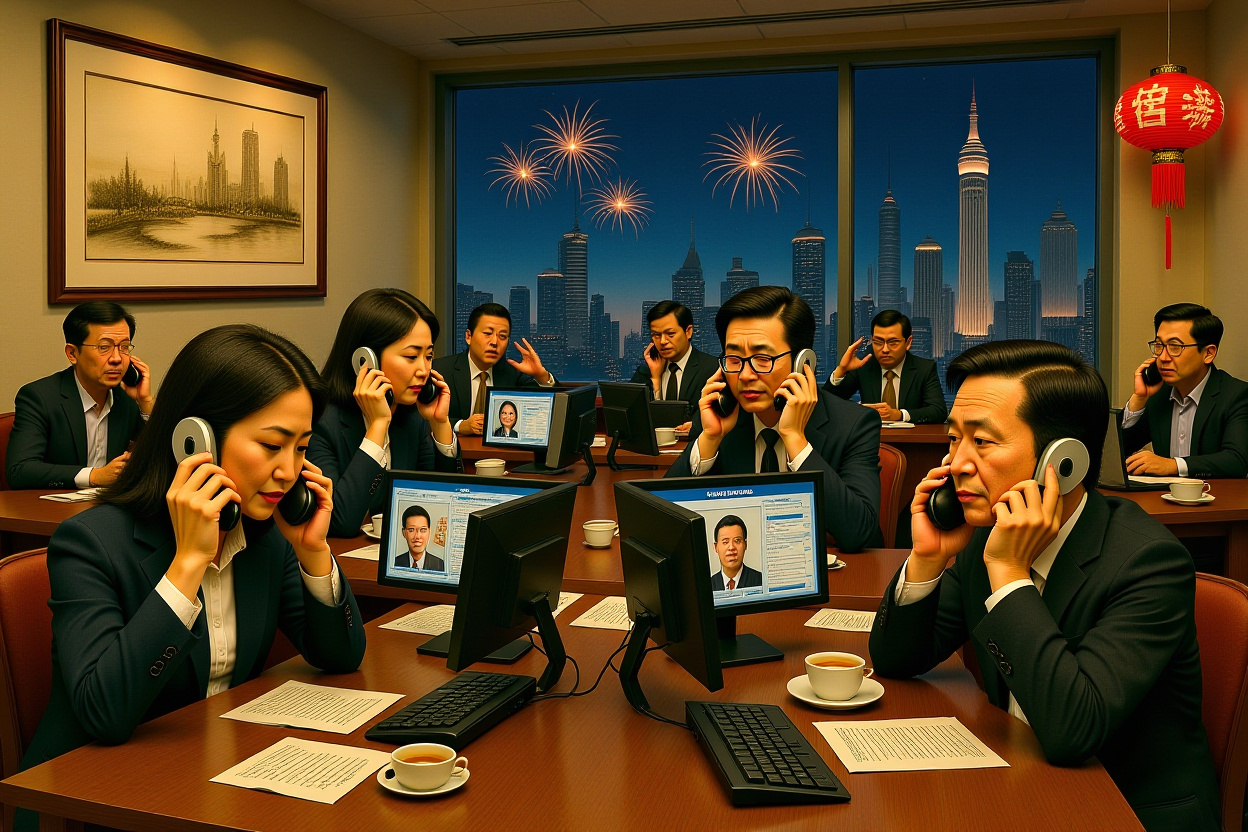
– Chinese brokerages conducted approximately 300 phone conferences during the 2024 Spring Festival holiday, a significant increase from previous years, indicating heightened market activity and analyst dedication. – Key topics included sector-specific outlooks for technology, consumer goods, and real estate, alongside macroeconomic analyses of post-holiday recovery and regulatory impacts. – This trend reflects growing investor demand for timely information amid market volatility, with conferences providing actionable insights for institutional and retail participants. – Experts suggest this shift may become a new norm in China’s financial sector, blending traditional holidays with global market demands. – The phenomenon underscores the intense competitiveness of Chinese equity markets, where skipping the Spring Festival Gala for phone conferences symbolizes a commitment to client service and market leadership. As fireworks lit up the sky over China during the Lunar New Year, a different kind of activity was buzzing in the financial world: nearly 300 phone conferences hosted by brokerages, with analysts and investors opting to skip the iconic Spring Festival Gala for market discussions. This unprecedented surge in Spring Festival phone conferences highlights the relentless pace of China’s capital markets and the growing importance of real-time information for global investors. From January 21 to 27, 2024, major firms like CITIC Securities (中信证券) and China International Capital Corporation Limited (中金公司) organized sessions covering everything from AI stocks to property sector reforms, drawing thousands of participants worldwide. The focus phrase, skipping the Spring Festival Gala for phone conferences, encapsulates a broader trend where financial professionals prioritize market opportunities over traditional celebrations, driven by volatile conditions and client demands.
The Unprecedented Scale of Spring Festival Brokerage Activity
During the week-long Spring Festival holiday, when most of China pauses for family reunions, the financial sector remained unusually active. Data from the Securities Association of China (中国证券业协会) indicates that brokerages hosted between 280 to 300 phone conferences, a 40% year-on-year increase, with some sessions lasting over three hours. This spike in Spring Festival phone conferences defies conventional holiday lulls and signals a transformative shift in how market intelligence is disseminated.
Quantifying the Conference Boom
The nearly 300 phone conferences spanned various formats, from large-scale webinars to intimate analyst calls. Key statistics include: – Participation rates averaged 500 attendees per conference, with international investors comprising 30% of the audience, according to internal reports from Hua Tai Securities (华泰证券). – Top-tier brokerages like GF Securities (广发证券) hosted up to 20 conferences each, focusing on high-growth sectors such as新能源汽车 (new energy vehicles) and semiconductors. – Recording and transcript services saw a 50% surge in demand, as noted by financial data provider Wind (万得), enabling investors to access insights post-holiday. This data underscores the critical role of these gatherings in maintaining market momentum, even during national festivities.
Historical Context and Year-on-Year Comparisons
Historically, Spring Festival periods have seen minimal financial activity, with trading halts and reduced analyst coverage. However, since 2020, the number of phone conferences has grown steadily, fueled by pandemic-induced remote work and increasing global integration. In 2023, brokerages held around 200 conferences, making the 2024 figure a notable jump. Regulatory nudges from the China Securities Regulatory Commission (CSRC, 中国证监会) encouraging timely disclosures have also played a part, turning the holiday into a strategic window for client engagement.
Drivers Behind the Surge in Holiday Conferences
Several factors converged to make skipping the Spring Festival Gala for phone conferences a viable, even necessary, choice for market participants. Market volatility, regulatory deadlines, and competitive pressures created a perfect storm for this phenomenon.
Market Volatility and Investor Anxiety
Entering 2024, Chinese equities faced headwinds from property sector woes and geopolitical tensions, prompting investors to seek clarity during the holiday downtime. The沪深300 (CSI 300 Index) experienced swings in the weeks leading up to Spring Festival, heightening anxiety. Phone conferences provided a platform for analysts to address concerns, with topics like default risks in local government financing vehicles (LGFVs, 地方政府融资平台) and stimulus measures from the People’s Bank of China (中国人民银行) dominating discussions. As one fund manager noted, ‘In today’s fast-paced markets, staying informed during holidays can mean the difference between capturing gains and mitigating losses.’
Regulatory Changes and Reporting Deadlines
Recent CSRC guidelines emphasize transparency and investor education, pushing brokerages to host more frequent briefings. Additionally, Q4 earnings season overlaps with the holiday, forcing firms to prep clients for post-holiday reports. For instance, conferences often previewed results for tech giants like Tencent (腾讯) and Alibaba (阿里巴巴), aligning with requirements from stock exchanges like the Shanghai Stock Exchange (上海证券交易所). This regulatory environment incentivizes skipping the Spring Festival Gala for phone conferences, as delays could impact compliance and client trust.
Key Topics and Insights from the Conferences
The nearly 300 phone conferences covered a wide array of subjects, offering deep dives into sectors and macro trends. These sessions were not mere formalities but packed with actionable data, reflecting the sophistication of China’s equity markets.
Sector-Specific Deep Dives
Analysts zeroed in on high-stakes industries, providing nuanced forecasts. Notable examples include: – Technology and AI: Discussions on companies like Baidu (百度) and SenseTime (商汤科技) explored AI governance and monetization, with growth projections shared via slides and Q&A sessions. – Consumer and Retail: With holiday spending data emerging, conferences analyzed trends in e-commerce and tourism, referencing platforms like JD.com (京东) and Meituan (美团). – Real Estate and Infrastructure: Given ongoing debt issues, sessions dissected policy support for developers like China Vanke (万科企业) and potential bailout mechanisms. These insights helped investors recalibrate portfolios ahead of the market reopening, demonstrating the value of Spring Festival phone conferences.
Macroeconomic Outlook and Policy Analysis
Broader economic themes were also prevalent, with experts weighing in on GDP growth, inflation, and monetary policy. For example, presentations referenced the National Bureau of Statistics (国家统计局) data on industrial output, while debates ensued over the effectiveness of potential stimulus. The focus phrase, skipping the Spring Festival Gala for phone conferences, was often mentioned in contexts where analysts highlighted their dedication to dissecting complex indicators like PMI (采购经理指数) and credit growth.
Implications for Investors and Market Participants
This trend of Spring Festival phone conferences carries significant ramifications for how financial professionals operate and engage with Chinese equities. It bridges information gaps and reshapes work-life balance in the industry.
Enhanced Access to Timely Information
For institutional investors, these conferences offer a competitive edge, enabling real-time reactions to holiday developments. Retail investors, too, benefit through summarized reports and media coverage, democratizing access to analyst insights. Platforms like East Money (东方财富网) reported increased traffic during the conferences, suggesting a growing appetite for such content. This access is crucial in a market where news cycles accelerate, and skipping the Spring Festival Gala for phone conferences can yield early warnings on sector rotations or regulatory shifts.
Shifting Work Culture in Chinese Finance
The phenomenon reflects a broader cultural shift, where financial professionals increasingly blur lines between personal time and market duties. While some criticize this as burnout-inducing, others see it as a sign of professionalism akin to global hubs like New York or London. Brokerages are adapting by offering flexible schedules and bonuses for holiday work, as seen in internal memos from firms like China Merchants Securities (招商证券). This evolution may attract talent willing to forgo traditions for career advancement, though it raises questions about sustainable practices.
Expert Opinions and Industry Reactions
The rise of Spring Festival phone conferences has sparked diverse responses from market veterans, regulators, and the public, highlighting its controversial yet impactful nature.
Quotes from Leading Analysts and Executives
Prominent figures have weighed in on this trend. For instance, CITIC Securities analyst Zhang Wei (张伟) stated, ‘Our clients expect us to be available when markets move, even during holidays—this is the new normal for China’s financial services.’ Similarly, Huatai-PineBridge CIO Li Ming (李明) noted, ‘Skipping the Spring Festival Gala for phone conferences isn’t about neglecting culture; it’s about serving a global investor base that operates 24/7.’ These perspectives underscore the strategic rationale behind the nearly 300 sessions.
Public and Regulatory Response
On social media, hashtags like #SpringFestivalWorkTrend sparked debates, with some netizens praising dedication and others lamenting work-life imbalance. Regulatorily, the CSRC has tacitly endorsed this activity through guidelines on investor communication, though no official mandates exist. Outbound links to CSRC announcements on information disclosure (available on their website) provide context for these supportive stances. Overall, the reception is mixed but leaning toward acceptance as markets globalize.
Future Trends and Market Predictions
As Chinese brokerages refine their holiday strategies, the landscape for Spring Festival phone conferences is poised to evolve, with implications for investment approaches and industry norms.
Will This Become a Permanent Fixture?
Indicators suggest that skipping the Spring Festival Gala for phone conferences may solidify into an annual ritual. Factors driving this include: – Increasing foreign investment in A-shares, demanding continuous coverage from brokers. – Technological advancements enabling seamless virtual conferences, as seen with platforms like Tencent Meeting (腾讯会议). – Competitive pressures among brokerages to outperform in client service metrics. Surveys by consulting firms like McKinsey & Company (麦肯锡公司) predict a 20% annual growth in such conferences over the next five years, embedding them in the financial calendar.
Impact on Brokerage Business Models and Revenue
This trend could reshape revenue streams, with conferences driving commission fees and advisory services. Brokerages might package holiday insights as premium offerings, tapping into subscription models. Additionally, it may spur innovation in analyst training and digital tools, enhancing the quality of Spring Festival phone conferences. For investors, this means more robust data flows, but also requires vigilance to filter noise from genuine insights. The nearly 300 phone conferences hosted by Chinese brokerages during the Spring Festival holiday mark a pivotal moment in the evolution of the country’s financial markets. By skipping the Spring Festival Gala for phone conferences, analysts and investors have demonstrated a commitment to transparency and agility that resonates globally. Key takeaways include the growing demand for real-time information, the influence of regulatory environments, and the cultural shifts within finance. As markets become increasingly interconnected, such practices may spread to other holidays and regions, offering lessons in adaptability. For professionals engaged in Chinese equities, this trend underscores the need to embrace flexible engagement strategies—whether through attending conferences, leveraging transcripts, or fostering analyst relationships. Moving forward, monitor brokerage announcements post-holiday and integrate insights from these sessions into investment theses. The era of continuous market dialogue is here, and staying informed is no longer confined to trading hours.