



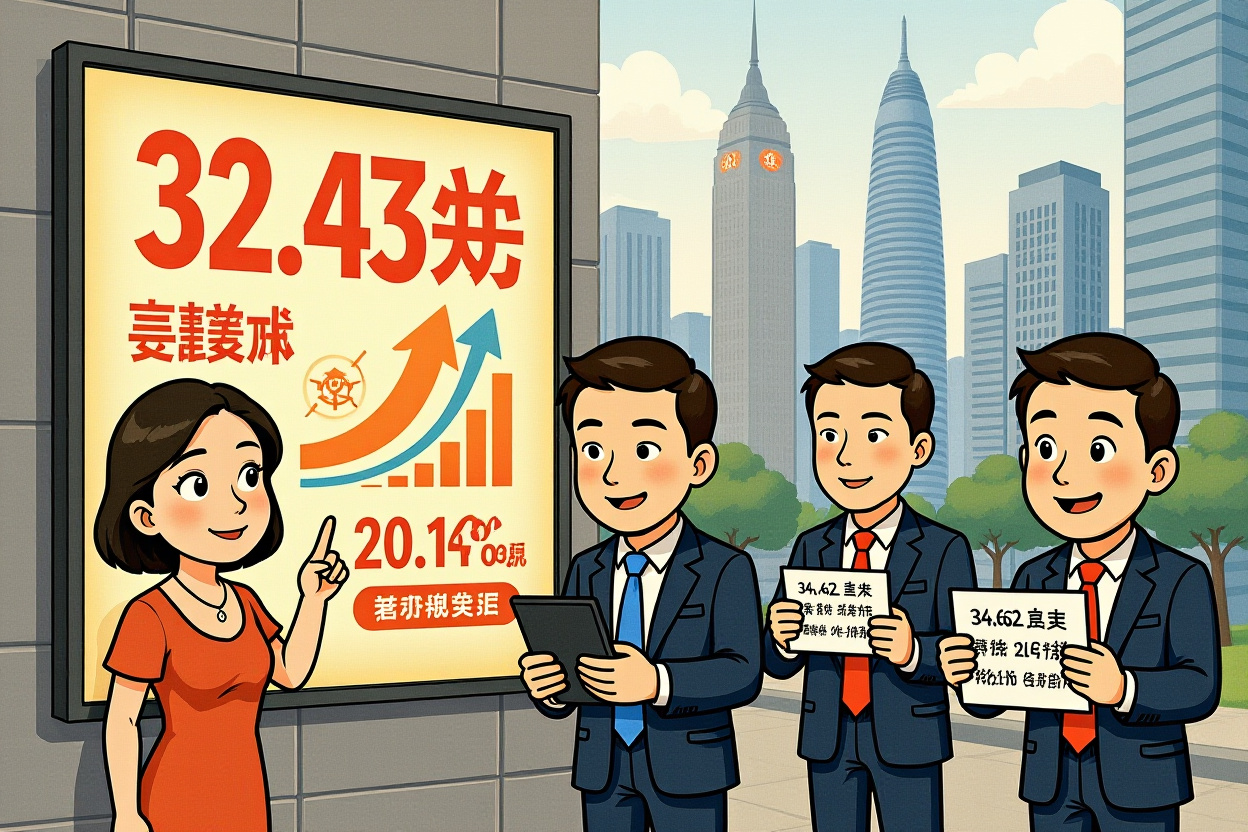
– Trust industry assets reached 32.43 trillion yuan by end-June 2025, a 20.11% year-on-year increase, indicating strong recovery momentum.
– Operating revenue and total profit both showed growth, with increases of 3.34% and 0.45% respectively, supporting the view that the industry has bottomed out.
– Asset management trusts, now at 24.43 trillion yuan, are the primary growth driver, fueled by a shift from non-standard to standard assets like securities investments.
– Asset service trusts are expanding steadily, with wealth management and other services growing, though institutional hurdles remain for sustainable business models.
– Regulatory pilot programs for property registration in key cities are paving the way for future growth, particularly in wealth management services.
After a period of regulatory recalibration and market consolidation, China’s trust sector is emerging with renewed vigor. Data released by the China Trust Industry Association for the first half of 2025 paints a picture of robust growth, with total trust assets scaling to 32.43 trillion yuan. This 20.11% year-on-year surge, coupled with modest increases in operating revenue and profit, raises a pivotal question for global investors: has the trust industry bottomed out and recovered? The figures suggest a sector in transition, where painful adjustments are giving way to a more stable and purpose-driven foundation. This potential recovery is not just a statistical blip but a sign that the industry’s long-awaited turnaround may be underway, offering fresh opportunities in one of China’s key financial segments.
A Resurgent Giant: Trust Assets Surge to 32.43 Trillion Yuan
The latest data from the China Trust Industry Association underscores a significant milestone. As of the end of June 2025, the total trust asset balance for the industry stood at 32.43 trillion yuan. This represents a substantial 20.11% increase compared to the same period last year, marking one of the strongest growth rates in recent years.
Key Performance Indicators Signal Stabilization
Beyond the headline asset figure, the industry’s operational health shows encouraging signs. In the first half of 2025, the entire sector achieved operating revenue of 343.62 billion yuan, a year-on-year increase of 3.34%. Total profit reached 196.76 billion yuan, edging up by 0.45%. This dual growth in revenue and profit is critical; after years of pressure from regulatory crackdowns on shadow banking and risky practices, many analysts interpret this as evidence that the industry has bottomed out and recovered. The focus on ‘returning to origin’—shifting toward genuine trust services and away from high-risk lending—appears to be bearing fruit, though the transition continues to pose challenges.
Asset Management Trust: The Unquestionable Growth Engine
A deep dive into the numbers reveals that asset management trusts are powering the sector’s expansion. According to the capital trust caliber statistics, the balance of asset management trusts was approximately 24.43 trillion yuan in the first half of 2025. This constitutes 75.33% of the total trust asset scale. It increased by 2.18 trillion yuan from the end of 2024, a growth of 9.80%, and surged by 4.48 trillion yuan year-on-year, a jump of 22.46%. This segment has solidified the trust industry’s position within China’s broader asset management landscape, which now totals 174.50 trillion yuan. Trust assets now rank third, just behind insurance asset management (36.23 trillion yuan) and public funds (34.39 trillion yuan).
The Pivot from Non-Standard to Standard Assets
The composition of asset management trusts has undergone a dramatic transformation. Expert director of the China Trust Industry Association, Zhou Xiaoming (周小明), noted that asset management trusts are developing healthily, with business structures adjusting to the times. He emphasized that standard assets have become the dominant allocation method, while non-standard assets have been relegated to a supplementary role. This shift is starkly evident in the data. By the end of 2022, non-standard assets accounted for 54.52% of the capital trust scale. By the first half of 2025, that proportion had plummeted to 39.70%. Conversely, securities investment trusts have ascended to dominance. From representing 34.34% of capital trust scale at the end of 2022, they ballooned to 12.48 trillion yuan, or 51.09%, by mid-2025. This reallocation toward more transparent, liquid standard assets is a core reason why the trust industry has bottomed out and recovered, reducing systemic risk and aligning with regulatory goals.
Asset Service Trust: Building a Foundation for the Future
While asset management trusts drive current growth, asset service trusts represent the sector’s strategic future. This category, which includes wealth management, administration, risk disposal, and asset securitization services, has shown steady expansion. As of June 2025, the scales for these services were notable: wealth management service trusts reached 4.37 trillion yuan, administrative service trusts hit 2.80 trillion yuan, risk disposal service trusts stood at 2.60 trillion yuan, and asset securitization service trusts were at 1.43 trillion yuan. The wide application scenarios fully demonstrate the trust industry’s wealth management and social service functions.
Regulatory Tailwinds and Persistent Challenges
Navigating the New Era: Strategic Imperatives for Trust CompaniesThe recovery narrative is compelling, but it does not erase the ongoing pains of transformation. The modest profit growth of 0.45% highlights that efficiency gains and sustainable profitability remain works in progress. The industry’s shift demands a fundamental rethinking of business models and strategic focus.
Crafting Sustainable Business Models for Long-Term Growth
Synthesis and Forward Guidance for the MarketThe data for the first half of 2025 presents a convincing case that China’s trust sector is on a firmer footing. The expansion to 32.43 trillion yuan in assets, led by asset management trusts and supported by budding asset service trusts, indicates a sector that has weathered the storm of restructuring. The dual growth in revenue and profit, however slight, reinforces the perception that the industry has bottomed out and recovered. For international investors and financial professionals, this signals a recalibration of risk and opportunity within Chinese financial markets. The continued shift toward standard assets enhances transparency and aligns with global investment preferences, while the potential in asset service trusts offers a new frontier for engagement.
Moving forward, market participants should closely monitor the implementation of property registration pilots and the profitability trends in asset service offerings. Trust companies that successfully navigate this evolution—by leveraging their unique positioning in wealth management and specialized finance—are likely to emerge as leaders in the post-transformation landscape. The recovery is underway, but sustained success will depend on strategic execution and adaptive innovation in the years to come.