



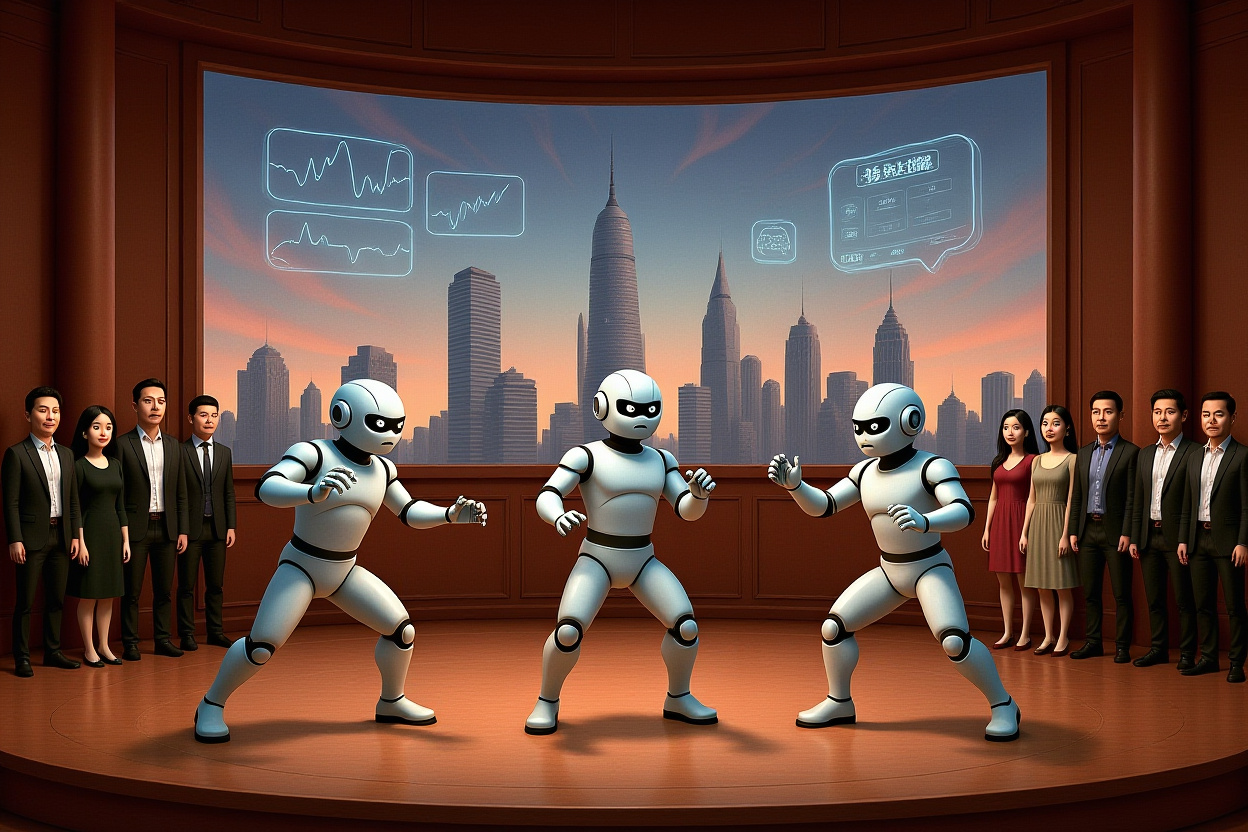
– The 2026 CCTV Spring Festival Gala featured a coordinated display by four domestic embodied AI companies—Magic Atom, Galaxy Universal, Yushu Technology, and Songyan Power—signaling a mature, collective industry push onto the national stage.
– This event transcends mere marketing; it serves as a critical validation platform for technological reliability, public acceptance, and investor confidence in China’s humanoid robotics sector.
– The industry now faces three sequential commercialization challenges: penetrating industrial settings, adapting to complex commercial environments, and ultimately achieving safe, affordable home adoption.
– IDC projects the Chinese embodied AI robot market to reach $770 billion in user spending by 2030, growing at a 94% CAGR, but sustainable growth depends on moving beyond stage performances to scalable, profitable applications.
– 2026 marks a definitive inflection point, where competition shifts from fundraising and hype to securing tangible customer orders, repeat business, and demonstrable ROI in real-world scenarios.
When the dazzling lights of the 2026 CCTV Spring Festival Gala illuminated a cohort of dancing, martial arts-performing humanoid robots, it marked far more than a technological novelty act. For China’s burgeoning embodied AI industry, this iconic cultural event has transformed into the ultimate proving ground for embodied AI, a very public and high-stakes examination of technical prowess, operational stability, and commercial viability. The synchronized performances by companies like Yushu Technology and Magic Atom were not merely for entertainment; they represented a strategic coming-out party, designed to convince a global audience of investors, enterprise clients, and policymakers that Chinese robotics is ready for prime time. As the applause fades, however, the real test begins: converting this national spotlight into sustainable market traction across factories, warehouses, and potentially, living rooms. The journey from the controlled environment of a television studio to the unpredictable chaos of the real world will define which players survive the impending industry shakeout.
The Spring Festival Gala as the Ultimate Proving Ground for Embodied AI
For decades, the CCTV Spring Festival Gala has served as a barometer for China’s technological ambitions, showcasing everything from 5G to holography. In 2026, it unequivocally became the ultimate proving ground for embodied AI, with humanoid robots taking center stage in a coordinated, multi-company display unprecedented in scale and sophistication.
The 2026 Cohort: A Strategic Showcase of China’s Robotics Vanguard
The selection of four firms—Magic Atom, Galaxy Universal, Yushu Technology, and Songyan Power—was a deliberate move by the Gala’s producers to present a unified front of Chinese innovation. Each company was assigned a distinct role that subtly hinted at its strategic positioning. Yushu Technology, building on its breakout performance in 2025, partnered with the renowned Tagou Martial Arts School for a program titled “武 BOT,” emphasizing precision and dynamic movement. Songyan Power appeared in a comedy sketch, highlighting interactive and narrative capabilities. Magic Atom supported a musical performance focused on futuristic themes, while Galaxy Universal featured in a micro-film, showcasing its integration with narrative content. Notably, the slight variations in their official titles—from “Spring Festival Robot Partner” to “Specified Embodied Large Model Robot”—reflected nuanced differences in their technical architectures, from general-purpose robotics to model-driven systems. This curated presentation was a masterclass in demonstrating the breadth of China’s capabilities on a single platform.
From Spectacle to Validation: The Gala’s Dual Economic Mandate
The Spring Festival Gala’s role extends far beyond providing a massive viewership, estimated at over a billion people. For the embodied AI sector, it fulfills two critical economic functions. First, it accelerates public familiarization and acceptance, demystifying robotics and making the concept of machines in daily life more palatable to the average consumer. Second, and more crucially for the industry, it provides a state-endorsed stamp of approval. Performing flawlessly live on national television, without the safety nets of post-production, serves as a powerful testament to reliability for potential B2B clients and investors. It signals that these technologies have progressed beyond the prototype and lab-demo phase. As one industry analyst noted, “A flawless Gala performance is worth a thousand technical whitepapers for building trust with manufacturing CEOs.” This validation is essential for unlocking the next phase of growth, making the Gala a unique and indispensable milestone on the path to commercialization.
Beyond the Stage: The Three-Tiered Commercialization Imperative
The ultimate proving ground for embodied AI is not the television stage, but the unforgiving environments of factories, commercial spaces, and homes. The industry consensus is clear: robots cannot forever dance on command. The real battle for market relevance and survival is fought across three progressively challenging frontiers of application.
Frontier One: Conquering the Industrial Domain
The most immediate and lucrative market for embodied AI robots lies within manufacturing and logistics. These settings offer structured tasks—such as precision assembly, palletizing, quality inspection, and material handling—where labor shortages are acute and ROI calculations are straightforward. However, industrial adoption imposes brutal requirements. Factories demand near-perfect uptime, millimeter precision, and the ability to operate 24/7 in environments with dust, vibration, and electromagnetic interference. A robot that stumbles during a Gala dance can reset; a robot that causes a minute of downtime on an automotive assembly line can incur costs exceeding tens of thousands of dollars. Success here depends on ruggedized hardware, fail-safe software, and deep integration with industrial IoT systems. Companies are now racing to prove their machines can handle not just a choreographed routine, but millions of repetitive, high-stakes cycles without failure.
Frontier Two: Mastering Unstructured Commercial Environments
The next tier of difficulty involves deploying robots in retail stores, hotels, hospitals, and warehouses. These scenarios are semi-structured but highly dynamic, requiring a significant leap in cognitive ability. A robot must navigate crowded aisles, avoid sudden obstacles like shopping carts or running children, understand natural language requests from customers, and manipulate a wider variety of objects. The skills demonstrated in a scripted Gala interaction are a foundational step, but commercial viability requires robust sensor fusion, real-time spatial reasoning, and adaptive decision-making. For example, a concierge robot in a hotel must distinguish between a guest asking for directions and a maintenance worker carrying equipment, all while maintaining a safe and courteous path. This frontier tests the integrated system intelligence of an embodied AI platform, moving beyond pre-programmed motions to contextual awareness and problem-solving.
The Long March Toward Domestic Adoption
While industrial and commercial applications form the near-term revenue base, the true “blue ocean” for the embodied AI industry is the consumer home. This represents the final and most formidable frontier, where the ultimate proving ground for embodied AI will be the average family’s living room.
The Daunting Challenges of the Home Environment
Domestic settings are the antithesis of controlled stages or structured factories. They are inherently chaotic, cluttered, and unpredictable. Challenges include navigating uneven floors covered with toys, safely interacting with pets and children, understanding ambiguous voice commands (e.g., “clean up around here”), and performing complex manipulation tasks like loading a dishwasher or folding laundry—all while being aesthetically pleasing, ultra-safe, and affordable. The cost threshold is particularly critical; while industrial robots can justify high price tags through productivity gains, consumer models must eventually reach a mass-market sweet spot, likely well below $10,000. Achieving this requires breakthroughs in low-cost sensor technology, energy-efficient actuators, and AI algorithms that can learn and adapt to individual household layouts and habits. The home is where the promise of embodied AI as a general-purpose helper will be truly tested.Safety and Trust: The Non-Negotiable Prerequisites
Before robots can become commonplace in homes, they must achieve an unprecedented level of safety and build deep user trust. This goes beyond physical safety mechanisms to encompass data privacy, ethical decision-making, and fail-safe behaviors. A robot must know to stop immediately if a toddler grabs its arm, to never record private conversations without explicit consent, and to handle emergencies like a fire or a fall. Regulatory frameworks will also need to evolve. The path to the home is therefore a marathon, not a sprint, requiring sustained investment in core AI safety research, rigorous testing, and public education campaigns that build on the familiarity initiated by showcases like the Spring Festival Gala.Market Realities and the 2026 Inflection Point
The glamour of the Gala unfolds against a backdrop of stark market projections and intensifying competition. The industry is at a pivotal juncture, where financial metrics are beginning to overshadow technological demonstrations.
Explosive Growth Projections Meet Hard Commercial Truths
Market research firms like IDC paint a compelling picture of the opportunity. Their forecast that China’s embodied intelligent robot user expenditure will hit $770 billion by 2030, growing at a compound annual rate of 94%, continues to fuel investor enthusiasm and strategic planning. This data point is frequently cited in pitch decks and annual reports. However, beneath this macro-optimism lies a pressing need for micro-validation. Venture capital, which flooded into the sector in the early 2020s, is now demanding clear paths to profitability. The conversation has shifted from “how advanced is your technology?” to “who is your paying customer, and what is your customer acquisition cost?” The Gala exposure provides a powerful top-of-funnel marketing boost, but it does not automatically translate into purchase orders or recurring revenue streams.
The Great Shakeout: From Hype to Hard Metrics
Industry observers widely regard 2026 as a watershed year. The phase of competing on fundraising totals, flashy prototype reveals, and trade show presence is giving way to a new era defined by contract wins, deployment scalability, and unit economics. Companies that leveraged the Spring Festival Gala spotlight effectively will be those that swiftly pivot their narrative from “look what we can do” to “here is the value we deliver.” The differentiation will increasingly be based on vertical-specific solutions—a robot optimized for electronics assembly, for instance, versus one for hospital logistics. Partnerships with major manufacturing conglomerates, logistics giants, and retail chains will become the true indicators of success, far more telling than social media views of a dance performance. This inflection point signifies the industry’s painful but necessary transition from a technology-driven to a market-driven ecosystem.Synthesizing the Path Forward for Stakeholders
The 2026 Spring Festival Gala has undeniably accelerated the embodied AI narrative in China, propelling it into the mainstream consciousness and onto the agendas of corporate boards worldwide. However, it has also raised the stakes, setting a high public benchmark that must now be met in the gritty reality of economic activity. For investors, the imperative is to look beyond the spectacle and scrutinize business models, supply chain resilience, and management teams with proven operational experience. For enterprise clients, the time for cautious pilot programs in controlled settings is now, using the Gala participants as a shortlist for potential vendors. For the robotics companies themselves, the mandate is unambiguous: harness the credibility earned on the national stage to forge deep, symbiotic partnerships with industries that have immediate pain points. The ultimate proving ground for embodied AI is, and will always be, the market itself. The Gala was the entrance exam; the final test—building profitable, scalable businesses that redefine work and life—is now adminsitered daily by customers. The call to action is clear: move swiftly from demonstration to deployment, for in the race to dominate the embodied AI future, commercial execution will separate the enduring pioneers from the forgotten performers.