



Executive Summary
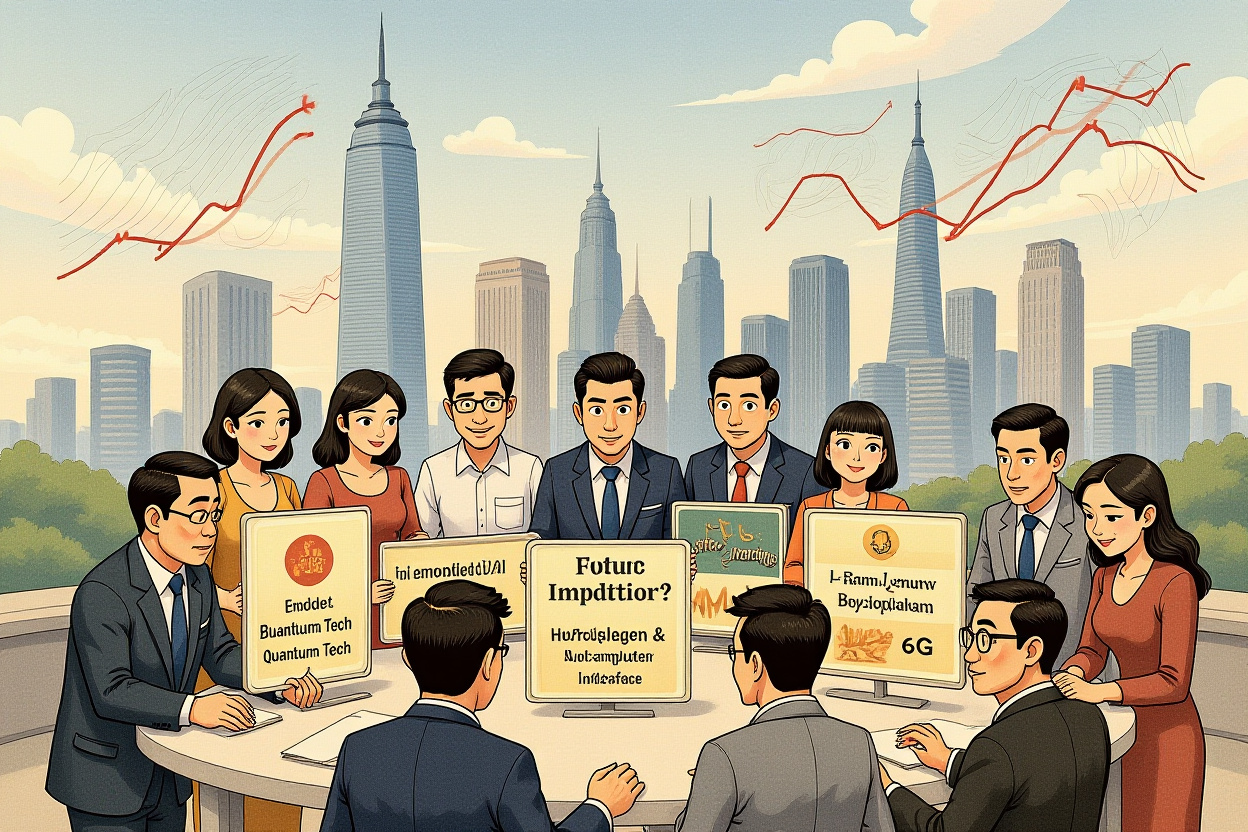
- China’s “15th Five-Year Plan” has officially designated six frontier sectors—Embodied AI, Quantum Tech, Bio-manufacturing, Hydrogen & Nuclear Fusion, Brain-Computer Interface, and 6G—as national strategic future industries, triggering a scramble among provinces to secure leading positions.
- Regional strategies are diverging: coastal powerhouses like Shanghai and Guangdong focus on commercializing embodied AI, while resource-rich provinces like Jilin and Heilongjiang leverage local advantages in hydrogen and bio-manufacturing, respectively.
- High-barrier sectors like quantum computing and nuclear fusion are currently dominated by a few innovation hubs, such as Anhui and Sichuan, highlighting the critical role of existing research infrastructure and talent.
- The competition signals a fundamental shift from uniform industrial policy to a more specialized, regionally-driven model for cultivating next-generation economic growth engines, with profound implications for global supply chains and technology leadership.
The Starting Gun Has Fired on China’s Next Industrial Revolution
The blueprint is set, and the race is on. In March 2026, the city of Suzhou—often dubbed China’s “strongest prefecture-level city”—unveiled ambitious plans to cultivate ten key emerging and ten key future industries. This move was not made in isolation. It is a direct response to a national clarion call issued in China’s 15th Five-Year Plan (2026-2030), which mandates the construction of a “whole-chain cultivation system for future industries.” The plan explicitly targets quantum technology, bio-manufacturing, hydrogen and nuclear fusion energy, brain-computer interfaces, embodied AI, and sixth-generation mobile communication (6G) as the new growth engines of tomorrow.
This national directive has ignited a fierce, strategic competition among China’s provinces and megacities. For local governments, securing a first-mover advantage in these future industries is not merely an economic opportunity; it is viewed as a matter of long-term survival and relevance in the nation’s evolving economic hierarchy. As National Development and Reform Commission (NDRC) Chairman Zheng Shanjie (郑栅洁) stated, these industries are on the “eve of technological breakthrough.” The future industries of today are poised to become the pillar industries of tomorrow. This article maps the unfolding regional battleground for these six critical sectors, analyzing which areas are accelerating their breakthroughs and what their distinct strategies reveal about the future shape of Chinese innovation.
The Embodied Intelligence Gold Rush: From Coast-Wide Buzz to Focused Application
Among the six national priorities, embodied AI—intelligent systems, particularly humanoid robots, with a physical form that can interact with the real world—is experiencing the most feverish level of activity. An analysis of 2026 provincial government work reports reveals that at least 21 provinces explicitly mentioned “embodied intelligence” or “robotics,” with all 31 provinces outlining部署 (plans) related to AI and the intelligent economy. This coast-to-coast buzz underscores the sector’s broad-based appeal due to its long industrial chain, diverse technical pathways, and vast application scenarios.
However, beneath this widespread interest, a tiered competition is emerging, distinguishing early commercializers from those still in the planning phase.
Shanghai: The Incubator for Commercial Scale
Shanghai has rapidly established itself as the domestic hub most likely to achieve scaled commercialization. Industry analysts cite the city’s unparalleled ecosystem: within a 150-kilometer radius, 100% of the core components for a humanoid robot can be sourced. This builds on the Yangtze River Delta’s world-class hardware supply chain, Shanghai’s deep pool of AI talent, and its established foundation in algorithm and data control. Global research firm Omdia reports that Chinese manufacturers led global humanoid robot shipments in 2025, with Shanghai-based companies like Zhiyuan and Fourier ranking in the global top ten.
Shanghai’s strategy now extends beyond manufacturing. The city is implementing an “AI Plus” action plan, focusing on building out computational power infrastructure, industry-specific data corpora, and vertical application models to drive the widespread adoption of next-gen intelligent terminals and agents.
Guangdong: The Manufacturing Province’s Application Play
While many regions remain in the “cultivation” phase, Guangdong, China’s manufacturing behemoth, is pushing aggressively into application. Following a directive from Guangdong Party Secretary Huang Kunming (黄坤明) to “put embodied AI to use,” the province released the Guangdong Province Artificial Intelligence Empowering High-Quality Manufacturing Development Action Plan (2025-2027). With manufacturing accounting for roughly one-eighth of the national total and hosting ten trillion-yuan industrial clusters, Guangdong’s strategy is to leverage its vast factory floors as a giant “testing ground.” Its goals include cultivating specialized AI models and accelerating the construction of embodied AI training facilities.
This application-focused theme is echoed elsewhere. Shandong proposes “building a training ground system for embodied intelligent robots,” Zhejiang aims to create a national AI application pilot base for embodied AI, and Beijing plans to open up specific scenarios—from automotive production to commercial retail—to prioritize the deployment of tens of thousands of robots, eyeing a trillion-yuan cluster.
Leveraging Local Advantages: The Resource-Driven Path in Bio-Manufacturing and Hydrogen
Not all future industries require the dense innovation networks of a Shanghai or Shenzhen. The national guidance emphasizes “adapting to local conditions,” recognizing that some sectors offer alternative pathways for provinces with specific resource endowments. This is vividly illustrated in the races for bio-manufacturing and hydrogen energy.
In bio-manufacturing, Heilongjiang province has emerged as a national leader not through software prowess, but through its vast agricultural feedstocks. Its Sui-Ha-Da-Qi bio-manufacturing cluster was designated as a national advanced manufacturing cluster in 2024—the only one in the bio-manufacturing field. From fewer than 80 core enterprises during the 13th Five-Year Plan period, Heilongjiang now hosts 194, with industry output exceeding 100 billion yuan and年均增长率 (average annual growth) over 10%. Its strategy focuses on a new round of “Double Hundred Projects” in the bio-economy to sustain this momentum.
Other provinces are finding their niches: Chongqing is establishing a Bio-manufacturing Research Institute, Yunnan is cultivating bio-manufacturing industrial parks, and Hainan is targeting marine bio-manufacturing.
Jilin’s Bid to Become the “Hydrogen Valley of the North”
The competition in hydrogen energy is even more geographically defined. As a secondary energy source, hydrogen’s production is tied to the availability of renewable energy (for green hydrogen) or industrial by-products. Jilin province is making a bold play, citing its status as one of China’s nine ten-million-kilowatt-level wind and solar power bases. Its 2026 government work report highlights leading national capacity in “green electricity-hydrogen-ammonia-alcohol” projects and the successful deployment of the country’s first hydrogen-powered tourist train.
Jilin’s industrial base provides a ready-made ecosystem. Automotive giants like FAW and rail leader CRRC Changchung are developing hydrogen equipment, while its dense chemical industry clusters offer a natural market for green hydrogen consumption. A recent pilot policy from the Ministry of Industry and Information Technology (MIIT), encouraging hydrogen use beyond transport in sectors like steel and chemicals, aligns perfectly with strategies seen in Inner Mongolia (focusing on coupling green hydrogen with metallurgy and chemicals) and Gansu (building hydrogen equipment projects).
The Innovation Fortresses: High-Barrier Sectors and the “Headquarters Economy”
In stark contrast to the widespread布局 (layout) of embodied AI, sectors like quantum technology, nuclear fusion, 6G, and brain-computer interfaces remain the domain of a select few regions possessing extraordinary concentrations of research talent, state-level laboratories, and decades of institutional investment. Here, the competition is less about widespread application and more about consolidating and extending an already formidable lead.
Anhui province stands as the undisputed global powerhouse in quantum technology. According to the 2024 Global Future Industry Development Index Report, Hefei’s quantum industry ranks second globally, behind only San Francisco. Of the four Chinese companies in the global top 20 for quantum, three are from Anhui. With over 100 quantum chain enterprises, Anhui’s focus for 2026 is on building quantum computing R&D platforms and implementing a “Thousand Scenarios” action plan to accelerate technology transfer.
The field of nuclear fusion energy is even more exclusive. Only Anhui, Hubei, and Sichuan list it as a key development direction in their 2026 work reports. This trifecta is supported by unique assets: Anhui’s Institute of Plasma Physics under the Chinese Academy of Sciences, Sichuan’s strong nuclear industry base and the Southwestern Institute of Physics, and Hubei’s J-TEXT device at Huazhong University of Science and Technology. Shanghai is also a key player, using its financial muscle through the Shanghai Future Industry Fund to invest in a portfolio of fusion startups like Star Fusion and Energy Singularity.
The Cautious Expansion of 6G and Brain-Computer Interface Hubs
The 6G landscape currently features a clear top tier. Only Beijing, Shanghai, and Jiangsu explicitly mentioned 6G in their 2026 reports, each boasting flagship achievements: Beijing’s small-scale experimental network, Shanghai’s cultivation plan, and Jiangsu’s全球首个 (world’s first) 6G field trial network. Signals from Guangdong, Anhui, and others suggest the competition will widen during the 15th Five-Year Plan period.
For brain-computer interfaces (BCI), the industrial chain is primarily concentrated in the Jiangsu-Zhejiang-Shanghai region, home to leading firms like BrainCo, NeuroXess, and Brainstrong. Research-driven clusters also exist in Beijing, Tianjin, and Shaanxi. However, a second wave of provinces—including Chongqing, Shandong, and Jiangxi—are now making moves to enter the BCI arena, indicating that even high-tech fields are seeing increased regional competition.
Strategic Implications and the Road Ahead for China’s Future Industries
The contours of China’s next-generation industrial map are rapidly taking shape. This is not a monolithic, state-directed push, but a dynamic and increasingly specialized regional contest. The development of these future industries will create clear winners and reshape the country’s economic geography. Coastal innovation hubs will deepen their integration of software, hardware, and capital, while interior provinces will leverage natural resources and existing industrial bases to carve out leading positions in bio-economy and new energy.
For global investors and corporate strategists, understanding this regional dimension is crucial. Investment opportunities and partnership potentials will vary dramatically depending on the sector and the specific strengths of each locale. The race also signals China’s long-term commitment to technological self-sufficiency and leadership in fields that will define the global economy of the 2030s and beyond.
The key takeaway is that the national “whole-chain cultivation system” is being built from the ground up, through fierce but strategic inter-provincial competition. Monitoring the progress of these regional champions—from Shanghai’s embodied AI factories to Anhui’s quantum labs and Jilin’s hydrogen valleys—will provide the clearest early indicators of where China’s formidable industrial might will strike next in the global arena. Stakeholders are advised to look beyond national headlines and develop a nuanced, region-specific understanding of where these critical future industries are truly taking root and thriving.