



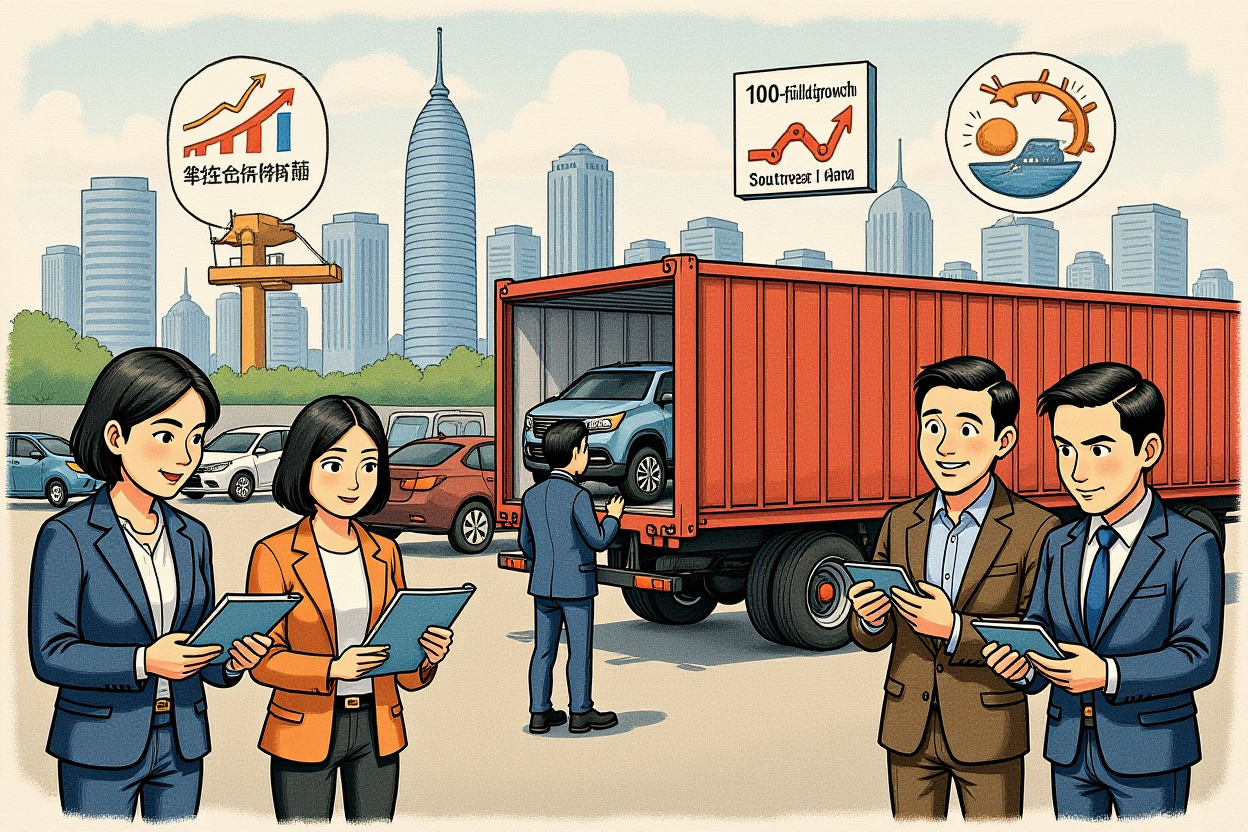
– Chinese used car exports have exploded from 4,300 units in 2020 to over 436,000 in 2024, a 100-fold increase, driven by demand in emerging markets.
– Price arbitrage opportunities exist, with export-oriented purchase prices in China often thousands of yuan higher than domestic rates, particularly for SUVs and specific models.
– Profit margins are squeezed by logistical costs, regulatory hurdles, and risks like shipment delays or currency fluctuations, leading to losses for unprepared traders.
– Regulatory crackdowns on ‘zero-kilometer used cars’—new cars exported as used—are forcing industry consolidation and emphasizing compliance and after-sales networks.
– Future growth hinges on building scalable supply chains and overseas service capabilities, with opportunities for established players but challenges for small entrants.
A quiet revolution is transforming global automotive trade, emanating from China’s bustling used car markets. Over the past four years, Chinese used car exports have not merely grown; they have skyrocketed, achieving a staggering 100-fold increase that has reshaped supply chains from Tianjin to Tashkent. For international investors and industry professionals, this boom represents a tantalizing mix of high-margin opportunities and complex, cross-border risks. The narrative of Chinese used car exports is no longer a niche story but a critical component of China’s automotive sector evolution, influencing everything from domestic vehicle residuals to emerging market mobility. As social media fills with ads offering premium prices for late-model, low-mileage vehicles destined for overseas, a new ecosystem has emerged, promising profits but also harboring tales of significant financial loss. Understanding the dynamics of this market is essential for anyone with exposure to Chinese equities or global automotive trends.
The Meteoric Rise of Chinese Used Car Exports
The trajectory of Chinese used car exports is nothing short of extraordinary. From a modest base of approximately 4,300 units in 2020, exports surged to over 436,000 units in 2024, according to data from the China Automotive Circulation Association (中国汽车流通协会). This represents a year-on-year growth of 46.5% in 2024 alone, underscoring the explosive demand. The export footprint now spans more than 160 countries and regions, with Southeast Asia, the Middle East, Europe, and Latin America as key destinations. This growth has been fueled by a perfect storm of factors: domestic new car price wars depressing trade-in values, creating a surplus of quality used vehicles, and burgeoning demand in markets where affordable, reliable transportation is in short supply.
From Domestic Surplus to Global Supply
In China, aggressive new vehicle discounts and rapid model turnover have accelerated the depreciation of recently purchased cars. This has created a pool of ‘young’ used vehicles—often 3-5 years old with under 50,000 kilometers—that are highly sought after abroad. A used car dealer in Tianjin explained to Tech Planet that export-oriented buyers are offering premiums of several thousand yuan over domestic market prices for specific models. This price differential acts as a powerful magnet, pulling quality inventory into the export pipeline. The expansion of Chinese used car exports is thus a direct response to global imbalances in vehicle affordability and availability.
Building an Industrial Ecosystem
The sector has matured rapidly, developing a full industrial chain. This includes:
– Front-end sourcing: Dealers and aggregators procuring vehicles based on precise overseas specifications.
– Mid-stream processing: Vehicles undergo refurbishment, compliance checks, and certification by specialized firms to meet import standards.
– Logistics and customs: A network of logistics providers and export bases, such as the Suifenhe Automobile Export Base (绥芬河汽车出口基地), handles international shipping and clearance.
– Overseas sales and service: Establishing distribution channels and after-sales support in target markets to build buyer trust.
This structured approach has helped standardize processes, though the ‘non-standard’ nature of each used vehicle continues to pose challenges.
Profiting from the Export Gold Rush: Who Are the Players?
The booming market for Chinese used car exports has attracted a diverse array of participants, from individual traders to corporate giants. Each plays a distinct role in the value chain, with varying levels of risk and reward. For many small and medium-sized enterprises (SMEs), this represents a pivotal shift from a struggling domestic market to potentially lucrative cross-border trade. However, access to the full profit potential is unevenly distributed, often hinging on scale, expertise, and overseas connections.
The Grassroots: Individual Traders and Service Platforms
A significant portion of the activity originates with individual used car dealers who have pivoted to sourcing for export. As one Hebei-based dealer noted, the volatility in China’s domestic used car market—driven by relentless new car price cuts—has made traditional inventory holding risky. Many now operate as agile sourcing agents, matching specific overseas orders for a fee. They typically focus on high-demand models like the Haval H6, Volkswagen Golf, or Mazda 3 (known as the Axela in China). However, these small players usually only engage in the initial acquisition. The subsequent steps—inspection, refurbishment, export licensing, and logistics—require partnerships with licensed export entities or service platforms. Companies like Dongyang International Auto City (东阳国际汽车城) offer integrated services, including资质代办 (qualification agency), logistics, and buyer matchmaking, allowing newcomers to enter with lower capital outlay. Yet, the core bottleneck remains securing stable overseas sales channels, as foreign buyers often prefer dealing with larger, more reputable firms that can guarantee vehicle condition and after-sales service.
Corporate Incumbents: Rental Fleets and Online Platforms
Major players have also entered the fray, leveraging their scale and resources. Shenzhou Zuche (神州租车), a leading car rental company, launched its used car export business in 2024. It has established 29 domestic used car center warehouses, 5 port front warehouses, and 6 overseas direct sales offices, creating a formidable integrated pipeline. Similarly, Guazi (瓜子二手车), a prominent online used car platform, began exploring exports as early as 2019. These companies benefit from large, consistent vehicle inventories from fleet turnover and strong brand recognition, which helps reassure international buyers. Their involvement signals the maturation of Chinese used car exports into a mainstream, institutional-grade business stream.
The Hidden Costs and Risks: Why High Margins Don’t Always Mean High Profits
Social media and industry forums are rife with stories of massive profits—buying a used truck for 30,000-50,000 yuan in China and selling it for over 100,000 yuan in Africa or Southeast Asia. These narratives have drawn many traders into the Chinese used car export business. However, experienced operators caution that the reality is far more nuanced, with net profits often being slim and vulnerable to multiple headwinds. The promise of Chinese used car exports must be weighed against a complex web of operational and financial hazards.
Deconstructing the Profit Margin
A veteran exporter explained to Tech Planet that the apparent high markup is eroded by successive cost layers. For a typical vehicle:
– Acquisition cost: The purchase price, which can vary widely based on model and condition.
– Refurbishment and compliance: Around 10,000 yuan for repairs, cleaning, and mandatory inspections to meet export and import standards.
– International logistics: Shipping costs, which have fluctuated but remain a significant expense.
– Overseas costs: Customs duties, local taxes, sales commissions, and potential warehousing fees in the destination country.
After all deductions, the net profit per vehicle often ranges from a few thousand to twenty or thirty thousand yuan. This is respectable but not the windfall often advertised. Moreover, this calculation assumes a smooth process without any disruptions.
Navigating Operational and Financial Pitfalls
The ‘non-standard’ nature of used cars makes the business inherently risky and labor-intensive. Each vehicle requires individual assessment and handling, preventing economies of scale. Key risks include:
– Shipment rejections: If a vehicle fails to meet the destination country’s standards upon arrival, it may be refused entry, leading to costly returns or abandonment.
– Logistics delays: Port congestion or shipping schedule disruptions can tie up capital and incur additional fees.
– Buyer default: Overseas clients might cancel orders after partial payment, leaving the exporter with stranded inventory.
– Currency volatility: Transactions settled in local currencies (e.g., Russian rubles or Central Asian tenge) expose exporters to exchange rate swings that can wipe out profits.
As more competitors enter popular markets like Russia and Central Asia, price competition for common models is intensifying, further compressing margins. The era of easy money in Chinese used car exports is fading for those without robust risk management.
The ‘Zero-Kilometer Used Car’ Phenomenon and Regulatory Backlash
A significant, albeit controversial, contributor to the export volume has been the trade in ‘zero-kilometer used cars’—brand new vehicles exported under used car licenses to circumvent higher tariffs or capitalize on export incentives. This practice became an open secret, involving a wide range of brands and powertrains. However, it posed serious risks, including the lack of manufacturer warranty support in export markets, potentially damaging brand reputation. In November 2025, a joint notice from the Ministry of Commerce (商务部), the Ministry of Industry and Information Technology (工业和信息化部), the Ministry of Public Security (公安部), and the General Administration of Customs (海关总署) titled ‘Notice on Further Strengthening the Management of Used Car Exports’ (关于进一步加强二手车出口管理工作的通知) effectively curtailed this gray market.
Regulatory Tightening and Its Immediate Impact
The new rules introduced two critical barriers:
– The 180-day rule: Vehicles must be registered and ‘aged’ for at least 180 days before becoming eligible for export as used cars.
– Manufacturer authorization: Exporters must obtain formal after-sales service authorization from the original equipment manufacturer (OEM) for the vehicles.
These measures aim to ensure that exported used cars are genuinely pre-owned and come with defined service support. An industry insider confirmed that continuing the ‘zero-kilometer’ trade now carries high risks of financial loss, as holding new inventory for six months exposes traders to domestic price depreciation and carrying costs. This regulatory shift is purging the market of speculators and forcing a focus on genuine used vehicle trade.
Silver Lining: A Push Towards Compliance and Quality
For legitimate used car exporters, the crackdown is viewed positively. It eliminates unfair competition from what was essentially a new car dumping channel and elevates the importance of sustainable, compliant operations. Companies with strong vehicle sourcing networks and the ability to establish overseas service partnerships are poised to gain market share. The future of Chinese used car exports will increasingly depend on transparency, reliability, and the ability to provide end-to-end customer assurance, aligning with global best practices.
Future Outlook: Consolidation and Strategic Growth in Chinese Used Car Exports
As the initial frenzy settles, the industry stands at an inflection point. Growth is expected to continue, but at a more measured pace, with quality and sustainability becoming paramount. For investors and corporate strategists, the evolution of Chinese used car exports offers clear signals about where value will accrue and which business models are likely to thrive.
Opportunities for Scalable and Integrated Operators
The market is shifting towards consolidation. Larger players with capital, logistical prowess, and overseas market intelligence will dominate. Key success factors include:
– Building integrated digital platforms that connect domestic sourcing with overseas demand in real-time.
– Developing certified refurbishment centers that can consistently prepare vehicles to international standards.
– Establishing owned or partnered service networks in key export destinations to provide maintenance and build brand loyalty.
– Diversifying export markets beyond the currently saturated low-end segments in Russia and Africa to include higher-value markets in Latin America or Eastern Europe.
Companies like Shenzhou Zuche and Guazi are well-positioned here. Furthermore, partnerships between Chinese exporters and foreign automotive distributors could unlock new channels.
Challenges for New Entrants and Niche Players
Small-scale traders will find it increasingly difficult to compete independently. The barriers to entry are rising due to:
– Higher compliance costs and regulatory scrutiny.
– The need for substantial working capital to manage inventory and logistics.
– Intensifying competition that erodes margin buffers.
However, opportunities remain in specialized niches, such as sourcing rare models or catering to specific regional preferences. Success will require deep market knowledge and agile operations, potentially through collaboration with larger platforms that offer ecosystem services.
Strategic Implications for Global Investors and Market Participants
The story of Chinese used car exports is more than an automotive trend; it is a lens through which to view broader shifts in China’s economy and its integration into global trade. For institutional investors, fund managers, and corporate executives, several actionable insights emerge. First, monitor companies in the automotive logistics, inspection, and digital platform sectors that are enabling this trade, as they may represent undervalued growth opportunities. Second, assess Chinese automakers’ strategies regarding used vehicle lifecycle management and international after-sales networks, as these can impact brand equity and recurring revenue streams. Third, stay abreast of regulatory developments in both China and key import countries, as policy changes can swiftly alter market dynamics. Finally, recognize that the maturation of Chinese used car exports signifies a deeper globalization of China’s automotive industry, moving beyond new vehicle sales to encompass the entire vehicle lifecycle. To capitalize on this, stakeholders should consider direct engagement with leading export facilitators, invest in market research on emerging import destinations, and build partnerships that bridge Chinese supply with global demand. The journey of a used car from Shanghai to Samarkand is now a paved road of commerce—navigate it with both optimism and diligent risk assessment.