



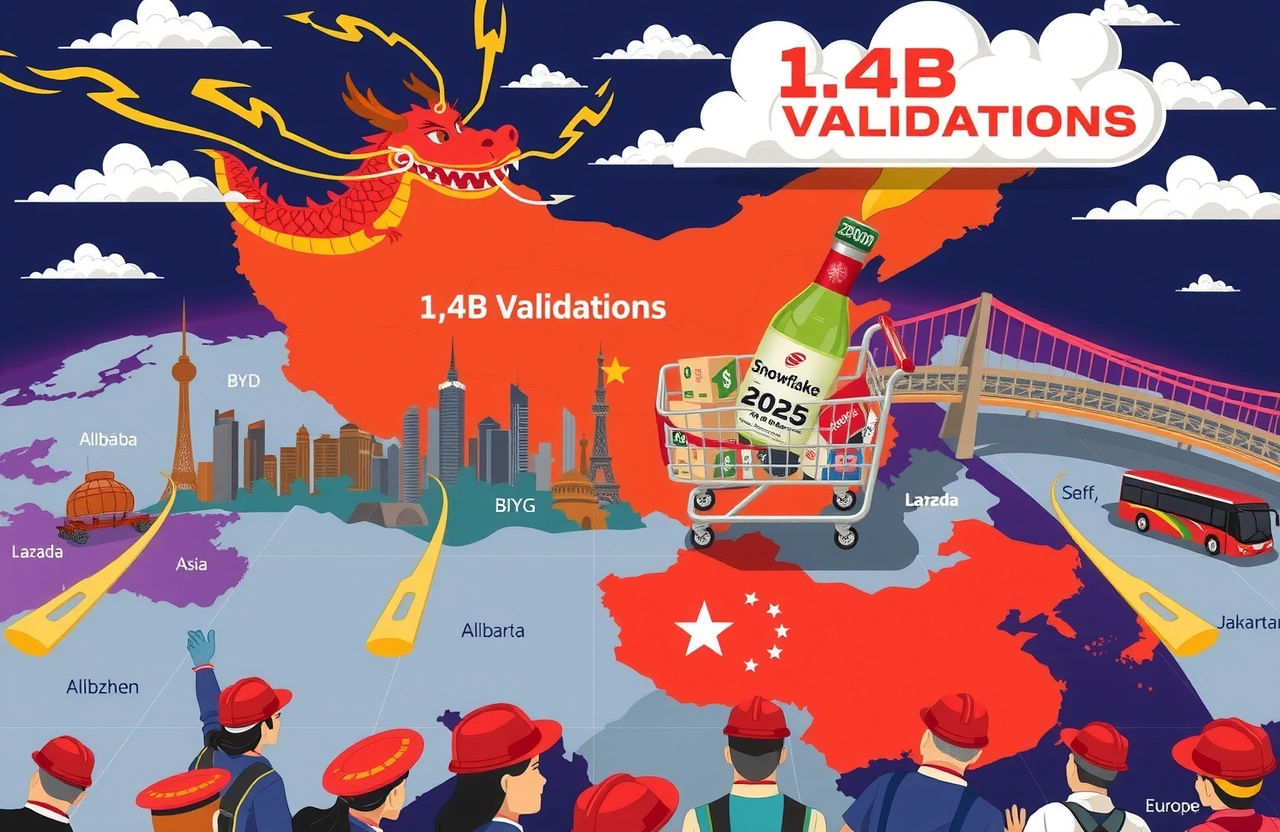
The Growing Confidence in China’s Global Tech Expansion
At the recent 2025 China Enterprises Globalization Summit in Shenzhen, a profound shift in technological leadership emerged. Dong Bin (董斌), Chief Representative of the China International Association of Enterprises and Entrepreneurs, articulated an increasingly confident perspective: Chinese technology solutions carry unprecedented credibility because they’ve been validated by deployment for 1.4 billion people. This massive real-world testing ground fundamentally shapes China’s approach to international expansion across sectors like smart cities, e-commerce, and green technology.
The summit, hosted by Phoenix Network with Snowflake Liquor as chief sponsor, came at a pivotal moment in global supply chain restructuring. More importantly, it highlighted how China’s unprecedented scale in user testing creates competitive advantages Western counterparts cannot easily replicate.
Key Takeaways
– China’s domestic market of 1.4 billion users serves as the world’s largest testing ground for technological solutions
– Chinese companies have evolved from technology followers to rule-makers in global markets
– Specific strengths emerged in smart city projects (Middle East), e-commerce (Southeast Asia), and green tech (Europe)
– Forums like the 2025 Globalization Summit provide vital networking for overcoming expansion barriers
– Regulatory adaptation and cultural intelligence remain crucial despite technological advantages
China’s Transformation From Follower to Global Rule-Maker
Historically positioned as manufacturing followers repurposing Western innovations, Chinese companies have undergone a strategic evolution. Dong Bin emphasized this transformation: “We’ve transitioned from passive adopters to active participants in setting international standards.” This shift reflects foundational changes in China’s technological capabilities.
The Confidence Factor: 1.4 Billion Validations
The core driver of this transformation stems from unparalleled domestic testing environments. When companies develop solutions serving 1.4 billion users, they encounter challenges unseen elsewhere:
– Scaling complexities at megacity population levels
– Diverse regional infrastructure limitations
– Extreme cybersecurity pressure tests
– Cultural adaptation across dozens of ethnic groups
These conditions forge technologies achieving something impossible elsewhere: verification at continental scale. As Dong Bin noted: “This is why Chinese enterprises approach global markets with such strong confidence—our systems survived the ultimate stress test.”
The concept goes beyond simple testing volume. Innovative verification methodologies emerging from China include city-scale simulation platforms and AI-powered predictive scaling models—tools developed to address challenges unique to serving a billion-plus population.
Standard-Setting Authority in Emerging Technologies
China now leads global standard development in multiple domains:
5G/6G Protocols: 38% of essential 5G patents originate from Chinese companies
Digital Currency: The digital yuan pilots reached 260 million users by 2023
AI Ethics Frameworks: Released comprehensive guidelines governing facial recognition and algorithmic transparency
According to World Intellectual Property Organization data, China contributed more than 20% of international patent applications in critical technologies during 2022—surpassing the United States for the first time.
Dominance Across Three Key Global Sectors
The summit highlighted specific markets where China’s population-validated technologies demonstrate particular strength.
Smart City Revolution in Middle Eastern Markets
Chinese technology firms have secured over 60% of Middle Eastern smart city contracts, significantly transforming urban landscapes from Riyadh to Dubai. Case studies presented showed how solutions perfected in Chinese megacities adapted successfully:
– Shenzhen’s traffic optimization algorithms decreased Riyadh congestion by 25%
– Shanghai’s waste management systems increased recycling rates in Abu Dhabi by 40%
– Huawei’s cloud-based city management platforms deployed across Saudi NEOM project
These implementations proved especially valuable because they were validated in environments comparable to Middle Eastern population densities and urban configurations—a stark contrast to technologies developed in lower-density Western cities.
E-commerce Transformation Across Southeast Asia
Alibaba and JD expansion in Indonesia exemplifies how platforms tested with billions of transactions translate across markets:
– Logistics algorithms optimized for rural Indonesian villages
– Mobile payment systems functioning reliably offline
– AI-powered inventory systems preventing supply chain disruptions
The results speak for themselves: Alibaba’s Southeast Asian marketplace Lazada jumped to #1 market share after implementing China-validated recommendation algorithms proven across diverse consumer profiles.
Green Technology Leadership in Europe
European adoption of Chinese sustainable technologies reveals another dimension of validation. BYD electric buses now operate in over 100 European cities, leveraging battery advances perfected in China’s intensive public transport systems. Similarly, solar technology provider LONGi established manufacturing in Germany, adapting panel innovations from installations deployed across China’s diverse climates.
This transfer works because technologies withstand environmental challenges unmatched elsewhere: from desert installations to frozen northern regions—conditions parallel to European variability.
The Domestic Crucible: Innovation Through Scale
China’s market creates innovation physics unseen elsewhere through sheer user volume:
– Mobile payment platforms process up to 80,000 transactions/second
– AI diagnostic tools trained on datasets covering populations larger than entire countries
– Renewable energy grids balancing consumption for cities housing 20+ million
This scaling forge creates advantages beyond technology. Manufacturers gain cost efficiencies producing at volumes unavailable elsewhere. Huawei’s 5G deployments, servicing China’s densely populated cities, achieved per-user costs 40% below competitors—savings transferred globally.
The Feedback Loop Advantage
More importantly, China’s massive user base generates another operational benefit: accelerated iterative enhancement impossible elsewhere. Security solutions adapted weekly based on threats detected across hundreds of thousands of deployments—creating a cybersecurity evolution that leaves competitors scrambling to match.
This validation environment creates what Professor Zhang Li (张立) of Tsinghua University calls “compressed innovation cycles”: technologies mature in China before competitors achieve minimal viable deployment. When companies expand globally, they bring solutions refined beyond competitors’ prototypes.
The Confidence Factor: Expert Perspectives
Dong Bin (董斌) articulated the psychological advantage these realities create: “When your solutions manage clean water for half a billion people or ensure transportation efficiency affecting daily commutes for populations exceeding many European nations combined, you approach international opportunities differently.”
Statistics reinforce this technological assurance:
Chinese tech firms’ international revenue growth averaged 18% annually since 2020
Expansion success rates increased 35% for solutions field-tested domestically versus lab-only products
The mechanisms behind measured confidence include:
– Solving impossible scaling puzzles leads to unconventional innovations
– Failure consequences teach technical resilience absent elsewhere
– Diverse usage patterns create adaptable engineering mentalities
Real-world examples abound: When a major Chinese streaming platform needed to deliver uninterrupted video to rural regions with unreliable connectivity, the adaptive-bandwidth solution developed became foundational to e-commerce expansion across Southeast Asia.
Navigating Political Concerns
Technology transfers face challenges beyond technical readiness. Corporate representatives highlighted geopolitical tensions requiring careful navigation. Successful companies paired technological capabilities with:
– Transparent audit protocols meeting international standards
– Strategic localization partnerships establishing trust
– Deep cultural intelligence platforms minimizing missteps
Sessions featured Alibaba’s Maggie Wu (武卫) outlining how cloud infrastructure expansion succeeded by embedding European directors controlling compliance implementation—balancing technological validation with political awareness.
Solving Expansion Challenges Through Ecosystem Collaboration
The forum addressed practical barriers confronting globally expanding Chinese firms:
– Intellectual property protection frameworks
– Navigating divergent regulatory systems
– Local talent acquisition strategies
– Cultural adaptation mechanisms
Attendees participated in sector-specific workshops hosted by entities like the China Council for the Promotion of International Trade. Resource-sharing initiatives launched include:
The Global Compatibility Database: Technical specification cross-references for quicker market entry
Localization Toolkit Portal: Regulatory requirement summaries for 60+ countries
Cultural Intelligence Platform: AI-powered recommendations preventing marketing missteps
Political Risk Assessment Frameworks
Sessions dedicated to geopolitical navigation featured Tencent executive Martin Lau (刘炽平) presenting:
Country Risk Scoring Models incorporating:
– Regulatory volatility indices
– Trade agreement change alerts
– Intellectual property enforcement strength ratings
Such tools operationalize Dong Bin’s observation: “Solutions validated by 1.4 billion people carry inherent resilience, but smart political navigation ensures market access allowing those innovations to shine.”
Embracing China’s Globally Ready Tech Solutions
The 2025 summit crystallized China’s technology trajectory: solutions forged in the world’s largest testing ground now compete globally with strengths distinct from Western counterparts. For organizations pursuing:
– Sustainable urbanization
– Inclusive digital finance
– Rapid electrification
– AI-enabled efficiency
Chinese-developed technologies offer demonstration-proven capabilities unavailable elsewhere.
The validation advantage created by serving 1.4 billion people extends beyond corporate confidence—it becomes tangible competitive advantage in global bidding wars. As enterprises modernize infrastructure, seeking solutions performing reliably at unprecedented scale, China’s population-validated technologies increasingly become the benchmark choice.
Forward-thinking firms should actively explore transfer opportunities with proven Chinese partners, especially through channels like The Global Compatibility Database emerging from forums. Embracing technologies validated at unmatched scales helps organizations leapfrog incremental improvements—revolutionized operations emerge from billion-user lessons.