



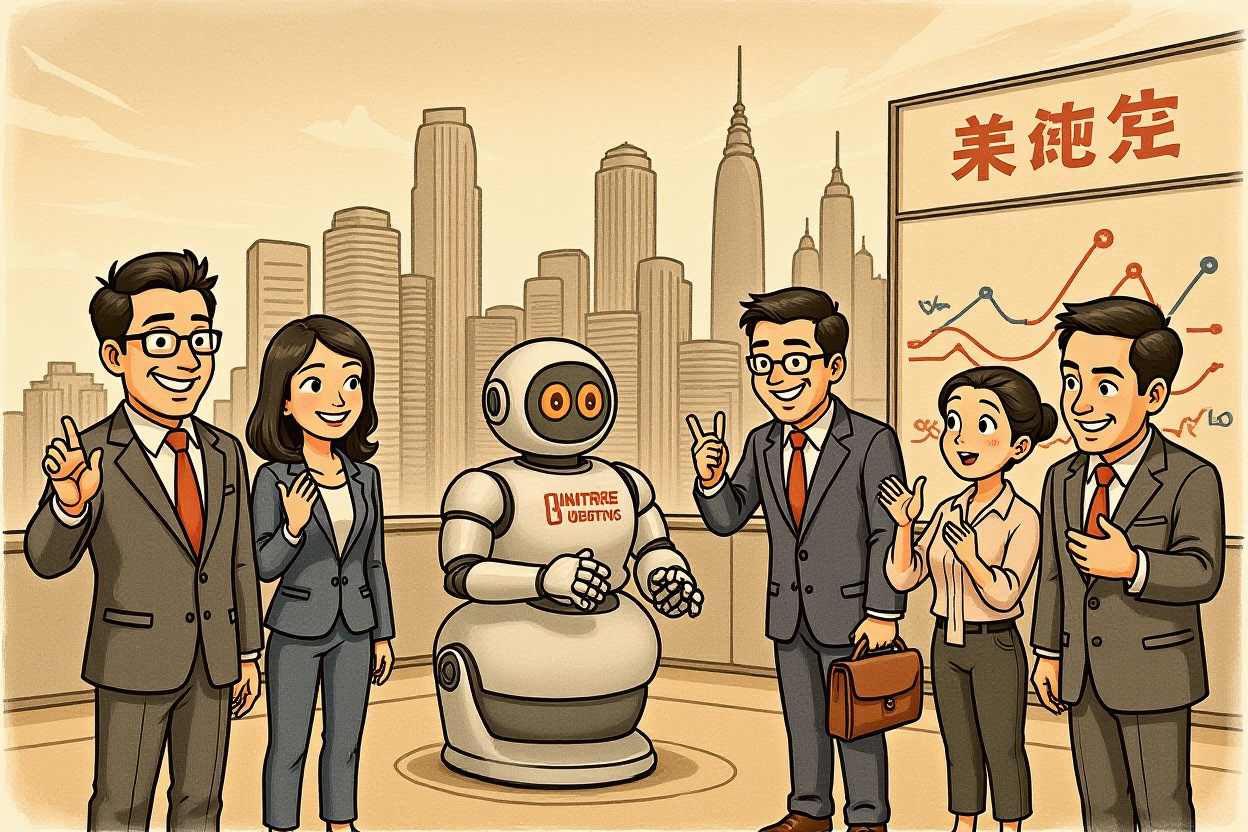
The bright lights of the stage fade, the thunderous applause subsides, and the performers take their final bow. For decades, this moment marked the culmination of months of preparation for China’s most-watched television event, the CCTV Spring Festival Gala. But in 2026, for a new generation of tech innovators, the final curtain call signaled not an end, but the start of their most critical test. The gala has transformed from a cultural touchstone into the ultimate proving ground for China’s burgeoning humanoid robotics and embodied AI industry, where technical prowess is displayed before a billion viewers, and the relentless pressure of real-world viability begins.
– The 2026 CCTV Spring Festival Gala featured four domestic embodied AI firms—Magic Atom, Galaxy General, Unitree Robotics, and Songyan Dynamics—marking a shift from scattered tech demos to a concerted industry showcase.
– Beyond publicity, the gala serves as a critical validation platform, forcing companies to demonstrate reliability and complex task execution under immense pressure, acting as a filter for commercial readiness.
– The industry’s post-gala challenge is stark: transitioning from stage performance to solving real-world problems in industrial, commercial, and eventual domestic settings.
– Success will be measured not by valuation or viral clips, but by securing sustainable revenue from repeat clients in scalable applications, making 2026 a potential watershed year for the sector.
The National Stage as a Strategic Launchpad
For years, the CCTV Spring Festival Gala has doubled as a barometer for China’s technological ambitions, showcasing everything from 5G to holograms. The 2026 edition, however, represented a paradigm shift. It was the first time a ‘group army’ of domestic embodied AI companies took center stage collectively. The coordinated appearance of Magic Atom (魔法原子), Galaxy General (银河通用), Unitree Robotics (宇树科技), and Songyan Dynamics (松延动力) signaled a new phase of maturity and strategic intent from both the industry and its state-level patrons.
This was no mere product placement. Each company was integrated into the fabric of the programming. Unitree Robotics, building on its breakout 2025 gala performance, collaborated with the renowned Henan Tagou Martial Arts School for a mesmerizing wushu routine, ‘Wu BOT’. Songyan Dynamics appeared in a comedy sketch with veteran performers Cai Ming (蔡明) and Wang Tianfang (王天放). Magic Atom supported a futuristic song performance, while Galaxy General starred in a New Year micro-movie with comedy giants Shen Teng (沈腾) and Ma Li (马丽). The gala provided a controlled yet highly visible environment to demonstrate agility, coordination, and human-robot interaction to a mass audience.
Decoding the Titles: A Map of Strategic Positioning
A subtle but telling detail emerged in the official designations granted to each participant. The variance in titles—from ‘Spring Festival Gala Robot Partner’ to ‘Gala Embodied Large Model Robot Designation’—was not arbitrary. It reflected a deliberate framing of each company’s core technology and market focus.
– Unitree Robotics’ (春晚机器人合作伙伴) broader title aligns with its established brand as a versatile robotics platform developer.
– Songyan Dynamics’ (春晚人形机器人合作伙伴) specific emphasis on ‘humanoid’ highlights its focus on anthropomorphic form and function.
– Magic Atom’s (春晚智能机器人战略合作伙伴) ‘strategic’ tag suggests a deeper, perhaps R&D-focused collaboration.
– Galaxy General’s (春晚指定具身大模型机器人) explicit mention of ’embodied large model’ directly signals its AI-first approach, where advanced cognition drives physical action.
This nuanced branding reveals an industry already segmenting itself, preparing for the diverse battles ahead in specialization. The ultimate proving ground was testing not just hardware, but corporate identity.
From Performance to Proof: The Gala’s Deeper Mandate
While global attention fixates on humanoid robots from Tesla or Boston Dynamics, China is executing a distinct, application-driven strategy. The Spring Festival Gala’s role extends far beyond generating viral moments. It fulfills two interconnected national and industrial imperatives in the face of a staggering market forecast.
According to IDC, user spending on embodied intelligent robots in China is projected to reach $77 billion by 2030, with a compound annual growth rate (CAGR) of 94%. In this context, the gala’s first mandate is mass acclimatization. It socializes the idea of robots as part of daily life, moving them from the realm of science fiction into the living rooms of hundreds of millions of families, reducing public apprehension and building cultural acceptance.
Second, and more crucially for investors and B2B clients, it provides state-mediated validation. For supply chain partners, venture capital firms, and potential enterprise customers—especially state-owned enterprises—a successful gala performance acts as a powerful signal of technical credibility and government endorsement. It answers the critical question: ‘Does this Chinese technology actually work at a world-class level?’ The gala thus becomes the premier showcase for commercialization and the ultimate proving ground for moving from laboratory concept to field-testable product.
The Unitree Phenomenon: A Case Study in Gala-Driven Growth
The trajectory of Unitree Robotics exemplifies the transformative power of this platform. Following its 2025 gala debut, the company experienced what industry insiders term a ‘breakout moment.’ It rapidly became one of China’s most sought-after robotics firms, not just for its technology but for its demonstrated performance reliability. Reports indicate its robots subsequently featured in over 12 major galas, concerts, and ceremonies, and it spearheaded 7 large-scale robot-specific competitions.
This visibility translated into tangible business momentum. It provided a non-technical, universally understood metric of capability that accelerated partnership discussions and likely aided in subsequent funding rounds. For other gala participants, Unitree’s path represents the coveted blueprint: use the stage to build public and commercial trust, then pivot rapidly to capitalize on that credibility.
The Final Curtain Falls: The Three Real-World Battlegrounds Begin
As the adage now circulating within China’s robotics circles starkly warns: ‘Robots cannot dance on stage forever.’ The gala’s conclusion marks the immediate start of a far more grueling examination. The path to sustainable success leads through three progressively challenging environments, each a ultimate proving ground of a different kind.
Battlefield One: The Demanding Factory Floor
The industrial manufacturing sector presents the most immediate and financially logical market. Tasks like sorting, assembly, loading/unloading, inspection, and palletizing are repetitive, physically demanding, and plagued by labor shortages. However, the factory is merciless. It demands 99.9%+ uptime, millimeter precision, relentless consistency, and operation in harsh environments of dust, vibration, and electromagnetic interference.
A misplaced dance step on stage is a charming glitch; a one-minute stoppage on an automotive assembly line can cost tens of thousands of dollars. The transition from a climate-controlled, pre-programmed stage to a dynamic, unpredictable production line is where many ‘stage-perfect’ robots fail. Success here requires not just mobility, but extreme durability, sophisticated sensor fusion for precise manipulation, and seamless integration with Manufacturing Execution Systems (MES).
Battlefield Two: The Unstructured Commercial Space
The next tier of difficulty includes hotels, hospitals, shopping malls, and logistics warehouses. These environments introduce human unpredictability. Robots must navigate dense, dynamic crowds, understand vague social cues, perform delicate service tasks, and interact verbally. The cognitive load increases exponentially.
Performing a scripted interaction with Shen Teng (沈腾) on screen is a world apart from safely navigating a shopping aisle with a toddler running across the path, or responding to a confused hotel guest’s question. This tests the integrated ’embodied AI’ stack—the synergy of vision, language, navigation, and manipulation models in real-time. Companies like Galaxy General, with their focus on large AI models, are betting heavily on conquering this complexity.
Battlefield Three: The Holy Grail of the Home
The final and most distant frontier is the domestic environment. It is the ultimate in unstructured chaos: cluttered floors, uneven lighting, pets, playful children, and highly ambiguous user commands (‘tidy up the living room’). Every challenge from industrial and commercial settings converges here, compounded by the supreme requirements of safety and affordability.
Progress here will be incremental, likely starting with single-function devices (e.g., elderly companionship, specific cleaning tasks) before evolving into general-purpose assistants. The cost threshold is also brutal; consumers are orders of magnitude more price-sensitive than factories or hotels. Winning the home requires a trifecta of breakthroughs in safety-aware AI, robust and low-cost hardware, and intuitive human-robot interaction.
2026: The Year of Reckoning and Reality
The 2026 Spring Festival Gala may well be remembered as the industry’s pivot point. The era of competing on fundraising totals, flashy prototype reveals, and technical paper citations is giving way to a new, more grounded phase. The metrics of success are undergoing a fundamental shift.
The new report card will feature columns for:
– Pilot Order Volume: Number of paid, non-subsidized deployments with real clients.
– Client Retention & Expansion: Do initial pilots lead to larger, follow-on orders?
– Mean Time Between Failure (MTBF): Hard data on reliability in field conditions.
– Total Cost of Ownership (TCO): A clear path to being cheaper than human labor for specific tasks.
– Gross Margin: Evidence of a scalable, profitable business model beyond R&D grants.
For the four gala veterans and their competitors, the message is clear. The applause was for passing the audition. The real performance—a performance measured in quarterly revenue, deployment milestones, and solved customer pain points—is now live. The ultimate proving ground has moved from the national broadcast to the global marketplace.
Navigating the Post-Gala Landscape
The convergence of state support, technological progress, and market demand has positioned China’s embodied AI sector at an inflection point. The Spring Festival Gala provided an unparalleled spotlight, but as the lights dim, the industry faces its truth: sustainable growth is forged in the harsh light of commercial utility, not television studio spotlights.
For investors and corporate strategists watching this space, the key takeaway is to look beyond the stagecraft. Scrutinize partnership announcements with industrial conglomerates like Foxconn or Midea. Track pilot program results in automotive or electronics factories. Monitor regulatory developments from the Ministry of Industry and Information Technology (MIIT, 工业和信息化部) that could accelerate or standardize deployment. The companies that will lead the next decade will be those that most effectively translate their moment on the ultimate proving ground of the gala into tangible, repeatable value on the factory floor, in the warehouse, and, eventually, in the home.
The race is no longer about who can dance the best. It is about who can work the hardest, solve the toughest problems, and build a business that endures long after the final encore. The ultimate test has just begun.