



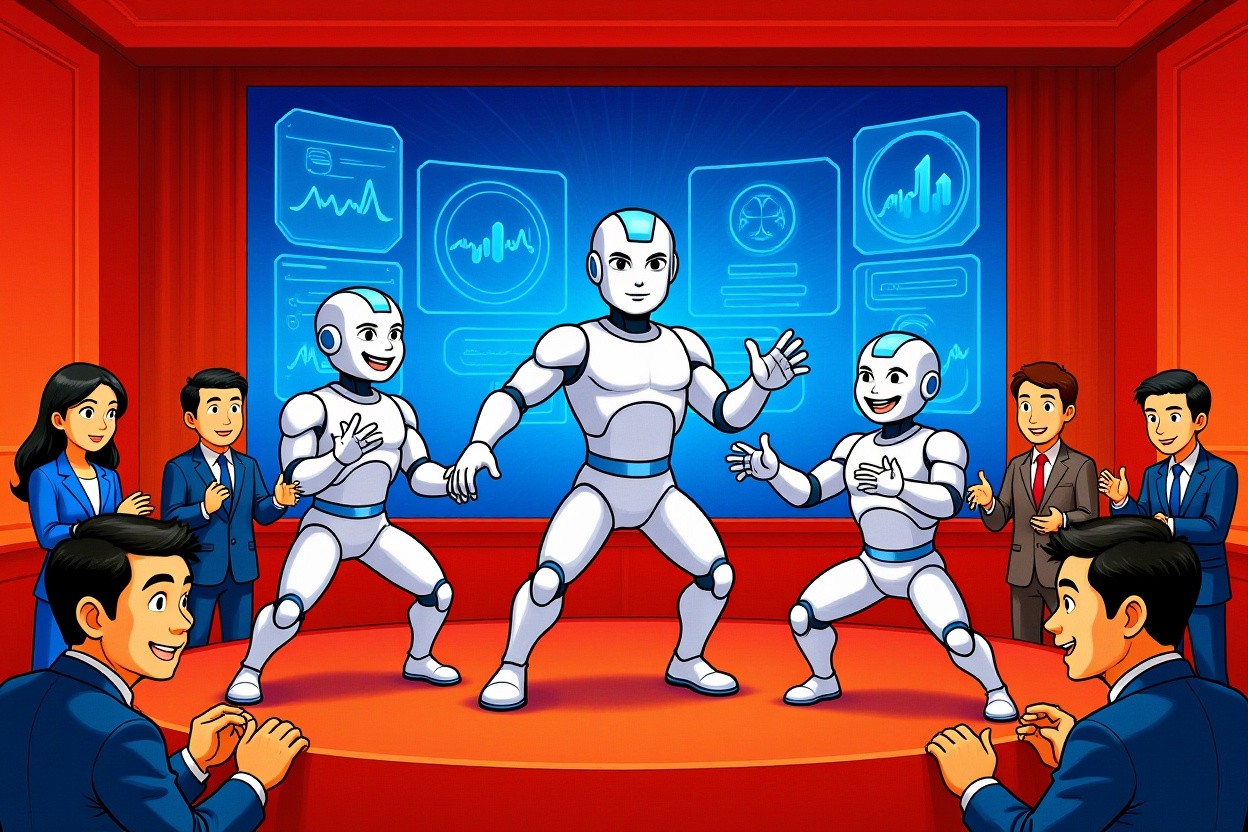
– The 2026 CCTV Spring Festival Gala featured four leading Chinese embodied AI firms—Yushu Technology (宇树科技), Songyan Power (松延动力), Magic Atom (魔法原子), and Galaxy Universal (银河通用)—showcasing humanoid robots in performances, marking a pivotal moment for the industry. – This high-profile exposure serves as the ultimate proving ground for embodied AI, transitioning from laboratory concepts to public acceptance and commercial viability. – Post-gala, the industry faces three critical challenges: achieving reliability in industrial settings, adaptability in commercial environments, and safety in home integration. – With IDC projecting user spending on embodied AI robots in China to reach $77 billion by 2030, the sector is poised for explosive growth, but companies must demonstrate real-world applications and profitability. – Investors should look beyond the hype, focusing on firms with scalable solutions, strong client pipelines, and robust technological foundations. When the curtains rose on the 2026 CCTV Spring Festival Gala, the spotlight wasn’t just on celebrities but on a new breed of performers: humanoid robots from China’s top embodied AI companies. This annual extravaganza has evolved into the ultimate proving ground for embodied AI, offering a national platform to demonstrate technological prowess and market readiness. As these robots danced, performed martial arts, and interacted with stars, they symbolized a critical juncture for an industry on the cusp of commercialization. However, beyond the applause and viral moments, the real test begins—transforming stage success into sustainable business models that can thrive in factories, stores, and homes. The journey from concept to consumer is fraught with hurdles, and the Gala’s glow merely illuminates the starting line for a race toward viability and scale.
The 2026 Spring Festival Gala: A National Stage for Embodied AI
The CCTV Spring Festival Gala has long served as a barometer for technological trends in China, and the 2026 edition cemented its role as the ultimate proving ground for embodied AI. Unlike previous years with scattered tech displays, 2026 witnessed a coordinated debut of four domestic firms, signaling a maturing industry ready for prime time. This collective appearance underscores how the Gala functions as a critical validation point, where companies must prove their mettle under intense scrutiny.
A Collective Debut of China’s Top Firms
The four companies—Yushu Technology (宇树科技), Songyan Power (松延动力), Magic Atom (魔法原子), and Galaxy Universal (银河通用)—took center stage in varied performances. Yushu Technology, building on its 2025 Gala success, partnered with the Henan Tagou Martial Arts School for a wushu routine titled “武 BOT,” highlighting precision and coordination. Songyan Power appeared early in a skit with actors Cai Ming (蔡明) and Wang Tianfang (王天放), while Magic Atom supported a song performance, and Galaxy Universal featured in a micro-film. This diverse integration demonstrates the versatility of embodied AI, moving beyond gimmicks to meaningful entertainment.
Technical Differentiation in Official Titles
A subtle yet telling detail lies in the official titles bestowed upon each company by the Gala organizers. Yushu Technology was dubbed the “Spring Festival Gala Robot Partner,” Songyan Power the “Spring Festival Gala Humanoid Robot Partner,” Magic Atom the “Spring Festival Gala Intelligent Robot Strategic Partner,” and Galaxy Universal the “Spring Festival Gala Designated Embodied Large Model Robot.” These distinctions reflect nuanced differences in technical routes, product forms, and strategic positioning, hinting at the competitive landscape where specialization may drive future market segmentation. For instance, Galaxy Universal’s focus on large models suggests deeper AI integration, while Yushu Technology emphasizes robust physical capabilities.
From Laboratory to Limelight: The Significance of the Gala
The Spring Festival Gala is more than a spectacle; it is a strategic platform that accelerates industry growth by serving as the ultimate proving ground for embodied AI. With over a billion viewers, the Gala educates the public, reduces skepticism, and builds trust in robotics technology. This exposure is crucial for an industry poised for explosive expansion, as it bridges the gap between innovation and adoption, setting the stage for commercial breakthroughs.
Educating the Public and Validating Technology
By featuring robots in relatable contexts—such as comedy skits and musical numbers—the Gala normalizes human-robot interaction, making advanced technology accessible to everyday consumers. This public education effort is vital for market penetration, as acceptance often precedes demand. Simultaneously, the Gala validates Chinese technological capabilities to key stakeholders, including investors, corporate clients, and policymakers. For example, seeing robots perform complex tasks live reassures potential buyers in manufacturing or logistics sectors about reliability and functionality.
The Commercialization Catalyst
The Gala acts as a catalyst for commercialization by providing unparalleled visibility that can attract funding and partnerships. According to IDC data, user spending on embodied AI robots in China is projected to reach $77 billion by 2030, with a compound annual growth rate of 94%. This golden growth trajectory means that companies leveraging the Gala’s platform can secure early-mover advantages. However, success on stage must translate into real-world applications; the Gala is merely the first window into a broader market where scalability and profitability are paramount.
The Post-Gala Reality: Three Critical Challenges
After the lights dim and the applause fades, embodied AI firms confront a harsh reality: performance on stage does not guarantee success in the market. Industry insiders often remark that robots cannot dance forever on platforms; they must prove their worth in practical settings. This transition involves overcoming three sequential hurdles that serve as the true ultimate proving ground for embodied AI, determining which companies will thrive and which will falter.
Industrial Applications: Reliability in Factories
The first and most immediate challenge is penetrating industrial environments, where robots can address labor shortages in tasks like sorting, assembly, and inspection. Factories demand unwavering reliability, low fault rates, and cost-effectiveness, with zero tolerance for errors that could halt production lines. While a robot might stumble on stage with minimal consequence, a malfunction in a factory incurs real financial losses. Companies must demonstrate that their systems can operate 24/7 under harsh conditions, a test that many prototypes fail when moving from controlled labs to chaotic workshops. For instance, Yushu Technology has reportedly begun pilot projects in automotive manufacturing, but scalability remains a key hurdle.
Commercial Scenarios: Adaptability in Dynamic Environments
Beyond factories, commercial settings such as retail stores, warehouses, and hospitals present a second layer of complexity. Here, robots must navigate crowded spaces, avoid obstacles, and interact with humans in unpredictable ways. The Gala’s scripted interactions pale in comparison to the chaos of a bustling supermarket where a robot might encounter running children or erratic shopping carts. This requires advanced perception, decision-making, and mobility capabilities—essentially, a fully integrated embodied AI system. Magic Atom and Galaxy Universal are exploring roles in customer service and logistics, but field trials will reveal if their technology can handle real-world variability.
Home Integration: The Ultimate Frontier
The final and most ambitious challenge is entering households, which represent the largest market potential but also the most unstructured environments. Homes feature uneven floors, scattered objects, pets, children, and varying light conditions, posing significant safety and usability concerns. Robots intended for domestic use must be affordable, intuitive, and exceptionally safe, capable of handling ambiguous commands and unexpected situations. While this frontier is years away from mass adoption, it is the ultimate proving ground for embodied AI, where companies like Songyan Power are conducting early research into assistive robotics for the elderly. Success here would unlock a multi-billion-dollar market but demands breakthroughs in AI cognition and cost reduction.
Market Dynamics and Investment Considerations
For investors and business professionals, the embodied AI sector presents both opportunities and risks. The Spring Festival Gala’s spotlight has heightened interest, but savvy stakeholders must look beyond the hype to assess fundamental drivers. The industry is at an inflection point, shifting from fundraising and demonstrations to tangible revenue and client acquisition, making 2026 a potential watershed year.
Growth Projections and Industry Trends
Market data supports optimistic long-term prospects. IDC’s forecast of $77 billion in user spending by 2030 underscores the sector’s potential, driven by factors like aging populations, rising labor costs, and government support for智能制造 (smart manufacturing). Additionally, policies such as China’s 14th Five-Year Plan emphasize robotics innovation, providing regulatory tailwinds. However, growth will be uneven; companies that quickly adapt to industrial and commercial demands will likely capture early market share, while those reliant on staged performances may struggle. Investors should monitor metrics like order volumes, repeat customers, and partnership announcements rather than media coverage alone.
Evaluating Companies Beyond the Hype
To make informed decisions, investors should scrutinize key aspects of embodied AI firms. First, assess technological depth—for example, Galaxy Universal’s focus on large models may offer superior adaptability, while Yushu Technology’s mechanical prowess could benefit industrial applications. Second, examine business models: are companies pursuing direct sales, subscriptions, or service-based revenues? Third, consider scalability; partnerships with major manufacturers or retailers can indicate market readiness. For instance, Magic Atom has reportedly signed deals with e-commerce giants for warehouse automation, a positive signal for future growth. Lastly, financial health matters—while venture capital has flooded the sector, profitability timelines and burn rates will separate winners from losers in the coming years.
The Future of Embodied AI in China
As the dust settles from the Spring Festival Gala, the embodied AI industry stands at a crossroads. The ultimate proving ground for embodied AI is no longer the stage but the market itself, where practical utility and economic viability will dictate success. Companies must navigate a complex landscape shaped by technological evolution, regulatory frameworks, and global competition, all while meeting the lofty expectations set by their Gala debut.
Regulatory and Economic Factors
Government policies will play a pivotal role in shaping the industry’s trajectory. Agencies like the Ministry of Industry and Information Technology (工业和信息化部) are likely to introduce standards for safety and interoperability, which could accelerate adoption by ensuring reliability. Economically, China’s push for technological self-sufficiency amid global tensions may drive domestic investment in robotics, reducing reliance on foreign components. However, challenges such as supply chain disruptions or intellectual property disputes could slow progress. Investors should stay abreast of regulatory announcements and economic indicators to gauge the sector’s resilience.
Strategic Recommendations for Stakeholders
For corporate executives and fund managers, a proactive approach is essential. Companies should diversify their applications beyond entertainment, focusing on high-demand sectors like healthcare or logistics to build recurring revenue streams. Investors might consider a portfolio strategy, backing firms with clear paths to industrialization while hedging with earlier-stage innovators in home robotics. Additionally, collaboration across the ecosystem—such as partnerships between AI software developers and hardware manufacturers—can spur innovation. The Gala has shown that Chinese embodied AI is ready for its close-up, but the real work begins now: turning promise into profit.As the embodied AI industry transitions from the Spring Festival Gala’s spotlight to the rigors of the market, several key takeaways emerge. First, the Gala served as the ultimate proving ground for embodied AI, validating technological advances and raising public awareness, but it is only the first step in a longer journey. Second, companies must overcome three critical challenges—industrial reliability, commercial adaptability, and home integration—to achieve sustainable growth. Third, market dynamics favor firms with scalable solutions and strong client relationships, making due diligence crucial for investors. Looking ahead, the sector’s success will hinge on its ability to deliver practical value in real-world settings, moving beyond表演 (performances) to解决问题 (problem-solving). For business professionals and investors, the call to action is clear: monitor implementation milestones, engage with companies demonstrating tangible progress, and position portfolios to capitalize on this transformative technology. The ultimate proving ground for embodied AI is now the global marketplace, and those who navigate it wisely will reap the rewards of innovation.