



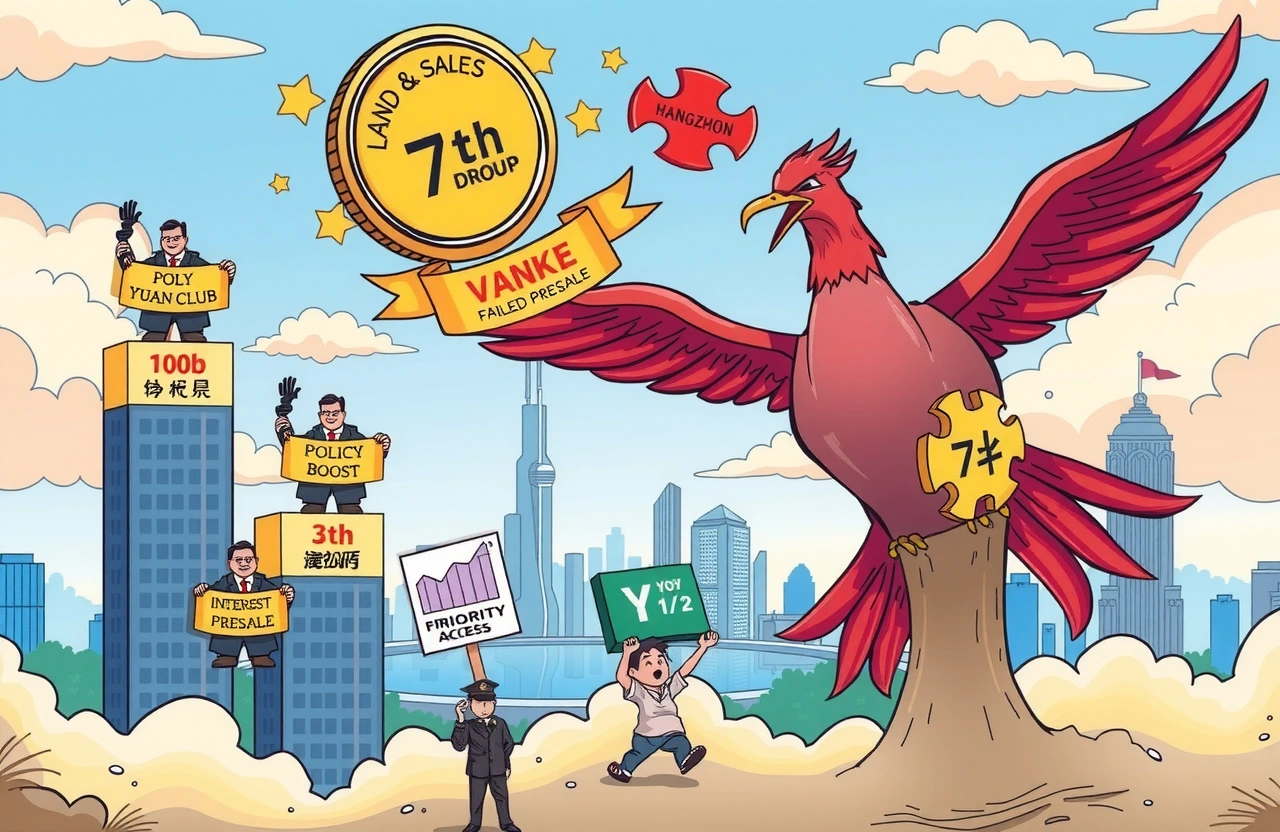
– Top 100 developers saw sales drop 11.8% YoY with only 4 crossing the 100 billion yuan threshold\n- State-owned giants dominate rankings as Vanke tumbles outside top five\n- Land acquisitions focus sharply on premium tier-1 cities like Hangzhou\n- Policy boosts expected with interest rate cuts and relaxed purchase restrictions\n\nChina’s real estate sector is undergoing its most dramatic restructuring in decades, marked by a historic contraction among top performers. In the first half of 2025, the exclusive ‘100 billion club’ of developers—those achieving over 100 billion yuan in sales—shrank to merely four companies. Simultaneously, industry stalwart China Vanke slid to seventh position with 68.6 billion yuan in sales, underscoring the acceleration of market realignment. Government-backed enterprises are advancing rapidly through financing advantages and strategic land acquisitions, while developers recalibrate investments toward economically resilient cities. This report examines the seismic shifts defining China’s property landscape, analyzing sales trajectories, corporate strategies, land acquisition patterns, and anticipated policy responses during this pivotal transformation phase.\n\n
The Vanishing 100 Billion Yuan Club
\n\n
Shrinking Elite Circle
\nThe contraction of what constitutes the property elite reveals fundamental industry recalibration. During January-June 2025, only Poly Development, China Overseas Land, China Resources Land, and China Merchants Shekou cleared the symbolic benchmark—down from six developers just one year prior. Their combined sales reached staggering heights: Poly Development maintained pole position with 145.2 billion yuan, followed by Greentown China (122.1 billion yuan), China Overseas Land (120.1 billion yuan), and China Resources Land (110.3 billion yuan). Such concentration underscores how even market leaders face unprecedented hurdles in sustaining growth momentum.\n\n
Industry-Wide Contraction
\nBeyond the shrinking top tier, broader market performance confirms deepening challenges:\n- Top 100 developers’ total sales: 1.836 trillion yuan, down 11.8% YoY\n- Equity sales plummeting to 1.281 trillion yuan\n- Total sales area contracting to 65.7 million square meters\n\nCapital Finance Research Institute Chief Economist Liu Tao notes: “The simultaneous shrinkage among giants and mid-sized firms signals systematic pressure across financing channels and buyer confidence levels.”\n\n
Corporate Ranking Upheaval
\n\n
Fading Titans and Rising Powers
\nThe most startling narrative emerges from Vanke’s tumble—the firm dropped out of China’s top five developers entirely. Once synonymous with industry dominance, its 68.6 billion yuan H1 sales relegated it to 7th position. Conversely, three enterprises achieved double-digit percentage jumps:\n- China Jinmao (up 7% YoY)\n- Yuexiu Property (10.8% growth)\n- C&D Real Estate (19.6% surge)\n\n
State-Owned Advantage Mechanics
\nBeyond balance sheets, qualitative factors drive SOE ascendance:\n- Lower financing costs through policy bank partnerships\n- Priority land access in municipal development zones\n- Stronger presale approval pipeline management\n- Cross-sector synergies with local infrastructure projects\n\nPoly Development CEO Zhang Ming (张明) attributes progress to “portfolio fortification in tier-1 economic hubs combined with operational efficiency benchmarks.”\n\n
Monthly Recovery Signals
\n\n
June Performance Green Shoots
\nDespite dismal half-year aggregates, June offered tentative resurgence signals:\n- CRIC data shows top 100 developers’ sales jumping 14.7% MoM\n- Contract volumes reached 338.96 billion yuan\n- 60% enterprises recorded monthly upticks\n- 28 developers exceeded 30% MoM growth\n\nGuosheng Securities analyst Jin Jing (金晶) contextualizes: “Mid-year clearance initiatives sparked this rebound, although last year’s elevated baseline maintains YoY contraction trajectory.”\n\n
Strategic Land Acquisition Revolution
\n\n
Core City Concentration
\nLand acquisition patterns reveal definitive strategic pivots:\n- Top 100 developers invested 506.55 billion yuan (33.3% YoY increase)\n- Residential plots in monitored cities: transaction value +45% YoY, land prices +22.3%\n- Core 24 cities attracted 500+ billion yuan land premiums\n- Hangzhou projects achieved 35.5% premium leadership\n\n
Inventory Leaders
\nPost-acquisition valuations showcase strategic winners:\n• Poly Development: 89.9 billion yuan new assets\n• Greentown China: 83.1 billion yuan\n• China Jinmao: 74.9 billion yuan\n\n
Surging Private Players
\nThough SOEs dominate land allocations, select private firms demonstrate resilience:\n- Binjiang Group secured top-ten acquisition ranking\n- Bangtai Group and DaHua Group entered top twenty\n\n58 Anjuke Research Institute Dean Zhang Bo (张波) emphasizes: “Financing environment improvements opened lanes for non-state participation—a healthy trend reinforcing diversified asset holders.”\n\n
Policy Support Horizon
\n\n
Upcoming Demand-Side Interventions
\nMultiple relief mechanisms already in advanced planning:\n• Mortgage interest rate deduction packages\n• Tiered relaxation of purchase/building restrictions\n• Enhanced subsidies for multi-child/new resident households\n\nKaiyuan Securities analyst Qi Dong (齐东) predicts: “After initial stabilization, coordinated fiscal-monetary easing appears inevitable for sustained sector rehabilitation.”\n\n
Supply-Side Structural Reforms
\nUrban renewal initiatives form another pillar:\n- State-backed affordable housing projects acceleration\n- Municipal renovation fund allocations\n- Blighted urban quarter rehabilitation quotas\n\n
Developer Adaptation Blueprints
\n\n
Emerging Business Paradigms
\nFrontrunners adopt innovations addressing market fragmentation:\n- Asset-light service franchises replacing ownership models\n- Non-residential revenue streams diversification\n- Tech-enabled construction/prefab solutions adoption\n\nYuexiu Property CFO Wang Liping emphasizes their “integrated urban operation frameworks” minimizing commodity volatility impacts.\n\n
High-Quality Metrics Emphasis
\nSOEs increasingly prioritize capital efficiency validation:\n- IRR targets >15% for acquisitions\n- Project cash-flow breakeven within 12 months\n- Third-party sustainability certifications\n\n
Navigating China’s Property Reset
\n\nAs China’s real estate industry completes its transition from expansion-driven frenzy to value-focused consolidation, stakeholders must recognize irreversible structural shifts. The evaporation of the 100 billion club into just four members alongside Vanke’s extraordinary demotion validates Beijing’s deleveraging resolve. Yet emerging bright spots—June sales rebounds and private developer land acquisitions—signal pathways toward diversified resilience. Developers championing financial discipline, digitalization, and core market specialization will survive consolidation; speculative misallocators face extinction. For policymakers, balancing SOE advantages with private-sector catalysts becomes paramount alongside tiered city policy tailoring. Equity investors should monitor Greentown China and Jinmao’s advancement vectors, while homeowners may leverage government subsidies during relaxation periods. Financial institutions must upgrade risk models incorporating stratified city-tier dynamics. This reset requires fundamental adaptation—the old expansionist playbook belongs to archaeology.