



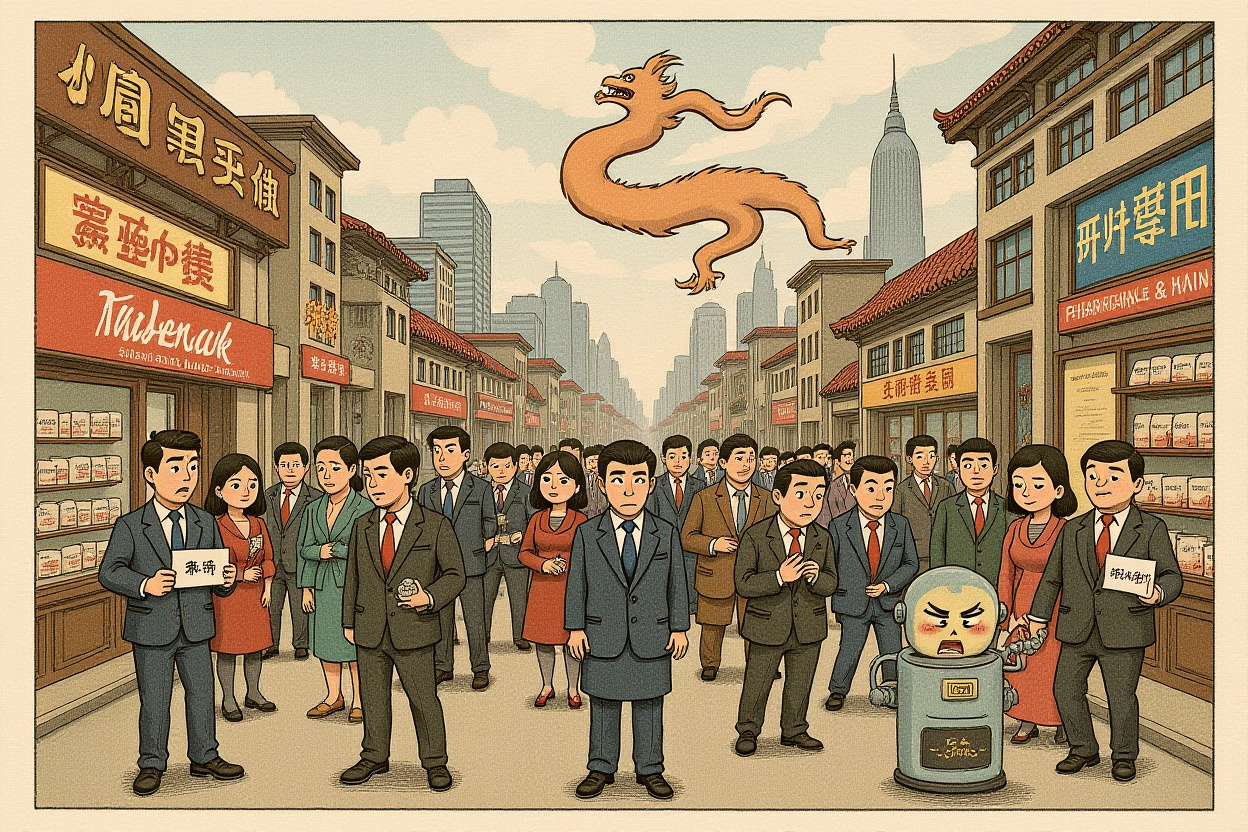
The Great Pharmacy Shakeout: An Industry in Crisis
Just a few years ago, pharmacies seemed like untouchable businesses—cash machines lining every street corner with seemingly endless demand. But today, China’s pharmaceutical retail sector is experiencing an unprecedented downturn. With 39,000 stores closing in a single year, major chains reporting declining profits, and founders rushing to exit their positions, the industry’s golden age appears to be over. What caused this dramatic reversal, and is there any hope for recovery?
This isn’t just about individual business failures—it’s about an entire sector hitting a wall. From regulatory changes and increased competition to shifting consumer behaviors, multiple factors have converged to create what many are calling the great pharmacy collapse.
Shareholders Rush for the Exits
When insiders start selling, it’s usually a sign that trouble lies ahead. That’s exactly what’s happening in China’s pharmacy sector, where executives and major investors are rapidly reducing their stakes in once-thriving chains.
Shuyu Minping’s Four-Round减持 Spree
Shandong-based Shuyu Minping Pharmacy Chain has become a case study in investor flight. The company experienced four separate waves of shareholder减持 within a single year, beginning in September 2024 when Alibaba Health announced plans to sell 3% of its stake. By February 2025, Alibaba Health had reduced its position from 8.47% to 6.72%, cashing out at prices between ¥11.60 and ¥13.53 per share.
The selling didn’t stop there. In November 2024, major shareholders Shuyu Jinyun and Shuyu Tongcheng announced plans to dump another 2% of company shares. By early 2025, they had followed through, reducing the combined stake of founder Li Wenjie (李文杰) and his partners from 56.31% to 54.48%.
Perhaps most telling was the third round of减持 in May 2025, when director and senior executive Qin Guangxia sold 3% of the company’s shares, pocketing approximately ¥140 million. Now, with a fourth round underway that includes the chairman himself reducing his stake, it’s clear that those who know the business best are losing confidence.
The Store Closure Accelerator
While shareholders were cashing out, Shuyu Minping’s store network was shrinking at an alarming rate. The company closed 119 locations in just the first quarter of 2025—more than it had shuttered in all of 2024. From a peak of 9,035 stores at the end of 2024, the chain dwindled to 8,916 stores by March 2025, with both company-owned and franchised locations affected.
This contraction reflects broader industry trends. According to Tianyancha data, 354,000 pharmacies have already entered注销,吊销, or停业 status, with only 210,000 still operating. The pace of closures is accelerating—from 6,000 in Q1 2024 to 14,000 in Q4—suggesting the worst may still be ahead.
Legal Troubles and Scandals Rock Major Chains
As if business challenges weren’t enough, several pharmacy giants are facing serious legal and regulatory issues that further complicate their turnaround efforts.
Dashenlin’s Leadership Crisis
Guangdong-based Dashenlin, which operates over 10,000 stores, has been rocked by scandal since July 2023, when co-founder Ke Jinlong (柯金龙) was first placed under留置. By November 2023, he faced formal charges of单位行贿罪 (unit bribery), and in April 2024, both Ke and the company’s subsidiary Maoming Dashenlin were found guilty.
The company’s response raised more questions than answers. Dashenlin waited until March 2024—eight months after the initial留置—to disclose the situation to investors. This delay earned the company and its leadership a public reprimand from regulators and further eroded investor confidence.
The Privacy Scandal That Went Viral
In a more unusual case, Dashenlin found itself at the center of a national conversation about privacy when one of its stores accidentally revealed a customer’s affair. When a payment for contraceptives failed, staff contacted the man’s wife—exposing his infidelity and leading to threats of legal action against the pharmacy.
While this individual incident might seem minor, it highlighted the operational challenges facing pharmacy chains as they struggle to maintain standards across thousands of locations.
Industry-Wide Profitability Plunge
The problems aren’t limited to individual companies—the entire sector is seeing profitability evaporate after years of steady growth.
All seven publicly-traded pharmacy chains reported declining profits in 2024, breaking years of consistent growth. For an industry once considered recession-proof, this represents a dramatic shift in fortunes.
Several factors have contributed to this profitability crash:
– Increased competition: With pharmacies on nearly every corner, market saturation has reached critical levels
– Regulatory changes: Stricter oversight of pricing and operations has squeezed margins
– Online competition: E-commerce platforms have captured growing share of OTC medication sales
– Rising costs: Rent, labor, and compliance expenses have all increased significantly
Desperate Times, Creative Measures: The “Pharmacy+” Experiment
Facing existential threats, pharmacy chains are getting creative with new business models designed to bring customers back through their doors.
The so-called “pharmacy+” movement has operators adding everything from clinical services to convenience goods in an effort to boost foot traffic and average transaction values.
Yixintang has pioneered the “convenience store” pharmacy model, selling not just medications and health supplements but also skincare products, cosmetics, household items, milk, and snacks. The approach aims to transform necessary pharmacy trips into broader shopping occasions.
Shuyu Minping has experimented with high-frequency consumables like dairy products and peanut oil, while also launching “Dashu Shuyu” stores in partnership with Dashu and Want Want—focusing on imported drugs and personal care products with higher margins.
The experimentation doesn’t stop there. Across China, pharmacies are testing:
– Pharmacy + clinic: Integrating traditional Chinese medicine services
– Pharmacy + convenience store: Expanding into everyday goods
– Pharmacy + experience center: Offering health consultations and screenings
– Pharmacy + pet services: Selling pet medications and supplies
– Pharmacy + coffee: Creating destinations rather than just points of sale
Some entrepreneurs are pushing the concept even further with proposals for pharmacy-foot massage combinations (where customers could get a massage then buy ointments), beauty salon-pharmacy hybrids (“wellness studios”), and even restaurant-pharmacy concepts focused on medicinal cuisine.
While creative, these efforts face significant challenges. Consumers may not embrace pharmacies as destinations for unrelated services, and operational complexity increases with each new offering.
Beyond Pharmacies: Broader Retail Apocalypse?
The pharmacy industry’s struggles reflect broader challenges facing physical retail in China. If even pharmacies—once considered immune to e-commerce disruption—are struggling, what does that mean for other retail categories?
Bank branches and securities brokerage offices face perhaps even more existential threats as digital adoption accelerates. With most consumers now opening accounts and conducting transactions online, these physical locations are becoming increasingly irrelevant despite growing customer numbers overall.
The question isn’t just how pharmacies will adapt, but how all physical retailers will evolve in an increasingly digital economy.
The Road Ahead for China’s Pharmacy Sector
The great pharmacy collapse of 2024-2025 represents more than just a market correction—it’s a fundamental restructuring of an entire industry. The days of easy profits and endless expansion are over, replaced by a new era of consolidation, specialization, and innovation.
Survivors will likely fall into two categories: massive scale players who can leverage their size for purchasing power and operational efficiency, and highly specialized operators who dominate specific niches or geographic markets.
The industry’s future may involve fewer stores but better ones—locations that serve as true healthcare destinations rather than just points of sale. Integration with digital health platforms, emphasis on professional services, and creative partnerships will likely characterize the next chapter of Chinese pharmacy retail.
For investors, the message is clear: look carefully before investing in pharmacy stocks, and pay close attention to management’s adaptation strategy. For entrepreneurs, opportunities exist in serving the industry’s evolution—from technology solutions to specialized retail concepts.
The pharmacy industry isn’t dead—but it is being reborn. Those who understand how it’s changing will be best positioned to benefit from its transformation.
What do you think about the future of pharmacy retail? Share your thoughts and experiences in the comments below.