



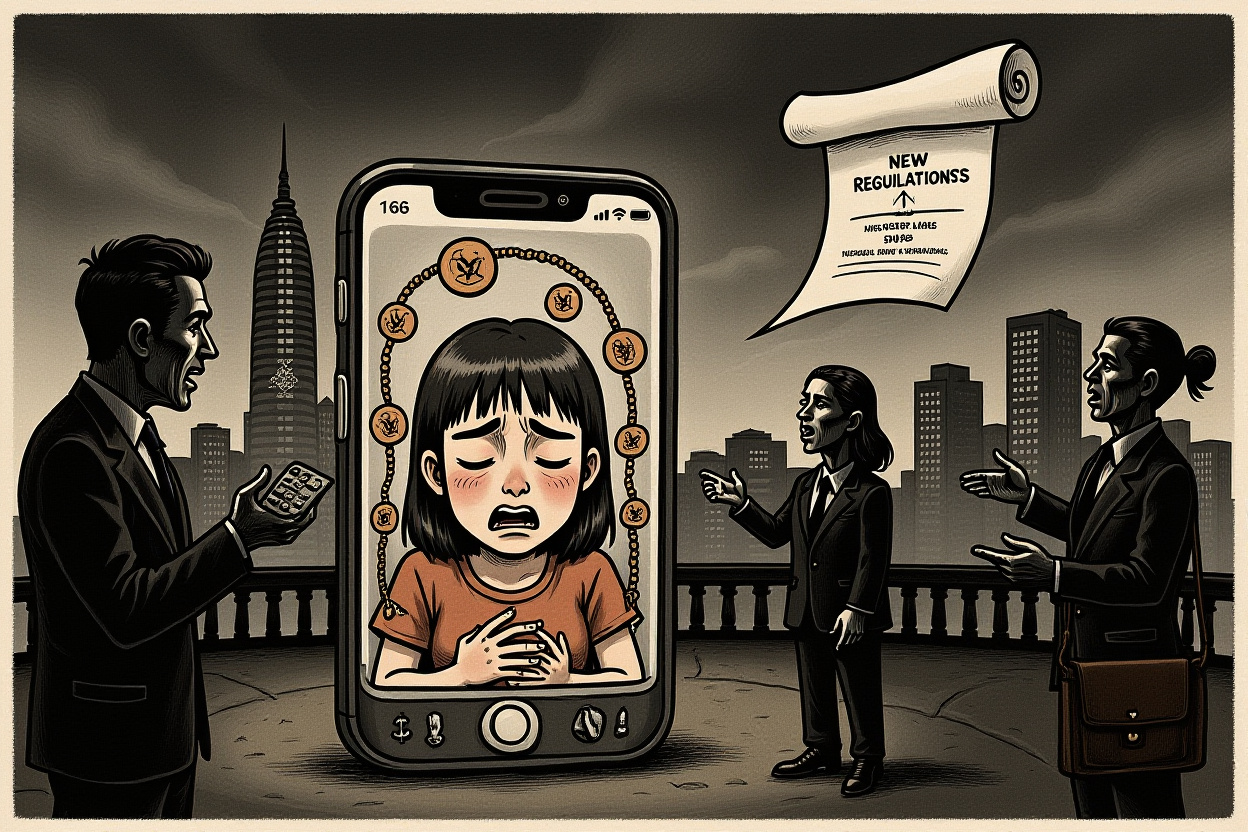
Executive Summary: Key Takeaways on China’s Mini-Loan Crisis
– Chinese micro-lending platform Fenqile (分期乐) faces allegations of charging effective annual interest rates up to 36%, leading to borrowers repaying nearly double their principal, as seen in a case where Ms. Chen (陈女士) borrowed 13,674 yuan but owes 26,859 yuan.
– New regulatory guidelines from the People’s Bank of China (中国人民银行) and National Financial Regulatory Administration cap comprehensive financing costs at 24% for new loans, with plans to reduce them to within four times the 1-year LPR by 2027, signaling a crackdown on predatory lending.
– Despite rebranding efforts, Fenqile’s parent company Lexin Group (乐信集团) retains ties to controversial campus lending practices, with ongoing complaints about targeting students and employing aggressive debt collection tactics that violate privacy.
– Consumer protection issues abound, with opaque fee structures, hidden charges like担保费 (guarantee fees), and a high volume of complaints on platforms like Black Cat Complaint, highlighting systemic risks in China’s fintech sector.
– Investors and market participants must monitor regulatory enforcement and ethical considerations, as the mini-loan model’s sustainability is questioned amid growing scrutiny and potential legal repercussions.
The Allure and Peril of China’s Booming Mini-Loan Market
As the Lunar New Year approaches, many young Chinese consumers find themselves in a financial bind—needing funds for red envelopes, family trips, or daily expenses. Platforms like Fenqile (分期乐) offer a tempting solution: quick, accessible ‘mini-loans’ with promises of low monthly payments and high credit limits. However, beneath this veneer of convenience lies a dangerous reality. These mini-loans, characterized by small amounts and extended repayment periods, often ensnare borrowers in a cycle of debt that can double their original obligations. The recent case of Ms. Chen (陈女士), who borrowed 13,674 yuan but faces a repayment of 26,859 yuan, has thrust this issue into the spotlight, exposing how mini-loans are draining the financial health of China’s youth. With regulatory bodies tightening rules, the future of such lending practices hangs in the balance, posing critical questions for investors and consumers alike.
Case Study: A Debt Nightmare Unfolds
Ms. Chen (陈女士), a university student at the time, fell into the trap of mini-loans through Fenqile (分期乐) between 2020 and 2021. She took out five loans totaling 13,674 yuan, including one for as little as 400 yuan spread over 36 months. The sales pitches emphasized ‘low interest’ and ‘monthly payments as low as 18.23 yuan,’ but the fine print revealed annual rates ranging from 32.08% to 35.90%. By August 2022, overwhelmed by the debt, she defaulted, and over 1,000 days of delinquency have led to aggressive collection efforts that exposed her financial struggles to family and friends, exacerbating mental health issues. This example underscores how mini-loans leverage psychological tactics to mask exorbitant costs, turning manageable debts into insurmountable burdens.
The Mechanics of Debt Snowballing
The mini-loan model thrives on extending repayment terms to make installments seem affordable, while compounding interest and fees escalate the total cost. For instance, Fenqile (分期乐) advertises annual rates as low as 8% and daily interest of 2.2 yuan per 10,000 yuan borrowed, but users report additional charges such as会员费 (membership fees),信用评估费 (credit assessment fees), and担保费 (guarantee fees). These opaque costs can push the comprehensive annual percentage rate (APR) close to the 36% legal limit, as evidenced by complaints on the Black Cat Complaint platform, where over 160,000 grievances cite hidden fees. A user from February 12, 2024, alleged that Fenqile’s rates hit 36%, exceeding the 24% cap, and demanded refunds for overcharges. This lack of transparency is a hallmark of mini-loans, enabling platforms to profit while borrowers struggle to understand the true cost of credit.
Regulatory Crackdown: New Rules Reshaping China’s Lending Landscape
In response to mounting consumer woes, Chinese authorities have introduced stringent measures to curb high-cost lending. On December 19, 2025, the People’s Bank of China (中国人民银行) and the National Financial Regulatory Administration jointly issued the ‘Guidelines for the Management of Comprehensive Financing Costs of Small Loan Companies.’ These rules prohibit new loans with comprehensive costs exceeding 24% annually and mandate that, by the end of 2027, all new lending must stay within four times the 1-year Loan Prime Rate (LPR), which currently hovers around 3.45%, implying a cap near 13.8%. From 2026 onward, local financial regulators are empowered to correct violations, halt new loans, and incorporate non-compliance into dynamic credit reporting systems. This regulatory shift aims to protect vulnerable borrowers from the predatory aspects of mini-loans, but enforcement remains a challenge as platforms adapt their fee structures to skirt the rules.
Enforcement Hurdles and Platform Evasion
Despite the clear caps, mini-loan providers like Fenqile (分期乐) continue to exploit loopholes. The platform, operated by吉安市分期乐网络小额贷款有限公司 (Jian Fenqile Network Microfinance Co., Ltd.), a subsidiary of Lexin Group (乐信集团), has been accused of repackaging interest as service fees to maintain high yields. For example, in cases reported by ‘China Consumer,’ borrowers like Mr. Meng from Hangzhou found that actual repayments exceeded contractually stated amounts by over 2,000 yuan due to undisclosed charges. Regulatory bodies face an uphill battle in monitoring these practices, especially with the proliferation of digital lending apps that obscure fee disclosures in lengthy electronic agreements. Investors should note that non-compliance risks could lead to fines, operational restrictions, and reputational damage for companies involved in the mini-loan sector.
Fenqile’s Controversial Legacy: From Campus Lending to Fintech Giant
Fenqile (分期乐) and its parent Lexin Group (乐信集团) have a storied history rooted in the controversial ‘campus loan’ era. Founded in 2013 by Xiao Wenjie (肖文杰), the platform initially targeted university students, offering分期购物 (installment shopping) for electronics like smartphones. This strategy fueled rapid growth, but it also attracted regulatory ire after a 2016 crackdown on校园贷 (campus loans) due to reports of exploitation and harassment. Lexin Group pivoted, rebranding as a financial technology firm and listing on Nasdaq in 2017. However, the mini-loan model retains echoes of its past, with ongoing allegations that Fenqile still targets students and employs aggressive promotion tactics on campuses. Searches for ‘分期乐 校园贷’ on Black Cat Complaint yield 922 results, including complaints about on-campus marketing booths and loans issued to minors, highlighting a persistent ethical dilemma.
Privacy Concerns and Data Misuse
Beyond high interest rates, mini-loan platforms like Fenqile (分期乐) raise significant privacy issues. According to an investigation by ‘Economic Reference Report,’ users who agree to Fenqile’s terms authorize the collection of sensitive data, including身份证号码 (ID numbers),银行卡信息 (bank card details),人脸信息 (facial recognition data), and location信息. This information is often shared with third parties such as payment processors,增信机构 (credit enhancement agencies), and even other merchants, creating risks of data breaches and misuse. In the context of mini-loans, this data can be leveraged for invasive debt collection, where collectors contact borrowers’ social circles, as seen in Ms. Chen’s case. Such practices not only violate privacy norms but also contravene China’s evolving data protection laws, like the Personal Information Protection Law, adding another layer of regulatory risk for investors to consider.
Consumer Backlash and Legal Recourse in the Mini-Loan Era
The backlash against mini-loans is intensifying, driven by a surge in consumer complaints and media exposure. Platforms like Black Cat Complaint serve as a barometer for dissatisfaction, with over 16,000 entries related to Fenqile (分期乐) alone. Users detail experiences of暴力催收 (violent debt collection), including harassment of family members, employers, and even community leaders. For instance, a complaint from January 20, 2024, described how Fenqile charged an extra 1,450 yuan in信用评估费用 (credit assessment fees) beyond the stated interest, prompting calls for refunds. Legal experts advise borrowers to scrutinize contracts, demand full fee disclosures, and report violations to local金融管理机构 (financial management authorities). As mini-loans face greater scrutiny, class-action lawsuits and regulatory penalties could emerge, impacting the profitability and stability of lending platforms.
Legal Perspectives and Protective Measures
Lawyers specializing in financial disputes emphasize that borrowers have rights under Chinese consumer protection laws. The ‘Guidelines for the Management of Comprehensive Financing Costs’ provide a basis for challenging excessive charges, and victims like Ms. Chen (陈女士) can seek redress through channels like the China Consumers Association. Key steps include:– Documenting all loan agreements and repayment records to identify hidden fees.
– Filing complaints with regulatory bodies such as the National Financial Regulatory Administration or local offices, citing specific violations of the 24% cap.
– Consulting legal aid services for potential lawsuits against platforms that engage in deceptive practices, as seen in cases reported by ‘Southern Daily.’ For investors, this trend signals increasing litigation risks and the need for due diligence on platforms’ compliance records to avoid exposure to mini-loan-related liabilities.
Forward-Looking Insights: The Future of Micro-Lending in China
The mini-loan sector in China is at a crossroads, balancing innovation with ethical responsibility. As regulatory pressures mount, platforms like Fenqile (分期乐) may need to overhaul their business models, perhaps by reducing reliance on high-interest short-term loans and focusing on transparent, lower-cost products. For institutional investors and fund managers, this implies a reassessment of fintech equities, with a focus on companies that demonstrate robust compliance and sustainable practices. The ongoing crackdown could also spur consolidation, as smaller players struggle to meet new standards, creating opportunities for larger, well-regulated entities. Meanwhile, young consumers must become more financially literate, recognizing the pitfalls of mini-loans and exploring alternatives like traditional bank loans or savings plans. The evolution of this market will be a key indicator of China’s commitment to financial inclusion and consumer protection in the digital age.
Market Implications and Investment Strategies
From an investment perspective, the mini-loan shake-up presents both risks and opportunities. Key considerations include:– Monitoring regulatory enforcement actions against major platforms, which could affect stock performance of companies like Lexin Group (乐信集团) on Nasdaq.
– Assessing the impact of lower interest rate caps on profitability; if mini-loan providers cannot maintain high margins, revenue growth may stagnate.
– Exploring sectors that benefit from increased financial literacy, such as edtech or advisory services, as consumers seek safer credit options. Data from the People’s Bank of China (中国人民银行) shows that household debt levels are rising, underscoring the need for responsible lending. Investors should prioritize firms with strong governance and clear disclosures to navigate the uncertainties surrounding mini-loans.
A Call to Action for Stakeholders
In conclusion, the mini-loan crisis in China serves as a cautionary tale about the dark side of fintech innovation. Borrowers must exercise vigilance, thoroughly reviewing terms before committing to任何贷款 (any loan) and reporting abuses to authorities. Platforms should embrace transparency, aligning their practices with regulatory goals to rebuild trust. For the global investment community, this is a moment to advocate for ethical standards in Chinese equities, supporting companies that prioritize consumer welfare over short-term gains. As China’s economy evolves, the resolution of the mini-loan dilemma will shape the future of consumer finance, making it imperative for all stakeholders to engage proactively. Stay informed on regulatory updates and market trends to make sound decisions in this dynamic landscape.