



Executive Summary: Key Takeaways from December’s PMI Data
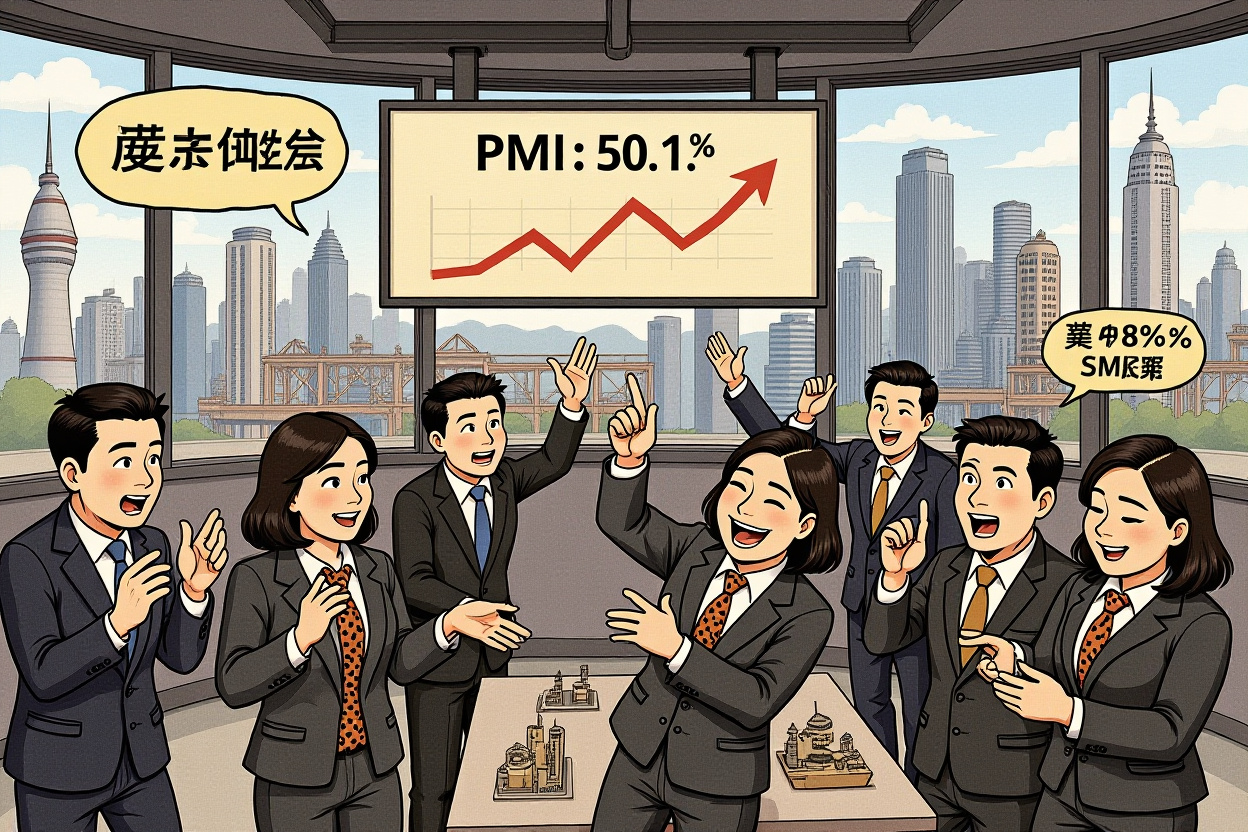
– China’s official manufacturing Purchasing Managers’ Index (PMI) reached 50.1% in December, rising 0.9 percentage points from November and moving above the critical 50-point expansion-contraction threshold for the first time in several months.
– The recovery was uneven, with large enterprises (PMI at 50.8%) driving the upturn, while small and medium-sized enterprises (SMEs) remained in contraction, highlighting persistent structural challenges.
– Non-manufacturing PMI also improved to 50.2%, led by a strong rebound in construction activity, but the services sector stayed below 50%, indicating mixed domestic demand.
– The composite PMI output index rose to 50.7%, suggesting overall business activity expanded in December, potentially supporting fourth-quarter GDP growth and offering a positive signal for 2025.
– Global investors should view this China manufacturing PMI expansion as a tentative stabilization cue, but must monitor policy support and export trends to assess sustainability for equity and bond markets.
A Turning Point for Chinese Industry
In a development that captured the immediate attention of trading desks from Hong Kong to New York, data released by 国家统计局 (National Bureau of Statistics) on December 31 revealed that China’s manufacturing sector snapped a period of contraction. The headline manufacturing PMI reading of 50.1% for December, a 0.9-percentage-point increase from November, represents a symbolic and economic milestone. This China manufacturing PMI expansion breaks a sequence of sub-50 readings that had fueled concerns about the depth of the industrial slowdown. For international investors allocating billions to Chinese equities, this datum serves as a crucial early indicator that concerted policy easing from Beijing may finally be permeating the real economy. The return to expansion, however modest, arrives at a critical juncture, offering a glimmer of hope for corporate earnings and broader economic momentum as the year concludes.
Decoding the PMI Components: Production and Demand Lead the Charge
The strength behind the December manufacturing PMI expansion can be traced to two key sub-indices. First, the production index jumped 1.7 points to 51.7%, indicating factories ramped up output. Second, and perhaps more importantly, the new orders index climbed 1.6 points to 50.8%, suggesting a genuine, albeit initial, improvement in market demand. This pairing is essential; increased production driven by inventory rebuilding is less sustainable than growth fueled by new orders. The supplier delivery time index, at 50.2%, also contributed positively, signaling smoother logistics. Conversely, the employment index dipped slightly to 48.2%, reminding observers that labor market recovery typically lags output. The raw materials inventory index, while still contracting at 47.8%, saw its rate of decline slow, hinting that businesses may be starting to restock cautiously. This nuanced picture underscores that the December manufacturing PMI expansion is a broad-based but nascent recovery, requiring confirmation in subsequent months.
The Great Divide: Enterprise Size and the Uneven Recovery
A granular look at the PMI data reveals a stark divergence in performance across company sizes, a critical factor for investors analyzing sectoral risks and opportunities. The China manufacturing PMI expansion in December was overwhelmingly propelled by large enterprises, whose PMI surged 1.5 points to 50.8%. These state-backed and export-oriented giants often benefit first from infrastructure stimulus and have easier access to credit. In contrast, medium enterprises saw a 0.9-point rise but remained at 49.8%, just below the expansion line. Most concerning, small enterprises saw their PMI decline by 0.5 points to 48.6%, deepening their contraction.
Implications for Supply Chains and Domestic Innovation
This divergence carries significant implications. Large enterprises are frequently at the apex of industrial supply chains, so their improved activity can have positive ripple effects. However, the continued weakness among SMEs, which account for a vast portion of employment and innovation, poses a threat to the recovery’s breadth and resilience. It suggests that broader financing conditions, often tight for smaller private firms, have not eased sufficiently. For portfolio managers, this means equity selections might favor large-cap industrial and manufacturing stocks in the short term, while remaining cautious on small-cap industrials until clearer signs of credit transmission emerge. The persistence of this gap will be a key metric for the 中国人民银行 (People’s Bank of China) and other regulators.
Beyond Manufacturing: Non-Manufacturing PMI and the Services Struggle
The companion dataset on non-manufacturing activity provided a mixed but generally improving picture. The non-manufacturing Business Activity Index rose 0.7 points to 50.2%, also returning to expansion. The standout performer was the construction sector, where the index leaped 3.2 points to 52.8%, likely reflecting accelerated project issuance and implementation as local governments sought to meet annual investment targets. This construction surge is a direct beneficiary of fiscal stimulus and bodes well for related sectors like cement, steel, and engineering.
The Services Sector Lag and Consumer Caution
In stark contrast, the services sector Business Activity Index edged up a mere 0.2 points to 49.7%, remaining in contraction. Within services, performance was highly bifurcated. Industries like 电信广播电视及卫星传输服务 (telecom, broadcast, and satellite transmission services) and 货币金融服务 (monetary financial services) reported robust activity above 60.0%, supported by digitalization trends and policy support. However, consumer-facing sectors like retail and catering stayed below 50%, underscoring persistent caution in household spending. The non-manufacturing new orders index, though improving, remained at a low 47.3%. This services weakness highlights that the domestic consumption engine, crucial for rebalancing China’s economy, is not yet firing on all cylinders. The path to a durable China manufacturing PMI expansion is intertwined with a recovery in service sector confidence and employment.
The Composite View and Macroeconomic Health
The 综合PMI产出指数 (composite PMI output index), which amalgamates manufacturing and non-manufacturing activity, rose 1.0 point to 50.7% in December. This index is a reliable high-frequency proxy for overall economic momentum and suggests that total business activity expanded at a faster pace than in November. Historically, the composite PMI has correlated closely with quarterly GDP growth rates. A reading above 50% for December provides a tangible boost to expectations for fourth-quarter GDP data, potentially mitigating fears of a sharper slowdown. It indicates that policy measures deployed throughout 2024—including incremental interest rate cuts, reserve requirement ratio reductions, and targeted fiscal spending—are beginning to show aggregated effect.
Linking PMI to Broader Economic Indicators
Analysts will now watch for corroboration from other data points. Will industrial production and retail sales data for December show similar improvement? How will export figures hold up amid global demand uncertainties? The PMI’s new export orders component, though not detailed in this release, will be critical. Furthermore, the business expectations index for non-manufacturing rose to 56.5%, indicating strong forward-looking confidence, particularly in construction and high-end services. This optimism can be self-fulfilling if it leads to increased investment and hiring. For a comprehensive view, investors are advised to consult the full release on the 国家统计局 (National Bureau of Statistics) website [https://www.stats.gov.cn].
Global Market Reactions and Strategic Implications
The immediate financial market reaction to the December PMI data was cautiously positive. Chinese equities, particularly the 沪深300指数 (CSI 300 Index) and sectors like industrials and materials, saw upticks. The 人民币 (Renminbi) exchange rate stabilized slightly, and commodity prices, especially for base metals, found support. This China manufacturing PMI expansion provides a fundamental rationale for the recent modest rallies in Chinese assets, which had been undervalued relative to growth concerns. For global fund managers, the data necessitates a strategic review.
Sectoral Opportunities and Risk Assessment
– **Equity Markets**: Focus may shift towards cyclical sectors poised to benefit from an industrial upturn. Companies in industrial automation, construction machinery, and select consumer goods linked to government procurement could see re-rating. However, the SME weakness suggests a stock-picking approach is essential, favoring companies with strong balance sheets and state linkages.
– **Fixed Income**: The recovery data may temper expectations for aggressive further monetary easing in the near term, potentially putting a floor under government bond yields. Credit spreads for industrial bonds, especially from large SOEs, could tighten.
– **Currency and Commodities**: A sustained manufacturing recovery would support the RMB and demand for imported raw materials, affecting global trade flows and commodity-exporting economies.
Investors should balance this positive signal against lingering risks: the property market overhang, local government debt, and geopolitical trade tensions. The December manufacturing PMI expansion is a step in the right direction, but not an all-clear signal.
Policy Trajectory and the 2025 Outlook
The December PMI report will undoubtedly influence the policy calculus in Beijing. The improvement, while welcome, is fragile and uneven. The central bank, led by Governor Pan Gongsheng (潘功胜), is likely to maintain an accommodative bias, but may now prioritize targeted tools over broad-based rate cuts to support specific weak spots like SMEs and the services sector. Fiscal policy, steered by the 财政部 (Ministry of Finance), is expected to remain proactive, with front-loaded bond issuance in early 2025 to sustain infrastructure investment.
Key Risks and Monitoring Points for the Coming Quarters
The sustainability of this China manufacturing PMI expansion hinges on several factors:
– **Domestic Demand**: Can consumer confidence rebound to lift the services sector out of contraction?
– **External Demand**: Will key export markets in the US and Europe avoid a deep recession, supporting China’s export-oriented manufacturers?
– **Policy Consistency**: Will support measures be sustained long enough to foster a private-sector-led recovery, rather than a state-driven sugar rush?
– **Structural Reforms**: Progress on addressing property sector risks and local debt will be crucial for long-term stability.
Forward-looking surveys embedded in the PMI report, like the business activity expectations index, suggest corporate leaders are moderately optimistic. This sentiment, if matched by concrete action on consumption stimulus and private enterprise support, could pave the way for a more robust 2025.
Synthesizing the Signals for Informed Investment Action
The December PMI data delivers a clear, though preliminary, message: China’s industrial engine is sputtering back to life. The return to expansion in both manufacturing and non-manufacturing PMI provides tangible evidence that policy support is filtering through and that economic activity found a firmer footing as the year ended. However, the recovery’s uneven nature—strong in large firms and construction, weak in SMEs and services—cautions against unbridled optimism. This China manufacturing PMI expansion should be viewed as the first green shoot in a garden that still requires careful nurturing.
For the global investment community, the imperative is now to move beyond headline numbers. Scrutinize upcoming data on credit growth, retail sales, and corporate earnings for confirmation. Re-evaluate allocations to Chinese assets, considering sectors directly linked to the early-cycle recovery while maintaining hedges against persistent vulnerabilities. Engage with on-the-ground research and company management teams to gauge the true pulse of demand. The December PMI rebound offers a strategic window to position for a potential stabilization narrative in Chinese equities, but it demands vigilance, selectivity, and a clear-eyed assessment of both the opportunities and the profound challenges that remain on the path to sustainable growth.