



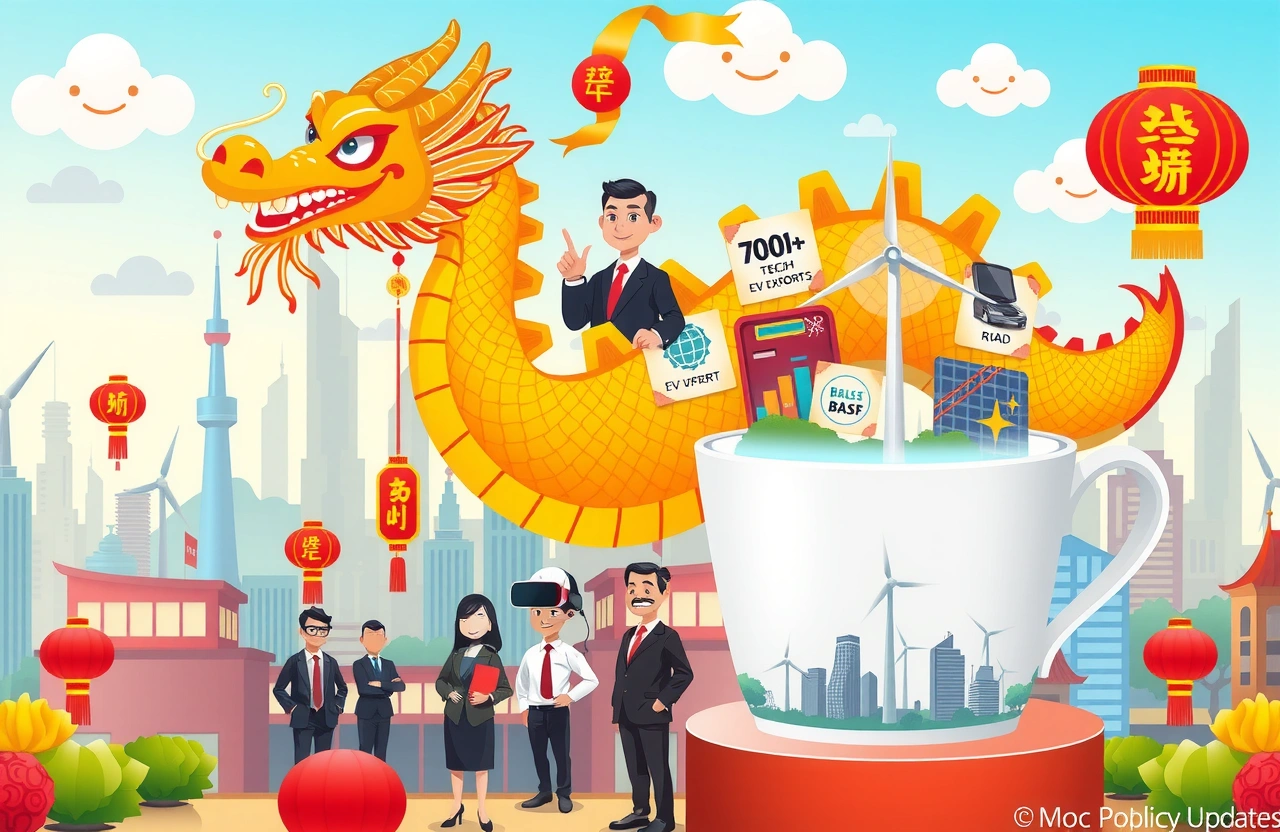
A Remarkable Economic Milestone
China’s Ministry of Commerce recently announced surpassing the $700 billion foreign direct investment target outlined in its 14th Five-Year Plan (2021-2025), demonstrating extraordinary economic resilience amid global challenges. At a State Council Information Office press conference reviewing China’s economic agenda, officials revealed foreign investment inflows now exceed initial projections despite pandemic disruptions and geopolitical tensions. Goods trade maintains its position as the world’s largest, while exports and imports command steady international market shares of 14% and 10% respectively. This achievement signals robust investor confidence in China’s economic transition toward high-quality development.
Foreign Investment Performance Exceeds Expectations
Since launching the 14th Five-Year Plan in 2021, China has attracted over $700 billion in cumulative foreign investment – outstripping initial targets despite volatile global conditions. The Ministry attributes this success to targeted policies enhancing China’s appeal as a premier investment destination.
Policy Drivers of Foreign Investment Growth
Several strategic initiatives accelerated foreign capital inflows:
- Negative List Simplification: Foreign investment restrictions reduced by 17% across sectors
- Tax Incentives: Preferential policies for advanced manufacturing and R&D investments
- Free Trade Zone Expansion: Pilot zones increased to 21 locations nationwide
As Minister of Commerce Wang Wentao emphasized: “We’re systematically addressing investor concerns through regulatory transparency” during the quarterly foreign enterprise roundtables.
Trade Resilience and Global Positioning
For three consecutive years, China maintained its ranking as the world’s top merchandise trader. Beyond sheer volume, structural improvements show maturation.
Sectoral Transformation
The export basket has shifted significantly since 2020:
- High-tech product exports increased 11% annually
- Automotive exports surpassed Germany as world’s second-largest
- Green technology shipments grew 29% year-on-year
The sustained import demand, accounting for over 10% of global imports, reflects strong domestic consumption and manufacturing needs.
Service Trade Advancement
China consolidated its position as the world’s second-largest service trader, demonstrating balanced economic development beyond manufacturing. Digital and knowledge-intensive services fueled growth:
Emerging Service Trade Leaders
- Cross-border e-commerce services grew 19% annually
- Intellectual property royalties imports reached $43 billion
- Cloud computing services recorded 27% expansion
Such diversification reduces traditional dependencies while creating higher-value economic linkages according to Shanghai University of Finance and Economics researchers.
Investment Quality Transformation
The composition of foreign investment reflects China’s economic upgrade priorities:
- High-tech manufacturing FDI increased 34% annually
- R&D center establishment grew by 17% year-on-year
- Central and western regions received 21% more FDI
Notable projects include Tesla’s Shanghai plant expansion and BASF’s $10 billion Guangdong chemical complex. This quality focus supports China’s domestic innovation ecosystem development.
Future Trajectory Beyond 2025
The Ministry confirmed new incentives for smart manufacturing, green energy and biotechnology investments, signaling continuity in market-oriented reforms:
- Foreign venture capital regulations simplification
- Enhanced IP protection mechanisms
- Streamlined data compliance for multinationals
Industry leaders including Siemens China President Dr. Xiao Song emphasizes China remains “indispensable in global value chains” despite diversification trends.
Sustaining Momentum
China’s achievement of the $700 billion foreign investment milestone demonstrates robust institutional capacity to deliver economic objectives amid complex global conditions. While challenges remain in demographic shifts and geopolitical pressures, the recalibrated investment-attraction strategy focusing on technological depth creates promising foundations. For global enterprises, China continues to offer unrivaled industrial ecosystems and digitization opportunities. Closely monitor Ministry of Commerce policy updates for precise alignment with development zones and emerging sector priorities.