



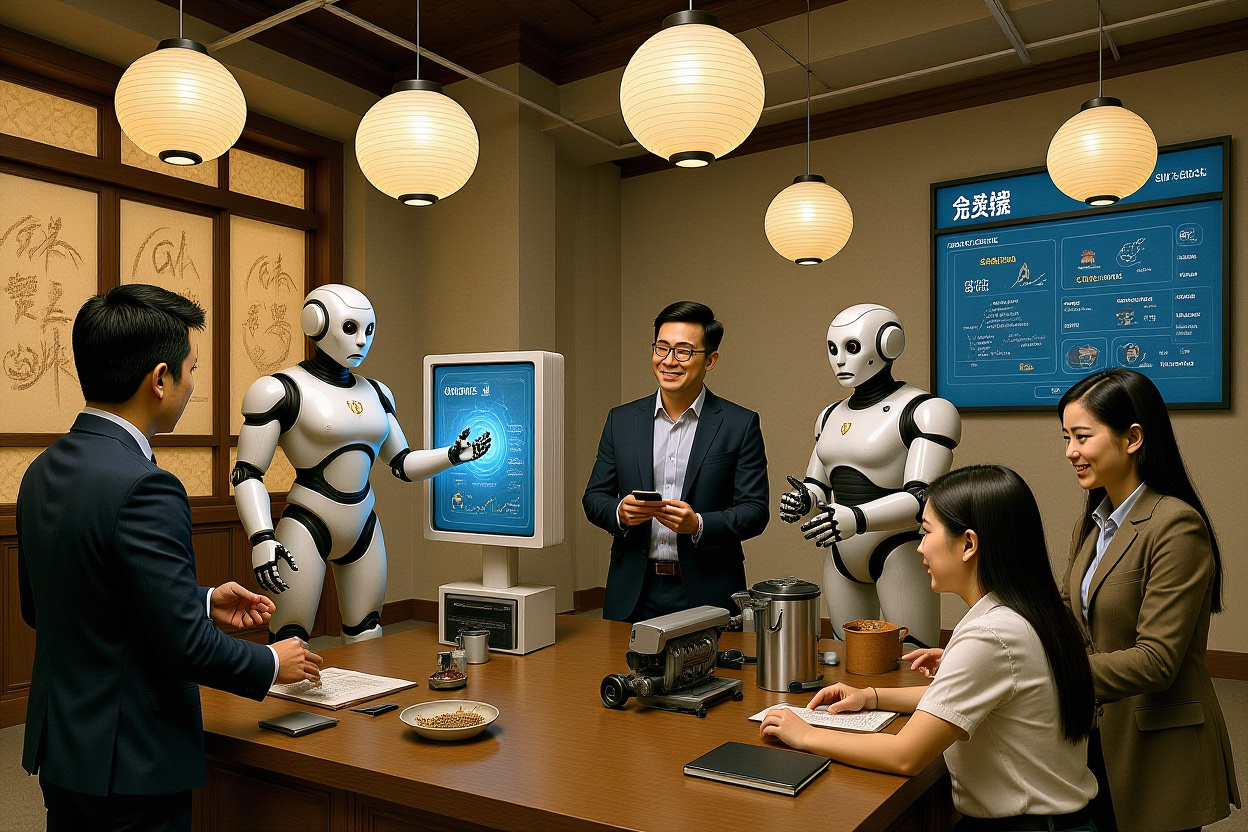
The stage lights of the 央视春晚 (China Central Television’s Spring Festival Gala) have dimmed, but for China’s burgeoning embodied AI industry, the glare of real-world scrutiny has only intensified. As a perennial barometer for technological trends, the 2026 Gala did more than just entertain; it functioned as a high-stakes national proving ground, a live-fire exercise for humanoid robots transitioning from laboratory curiosities to commercial contenders. For sophisticated investors and corporate strategists monitoring China’s tech frontier, understanding the implications of this showcase is crucial. The gala’s spectacle marks not an end, but the true beginning of a brutal elimination race where market validation, not stage performance, will determine the winners. This event underscores a pivotal moment where the Spring Festival Gala serves as the ultimate crucible for embodied AI, separating promising prototypes from viable products.
Executive Summary: Key Takeaways from the Gala Showcase
- The 2026 CCTV Spring Festival Gala featured a coordinated “group army” debut of four major Chinese embodied AI firms: 魔法原子 (Magic Atom), 银河通用 (Galaxy General), 宇树科技 (Unitree Robotics), and 松延动力 (Songyan Dynamics), signaling maturing industry collaboration and government endorsement.
- Subtle differences in official partnership titles (e.g., “Robot Partner” vs. “Strategic AI Robot Partner”) reflect distinct technical pathways and strategic positioning among the companies, highlighting a diversifying competitive landscape.
- The core challenge post-Gala is the transition from staged demonstrations to reliable, profitable applications in industrial, commercial, and ultimately, consumer settings. Success on stage is merely a prerequisite for the far harder test of market adoption.
- Industry analysts project explosive growth for China’s embodied AI sector, with IDC forecasting user spending to reach $77 billion by 2030, making the current race for scalable use cases critically important for investors.
- 2026 is poised to be an industry inflection point, shifting focus from fundraising and publicity to securing tangible orders, achieving client retention, and demonstrating operational stability in real-world environments.
The Gala as a National Stage and Strategic Inflection Point
For decades, the央视春晚 (China Central Television’s Spring Festival Gala) has served as China’s premier cultural and technological showcase, viewed by hundreds of millions. Its selection of featured technologies offers powerful state-backed validation and unparalleled public exposure. The 2026 edition marked a significant evolution: rather than scattered demonstrations of single technologies, it presented a coordinated “group army” deployment of China’s embodied AI frontrunners. This collective unveiling of 魔法原子 (Magic Atom), 银河通用 (Galaxy General), 宇树科技 (Unitree Robotics), and 松延动力 (Songyan Dynamics) was a strategic statement, designed to signal collective national strength in a critical frontier technology.
From Novelty Act to Mainstream Endorsement
The participation of these four firms represents a maturity milestone. 宇树科技 (Unitree Robotics), having broken through at the 2025 Gala, exemplified the potential payoff, leveraging that exposure for numerous subsequent high-profile appearances. Its 2026 return, partnering with the renowned 河南塔沟武术学校 (Henan Tagou Martial Arts School) for a wushu performance, showcased advanced mobility and coordination. Meanwhile, 松延动力 (Songyan Dynamics) integrated into a comedy sketch, 魔法原子 (Magic Atom) supported a musical act, and 银河通用 (Galaxy General) featured in a micro-movie. This diversity of integration—from athletic performance to narrative acting—demonstrated broader functional applicability beyond simple movement.
Decoding the Partnership Titles: A Map of Strategic Divergence
A telling detail for market analysts was the variance in official partnership designations. 宇树科技 was labeled the “春晚机器人合作伙伴” (Gala Robot Partner), 松延动力 as “春晚人形机器人合作伙伴” (Gala Humanoid Robot Partner), 魔法原子 as “春晚智能机器人战略合作伙伴” (Gala Intelligent Robot Strategic Partner), and 银河通用 as “春晚指定具身大模型机器人” (Gala Designated Embodied Large Model Robot). This nuanced terminology is not mere semantics; it publicly delineates each company’s core focus—whether on general robotics, humanoid form factor, intelligent systems integration, or large model-driven embodiment. For investors, these labels offer initial clues to differentiate business models and technological bets in a crowded field. The event clearly demonstrated how the Spring Festival Gala serves as the ultimate crucible for embodied AI, forcing companies to articulate and demonstrate their unique value proposition under extreme, live scrutiny.
The Three Brutal Gateways to Commercial Viability
As the curtain fell, the industry’s sobering mantra echoed: robots cannot dance on stage forever. The gala’s immense visibility is a double-edged sword—it creates sky-high expectations that must now be met with gritty, unglamorous execution. The path from national showcase to sustainable business runs through three sequential and increasingly difficult commercial gateways. Successfully navigating these is the only metric that will ultimately matter for valuations and survival.
Gateway One: Conquering the Factory Floor
The first and most immediate proving ground is industrial automation. Factories present a clear value proposition: replacing repetitive, strenuous, or hazardous human labor in tasks like sorting, assembly, loading/unloading, inspection, and palletizing. The market is vast and the economic logic is straightforward. However, industrial clients demand unwavering reliability, precision, and cost-effectiveness. A robot that stumbles during a choreographed Gala routine can reset; a robot that fails on a 24/7 production line causes immediate financial loss. The transition from a controlled stage to a gritty, variable factory environment tests sensor durability, mechanical robustness, and error-recovery algorithms under conditions that no laboratory can fully replicate. Companies that secure and reliably fulfill manufacturing contracts will establish the first pillar of commercial credibility.
Gateway Two: Mastering Dynamic Commercial Spaces
The second gateway leads into commercial service environments: warehouses, retail stores, hotels, and hospitals. These settings introduce a layer of complexity absent from structured factories. Robots must navigate unpredictable human traffic, avoid dynamic obstacles (like shopping carts or medical equipment), and often engage in basic interactive tasks. The cognitive leap required is significant. Performing a pre-programmed interaction with an actor on stage, as 松延动力 did, is fundamentally different from safely navigating a crowded supermarket aisle or responding appropriately to a customer’s spontaneous query. This gateway tests the integrated “embodied intelligence” stack—perception, real-time decision-making, navigation, and human-robot interaction—in semi-structured chaos. Success here opens large B2B service markets but requires a demonstrably higher level of AI sophistication.
Gateway Three: The Distant Summit of the Home
The final and most challenging frontier is the consumer household. The home is the ultimate unstructured environment: cluttered floors, variable lighting, unpredictable pets and children, and highly ambiguous user commands. It presents a convergence of all previous challenges but with near-zero tolerance for error and a stringent requirement for affordability and simplicity. While the market potential is astronomical, the technical and safety hurdles are immense. A robot must be not only capable and safe but also intuitive and cheap enough for mass adoption. This gateway remains years away for most, representing the industry’s “final exam.” Current Gala demonstrations, while impressive, are merely preschool relative to the PhD-level intelligence and robustness required for true in-home utility. The journey to make the Spring Festival Gala serves as the ultimate crucible for embodied AI a prelude to home integration will be long and capital-intensive.
Investment Implications and the 2026 Inflection Point
For the global investment community, the post-Gala landscape demands a sharp shift in analytical focus. The narrative is transitioning from potential to proof, from technical specs to business metrics. The staggering growth forecast—with IDC predicting China’s embodied AI robot user spending to hit $77 billion by 2030 at a 94% CAGR—ensures capital will continue to flow, but it will flow more discerningly.
Metrics That Will Define Winners and Losers
In 2026 and beyond, key performance indicators (KPIs) for these companies will evolve. Investor attention should pivot from press release counts and funding round sizes to more substantive data:
- Pilot Program Scale & Conversion: Number of active commercial pilots, their scale, and their rate of conversion into paid, multi-unit contracts.
- Mean Time Between Failures (MTBF): Operational reliability data from field deployments, especially in industrial settings.
- Cost per Operation Hour: The all-in cost of deploying and running a robot versus the human labor or process it replaces.
- Software Recurring Revenue: The ability to monetize AI models, fleet management software, and data services, creating sticky, high-margin income streams.
Companies like 宇树科技, which has aggressively pursued public demonstrations, must now demonstrate it can translate that brand awareness into durable enterprise sales. Firms like 银河通用, emphasizing its “large model” capabilities, must prove that its AI delivers tangible superiority in task comprehension and adaptability. The market will ruthlessly punish companies that remain trapped in a cycle of demo-dependent hype.
Regulatory and Ecosystem Considerations
The government’s role, highlighted by the platform provided by the央视春晚 (China Central Television’s Spring Festival Gala), extends beyond endorsement. As these robots move into public spaces and workplaces, a regulatory framework will inevitably take shape, covering safety certification, data privacy, liability for accidents, and ethical use. Proactive engagement with regulators will be a strategic advantage. Furthermore, building a robust ecosystem—including developer tools, training simulators, and integration partnerships—will be critical for accelerating application development. The companies that succeed will likely be those that foster vibrant third-party developer communities around their platforms, unlocking use cases beyond their own imagination.
From Spectacle to Substance: The Road Ahead
The 2026 Spring Festival Gala provided a magnificent snapshot of China’s progress in embodied AI, showcasing agility, coordination, and increasing integration into human-centric activities. It was a powerful testament to engineering prowess. However, for institutional investors and corporate executives, the true analysis begins now. The gala was the ultimate stress test for public performance, but the far more consequential stress test of market economics is underway.
The coming 18-24 months will see a stark stratification within the sector. Winners will be defined by their ability to cross the commercial gateways, moving from showcase partners to indispensable suppliers. They will be the companies that replace viral video clips with case studies featuring hard ROI numbers, client testimonials, and scalable deployment blueprints. The era of competing on funding announcements and stage time is closing; the era of competing on logbooks, reliability reports, and profit margins is now open. To stay ahead in this dynamic market, stakeholders must look beyond the glare of the stage lights and scrutinize the grind of the factory floor, the hustle of the warehouse, and the slow, steady progress toward the home. The ultimate grade for this ultimate crucible for embodied AI will not be given by a TV audience, but by the unforgiving report cards of the global market.