



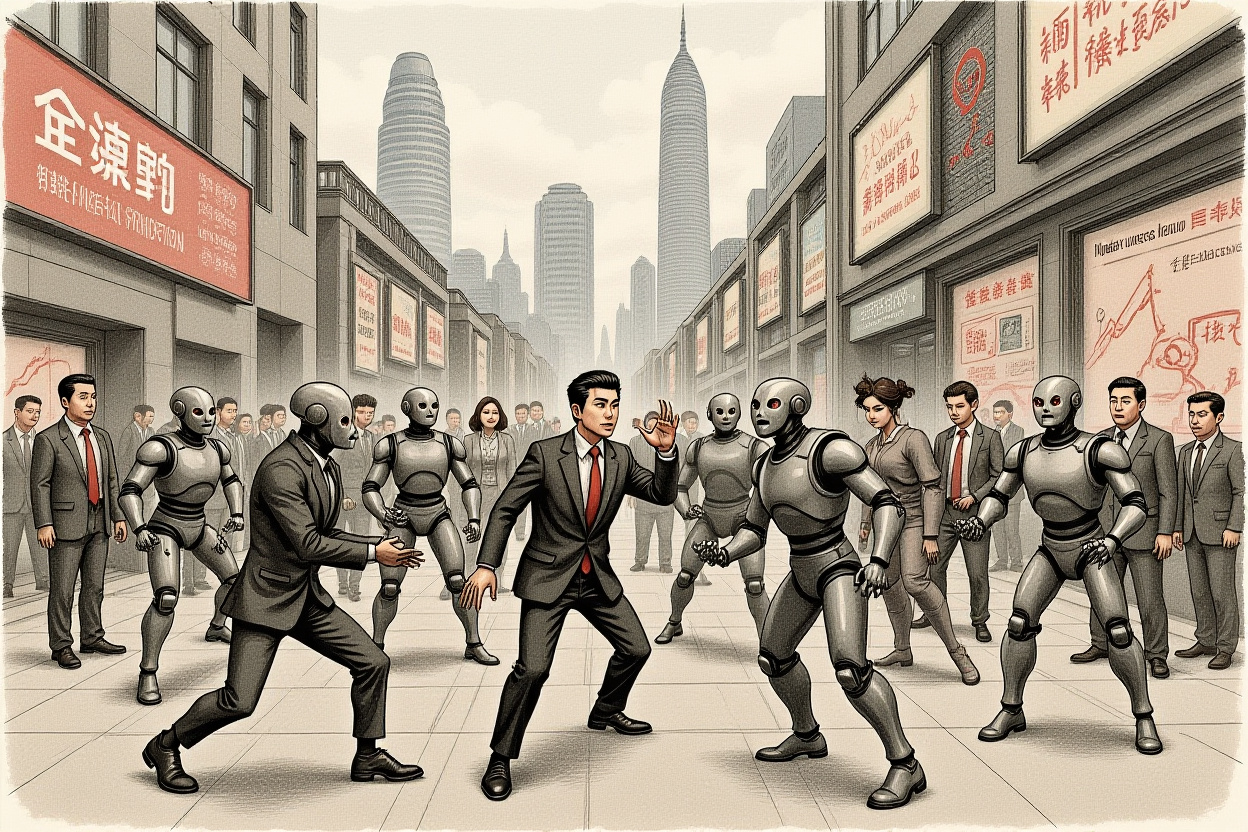
– The 2026 CCTV Spring Festival Gala served as a pivotal platform for four leading Chinese embodied AI companies—魔法原子 (Magic Atom), 银河通用 (Galaxy Universal), 宇树科技 (Unitree Robotics), and 松延动力 (Songyan Power)—highlighting the sector’s maturation and national strategic importance.
– While stage performances generate significant public and investor buzz, the true benchmark for success lies in overcoming real-world challenges in industrial, commercial, and household environments, which will define market winners.
– IDC projects China’s embodied intelligent robot user spending to reach $770 billion by 2030, with a compound annual growth rate of 94%, signaling a high-growth investment opportunity in a nascent but rapidly scaling industry.
– The industry is transitioning from a focus on funding rounds and technological demonstrations to prioritizing scalable orders, client retention, and profitable business models, with 2026 marking a potential inflection point.
– Investors and corporate executives should evaluate companies based on their ability to secure repeatable contracts, demonstrate reliability in unstructured settings, and navigate regulatory landscapes, as the ultimate test field for embodied AI shifts from the stage to the marketplace.
For decades, the CCTV Spring Festival Gala has acted as a cultural and technological barometer for China, spotlighting innovations that define national progress. In 2026, this tradition reached a new zenith as embodied artificial intelligence took center stage, with a quartet of domestic firms—魔法原子 (Magic Atom), 银河通用 (Galaxy Universal), 宇树科技 (Unitree Robotics), and 松延动力 (Songyan Power)—orchestrating a symphony of robotic dances, martial arts, and interactive sketches. This event is far more than entertainment; it represents the ultimate test field for embodied AI, where technical prowess meets public scrutiny and investor expectations. As the global investment community watches, the real examination begins: translating this stage glory into sustainable market share and commercial viability in the world’s second-largest economy. The gala’s lights may dim, but for China’s embodied AI sector, the journey from concept to cash flow is just commencing, with profound implications for equity markets and technological sovereignty.
The Spring Festival Gala: A National Stage for Embodied AI Innovation
The 2026 Spring Festival Gala marked a watershed moment for China’s embodied intelligence industry, moving beyond fragmented technological displays to a coordinated, large-scale demonstration of robotic capabilities. This collective debut underscores the sector’s evolution from laboratory curiosities to commercially viable entities ready for prime time.
A Showcase of China’s Robotic Prowess
Among the performers, 宇树科技 (Unitree Robotics) stood out, building on its 2025 gala breakthrough with a martial arts routine titled “武 BOT,” developed in collaboration with the Henan Tagou Martial Arts School. This performance highlighted not just agility but also collaborative intelligence, as robots executed synchronized movements with human counterparts. Similarly, 松延动力 (Songyan Power) partnered with comedians Cai Ming (蔡明) and Wang Tianfang (王天放) in a skit, while 魔法原子 (Magic Atom) supported a musical number, and 银河通用 (Galaxy Universal) appeared in a micro-film. Such diverse applications signal that embodied AI is permeating various facets of entertainment and beyond, serving as the ultimate test field for public acceptance and technical integration.
Decoding the Titles: Strategic Positioning of Key Players
A subtle yet revealing detail from the gala was the distinct official titles bestowed upon each company: 宇树科技 (Unitree Robotics) as “Spring Festival Gala Robot Partner,” 松延动力 (Songyan Power) as “Spring Festival Gala Humanoid Robot Partner,” 魔法原子 (Magic Atom) as “Spring Festival Gala Intelligent Robot Strategic Partner,” and 银河通用 (Galaxy Universal) as “Spring Festival Gala Designated Embodied Large Model Robot.” These nuanced designations reflect divergent technical pathways and market strategies. For instance, 宇树科技 (Unitree Robotics) emphasizes general-purpose robotics, whereas 松延动力 (Songyan Power) focuses on humanoid forms tailored for interactive roles. This differentiation is crucial for investors assessing competitive moats and scalability in a crowded landscape, as the ultimate test field for embodied AI demands not just innovation but also clear strategic vision.
Market Potential: IDC Forecasts and Growth Drivers
Behind the glitz of the gala lies a staggering market opportunity. According to IDC data, China’s embodied intelligent robot user expenditure is projected to soar to $770 billion by 2030, growing at a compound annual rate of 94%. This trajectory positions the sector as one of the fastest-growing segments within the broader AI and robotics ecosystem, driven by government support, declining hardware costs, and escalating demand for automation across industries.
Explosive Growth Trajectory and Investment Implications
The IDC forecast, accessible via industry reports, underscores a near-doubling of market size annually, making embodied AI a magnet for venture capital and strategic investments. Key drivers include China’s aging population, which exacerbates labor shortages in manufacturing and services, and policy initiatives like the “Made in China 2025” and “Artificial Intelligence Development Plan” that prioritize robotics development. For institutional investors, this growth narrative offers exposure to a transformative technology, but it also necessitates scrutiny of companies’ abilities to convert hype into revenue, as the ultimate test field for embodied AI shifts from stage performances to balance sheets.
The Dual Role of the Gala: Public Education and Industry Validation
The Spring Festival Gala serves a dual purpose: educating the masses about embodied AI’s potential and validating technological readiness for enterprise clients and capital markets. By featuring robots in relatable contexts—from comedy sketches to action sequences—the gala demystifies advanced robotics, fostering societal acceptance. Simultaneously, it provides a high-stakes platform for companies to demonstrate reliability under pressure, akin to a live stress test. This validation is critical for securing partnerships with manufacturers, retailers, and healthcare providers, as passing this ultimate test field can unlock supply chain integrations and pilot projects that drive long-term valuation.
The Ultimate Test Field: Three Barriers to Commercialization
While the gala showcased technical fluency, the embodied AI industry must now confront three formidable barriers to achieve sustainable commercialization. These hurdles represent the ultimate test field for embodied AI, where failure to adapt could spell obsolescence in a fiercely competitive market.
Conquering the Factory Floor: Industrial Applications
The first barrier is penetrating industrial settings, where robots must execute repetitive tasks like sorting, assembly, and quality inspection with near-perfect reliability. Factories demand low error rates, cost-effectiveness, and continuous operation—standards far stricter than stage performances. For example, a robot that stumbles during a dance routine may be forgiven, but a malfunction on an automotive assembly line can incur millions in losses. Companies like 宇树科技 (Unitree Robotics) are targeting this sector, but success hinges on overcoming environmental challenges such as dust, vibration, and electromagnetic interference. Investors should monitor metrics like mean time between failures (MTBF) and deployment scales in pilot factories to gauge progress in this ultimate test field.
Navigating Dynamic Environments: Commercial Deployments
Commercial spaces—including supermarkets, warehouses, and hospitals—present a second barrier characterized by unpredictability. Here, robots must process visual data, avoid obstacles, and interact with humans in real-time. The gala’s scripted interactions pale in comparison to navigating a crowded mall where children dart unpredictably or customers pose unscripted queries. This requires advanced sensor fusion, machine learning algorithms, and natural language processing capabilities. Firms like 魔法原子 (Magic Atom) are exploring retail integrations, but scalability depends on reducing latency and improving contextual awareness. As the ultimate test field for embodied AI expands, commercial adoption rates will serve as a key indicator of technological maturity.The Holy Grail: Integration into Households
The third and most challenging barrier is domestic adoption, where robots must operate in highly unstructured home environments. Issues like cluttered floors, pet interference, and varied lighting conditions test the limits of current AI systems. Additionally, affordability and safety are paramount; a household robot must be priced accessibly while preventing accidents. While mass-market penetration remains years away, advancements in cost reduction and AI training—such as sim-to-real transfer learning—are accelerating progress. For investors, this segment offers the highest long-term upside but also the greatest risk, making it the ultimate test field for embodied AI’s endurance and innovation.
Investment Implications: From Hype to Hard Metrics
The post-gala landscape necessitates a shift in investment criteria, from valuing fundraising prowess to prioritizing fundamental business metrics. As the ultimate test field for embodied AI transitions to the market, companies must demonstrate tangible traction to justify valuations and attract further capital.
Shifting Metrics: From Funding to Fundamentals
In 2026, the industry is poised to move beyond the “demo economy,” where flashy presentations sufficed for securing venture rounds. Instead, investors should focus on order books, recurring revenue streams, and customer retention rates. For instance, 宇树科技 (Unitree Robotics) has reportedly participated in over 12 large-scale events and 7 dedicated robot competitions since 2025, but the critical question is whether these engagements translate into industrial contracts. Metrics like annual recurring revenue (ARR), gross margins, and deployment footprints in sectors like logistics or healthcare will separate contenders from pretenders in this ultimate test field.Key Players to Watch: Unitree, Magic Atom, and Others
A comparative analysis of the gala participants reveals distinct investment profiles. 宇树科技 (Unitree Robotics), with its emphasis on versatile legged robots, may appeal to investors seeking exposure to multiple verticals, from entertainment to inspection services. 魔法原子 (Magic Atom), focusing on collaborative robots (cobots), could benefit from manufacturing automation trends. 银河通用 (Galaxy Universal)’s large-model approach aligns with cloud AI integration, potentially reducing on-device costs. 松延动力 (Songyan Power)’s humanoid design targets service roles. Each company’s ability to secure partnerships—such as with automotive giants or e-commerce platforms—will be a litmus test in the ultimate test field for embodied AI, influencing stock performance and merger activity.Regulatory and Global Context: China’s AI Ambitions
China’s embodied AI push is inextricably linked to broader geopolitical and economic strategies, with regulatory frameworks shaping market dynamics. Understanding this context is essential for global investors navigating the ultimate test field for embodied AI, where policy support can accelerate adoption but also introduce compliance complexities.Government Support and Policy Frameworks
Chinese authorities have enacted policies like the “Robotics Industry Development Plan (2021-2025)” to bolster domestic capabilities, offering subsidies, tax incentives, and R&D grants. This support reduces capital expenditure barriers for companies, fostering a fertile ecosystem for innovation. However, investors must also consider regulatory risks, such as data privacy laws and export controls, which could impact international expansion. The People’s Bank of China (中国人民银行) and other bodies may further influence funding through monetary policies affecting tech lending. In this ultimate test field, aligning with national priorities can provide competitive advantages, but over-reliance on state backing may obscure market-driven viability.Global Competitiveness in the AI Race
Globally, China’s embodied AI firms face competition from Western counterparts like Boston Dynamics and Tesla’s Optimus, as well as Japanese and South Korean robotics leaders. The gala showcase underscores China’s ambition to lead in this frontier, leveraging massive data sets and manufacturing scale. For international investors, this represents both opportunity and caution; while Chinese companies may achieve cost advantages and rapid iteration, geopolitical tensions could disrupt supply chains or market access. Monitoring intellectual property developments and cross-border collaborations will be crucial in assessing long-term prospects in the ultimate test field for embodied AI, where technological sovereignty often dictates market boundaries.The 2026 Spring Festival Gala has illuminated the path for China’s embodied AI industry, but the journey from concept to cash flow is fraught with challenges. Success in this ultimate test field requires more than technical demonstrations; it demands robust solutions for real-world problems across factories, commercial spaces, and homes. As the market evolves, investors must prioritize companies with proven deployment records, clear paths to profitability, and adaptive strategies in the face of regulatory and competitive pressures. The spotlight may fade, but for those who navigate the commercialization maze, the rewards could be transformative, reshaping industries and generating alpha in Chinese equity portfolios. To stay ahead, subscribe to market intelligence reports, attend industry conferences, and engage directly with company management to discern the true pioneers in this dynamic arena.