



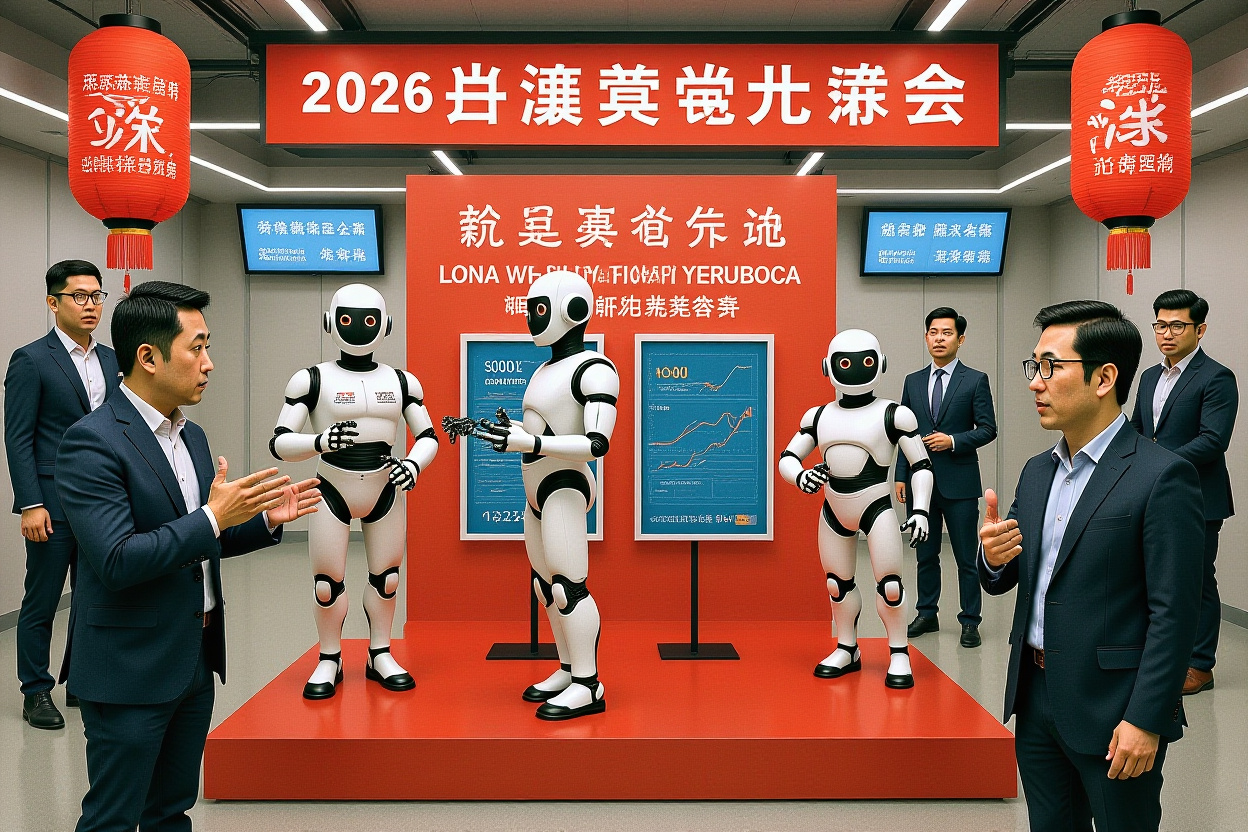
The Gala as a Strategic Showcase: Beyond the Spotlight
The CCTV Spring Festival Gala, a cultural institution watched by hundreds of millions, has evolved into a de facto national stage for technological ambition. The 2026 edition marked a pivotal moment, transitioning from showcasing discrete tech gadgets to presenting a coordinated “battalion” of China’s most promising embodied artificial intelligence firms. This strategic move signals that the industry has moved beyond the laboratory prototype phase into a critical period of public validation and commercial proof-of-concept.
For international investors and industry observers, the Gala serves as a high-fidelity signal of both technological readiness and state-backed endorsement. The participation of Magic Atom (魔法原子), Galaxy General (银河通用), Unitree Robotics (宇树科技), and Songyan Dynamics (松延动力) was not merely a spectacle; it was a carefully choreographed statement of China’s capabilities in a frontier technology sector deemed crucial for future economic competitiveness. This event functions as the ultimate testing ground for public perception and technical performance under extreme, live-broadcast pressure.
The Four Contenders: Decoding the Official Titles
The nuanced official designations assigned to each company reveal deliberate positioning within the broader embodied AI ecosystem:
- Unitree Robotics was labeled the “Gala Robot Partner,” emphasizing its generalist robotics platform.
- Songyan Dynamics was the “Gala Humanoid Robot Partner,” highlighting its focus on anthropomorphic form.
- Magic Atom was named a “Gala Intelligent Robot Strategic Partner,” suggesting a deeper, model-driven collaboration.
- Galaxy General received the title “Gala Designated Embodied Large Model Robot,” directly tying its offering to the cutting-edge AI model paradigm.
This taxonomy, while subtle, provides key insights for stakeholders. It indicates a maturation of the sector where companies are beginning to specialize and differentiate their core value propositions—a necessary precursor to scalable business models and clear investment theses.
Case Study: Unitree Robotics – From Viral Sensation to Commercial Frontrunner
No company exemplifies the potential trajectory from Gala fame to market leadership better than Unitree Robotics. Its 2025 Gala performance catapulted it from industry insider favorite to a mainstream name. The 2026 follow-up, featuring a collaborative martial arts routine “Wǔ BOT” with the renowned Henan Tagou Martial Arts School, was a masterclass in blending high-performance robotics with traditional Chinese culture.
The commercial ripple effects have been significant. According to industry reports, Unitree’s robots have since appeared in over 12 major galas, concerts, and ceremonies, and the company has organized 7 large-scale robot-specific sporting events. This public relations success translates into tangible business advantages: enhanced brand equity, greater visibility to potential B2B and B2G clients, and a stronger position in talent acquisition.
The Funding and Policy Tailwind
The Gala spotlight shines on companies already riding a powerful wave of capital and policy support. China’s national and local governments have identified embodied AI and humanoid robots as strategic priorities within broader frameworks like “Made in China 2025” and the 14th Five-Year Plan for Robotics Industry Development. Venture capital and corporate investment have flowed into the sector, betting on its exponential growth.
Market research firm IDC predicts China’s embodied intelligent robot user expenditure will reach $77 billion by 2030, representing a staggering compound annual growth rate (CAGR) of 94%. This projection underpins the intense interest and justifies the high-stakes ultimate testing ground presented by the Gala. For funds and strategic investors, a successful Gala appearance de-risks an investment by demonstrating technical robustness and mainstream acceptance.
The Post-Gala Reality: Three Gates to Commercial Viability
When the stage lights dim, the real challenge begins. As one industry insider starkly noted, “Robots can’t dance on stage forever.” The transition from a controlled, pre-programmed performance to solving real-world problems is the sector’s defining challenge. Companies must successfully navigate three critical gates to achieve sustainable commercialization.
Gate 1: Conquering the Industrial Workspace
The factory floor represents the most immediate and pragmatic market. Applications like sorting, assembly, loading/unloading, inspection, and palletizing address acute labor shortages and rising wage pressures. However, industrial clients demand near-perfect reliability, low total cost of ownership, and seamless integration into existing workflows. A minute of downtime can cost thousands. The Gala demonstrates a robot’s mechanical prowess, but the factory tests its endurance, precision, and economic logic in a brutal, unscripted environment.
Gate 2: Mastering Complex Commercial Environments
Retail stores, warehouses, hotels, and hospitals present a more dynamic and unpredictable challenge than factories. Here, robots must navigate dense human traffic, adapt to constantly changing layouts, and perform a wider variety of interactive tasks. The ability to execute a pre-set skit with an actor like Shen Teng (沈腾) or Ma Li (马丽) on the Gala stage is fundamentally different from safely navigating a crowded supermarket aisle or responding appropriately to a customer’s spontaneous query. This gate tests the integrated system—the synergy of vision, navigation, manipulation, and human-robot interaction that defines true embodied intelligence.
Gate 3: The Distant Horizon of the Home
The consumer home remains the final frontier—a massively lucrative but exceptionally difficult market. Homes are unstructured, cluttered, and filled with unpredictable variables: pets, children, uneven flooring, and highly variable lighting. Safety, affordability, simplicity, and extreme robustness are non-negotiable. While this market may be years away from mass adoption, it represents the industry’s “North Star,” driving long-term R&D in dexterity, common-sense reasoning, and emotional intelligence. Success in the first two gates builds the technological and financial foundation necessary to eventually tackle this ultimate testing ground for consumer robotics.
2026: The Pivot from Hype to Hard Metrics
The 2026 Lunar New Year is poised to be a watershed moment for China’s embodied AI industry. The era of competition based primarily on fundraising announcements, flashy prototype reveals, and technical specifications is giving way to a new phase. The key metrics are shifting decisively toward real-world validation: paid pilot projects, repeat customer orders, demonstrable return on investment (ROI) for clients, and a clear path to positive unit economics.
Regulatory Landscape and Standardization
As robots move into public and industrial spaces, regulatory frameworks will become increasingly important. Chinese authorities, including the Ministry of Industry and Information Technology (MIIT 工业和信息化部), are actively working on safety standards, data security protocols, and ethical guidelines for AI and robotics. Companies that proactively engage with this process and design compliant products will gain a significant advantage. The Gala appearance, implicitly blessed by state media, suggests a level of regulatory alignment, but detailed compliance will be a continuous effort.
The ultimate testing ground for these firms is no longer a televised stage but the complex interplay of technology, business models, and regulation. Investors should scrutinize partnerships with real industrial conglomerates, contracts with logistics giants, and deployments in municipal smart city projects as more telling indicators of progress than stage time.
Strategic Implications for the Global Market
The concerted push by Chinese embodied AI firms has significant implications for the global competitive landscape. Western leaders like Boston Dynamics and Tesla are no longer the sole focal points of innovation. The Chinese ecosystem benefits from intense domestic competition, a vast manufacturing and supply chain base, strong government-industrial policy coordination, and a large domestic market for initial deployment.
Investment and Partnership Opportunities
For global institutional investors, the sector offers high-growth potential but requires nuanced due diligence. Key considerations include:
- Technology Stack Depth: Does the company control its core actuators, sensors, and AI models, or is it an integrator?
- Path to Market: Does it have a clearly defined beachhead application with a willing lead customer?
- Capital Efficiency: Can it achieve scale without perpetual, dilutive fundraising rounds?
- Management Vision: Does leadership balance technical ambition with commercial pragmatism?
Strategic partnerships between Chinese robotics firms and international industrial or automotive companies are likely to increase, blending hardware prowess with global distribution and domain expertise.
The Final Curtain Call is in the Marketplace
The 2026 CCTV Spring Festival Gala provided a magnificent showcase, but it was merely the opening act. The real performance—the grueling, unglamorous work of engineering reliability, driving down costs, and solving concrete business problems—is now underway. The four companies that shared the stage, and their peers, are entering the most consequential phase of their development.
The transition from technology demonstration to commercial utility is the definitive challenge. Success will be measured not in viral video views or social media mentions, but in deployment numbers, operational uptime, and balance sheets. The Gala served as a powerful launchpad, demonstrating that China’s embodied AI sector possesses the technical skill and ambition to compete globally. However, the coming 18-24 months will separate the contenders from the pretenders, as the industry collectively faces the ultimate testing ground of the open market.
For market participants worldwide, the directive is clear: look beyond the stage. Monitor factory pilot programs, analyze supply chain partnerships, and track regulatory developments. The companies that transform their Gala-generated momentum into tangible, scalable business solutions will define the next chapter of global robotics and unlock one of the most compelling investment narratives of the decade.