



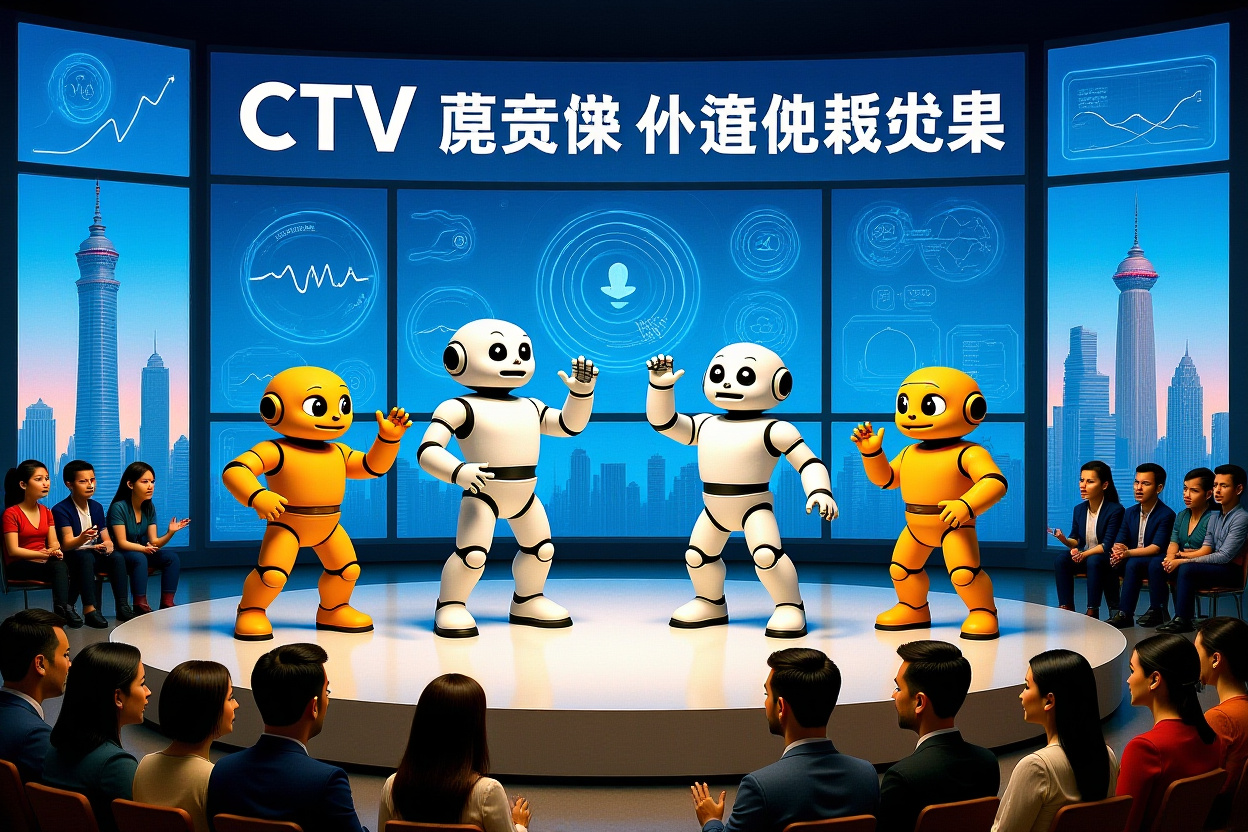
– The 2026 CCTV Spring Festival Gala (春晚) served as a national platform for four Chinese embodied AI companies—Magic Atom (魔法原子), Galaxy General (银河通用), Yushu Technology (宇树科技), and Songyan Power (松延动力)—to demonstrate their humanoid robots, signaling a strategic push towards commercialization.
– This high-profile showcase underscores the transition from laboratory prototypes to real-world applications, with the industry poised for explosive growth, projected to reach 770 billion USD in user spending by 2030 according to IDC.
– Key challenges ahead include proving reliability in industrial settings, adapting to dynamic commercial environments, and ultimately achieving safe and affordable integration into households.
– For investors, the Gala highlights both the potential and the pitfalls of the embodied AI sector, emphasizing the need to focus on tangible business metrics like customer orders and scalability rather than mere technological demonstrations.
– The event reflects broader trends in Chinese technology policy and global competitiveness in AI, making it a critical barometer for market entry and investment timing.
The CCTV Spring Festival Gala, China’s most-watched television event, has long transcended its role as mere entertainment to become a definitive showcase for the nation’s technological ambitions. In 2026, this tradition reached a new zenith as the stage transformed into the ultimate testing ground for embodied AI, with humanoid robots taking center stage. This pivotal moment not only captivates a global audience but also serves as a clear signal to investors and industry stakeholders about the maturation of China’s robotics sector. As these machines perform alongside human stars, the real question emerges: can they transition from curated performances to practical, revenue-generating applications? The CCTV Spring Festival Gala as the ultimate testing ground offers a compelling lens through which to assess the future of embodied AI in China and beyond.
The CCTV Spring Festival Gala: A National Stage for Technological Innovation
For decades, the CCTV Spring Festival Gala has been a cultural touchstone in China, but its influence extends far beyond arts and entertainment. It has consistently acted as a launchpad for emerging technologies, from 5G demonstrations to virtual reality experiences. The 2026 edition, however, marked a significant evolution by featuring embodied AI not as a sidebar attraction but as a core component of the programming. This shift underscores the government’s and industry’s concerted effort to normalize human-robot interaction and accelerate public acceptance.
Historical Context and Significance
Past Galas have highlighted incremental advancements, such as drone light shows or AI-generated content, but the focused inclusion of multiple humanoid robot companies represents a strategic escalation. It aligns with national policies like Made in China 2025 (中国制造2025) and the recent focus on AI sovereignty. By providing a prime-time platform, the Gala reduces the perception gap between futuristic concepts and tangible products, thereby stimulating consumer interest and investor confidence. This move is particularly timely as global competition in robotics intensifies, with countries like the United States and Japan also vying for leadership. The CCTV Spring Festival Gala as the ultimate testing ground has thus become a barometer for China’s tech prowess, with implications for global market dynamics.
2026 Gala Highlights: A Concentrated Display of Embodied AI
The 2026 Gala featured four distinct companies, each with unique presentations. Yushu Technology (宇树科技) collaborated with the Henan Tagou Martial Arts School for a martial arts performance titled Wǔ BOT, building on its previous year’s success. Songyan Power (松延动力) appeared in a comedy sketch with veteran actors, Magic Atom (魔法原子) supported a song about intelligent manufacturing, and Galaxy General (银河通用) participated in a micro-movie. This diversity in roles—from 春晚机器人合作伙伴 (Spring Festival Gala Robot Partner) to 春晚指定具身大模型机器人 (Designated Embodied Large Model Robot)—reflects varying technological emphases, from general-purpose robots to those integrated with advanced AI models. The CCTV Spring Festival Gala as the ultimate testing ground allowed these firms to demonstrate not just technical prowess but also narrative integration, a key aspect of market readiness. For instance, Yushu Technology’s repeat appearance suggests it has passed initial validation, while newcomers like Galaxy General are testing their AI capabilities in more complex scenarios.
Participant Analysis: Strategic Divergence Among Four Firms
The nuanced titles assigned to each company at the Gala reveal deeper strategic positioning. Yushu Technology (宇树科技), labeled as the 春晚机器人合作伙伴, has leveraged such appearances to build brand equity, having participated in over 12 major events and 7 dedicated robot competitions since 2025. This consistent visibility has made it a household name in China’s robotics scene. In contrast, Magic Atom’s (魔法原子) designation as 春晚智能机器人战略合作伙伴 suggests a focus on intelligent, interactive capabilities, possibly targeting educational or service sectors. Understanding these distinctions is crucial for investors evaluating competitive advantages and market niches.
Yushu Technology (宇树科技): From Breakout to Mainstay
Yushu’s journey from a 2025 Gala debut to a 2026 return highlights its rapid scaling and market penetration. Sources indicate that its robots are increasingly used in entertainment and promotional events, generating early revenue streams. However, the company faces the challenge of diversifying beyond performance-based applications. Investors should note its partnerships with institutions like martial arts schools, which could pave the way for cultural or tourism-related deployments. The CCTV Spring Festival Gala as the ultimate testing ground has provided Yushu with unparalleled exposure, but sustaining growth will require moving into industrial or commercial realms where reliability and cost-effectiveness are paramount. Monitoring its order book and client testimonials will be essential for assessing long-term viability.
Magic Atom (魔法原子), Galaxy General (银河通用), and Songyan Power (松延动力): Varied Roles and Positioning
Magic Atom’s involvement in a song performance emphasizes its focus on human-robot collaboration in creative domains, potentially appealing to the entertainment and education sectors. Galaxy General’s (银河通用) role in a micro-film, coupled with its title referencing 具身大模型 (embodied large models), points to advancements in AI-driven perception and decision-making, crucial for complex tasks like logistics or healthcare. Songyan Power (松延动力), appearing in a comedy sketch, likely prioritizes social robotics and emotional engagement, targeting consumer markets. These distinctions are critical for investors assessing niche strengths and potential market segments. The CCTV Spring Festival Gala as the ultimate testing ground has effectively segmented the market, revealing which companies are betting on hardware reliability versus AI sophistication. For example, Galaxy General’s focus on large models may align with China’s push for AI self-sufficiency, offering a strategic edge in policy-supported areas.
From Stage to Reality: The Three Critical Hurdles for Embodied AI
While the Gala showcases technological feats, the industry’s sustainability hinges on overcoming practical barriers. As industry insiders aptly note, robots cannot forever dance on stages. The transition to real-world utility involves three sequential challenges: industrial adoption, commercial deployment, and home integration. Each hurdle tests different aspects of embodied AI, from mechanical durability to cognitive flexibility, and success in one does not guarantee progress in another. Investors must evaluate companies based on their roadmaps for navigating these phases, as missteps here could lead to significant capital erosion.
Industrial Applications: The First Hurdle
Factories represent the most immediate market for robots, with tasks like sorting, assembly, and handling facing labor shortages. However, industrial environments demand extreme reliability, low error rates, and cost-effectiveness. A robot that stumbles on stage might be forgiven, but a malfunction on a production line can cause significant financial losses. Companies must prove their machines can operate 24/7 in harsh conditions, with minimal downtime. For example, Yushu Technology (宇树科技) has begun pilot projects in manufacturing, but scalability remains a question. Investors should look for partnerships with industrial giants or contracts from automotive or electronics firms as positive indicators. The CCTV Spring Festival Gala as the ultimate testing ground has validated basic functionalities, but industrial settings require rigorous stress-testing that goes beyond choreographed routines. Key metrics to track include mean time between failures (MTBF) and total cost of ownership (TCO), which directly impact adoption rates.
Commercial Scenarios: Complexity and Adaptability
Beyond factories, robots must navigate dynamic settings like supermarkets, warehouses, hospitals, and hotels. These environments require not just movement but also perception, obstacle avoidance, and human interaction. The Gala performances, while choreographed, do not fully test these capabilities. A robot that can dance with precision may struggle with a sudden crowd surge or an unpredictable customer query. This hurdle tests the integration of sensors, algorithms, and user interfaces. Magic Atom (魔法原子) and Galaxy General (银河通用) are likely targeting these sectors, given their focus on intelligence and interaction. Success here depends on robust testing in real-world pilots and partnerships with retail or healthcare chains. For investors, evidence of pilot programs with recognizable brands or public institutions can signal progress. The CCTV Spring Festival Gala as the ultimate testing ground has raised awareness, but commercial viability will be determined by user feedback and repeat purchase rates, which should be monitored through industry reports and company disclosures.
The Home Frontier: The Ultimate Goal
The most ambitious yet distant market is the household, where robots must handle unstructured environments with safety, intelligence, simplicity, and affordability. Challenges include cluttered spaces, pet interference, variable lighting, and ambiguous commands. No company has fully cracked this code globally, but Chinese firms are making strides. The Gala’s portrayal of robots in familial settings, such as in sketches or films, helps normalize the concept but masks the technical hurdles. For investors, this represents a long-term bet, with companies like Songyan Power (松延动力) possibly eyeing elder care or domestic assistance. Progress will be measured in incremental improvements in AI, reductions in cost, and regulatory approvals for home use. The CCTV Spring Festival Gala as the ultimate testing ground has sparked public interest, but mass adoption hinges on addressing privacy concerns and achieving price points comparable to consumer electronics. Investors should watch for advancements in areas like reinforcement learning and modular design, which could accelerate this timeline.
Market Dynamics and Investment Implications
The embodied AI sector in China is on the cusp of exponential growth. According to IDC, user spending on embodied intelligent robots in China is projected to reach 770 billion USD by 2030, with a compound annual growth rate (CAGR) of 94%. This trajectory presents lucrative opportunities but also high risks, as the industry shifts from fundraising and hype to tangible business metrics. The Gala’s spotlight has catalyzed this transition, but investors must adopt a disciplined approach to capitalize on the trend while mitigating downside exposure.
Growth Projections and Industry Trends
The IDC forecast underscores the potential scale, driven by government support, technological advancements, and demographic shifts like aging populations. The Gala’s role in this ecosystem cannot be overstated—it acts as a catalyst for both demand and supply. However, investors must differentiate between companies with viable business models and those reliant on subsidies or speculative investments. Key metrics to watch include:
– Order volumes from industrial or commercial clients, which indicate market traction
– Customer retention and repeat purchases, reflecting product reliability and value
– Partnerships with established corporations, such as collaborations with Alibaba Group (阿里巴巴集团) or Tencent Holdings (腾讯控股) for cloud AI integration
– Patent portfolios and R&D expenditures, signaling innovation capacity
– Profitability timelines and burn rates, essential for assessing financial health
For deeper insights, refer to IDC’s latest reports on embodied AI at https://www.idc.com. The CCTV Spring Festival Gala as the ultimate testing ground has validated the technological base, but sustained growth requires aligning with these broader market trends.
Risks and Opportunities for Investors
Risks include technological immaturity, regulatory changes, supply chain disruptions, and intense competition from global players like Boston Dynamics or Tesla. Opportunities lie in early-mover advantages, especially in sectors prioritized by Chinese policy, such as 智能制造 (intelligent manufacturing) and 智慧城市 (smart cities). The CCTV Spring Festival Gala as the ultimate testing ground has validated the technological base, but due diligence is essential. Investors should consider diversified exposure through ETFs focused on Chinese tech or direct investments in companies demonstrating clear paths to revenue. For instance, Yushu Technology (宇树科技) might appeal to those betting on entertainment and education, while Galaxy General (银河通用) could attract investors interested in AI integration. Additionally, monitoring regulatory announcements from bodies like the Ministry of Industry and Information Technology (工业和信息化部) can provide clues on policy support. The Gala has set the stage, but investment decisions should be data-driven, incorporating both quantitative analysis and qualitative assessments of management teams and strategic vision.
Regulatory and Economic Context
China’s embodied AI push is not occurring in a vacuum. It is deeply embedded in national strategic plans and global economic trends. Understanding this context is crucial for assessing long-term viability and anticipating shifts that could impact investment returns. The Gala’s inclusion of these technologies reflects a top-down endorsement that shapes market dynamics, but it also introduces dependencies on policy continuity and international relations.
Chinese Government Support and Policies
Initiatives like the New Generation Artificial Intelligence Development Plan (新一代人工智能发展规划) and local subsidies for robotics adoption provide a favorable backdrop. The participation of these companies in the Gala, a state-managed event, signals implicit endorsement from authorities. This can facilitate access to grants, pilot programs, and public procurement contracts. However, investors must monitor potential regulatory tightening around data privacy, safety standards, or export controls, especially as geopolitical tensions affect tech sectors. For example, recent guidelines from the Cyberspace Administration of China (国家互联网信息办公室) on AI ethics could influence development timelines. The CCTV Spring Festival Gala as the ultimate testing ground is thus intertwined with policy objectives, making it imperative for investors to stay abreast of regulatory updates through official channels like http://www.gov.cn.
Global Competitiveness in AI and Robotics
China aims to lead in AI by 2030, and embodied AI is a key battleground. The Gala showcases domestic capabilities, reducing reliance on foreign technology. For international investors, this represents both a threat to incumbent firms and an opportunity to tap into a rapidly growing market. Comparisons with global advancements, such as the United States’ investments in AI through agencies like DARPA or Europe’s focus on ethical robotics, can inform investment strategies. The CCTV Spring Festival Gala as the ultimate testing ground highlights China’s progress but also the need for continuous innovation to stay ahead. Investors should evaluate Chinese firms not just on domestic performance but also on their potential for global expansion, considering factors like intellectual property portfolios and partnerships with multinational corporations. The Gala has elevated China’s profile, but sustained competitiveness will require overcoming challenges in core technologies like semiconductors and software algorithms.
The 2026 CCTV Spring Festival Gala has undeniably cemented its role as the ultimate testing ground for embodied AI, offering a glamorous yet rigorous preview of China’s robotic future. While the stage performances captivate audiences, the real drama unfolds in factories, commercial spaces, and eventually homes, where these machines must prove their worth. For investors, the key takeaway is to look beyond the spotlight and focus on fundamental business drivers: scalability, reliability, and market demand. As the industry enters a phase of consolidation and commercialization, those who can navigate the transition from concept to customer will reap the rewards. We encourage stakeholders to closely monitor quarterly reports, partnership announcements, and regulatory developments in this dynamic sector. The Gala may have lowered the curtain, but the show is just beginning for China’s embodied AI revolution—take action now by conducting thorough due diligence and positioning portfolios to capture the long-term growth potential of this transformative technology.