



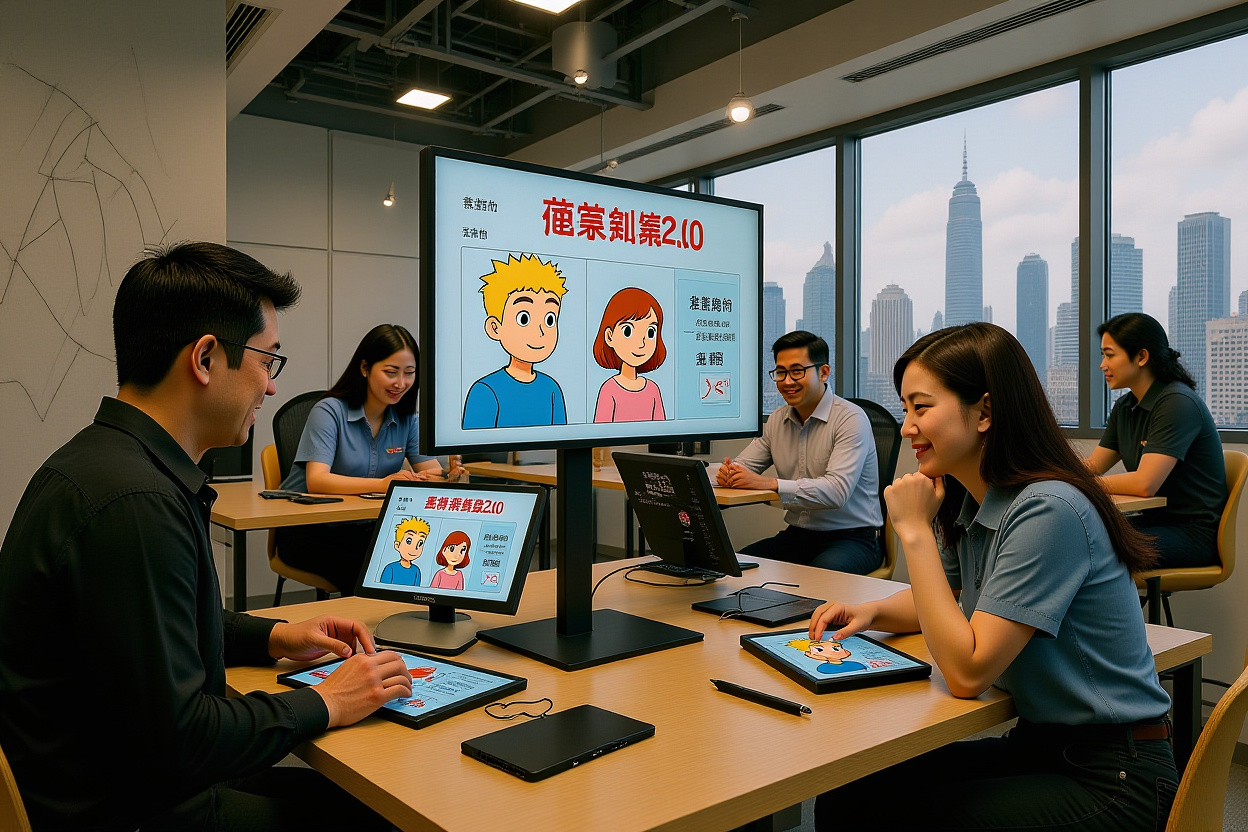
Discover how AI-generated comic dramas are revolutionizing China’s media sector, enabling vocational school graduates to challenge elite film directors and creating new investment avenues.
Executive Summary
– AI-generated comic dramas (AI漫剧) are experiencing explosive growth, with platforms like ByteDance’s Hongguo Manju (红果漫剧) surpassing 10 million daily active users in just months.
– Vocational school graduates are at the forefront, using AI tools to slash production costs from thousands to hundreds of yuan per minute, democratizing content creation.
– Technological breakthroughs like Seedance2.0 are rendering traditional roles such as storyboard directors obsolete, streamlining workflows and boosting efficiency.
– The market is rapidly evolving from low-quality bulk production to premium AI simulation human dramas (AI仿真人剧), attracting heavy investment from major platforms.
– This disruption echoes historical media shifts, urging a reevaluation of content value and investment strategies in the age of AI.
The Rise of AI-Generated Comic Dramas in China
The Chinese media landscape is undergoing a profound transformation, driven by the surge of AI-generated comic dramas. What began as a niche content form has ballooned into a multi-billion-yuan industry, largely powered by individuals without formal film education. Vocational school graduates, earning modest salaries, are now producing content that competes directly with output from prestigious institutions like the Beijing Film Academy (北京电影学院). This shift is not merely a cultural curiosity but a significant market movement with deep implications for investors in Chinese technology and media equities.
From Obscurity to Market Dominance
The journey of AI-generated comic dramas from obscurity to mainstream success is a testament to China’s rapid tech adoption. In late 2025, companies like Jiangyou Anime (酱油动漫), founded by Huang Haonan (黄浩南), saw monthly revenues exceed 50 million yuan. Huang Haonan (黄浩南), a vocational school graduate with no family backing, epitomizes the new breed of entrepreneurs leveraging AI to climb the economic ladder. His company’s aggressive expansion—from dozens to over 1,200 employees in under six months—highlights the labor-intensive yet low-cost model fueling this boom. Employees, often with minimal higher education, are trained in days to use AI tools, earning average wages of 3,000-4,000 yuan per month. This contrast between advanced technology and廉价的人力 (cheap labor) is central to the industry’s scalability.
The Platform Catalyst: ByteDance’s Strategic Play
Platforms have been instrumental in accelerating this trend. ByteDance’s (字节跳动) Hongguo Manju (红果漫剧) app achieved over 10 million daily active users within three months of launch, showcasing the immense demand for such content. The platform’s integration with Tomato Novel (番茄小说) and oversight by executive Zhang Chao (张超) allowed for swift market penetration. ByteDance’s proactive approach, including adjusting revenue shares and acquiring premium content, forced the industry to pivot quickly from low-quality AI漫剧 to more sophisticated AI simulation human dramas. This velocity is a critical competitive edge in a sector where trends can shift within weeks.
Technological Enablers Democratizing Content Creation
At the heart of this disruption are multimodal AI models that have matured over the past year. Tools like Seedance2.0, Kling 2.0 (可灵), and Veo3 have made it possible to generate coherent, emotive video content from simple text prompts. These advancements have drastically reduced barriers to entry, allowing individuals with limited resources to produce content that was once the domain of well-funded studios.
Seedance2.0: A Game-Changer for Efficiency
The release of Seedance2.0 in early 2026 marked a pivotal moment. This model enables users to create 10-second videos with consistent characters, dialogue, and action scenes using prompts of under 20 words, at a cost of just 10 yuan. As Feng Ji (冯骥), producer of Black Myth: Wukong (黑神话:悟空), noted, “The childhood era of AIGC has ended.” For producers, this meant immediate organizational changes. Companies like Heya Manju (鹤芽漫剧), led by Yang Hao (杨浩), laid off storyboard directors—many from elite film schools—overnight, as AI could now handle their roles. The efficiency gains are staggering, with teams shrinking from 8-10 people to just 3 per project.
Cost Dynamics and Scalability
The economics of AI-generated comic dramas are compelling. Traditional dynamic comics cost 8,000-10,000 yuan per minute to produce, but AI has slashed this to 600 yuan or even lower. This cost reduction is amplified by decreasing compute expenses; for instance, Kling’s pricing fell from 1 yuan per second to 0.5 yuan per second within a year. According to Jiang Yigi (姜奕祺), former AI expert at Alibaba DAMO Academy (阿里达摩院) and now CEO of Sansheng Qingying (三生清影), when underlying models are inaccessible, core competitiveness hinges on产能和成本 (capacity and cost). This has led to a production explosion, with monthly releases exceeding 13,000 titles by late 2025, nearing the annual output of真人短剧 (real-person short dramas).
Business Dynamics and Market Evolution
The business model for AI-generated comic dramas mirrors that of真人短剧 (real-person short dramas), with over 80% of revenue often allocated to user acquisition through投流 (traffic buying). However, the industry is evolving rapidly, moving from a focus on quantity to an emphasis on quality, driven by platform policies and technological progress.
The Shift to Premium AI Simulation Human Dramas
Early forms like沙雕漫 (silly comics) had short lifespans, but AI simulation human dramas (AI仿真人剧) represent the current vanguard. These dramas use AI to create realistic human characters, aiming to capture audiences from longer-form video content. Yang Hao (杨浩) of Heya Manju (鹤芽漫剧) capitalized on this early, with his series Pansi Dong Sujin Chuan (盘丝洞素锦传) achieving a 3x return on investment without paid promotion. Platforms like Hongguo Manju (红果漫剧) are now acquiring 120-minute不分集的 (non-episodic) AI仿真人剧, signaling a push into traditional film territory. This shift is essential for sustaining growth, as natural traffic for low-quality content has dwindled; Huang Haonan (黄浩南) reported that natural flow收入 (revenue) dropped from tens of thousands to under 1,000 yuan per release.
Investment and Competitive Landscape
Major tech firms are racing to dominate this space. ByteDance (字节跳动), Tencent (腾讯), Baidu (百度), and Kuaishou (快手) are all procuring content aggressively, often booking production capacity months in advance. For instance, Baidu’s subsidiary Qimao (七猫) engaged in挖人 (poaching) wars, offering tenfold salaries to lure talent from rivals like Jiangyou Anime (酱油动漫). This competition has fueled a FOMO (fear of missing out) sentiment, even among top真人短剧 (real-person short drama) companies like Tinghuadao (听花岛), which are now diversifying into AI漫剧. The market’s volatility, however, has made investors cautious; as entrepreneur Youyou (悠悠) found, securing funding requires demonstrating a defensible edge in an era of技术平权 (technology parity).
Implications for Traditional Media and Employment
The rise of AI-generated comic dramas is reshaping labor markets and challenging established media hierarchies. Vocational school graduates, once confined to factory jobs, are now producing content viewed billions of times, while film school alumni face displacement.
Job Displacement and New Roles
The role of the分镜导演 (storyboard director) is emblematic of this shift. With AI models like Seedance2.0 generating competent visuals, these positions are becoming redundant. Liu Wei (刘伟), founder of Minglu Animation (鸣鹿动画), noted that after Seedance2.0’s launch, his team discarded a week’s work because redoing it with AI was cheaper and better. Similarly, the occupation of抽卡师 (“card-drawer”—those who generate AI video clips) is evolving; what was once a tedious, unpredictable task is now streamlined, reducing demand for human labor. This mirrors historical disruptions, such as television’s impact on Hollywood in the mid-20th century, which eventually spurred innovation in content storytelling rather than technology alone.
Content Value in the AI Era
As technology lowers production barriers, the enduring differentiator may shift back to content quality. Xiao Chuan (小川), a former short-drama executive, plans to创业 (start a business) in content production, anticipating a回归 (return) to focus on narrative strength once the industry cools. This perspective aligns with lessons from film history, where movements like the French New浪潮 (New Wave) thrived by emphasizing storytelling over spectacle. For AI-generated comic dramas, this means that while AI can produce奇观 (spectacle) cheaply, sustainable success may depend on原创内容 (original content) that resonates emotionally with audiences.
Navigating the Future of China’s Media Industry
The trajectory of AI-generated comic dramas underscores a broader trend in China’s tech-driven economy: rapid innovation coupled with cost-efficient scalability. For investors, this presents both opportunities and risks. The market for AI漫剧 is projected to exceed 200 billion yuan, with potential spillover into adjacent sectors like film and长剧 (long-form dramas). However, the pace of change—described by insiders as三天一变 (changing every three days)—requires agility. Companies that balance technological adoption with content innovation, like those pivoting to AI仿真人剧, may capture lasting value. Meanwhile, traditional media players must adapt or risk obsolescence, as seen in the ongoing contraction of the真人短剧 (real-person short drama) sector. To capitalize on this shift, stakeholders should monitor platform policies, technological advancements, and content trends closely, positioning portfolios to leverage the disruption while mitigating volatility. The story of vocational graduates out pacing elite directors is just beginning, and its implications will reverberate across global markets invested in China’s digital future.