



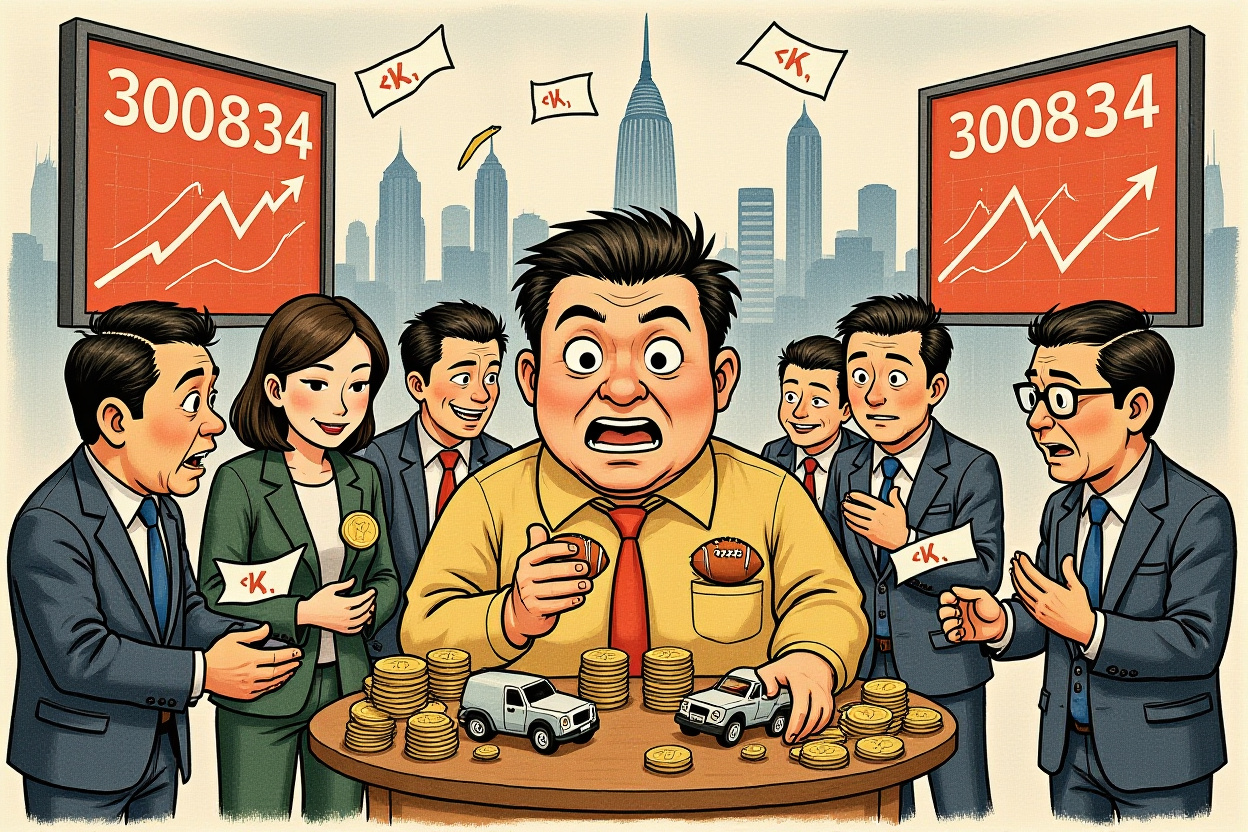
The Frenzied Rally and the Paper Fortune
The Chinese A-share market witnessed another episode of speculative fervor in late March 2026. Shares of Xinghui Huancai (星辉环材, Stock Code: 300834), a manufacturer of polystyrene plastics, skyrocketed by approximately 85.6% over four consecutive trading sessions. This parabolic move was triggered by a single announcement: the controlling shareholder family agreed to sell a significant indirect stake to a subsidiary of JiuShi Intelligent (九识智能), a prominent autonomous driving unicorn.
The immediate effect was the creation of a staggering paper fortune. For Chen Yansheng (陈雁升), the founder and controlling shareholder known as the “Chaoshan Toy King,” and his family, the surge in Xinghui Huancai’s market capitalization translated into an increase in their net worth of nearly 2.69 billion Chinese Yuan (approximately $375 million USD) – all within 96 hours. This event serves as a textbook case of the powerful, and often perilous, dynamics of thematic investing and strategic入股 (equity investment) speculation in China’s equity markets. For global investors, understanding the mechanics behind such moves is crucial to navigating opportunities and avoiding potential pitfalls.
Executive Summary: Critical Takeaways
- Event-Driven Volatility: Xinghui Huancai’s 85.6% four-day surge was purely driven by the announcement of JiuShi Intelligent’s indirect入股, highlighting the outsized impact of strategic investment news in the A-share market.
- Wealth Creation Mechanism: Founder Chen Yansheng’s (陈雁升) paper wealth ballooned by ~¥2.69 billion, demonstrating how controlling stakes in low-float companies can magnify gains during speculative rallies.
- Fundamental Disconnect: The rally occurred despite weak company fundamentals, including a 44.29% year-on-year drop in net profit for the first three quarters of 2025, raising significant sustainability concerns.
- Historical Precedents Warn: Similar “cross-border入股” themes, involving companies like Shangwei New Materials (上纬新材) and Fenglong Co., Ltd. (锋龙股份), have seen dramatic boom-and-bust cycles, with post-peak corrections often exceeding 40-60%.
- Regulatory and Company Cautions: Both Xinghui Huancai and the investor, JiuShi Intelligent, issued clear statements ruling out any asset injection or control change for 36 months, directly challenging the market’s transformative narrative.
Anatomy of a Four-Day Rally
The sequence of events followed a classic pattern for speculative A-share moves: an after-market announcement, followed by frenetic buying at the open.
The Catalytic Announcement
On the evening of March 30, 2026, Xinghui Huancai disclosed that the controlling Chen Yansheng (陈雁升) family and their concert parties had signed equity transfer agreements. The counterparty was two wholly-owned subsidiaries of JiuShi Intelligent. The total consideration was approximately 1.182 billion Chinese Yuan. Upon completion, JiuShi Intelligent would indirectly hold a 27.49% stake in the listed company, while the Chen family would retain control with a 45.19% stake.
The market’s reaction was immediate and intense. When trading resumed on March 31, buy orders flooded in. The stock hit the daily upward limit of 20% on the ChiNext Board of the Shenzhen Stock Exchange (深圳证券交易所). The frenzy continued for the next two days, with consecutive 20% limit-up moves. On the fourth day, April 3, the stock opened at another 20% limit-up but failed to hold, closing with a 7.43% gain. The intraday high of 52.19 Chinese Yuan represented a doubling from the pre-announcement price near 25 Yuan.
The Capital Flow Behind the Surge
The rally was characterized by a typical mix of investor types seen in Chinese market frenzies. Data showed significant net inflows from main institutional funds on the first two days of the rally, amounting to 136 million and 134 million Yuan respectively. More notably, trading volume and turnover rate exploded, indicating massive participation from retail investors and hot money (游资) chasing the momentum. This combination of institutional curiosity and speculative retail froth created the perfect storm for a short-term parabolic move, a classic example of市场炒作 (market speculation).
The Protagonist: From Toy King to A-Share Player
To understand the significance of this wealth surge, one must examine the profile of Chen Yansheng (陈雁升), the primary beneficiary.
A Humble Beginning in Toys
Chen Yansheng’s (陈雁升) entrepreneurial journey is a classic Guangdong success story. Hailing from Chenghai, Shantou – a region famed for its toy manufacturing – Chen and his wife Chen Dongqiong (陈冬琼) founded Xinghui Plastic Factory in 1995. Their first major success came from toy footballs. The business expanded significantly after securing licensing rights to produce model cars for international brands like BMW, evolving into a well-known toy enterprise.
Chen’s business empire, centered on Guangdong Xinghui Holdings, eventually controlled two A-share listed companies: Xinghui Entertainment (星辉娱乐, 300043), focused on games and entertainment (including the famous Spanish football club Espanyol acquisition), and Xinghui Huancai (星辉环材), the plastics arm. His appearance on the Hurun Global Rich List in 2022 with an 8.5 billion Yuan fortune marked a peak, but subsequent challenges in both businesses led to his disappearance from the list in recent years.
The Dual Challenges and a Sudden Windfall
Prior to the rally, Chen’s listed assets were under pressure. Xinghui Entertainment struggled with losses from its football club and sluggish game operations. Xinghui Huancai, which went public in January 2022, experienced a post-IPO price decline and saw its市值 (market capitalization) stagnate in a challenging chemical sector environment. The入股 by a high-flying tech unicorn was perceived as a potential lifeline and validation, directly catalyzing the revaluation of his largest liquid asset. The nearly 2.7 billion Yuan paper gain, while not yet realized through a share sale, provided a dramatic reversal of fortune on paper.
The Market Narrative: Why “Cross-Border入股” Ignites Fervor
The market’s explosive response to the JiuShi Intelligent入股 was not about Xinghui Huancai’s existing polystyrene business. It was a bet on a transformative future narrative.
The Allure of the Strategic Investor
JiuShi Intelligent is a star in China’s autonomous vehicle landscape. Founded in 2021, it claims to be the world’s largest RoboVan (unmanned delivery van) operator, specializing in L4级自动驾驶技术 (L4-level autonomous driving technology). A $300+ million funding round in February 2026 reportedly pushed its valuation over the 10 billion Yuan mark. Furthermore, its strategic integration with Cainiao’s (菜鸟) unmanned vehicle business in January 2026 created a combined fleet of over 20,000 vehicles.
For the market, JiuShi’s入股 was seen as more than a financial investment. It was interpreted as a strategic beachhead in the A-share market, potentially presaging a deeper relationship. Investors speculated that Xinghui Huancai’s materials expertise could somehow dovetail with JiuShi’s need for specialized automotive or sensor materials, creating a “New Materials + Unmanned Driving” synergy. This narrative, however tenuous, was enough to fuel the buying frenzy around the concept of strategic入股.
Contradictions in the Official Story
Importantly, the official announcements actively contradicted the market’s most bullish assumptions. In two consecutive abnormal volatility announcements, Xinghui Huancai explicitly stated:
- The transaction would not change the controlling shareholder or actual controller.
- JiuShi Intelligent committed to not seeking control for 36 months.
- There were no plans to inject assets into the listed company.
- The company’s price-to-earnings (P/E) ratio of 86.66 was far above the industry average of 32.88, and its financial performance was weak.
These disclosures, mandated by the Shenzhen Stock Exchange (深圳证券交易所), were clear warnings. Yet, in the heat of the moment, they were largely ignored by momentum traders, showcasing a classic disconnect between fundamental reality and speculative narrative during a thematic rally.
Historical Precedents: A Cautionary Tale of Boom and Bust
The speculative pattern surrounding Xinghui Huancai is not unique. Recent A-share history is littered with similar episodes of “cross-border入股” mania, which often end in dramatic reversals. Analyzing these provides critical context for assessing the sustainability of the current rally.
Case Study 1: Shangwei New Materials and Zhiyuan Robot
In a highly parallel case, Shangwei New Materials (上纬新材) saw its stock price skyrocket over 15-fold in the second half of 2025 after it was revealed that Zhiyuan Robot (智元机器人), a humanoid robot startup, planned to take a controlling stake. The narrative of a traditional materials company transforming into a robotics play fueled an incredible rally. However, after intense scrutiny from regulators and as the initial euphoria faded, the stock price underwent a severe correction, retracing over 60% from its peak. This case underscores how regulatory inquiry and a re-focus on execution risks can quickly deflate speculative bubbles.
Case Study 2: Fenglong Co., Ltd. and UBTech
An even more extreme example unfolded with Fenglong Co., Ltd. (锋龙股份). In late 2025, news that UBTech (优必选), often called the “humanoid robot第一股 (first stock),” intended to become its controlling shareholder triggered an insane trading sequence. The stock recorded 18 consecutive limit-up days, soaring over 400% in a matter of weeks. The frenzy was halted by a regulatory trading suspension for verification. Upon resumption of trading, and after clear statements that there would be no asset injection for three years, the股价 (stock price) collapsed rapidly, falling approximately 40% from its highs. This is a prime example of how regulatory intervention and clarified corporate intentions can act as a cold shower for overheated markets.
The Common Thread: Narrative vs. Fundamentals
These historical precedents share a common theme: a powerful narrative about technological transformation and strategic入股 drives valuations to levels completely disconnected from current financial performance, asset quality, or near-term business plans. The eventual correction occurs when investors realize the transformative event is distant, uncertain, or non-existent, and attention returns to weak underlying fundamentals. For Xinghui Huancai, with its declining revenues and profits, this risk is pronounced.
Strategic Implications and Investor Guidance
For institutional and sophisticated investors monitoring Chinese equities, events like the Xinghui Huancai rally offer important lessons on strategy, risk management, and market psychology.
Deconstructing the Investment Thesis
Any rational investment thesis following the入股 announcement must separate hope from reality. The bullish case rests entirely on future, unspecified synergies between a plastics maker and an autonomous driving firm. The bearish case is supported by:
- Explicit company statements ruling out asset injection or control change for 36 months.
- Poor current fundamentals in the core business.
- A valuation (P/E of 86+) that implies miraculous future growth.
- The historical tendency for such thematic rallies to reverse violently.
- The fact that the入股 itself is indirect and the deal may not complete.
An investor must weigh the probability of a successful, value-creating collaboration against these substantial and immediate risks. The extreme volatility in the stock is a direct reflection of this unresolved tension.
Navigating Speculative Frenzies in A-Shares
For market participants, the key is to have a defined framework. Is one trading the momentum or investing in the long-term business? Momentum traders in such environments are engaged in a high-risk game of musical chairs, requiring strict discipline and stop-loss strategies. Long-term investors should be deeply skeptical unless they have a firm, fundamental belief in the strategic rationale—a rationale that, in this case, has not been publicly articulated by either party beyond generic statements about “recognizing long-term value.” Monitoring regulatory filings from the China Securities Regulatory Commission (CSRC, 中国证监会) and exchange announcements is critical, as these often contain the sobering details that temper market euphoria.
Looking Ahead: Paper Wealth and Lasting Value
The four-day, 27-billion-Yuan paper fortune created for Chen Yansheng (陈雁升) is a stark reminder of the potent forces at play in China’s capital markets. It highlights how the mere association with a hyped technological theme like autonomous driving can trigger a massive re-rating, regardless of present circumstances. This phenomenon of strategic入股 acting as a catalyst for speculative frenzy is a recurring feature of the A-share landscape.
However, as history has repeatedly shown,股价 (stock prices) built on narrative alone, without the foundation of strong fundamentals and clear execution plans, are inherently fragile. The warnings embedded in Xinghui Huancai’s own volatility announcements, the cautionary tales from Shangwei New Materials and Fenglong, and the fundamental struggles of the company itself all point to significant downside risk once the initial excitement subsides. For the wealth to be realized and sustained, it must transition from paper gains driven by speculation to real value creation driven by business performance.
For global investors, the key takeaway is vigilance. The Chinese market offers tremendous opportunities driven by innovation and strategic realignment, but it also presents unique risks stemming from speculative herd behavior. Conducting thorough due diligence, focusing on fundamental business metrics, and maintaining a healthy skepticism towards transformative narratives in the absence of concrete plans are essential disciplines. The next move in this story will be telling: will the股价 find a sustainable plateau backed by genuine prospects, or will it follow the well-worn path of a speculative boom and bust? Only a disciplined, fact-based approach will navigate these crosscurrents successfully.