



Executive Summary
This analysis delves into the pivotal role of China’s CCTV Spring Festival Gala in shaping the embodied AI and humanoid robotics industry. Key takeaways include:
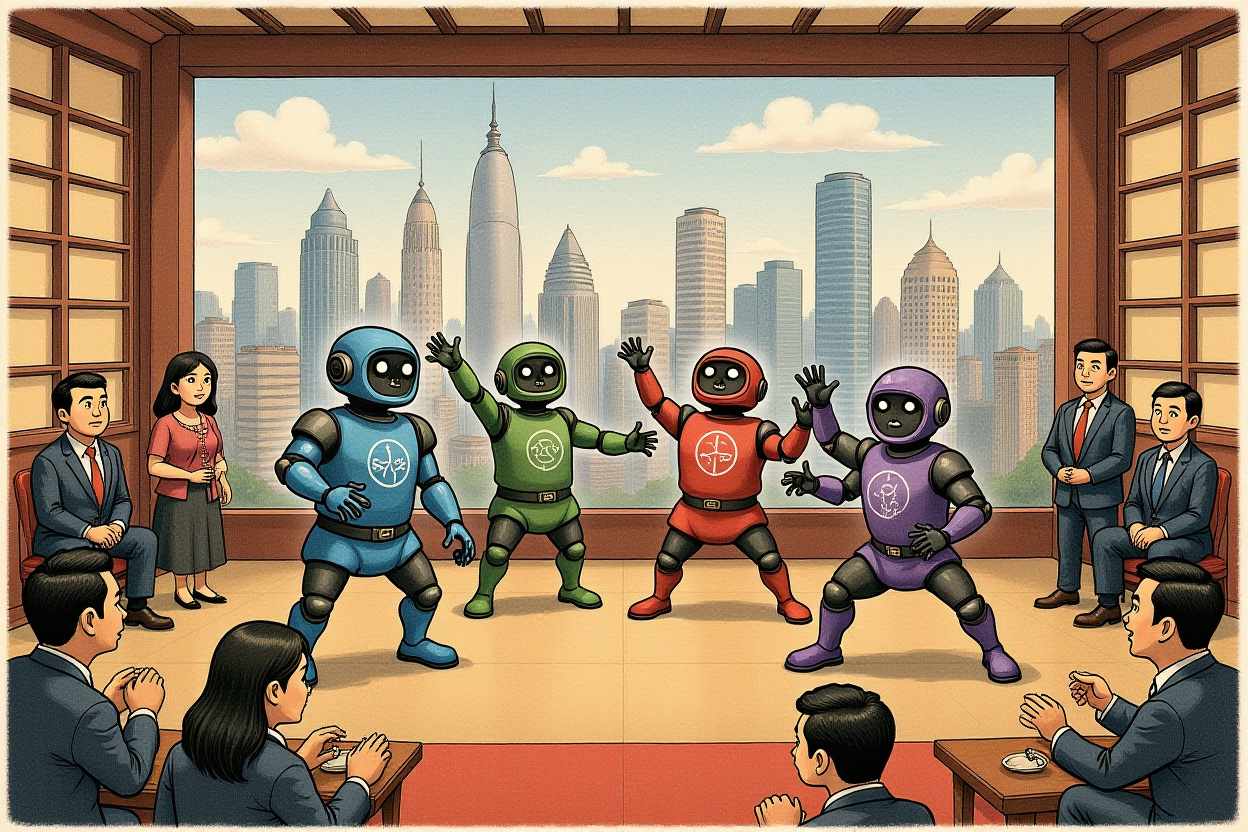
– The 2026 Gala featured four leading Chinese embodied AI firms—Magic Atom (魔法原子), Galaxy Universal (银河通用), Unitree Tech (宇树科技), and Songyan Power (松延动力)—showcasing a unified push toward technological validation and public acceptance.
– Beyond stage performances, the industry faces three critical hurdles: industrial automation reliability, commercial environment adaptability, and home integration feasibility, which will determine long-term success.
– Market projections are staggering; IDC forecasts China’s embodied AI robot user spending to reach $770 billion by 2030, with a compound annual growth rate (CAGR) of 94%, signaling a high-growth investment frontier.
– The Gala acts as a catalyst for commercialization, but real-world applications and revenue generation are now the primary metrics for evaluating companies, moving beyond fundraising and media hype.
– For global investors and business professionals, focusing on firms with proven order books, scalable solutions, and regulatory alignment in China’s tech-driven economy is essential for capitalizing on this trend.
The Spring Festival Gala as a National Stage for Technological Ambition
For decades, the CCTV Spring Festival Gala has served as a cultural touchstone and a strategic platform for highlighting China’s technological prowess. In 2026, it evolved into the ultimate testing ground for embodied AI, where humanoid robots transitioned from niche demonstrations to mainstream spectacle. This shift reflects broader national priorities under initiatives like “Made in China 2025” and the “14th Five-Year Plan,” which emphasize AI and robotics as key growth engines. For international investors, the Gala offers a rare glimpse into the competitive landscape of China’s tech sector, where state endorsement can accelerate market adoption and global credibility.
The 2026 edition marked a departure from past years, with embodied AI companies presenting a coordinated “集团军” or “group army” showcase. This collective appearance underscores the industry’s maturation, as firms move beyond isolated prototypes to integrated ecosystems. The Gala’s massive audience—over 1 billion viewers annually—provides unparalleled exposure, but it also sets high expectations for performance reliability and public engagement. As the ultimate testing ground for embodied AI, the event forces companies to demonstrate not just technical feats but also cultural resonance, such as blending robotics with traditional Chinese elements like martial arts in Unitree Tech’s collaboration with the Henan Tagou Martial Arts School for the program “武 BOT.”
Showcasing China’s Embodied AI Leaders: A Strategic Breakdown
The four featured companies—Magic Atom, Galaxy Universal, Unitree Tech, and Songyan Power—each brought distinct strengths to the Gala, revealing nuanced strategies in a crowded market. Unitree Tech, having gained fame from the 2025 Gala, leveraged its recurring presence to solidify brand leadership, participating in over 12 major events and 7 dedicated robot competitions in 2025 alone. Songyan Power focused on comedic integration, appearing in the sketch “奶奶的最爱” with actors Cai Ming (蔡明) and Wang Tianfang (王天放), while Magic Atom supported the song “智造未来,” and Galaxy Universal partnered with Shen Teng (沈腾) and Ma Li (马丽) in the micro-film “我最难忘的今宵.”
A critical insight lies in their official titles: Unitree Tech as “春晚机器人合作伙伴” (Spring Festival Gala Robot Partner), Songyan Power as “春晚人形机器人合作伙伴” (Humanoid Robot Partner), Magic Atom as “春晚智能机器人战略合作伙伴” (Intelligent Robot Strategic Partner), and Galaxy Universal as “春晚指定具身大模型机器人” (Designated Embodied Large Model Robot). These subtle distinctions highlight divergent technical pathways—from general-purpose robotics to AI-driven models—and signal to investors where each firm is positioning itself in the value chain. For example, Galaxy Universal’s emphasis on “具身大模型” (embodied large models) suggests a focus on AI integration, whereas Unitree Tech’s broader “机器人” (robot) label may indicate hardware-centric offerings.
Beyond the Stage: The Real-World Challenges of Embodied AI Commercialization
While the Spring Festival Gala provides a glittering launchpad, it is merely the opening act in a much longer narrative. The true ultimate testing ground for embodied AI lies in harsh, unstructured environments where robots must deliver tangible value. Industry insiders often quip, “机器人,不能永远只在舞台上跳舞” (Robots can’t dance on stage forever), a reminder that spectacle alone cannot sustain a business. For companies like Magic Atom and Songyan Power, the post-Gala phase involves navigating three formidable barriers that will separate winners from also-rans in China’s competitive tech landscape.
First, industrial applications represent the most immediate and lucrative market. Factories demand robots for tasks such as sorting, assembly, and logistics, where labor shortages are acute. However, as noted in a report by the Ministry of Industry and Information Technology (MIIT) [link to MIIT robotics guidelines], industrial robots must achieve near-perfect reliability with minimal downtime. A single malfunction on a production line can cost thousands of dollars, contrasting sharply with the forgiving nature of stage performances. Companies that have leveraged Gala exposure to secure pilot projects in manufacturing hubs like Guangdong or Zhejiang are better positioned for scale.
Industrial Reliability: The Make-or-Break Metric
In industrial settings, embodied AI systems face extreme conditions—temperature variations, dust, and continuous operation—that test durability beyond laboratory benchmarks. For instance, Songyan Power’s robots, which showcased agility in the Gala sketch, must now prove they can handle 24/7 material handling in automotive plants without frequent recalibration. Data from the China Robot Industry Alliance (CRIA) indicates that adoption rates in manufacturing have grown by 30% annually, but failure rates for new entrants remain high at around 15%. This underscores the importance of partnerships with established industrial firms, such as collaborations between Galaxy Universal and state-owned enterprises like COSCO Shipping, to refine technology through real-world feedback.
Commercial and Domestic Integration: Scaling Complexity
The second hurdle involves commercial environments like retail stores, warehouses, and hospitals. Here, robots must interact with humans, navigate dynamic obstacles, and process ambiguous commands. The Gala’s scripted interactions, such as Magic Atom’s coordinated dance, offer little preparation for the chaos of a busy supermarket. Success in this arena depends on advances in computer vision, natural language processing, and edge computing—areas where Chinese firms are investing heavily, with R&D spending up 25% year-over-year according to National Bureau of Statistics data [link to NBS tech investment report].
The final frontier is home integration, the most challenging yet potentially rewarding segment. Households present non-standardized layouts, safety concerns, and cost sensitivity. While the Gala sparks public curiosity, widespread adoption requires affordability—current high-end models like those from Unitree Tech can exceed $50,000, far beyond mass-market reach. Industry leaders predict a decade-long journey before robots become household staples, but early moves by companies like Xiaomi and Huawei into smart home ecosystems could accelerate this timeline. For investors, monitoring pilot programs in aging care or education, supported by policies like the “Healthy China 2030” initiative, may reveal promising niches.
Market Implications: Growth Projections and Investment Opportunities
The embodied AI sector in China is on the cusp of explosive growth, fueled by the visibility from events like the Spring Festival Gala. IDC’s projection of $770 billion in user spending by 2030, with a 94% CAGR, highlights a market expanding at near-doubling rates. This growth is driven by converging factors: declining hardware costs, advancements in AI chips from firms like Huawei’s HiSilicon (海思), and strong government support through subsidies and regulatory frameworks. For global fund managers, this represents a high-risk, high-reward opportunity akin to earlier tech booms in electric vehicles or semiconductors.
However, the path to profitability is fraught with challenges. Many embodied AI startups have relied on venture capital, with funding rounds often valuing companies based on technological promise rather than revenue. The Gala serves as a reality check, pushing firms to demonstrate commercial viability. For example, Unitree Tech’s post-2025 Gala surge included securing orders from logistics giant SF Express and entertainment venues, translating stage success into contractual wins. Investors should prioritize metrics such as recurring revenue, customer retention rates, and partnerships with blue-chip corporations over media coverage alone.
Regulatory and Economic Context: Navigating China’s Tech Ecosystem
China’s regulatory environment plays a crucial role in shaping the embodied AI landscape. Agencies like the Cyberspace Administration of China (CAC) and the Ministry of Science and Technology (MOST) have issued guidelines promoting ethical AI development and data security, which companies must adhere to for long-term success. The Gala’s state-backed platform implicitly signals regulatory approval, reducing perceived risks for corporate clients and international investors. Moreover, economic indicators such as China’s push for dual circulation (dual circulation strategy) and innovation-driven growth create tailwinds, with robotics included in tax incentive programs for high-tech enterprises.
From a global perspective, China’s embodied AI push intersects with geopolitical tensions, particularly in technology supply chains. Reliance on imported components, such as precision sensors or advanced semiconductors, could pose vulnerabilities. Companies that diversify sourcing or develop indigenous alternatives, as seen with Galaxy Universal’s partnerships with domestic chipmakers, may offer more resilient investment prospects. Additionally, cross-border collaborations, such as joint ventures with European or Japanese robotics firms, could mitigate risks while accessing foreign expertise.
Case Studies: From Gala Spotlight to Market Traction
Examining individual companies reveals how the ultimate testing ground for embodied AI translates into business outcomes. Unitree Tech’s trajectory is illustrative: after its 2025 Gala debut, the company expanded its product line from entertainment robots to industrial legged robots, targeting sectors like inspection and disaster response. Its collaboration with the Henan Tagou Martial Arts School for the 2026 Gala not only showcased cultural integration but also opened doors to educational and tourism applications, with reported deals worth over $20 million in 2026 Q1.
Magic Atom and Galaxy Universal, while less prominent in industrial markets, are focusing on AI software and large language models tailored for robotics. Magic Atom’s Gala performance emphasized human-robot harmony, aligning with China’s societal goals of technological harmony. In contrast, Galaxy Universal’s “具身大模型” approach leverages China’s strengths in AI research, with backing from academic institutions like Tsinghua University. For investors, this diversity means portfolio diversification across hardware, software, and hybrid models can capture different growth vectors within the embodied AI ecosystem.
Strategic Partnerships and Brand Differentiation
The varied titles used by the four companies at the Gala reflect deliberate branding strategies to carve out market niches. Songyan Power’s emphasis on “人形机器人” (humanoid robot) targets applications requiring anthropomorphic design, such as customer service or healthcare, where human-like interaction is valued. Meanwhile, Magic Atom’s “智能机器人战略合作伙伴” (Intelligent Robot Strategic Partner) status suggests a broader ecosystem role, possibly involving integration with smart city projects supported by local governments. These distinctions are critical for investors assessing competitive moats and scalability potential beyond the Gala’s limelight.
The Path Forward: Key Metrics for Success in a Crowded Arena
As the embodied AI industry moves past the Spring Festival Gala hype, several indicators will separate sustainable players from ephemeral contenders. First, order book visibility: companies with publicly disclosed contracts, like Unitree Tech’s deal with a major e-commerce platform for warehouse automation, demonstrate market validation. Second, technological moats: patents filed in areas such as dynamic balance control or AI-driven decision-making, as tracked by the China National Intellectual Property Administration (CNIPA) [link to CNIPA database], can signal innovation leadership. Third, cost reduction curves: achieving economies of scale in production, perhaps through partnerships with manufacturing giants like Foxconn, is essential for mass adoption.
For business professionals and institutional investors, due diligence should extend beyond Gala appearances to include site visits, customer interviews, and analysis of supply chain resilience. The ultimate testing ground for embodied AI is not a televised stage but the relentless demands of global markets. As China’s robotics sector matures, opportunities will emerge in ancillary areas too, such as component suppliers, training simulators, or maintenance services, offering diversified exposure to this transformative trend.
Synthesizing Insights for Strategic Decision-Making
The 2026 CCTV Spring Festival Gala has undeniably accelerated China’s embodied AI revolution, serving as a catalyst for public engagement and technological benchmarking. However, the journey from concept to cash flow requires overcoming substantial hurdles in reliability, cost, and integration. Companies that leverage Gala exposure to forge real-world partnerships—like Magic Atom with retail chains or Songyan Power with industrial conglomerates—will likely lead the next phase of growth. Market projections remain bullish, but investors must temper optimism with scrutiny of fundamental business metrics.
Looking ahead, the embodied AI landscape will be shaped by regulatory developments, international collaborations, and breakthroughs in adjacent technologies like 5G and quantum computing. For corporate executives and fund managers, the call to action is clear: engage deeply with China’s robotics ecosystem through strategic investments, joint ventures, or pilot projects. Monitor upcoming policy announcements from bodies like the National Development and Reform Commission (NDRC) and leverage data from industry reports to identify undervalued opportunities. By focusing on applications that solve pressing economic challenges—from labor shortages to aging populations—stakeholders can not only profit from but also contribute to one of the most dynamic sectors in global technology today.