



Executive Summary
– The 2026 CCTV Spring Festival Gala featured four leading Chinese embodied intelligence companies—Magic Atom (魔法原子), Galaxy Universal (银河通用), Unitree Robotics (宇树科技), and Songyan Power (松延动力)—showcasing humanoid robots in performances, marking a pivotal moment for the industry’s commercialization.
– This national platform serves as the ultimate test ground for embodied intelligence, transitioning robots from lab curiosities to viable products, with IDC projecting China’s market to reach $770 billion in user spending by 2030 at a 94% CAGR.
– The event highlights critical challenges: robots must move beyond stage performances to succeed in industrial, commercial, and domestic applications, where reliability, cost-effectiveness, and adaptability are paramount.
– For investors and business professionals, 2026 represents a watershed year, shifting focus from funding and hype to real-world orders, scalability, and profitability in a sector poised for explosive growth.
– Strategic insights include monitoring regulatory support, technological advancements, and market entry strategies to capitalize on opportunities in China’s rapidly evolving robotics landscape.
The 2026 Spring Festival Gala: A National Stage for Embodied Intelligence
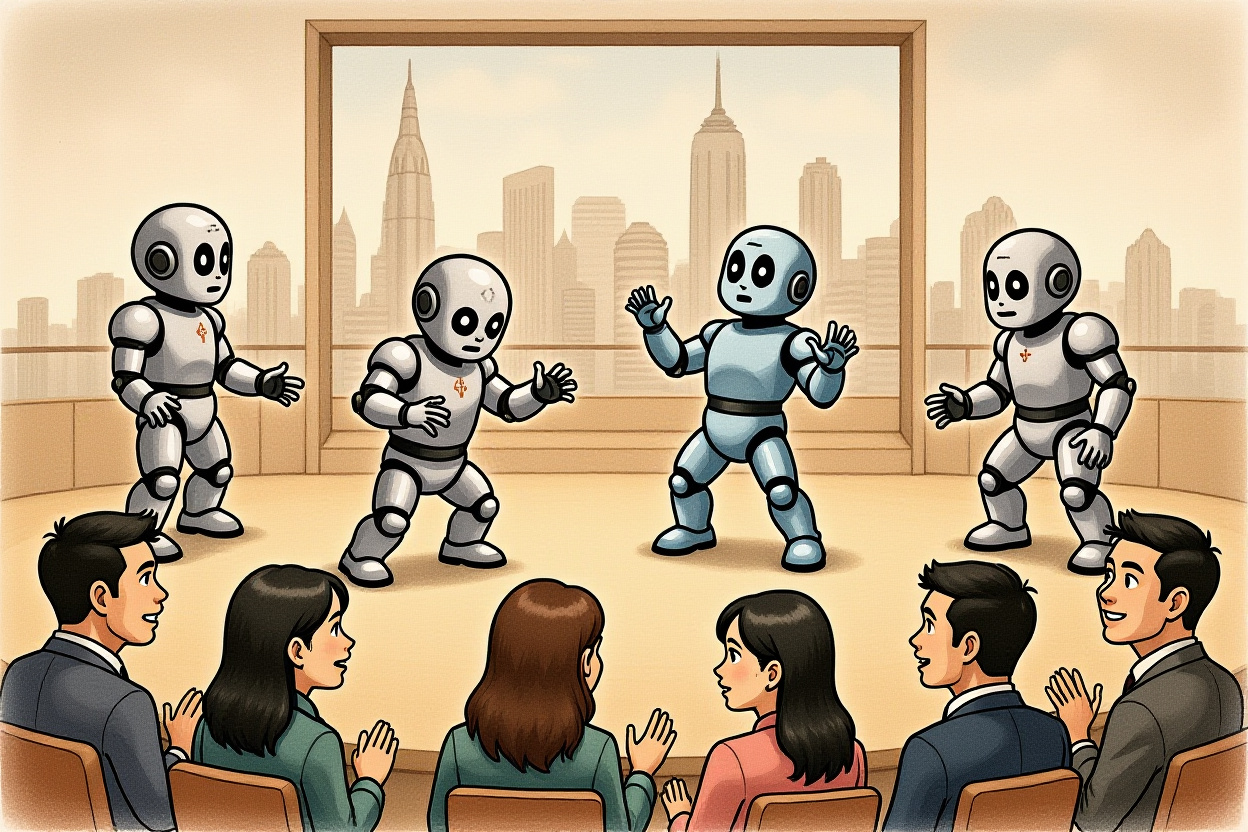
The CCTV Spring Festival Gala has long been a barometer for technological trends in China, but the 2026 edition elevated this role to new heights. As millions tuned in worldwide, the gala transformed into the ultimate test ground for embodied intelligence—a field where robots integrate physical interaction with AI-driven cognition. This year, the spotlight wasn’t on mere gadgets but on a coordinated display by four domestic pioneers: Magic Atom (魔法原子), Galaxy Universal (银河通用), Unitree Robotics (宇树科技), and Songyan Power (松延动力). Their humanoid robots danced, performed martial arts, and engaged in skits, signaling a strategic push to normalize robotics in everyday life.
The Four Companies and Their Performances
Each company brought distinct capabilities to the stage, reflecting diverse technical pathways. Unitree Robotics (宇树科技), already a breakout star from the 2025 gala, partnered with the Henan Tagou Martial Arts School for a wushu performance titled “武 BOT,” demonstrating agility and precision. Songyan Power (松延动力) appeared in a comedy sketch “奶奶的最爱” with actors Cai Ming (蔡明) and Wang Tianfang (王天放), highlighting interactive potential. Magic Atom (魔法原子) supported a song “智造未来,” while Galaxy Universal (银河通用) featured in a micro-film “我最难忘的今宵” with Shen Teng (沈腾) and Ma Li (马丽). Notably, their official titles varied—from “春晚机器人合作伙伴” to “春晚指定具身大模型机器人”—underscoring nuanced strategic positioning in a competitive arena.
Why the Gala Matters as the Ultimate Test Ground
The Spring Festival Gala isn’t just about entertainment; it’s a crucible for validation. With viewership exceeding billions, it accelerates public acceptance and provides a credibility boost for domestic technology. As the ultimate test ground, it forces companies to demonstrate robustness under pressure—akin to a live product launch with zero room for error. This exposure catalyzes investment interest and partnership opportunities, essential for scaling in a capital-intensive industry. According to industry analysts, such platforms help bridge the gap between conceptual prototypes and market-ready solutions, a critical step for China’s ambitions in global robotics leadership.
From Stage to Reality: The Commercialization Imperative
While the gala offers a glamorous debut, the real challenge begins when the curtains fall. Embodied intelligence must prove its worth beyond choreographed routines, confronting three sequential hurdles that define commercial viability. The ultimate test ground thus extends from the stage to factories, stores, and homes, where performance metrics shift from applause to efficiency and cost savings.
Industrial Applications: The First Frontier
The most immediate market for embodied intelligence lies in manufacturing, where robots can address labor shortages in tasks like sorting, assembly, and quality control. However, industrial environments demand extreme reliability. A robot that falters on an assembly line can cause production halts, leading to significant financial losses. Companies like Unitree Robotics (宇树科技) are already piloting solutions in automotive and electronics plants, but widespread adoption requires overcoming technical barriers such as sensor accuracy in dusty conditions and seamless integration with legacy systems. Data from the Ministry of Industry and Information Technology (工业和信息化部) indicates that automation penetration in Chinese factories is rising, but humanoid robots remain a niche, emphasizing the need for proven durability.
Commercial and Domestic Scenarios: Navigating Complexity
Beyond factories, commercial settings like retail stores, warehouses, and hospitals present dynamic challenges. Here, robots must handle unpredictable human interactions, obstacle avoidance, and multi-tasking. For instance, a robot assisting in a supermarket must respond to customer inquiries while navigating crowded aisles—a far cry from scripted stage performances. The ultimate test ground in these contexts involves advanced perception algorithms and real-time decision-making. In homes, the hurdles multiply due to unstructured spaces and safety concerns. Companies are investing in AI training simulators to prepare for these scenarios, but mass adoption hinges on affordability and user-friendly design. A report by Goldman Sachs (高盛) estimates that household robotics could become a $100 billion market in China by 2035, driven by aging demographics and smart home trends.Market Dynamics and Financial Implications
The embodied intelligence sector in China is on the cusp of exponential growth, with profound implications for investors and corporate strategists. The Spring Festival Gala’s spotlight has intensified scrutiny on business models and revenue streams, moving beyond valuation hype to tangible metrics.
IDC Projections and Growth Trajectory
International Data Corporation (IDC) forecasts that user spending on embodied intelligent robots in China will surge to $770 billion by 2030, representing a compound annual growth rate (CAGR) of 94%. This growth is fueled by government initiatives like “Made in China 2025” and the 14th Five-Year Plan, which prioritize AI and robotics. For context, the global robotics market is expected to reach $500 billion by 2030, positioning China as a dominant player. Key drivers include declining sensor costs, advancements in machine learning, and rising labor expenses. Investors should note that early movers like the gala participants are well-placed to capture market share, but success depends on scaling production and securing enterprise contracts.
Investment Trends and Capital Flows
Venture capital and private equity have flooded into China’s robotics space, with over $5 billion invested in 2025 alone, according to PitchBook data. Companies such as Unitree Robotics (宇树科技) have attracted funding from top firms like Sequoia Capital China (红杉资本中国) and Hillhouse Capital (高瓴资本). However, the focus is shifting from burn rates to unit economics. The ultimate test ground for investors is whether these companies can achieve profitability through repeat orders and diversified applications. Public markets are also taking note: several robotics firms are eyeing IPOs on the STAR Market (科创板) and Hong Kong exchanges, offering liquidity opportunities. Analysts recommend monitoring quarterly reports for metrics like gross margin and customer acquisition cost to gauge long-term sustainability.Regulatory and Economic Environment
China’s regulatory framework and economic policies play a crucial role in shaping the embodied intelligence landscape. The government’s supportive stance, coupled with strategic investments, creates a fertile ground for innovation, but compliance and global competition pose ongoing challenges.
Government Policies and Support Mechanisms
The Chinese government has launched multiple initiatives to bolster robotics, including tax incentives for R&D and subsidies for manufacturing upgrades. Agencies like the Ministry of Science and Technology (科学技术部) and the National Development and Reform Commission (国家发展和改革委员会) have outlined roadmaps for AI integration, with embodied intelligence as a key pillar. For example, the “Robotics +” application action plan aims to deploy over 500,000 industrial robots by 2027. Additionally, regulatory bodies such as the Cyberspace Administration of China (国家互联网信息办公室) are crafting guidelines for ethical AI use, ensuring safety in human-robot interactions. These policies reduce entry barriers and foster collaboration between academia and industry, as seen in partnerships with universities like Tsinghua University (清华大学).
Global Competitiveness and Export Potential
While China leads in manufacturing scale, it faces stiff competition from global players like Boston Dynamics and Tesla in humanoid robotics. The ultimate test ground extends internationally, where Chinese companies must meet stringent quality standards to export to markets in Europe and North America. Trade policies and geopolitical tensions, such as U.S. restrictions on AI technology, could impact supply chains. However, China’s strength lies in vertical integration—from chip design by companies like Huawei (华为) to software platforms by Baidu (百度). By leveraging cost advantages and customization capabilities, firms like Magic Atom (魔法原子) are targeting emerging markets in Southeast Asia and the Middle East. Financial professionals should assess currency risks and tariff implications when evaluating investment portfolios in this sector.The Road Ahead: 2026 as a Turning Point
The 2026 Spring Festival Gala has set the stage for a pivotal year in embodied intelligence, where the industry transitions from demonstration to deployment. The ultimate test ground will now shift to boardrooms and balance sheets, with success measured by market penetration and financial resilience.
From Performance to Profitability: Key Metrics to Watch
Companies must pivot from staging impressive shows to securing contracts that drive revenue. Critical metrics include:– Order volume: Track announcements from industrial clients in sectors like logistics and healthcare.
– Customer retention: High repeat rates indicate product reliability and satisfaction.
– Cost per unit: Economies of scale will be vital for price competitiveness, especially in consumer markets.
– Patent filings: Innovation intensity can be gauged through intellectual property portfolios, with China leading globally in robotics patents.
Investors should engage with management teams to understand roadmaps for achieving positive cash flow, as many startups are still in pre-revenue phases.
Strategic Recommendations for Stakeholders
For institutional investors and corporate executives, actionable steps include:– Diversify exposure: Consider ETFs focused on AI and robotics, such as the ChinaAMC Intelligent Robotics ETF, while conducting due diligence on individual stocks.
– Monitor regulatory updates: Stay informed on policy shifts that could impact subsidies or export controls.
– Engage with ecosystems: Attend industry conferences like the World Artificial Intelligence Conference in Shanghai to network with innovators.
– Assess risk tolerance: Early-stage investments in embodied intelligence carry high volatility but offer potential for outsized returns in a nascent market.
The ultimate test ground for decision-makers is balancing optimism with prudence, leveraging data-driven insights to capitalize on this transformative trend.
Synthesis and Forward Guidance
The CCTV Spring Festival Gala has unequivocally established itself as the ultimate test ground for China’s embodied intelligence robotics, catalyzing a shift from theoretical promise to practical application. The performances by Magic Atom (魔法原子), Galaxy Universal (银河通用), Unitree Robotics (宇树科技), and Songyan Power (松延动力) are not mere spectacles but harbingers of an industry poised for disruption. With IDC’s bullish projections and robust government backing, the sector offers lucrative opportunities, yet risks abound in scalability and competition.
As the market matures, stakeholders must focus on real-world validation—whether robots can enhance productivity in factories, streamline operations in commerce, or assist in homes. The ultimate test ground will be defined by those who navigate the triad of technology, regulation, and economics with agility. For global investors and business leaders, now is the time to deepen analysis, foster partnerships, and position portfolios to harness the growth of embodied intelligence. The journey from stage to sustainability has begun; proactive engagement will separate pioneers from spectators in this dynamic landscape.