



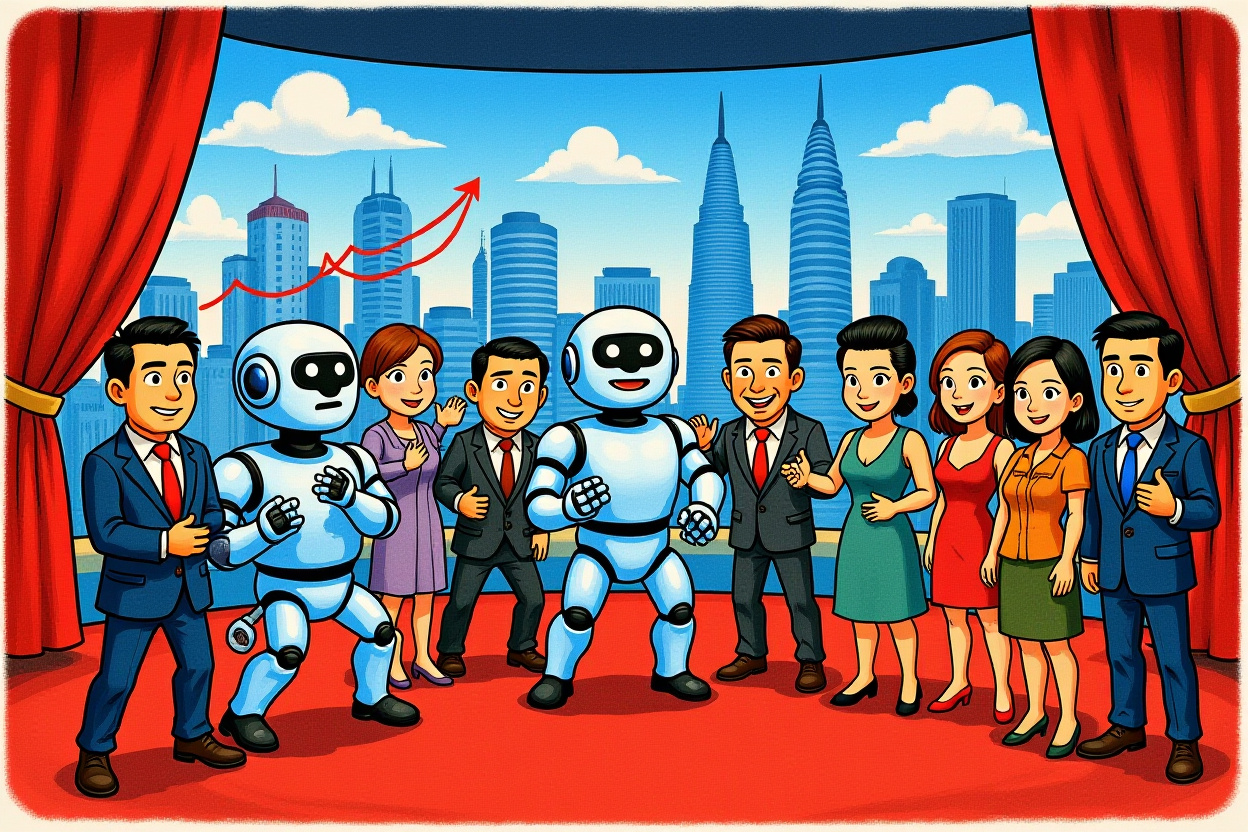
As the 2026 CCTV Spring Festival Gala unfolds, embodied intelligence takes center stage, transforming from a niche technology into a national spectacle. This article delves into the performances, strategies, and future challenges for China’s leading embodied AI companies, highlighting the ultimate test for embodied intelligence as they transition from lab to market.
Executive Summary: Key Takeaways from the 2026 Spring Festival Gala Showcase
The 2026 CCTV Spring Festival Gala featured four prominent Chinese embodied AI firms—Magic Atom (魔法原子), Galaxy Universal (银河通用), Unitree Tech (宇树科技), and Songyan Power (松延动力)—in a coordinated display that underscores the sector’s rapid maturation. This event serves as a critical benchmark for the ultimate test for embodied intelligence, moving beyond theoretical demonstrations toward real-world validation.
Key insights include:
– The Gala acts as a mass-market catalyst, accelerating public acceptance and commercial interest in humanoid robots and embodied AI systems.
– Companies are leveraging this platform to differentiate their technological approaches, with variations in official titles reflecting distinct strategic focuses on robotics, AI models, or integrated solutions.
– Industrial applications remain the immediate priority, but long-term growth hinges on overcoming hurdles in commercial and household environments, where complexity and cost sensitivity increase.
– Market projections from IDC indicate explosive growth, with China’s embodied intelligent robot user expenditure expected to reach $770 billion by 2030, driven by a 94% compound annual growth rate.
– The industry is at an inflection point, shifting from capital-driven hype to application-based sustainability, with 2026 poised as a watershed year for consolidation and scalable deployment.
The Spring Festival Gala as a Technological Bellwether
For decades, the CCTV Spring Festival Gala has served as a cultural touchstone and a barometer for emerging trends in China’s tech landscape. In 2026, this tradition evolved dramatically with the inclusion of embodied AI companies, marking their debut as a cohesive “集团军” (group army) on a national stage. This move signals a strategic push by industry players and policymakers to showcase domestic innovation, positioning the Gala as the ultimate test for embodied intelligence in terms of public perception and technical readiness.
The participation of Magic Atom (魔法原子), Galaxy Universal (银河通用), Unitree Tech (宇树科技), and Songyan Power (松延动力) represents a calculated effort to demystify robotics and AI for a billion-plus viewers. By integrating robots into segments like martial arts performances, comedy skits, and musical numbers, the Gala normalizes their presence in everyday life, a crucial step toward commercialization. As one industry analyst noted, “The Gala isn’t just about entertainment; it’s a live demo for potential clients and investors, proving that Chinese embodied AI can perform under pressure.”
From Laboratory to Limelight: A Strategic Showcase
Each company’s role in the Gala was meticulously curated to highlight its strengths. Unitree Tech, for instance, partnered with the Henan Tagou Martial Arts School for a segment titled “武 BOT,” emphasizing agility and coordination in dynamic movements. Songyan Power appeared in a sketch with veteran performers Cai Ming (蔡明) and Wang Tianfang (王天放), showcasing interactive capabilities in a comedic setting. Magic Atom supported a song performance focused on futuristic themes, while Galaxy Universal collaborated with popular actors Shen Teng (沈腾) and Ma Li (马丽) in a micro-film, blending AI with narrative storytelling.
These collaborations reveal deeper strategic nuances. The official titles assigned—such as “春晚机器人合作伙伴” (Spring Festival Gala Robot Partner) for Unitree Tech versus “春晚指定具身大模型机器人” (Spring Festival Gala Designated Embodied Large Model Robot) for Galaxy Universal—reflect divergent focuses on hardware, software, or integrated systems. This differentiation is pivotal for investors assessing market positioning; as the ultimate test for embodied intelligence unfolds, companies must articulate clear value propositions to secure funding and partnerships in a crowded field.
Key Players and Their Market Trajectories
The 2026 Gala spotlighted companies at varying stages of development, with Unitree Tech emerging as a standout due to its sustained visibility. Following a breakout appearance in the 2025 Gala, Unitree Tech capitalized on the exposure, participating in over 12 major events and hosting seven dedicated robot competitions within a year. This aggressive outreach strategy has cemented its reputation as a market leader, but it also raises questions about scalability beyond staged performances.
Magic Atom and Galaxy Universal, while less established in public consciousness, represent innovative approaches to embodied AI. Magic Atom’s emphasis on “智能机器人” (intelligent robotics) suggests a focus on autonomous decision-making, whereas Galaxy Universal’s tie to “具身大模型” (embodied large models) highlights advancements in AI-driven perception and learning. Songyan Power’s involvement in小品 (sketches) underscores a push for human-robot interaction, a critical component for service-oriented applications.
Unitree Tech’s Ascent: A Case Study in Strategic Marketing
Unitree Tech’s journey from a niche robotics firm to a household name illustrates the power of the Spring Festival Gala as a launchpad. According to industry reports, the company’s 2025 performance generated significant media buzz, leading to increased inquiries from industrial clients and venture capitalists. In 2026, its repeat appearance reinforces brand durability, but insiders caution that the real challenge lies in translating this visibility into sustainable revenue. As one source from Phoenix News’ Company Research Institute noted, “Unitree’s success on stage is impressive, but the ultimate test for embodied intelligence will be its ability to secure repeat orders in factories or warehouses.”
Data from market research firms supports this view. While IDC’s optimistic forecasts paint a rosy picture, actual adoption rates depend on factors like cost-efficiency and reliability. For example, Unitree Tech’s robots, praised for their dexterity in performances, must now prove they can handle repetitive tasks in harsh industrial environments without frequent maintenance. This transition from showpiece to workhorse defines the next phase of growth for all featured companies.
Commercial Realities: The Path from Stage to Market
The glitter of the Spring Festival Gala inevitably fades, leaving embodied AI firms to confront the harsh realities of commercialization. The ultimate test for embodied intelligence begins once the cameras stop rolling, as companies must navigate a trio of critical hurdles: industrial integration, commercial deployment, and household adoption. Each stage presents unique technical and economic challenges that will determine which players thrive in the long run.
IDC’s projection of a $770 billion market by 2030, with a 94% CAGR, underscores the immense potential, but also the competitive intensity. To capture this opportunity, firms must move beyond表演 (performances) and demonstrate tangible value in real-world settings. As a common industry adage goes, “Robots can’t dance on stage forever”—a reminder that sustained success hinges on practical applications that drive cost savings and efficiency gains.
Industrial Applications: The First and Most Critical Frontier
Factories and warehouses represent the low-hanging fruit for embodied AI, given the pressing need for automation amid labor shortages and rising wages. Tasks such as sorting, assembly, loading, and inspection offer clear use cases, but they demand extreme reliability. Unlike stage performances, where errors can be masked or retaken, industrial settings tolerate zero downtime; a malfunctioning robot can halt production lines, resulting in significant financial losses.
Companies like Songyan Power are already piloting solutions in manufacturing hubs, but feedback indicates that many robots struggle with environmental variables like dust, temperature fluctuations, or electromagnetic interference. The ultimate test for embodied intelligence here is not just mobility, but robustness—the ability to operate 24/7 with minimal supervision. For investors, this means scrutinizing companies with proven track records in pilot projects rather than those reliant on flashy demos.
Commercial and Household Scenarios: Scaling Complexity
Beyond factories, embodied AI must conquer commercial spaces such as retail stores, hotels, and hospitals. These environments are less structured, requiring advanced capabilities in computer vision, natural language processing, and obstacle avoidance. A robot that interacts seamlessly with customers in a controlled Gala sketch may falter in a busy supermarket with unpredictable foot traffic or noisy backgrounds.
Household adoption represents the final and most demanding frontier. Homes are inherently chaotic, with cluttered spaces, playful pets, and varied lighting conditions. Safety becomes paramount, as robots must avoid harming residents or damaging property. Moreover, affordability is crucial; current high costs—often exceeding $50,000 per unit—limit mass-market appeal. The ultimate test for embodied intelligence in this domain involves achieving a balance of intelligence, safety, simplicity, and cost-effectiveness, a challenge that may take years to overcome.
Strategic Implications for Investors and the Broader Ecosystem
The 2026 Spring Festival Gala serves as a microcosm of China’s embodied AI ambitions, with implications extending beyond technology to investment trends and regulatory frameworks. For institutional investors and fund managers, this event highlights the need to differentiate between hype and substance. The ultimate test for embodied intelligence will be reflected in financial metrics such as order volumes, customer retention rates, and profit margins, rather than media coverage alone.
Government policies, including initiatives from the Ministry of Industry and Information Technology (工业和信息化部), are likely to shape the sector’s trajectory through subsidies, standards, and pilot programs. Companies that align with national priorities—such as upgrading manufacturing under the “Made in China 2025” (中国制造2025) framework—may gain preferential access to resources. However, as the market matures, consolidation is inevitable; smaller players without clear commercialization paths may be acquired or sidelined.
Market Projections and Risk Factors
IDC’s bullish forecast of $770 billion in user spending by 2030 assumes rapid technological advancement and widespread adoption. However, risks abound, including supply chain disruptions for critical components like semiconductors, evolving safety regulations, and competition from global giants like Tesla’s Optimus or Boston Dynamics. Chinese firms must also address ethical concerns around data privacy and job displacement, which could influence public acceptance.
To mitigate these risks, companies are diversifying their approaches. For instance, Galaxy Universal’s focus on large AI models could enable faster adaptation to new tasks via software updates, reducing hardware dependency. Meanwhile, Magic Atom’s partnerships with entertainment venues suggest a strategy to build revenue streams in niche markets before scaling to industrial clients. Investors should monitor these differentiated strategies as indicators of resilience in the face of the ultimate test for embodied intelligence.
Looking Beyond the Gala: The Road Ahead for Embodied AI
The 2026 Spring Festival Gala has undoubtedly accelerated awareness of embodied AI, but it marks only the beginning of a rigorous journey. The ultimate test for embodied intelligence lies in achieving scalable, profitable deployments across diverse sectors. Companies that succeed will be those prioritizing reliability over spectacle, customer needs over technological novelty, and incremental progress over grandiose promises.
For stakeholders—from corporate executives to international investors—the key takeaway is to focus on tangible milestones. Track progress in industrial pilot programs, evaluate partnerships with logistics firms or healthcare providers, and assess R&D investments in cost-reduction technologies. As the industry pivots from demonstration to delivery, the winners will be those that transform the Gala’s spotlight into lasting market presence.
Take the next step: engage with detailed market analyses from sources like IDC or consult with experts at the China Robotics Industry Alliance (中国机器人产业联盟) to refine investment strategies. The embodied AI revolution is underway, and its success hinges on navigating the ultimate test for embodied intelligence with pragmatism and vision.