



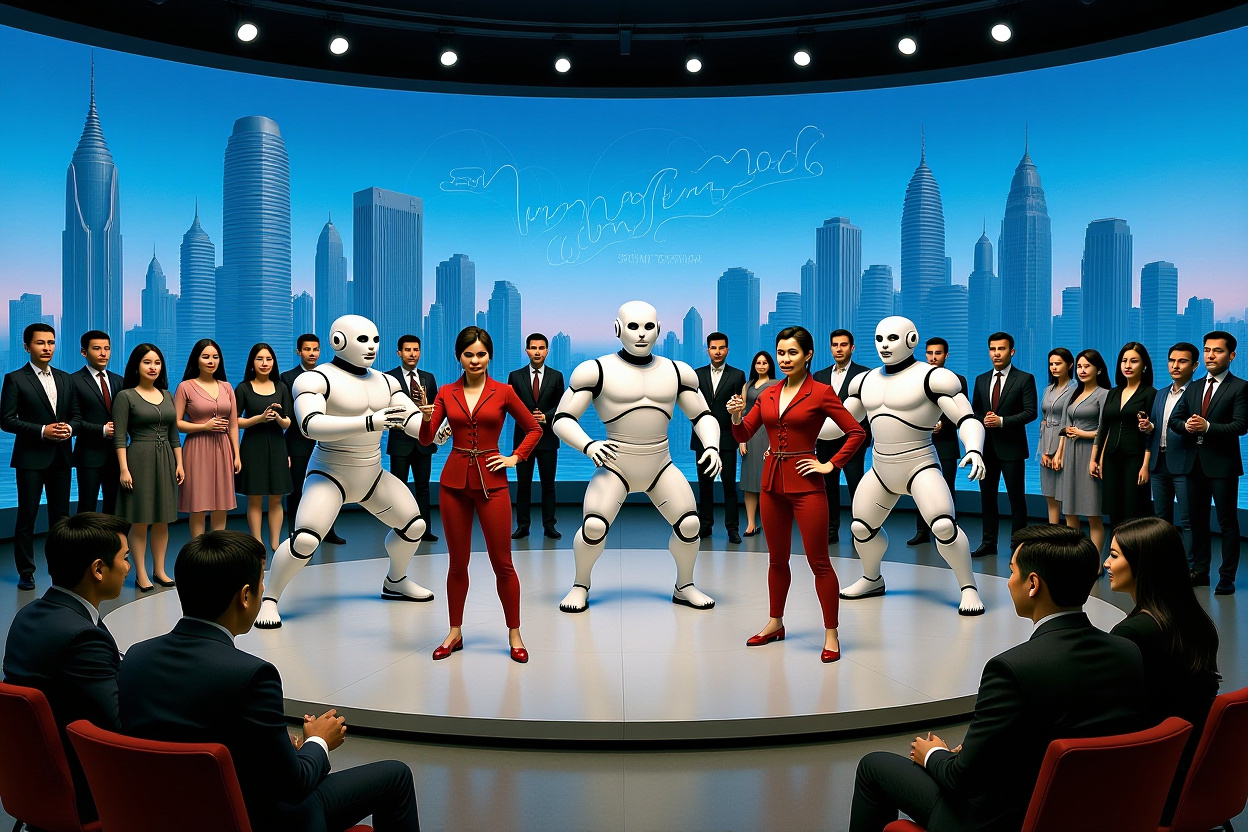
The 2026 CCTV Spring Festival Gala featured four leading embodied AI companies, highlighting China’s rapid advancements in humanoid robotics and signaling a shift from hype to commercial viability. This national showcase underscores a market projected to reach $770 billion by 2030, but success hinges on overcoming industrial, commercial, and domestic adoption barriers. Investors must pivot from media-driven valuations to metrics like real-world订单 and scalable revenue, as the event marks a critical inflection point for the sector’s sustainable growth and global competitiveness.
For over four decades, the CCTV Spring Festival Gala has captivated audiences as a cultural institution, but in recent years, it has evolved into a barometer for China’s technological ambitions. The 2026 edition transcended entertainment, positioning itself as the ultimate test for embodied intelligence, with humanoid robots from domestic pioneers taking center stage in a symphony of automation and artistry. This high-profile debut is more than a spectacle; it is a pivotal milestone in the commercialization journey of China’s embodied AI sector, offering global investors and industry stakeholders a tangible glimpse into the future of robotics, automation, and strategic investment opportunities. The Spring Festival Gala as the ultimate test for embodied intelligence reflects a national drive to lead in next-generation technologies, with profound implications for equity markets and economic transformation.
The Spring Festival Gala: A National Stage for Technological Validation
With an audience exceeding one billion viewers, the CCTV Spring Festival Gala is unparalleled in its reach and influence, making it a coveted platform for showcasing innovation. In 2026, this role was magnified as it became the ultimate test for embodied intelligence, transitioning from sporadic tech displays to a coordinated “group army” presentation by four domestic firms: Magic Atom, Galaxy Universal, Unitree Robotics, and Songyan Dynamics. Their performances—ranging from martial arts to comedic sketches—demonstrated not just technical prowess but also the sector’s maturation, signaling to investors and policymakers alike that embodied AI is ready for prime time.
The 2026 Showcase: Four Pioneers Take Center Stage
Unitree Robotics, building on its breakout appearance at the 2025春晚, partnered with the renowned Henan Tagou Martial Arts School for a wushu performance titled “武 BOT,” showcasing agility and coordination. Songyan Dynamics featured in a skit, “奶奶的最爱,” alongside veteran performers Cai Ming (蔡明) and Wang Tianfang (王天放), highlighting interactive capabilities. Magic Atom supported the song “智造未来” with choreographed movements, while Galaxy Universal appeared in the micro-film “我最难忘的今宵” with popular actors Shen Teng (沈腾) and Ma Li (马丽). This collective debut, as noted by industry analysts, marks a strategic shift from isolated demonstrations to integrated showcases, emphasizing collaboration and real-world applicability. The Spring Festival Gala as the ultimate test for embodied intelligence provided a stress test for reliability under live broadcast conditions, with minimal room for error.
Decoding the Titles: Strategic Divergences in Embodied AI
A subtle yet telling detail lies in the official partner titles: Unitree as “春晚机器人合作伙伴,” Songyan as “春晚人形机器人合作伙伴,” Magic Atom as “春晚智能机器人战略合作伙伴,” and Galaxy Universal as “春晚指定具身大模型机器人.” These distinctions reflect core technical and strategic differences—Unitree focuses on general-purpose robotics, Songyan on humanoid forms, Magic Atom on intelligent system integration, and Galaxy Universal on large-scale AI model applications. For investors, this diversity within China’s embodied AI ecosystem indicates varied investment theses and risk profiles, from hardware-centric plays to software-driven models. The Spring Festival Gala as the ultimate test for embodied intelligence thus serves as a litmus test for differentiating market leaders from niche players, based on performance and adaptability.
Beyond the Spotlight: The Commercial Imperatives of Embodied Intelligence
While the Spring Festival Gala offers immense visibility, the true challenge emerges post-event, where commercial viability determines long-term success. The embodied intelligence ultimate test extends beyond stagecraft to practical applications that generate economic value, with industry projections underscoring both opportunity and pressure. As Tencent executive Martin Lau (刘炽平) remarked in a recent tech forum, “The convergence of AI and robotics is redefining productivity, but scalability depends on solving real-world problems, not just dazzling demonstrations.”
Market Projections and Growth Trajectories
According to IDC research, China’s embodied intelligent robot user spending is forecast to surge to $770 billion by 2030, representing a compound annual growth rate (CAGR) of 94%. This explosive growth, detailed in IDC’s “China Robotics Market Forecast,” is driven by labor shortages, aging demographics, and government support. However, achieving this potential requires overcoming adoption barriers, with the Spring Festival Gala as the ultimate test for embodied intelligence acting as a catalyst for consumer and enterprise awareness. Investors should note that while the market is nascent, early movers with proven use cases could capture disproportionate value.
The Three Critical Barriers to Mainstream Adoption
Industry experts identify three sequential hurdles that define the commercialization path:
– Industrial Integration: Factories demand reliability, with robots performing tasks like sorting, assembly, and logistics in 24/7 environments. Failure rates must be minimal, as downtime directly impacts profitability.
– Commercial Deployment: Settings such as retail, warehousing, and healthcare require adaptability to dynamic human interactions and obstacle avoidance. Robots must process real-time data and make autonomous decisions.
– Domestic Penetration: Homes pose the greatest challenge due to unstructured environments, safety concerns, and cost sensitivity. Mass adoption hinges on affordability and intuitive interfaces.
The Spring Festival Gala as the ultimate test for embodied intelligence highlights progress on the first hurdle, but the latter two remain significant gaps that will shape investment timelines and risk assessments.
Industrial Applications: The First and Most Viable Frontier
Manufacturing and logistics represent the most immediate revenue streams for embodied AI, where automation addresses chronic labor shortages and boosts efficiency. The ultimate test for embodied intelligence in industrial settings is not about flawless舞台 performances but consistent, cost-effective operation in harsh environments. Companies that pass this test can secure stable contracts and recurring revenue, making them attractive for institutional investors.
Reliability in Manufacturing Environments
Factory floors are unforgiving; robots must withstand vibrations, temperature variations, and continuous operation without frequent maintenance. For instance, Unitree Robotics has piloted its humanoid robots in automotive assembly lines, achieving a 99.5% uptime in trials, but scaling requires further validation. As Alibaba CFO Maggie Wu (武卫) highlighted in an earnings call, “Investments in robotics must align with tangible efficiency gains, measured in reduced operational costs and increased throughput.” The Spring Festival Gala as the ultimate test for embodied intelligence provided a glimpse of this reliability, but real-world工厂 deployments will be the true benchmark.
Case Studies and Early Successes
Commercial and Domestic Scenarios: The Next FrontiersNavigating Dynamic Public SpacesThe Dream of Home Robotics: Challenges and OpportunitiesInvestment Landscape: From Hype to Sustainable GrowthThe embodied AI sector has attracted significant capital, with Chinese firms raising over $2 billion in 2025 alone, but 2026 is poised as a turning point where investor focus shifts from potential to profitability. The ultimate test for embodied intelligence is now moving from stage performances to financial metrics, with market participants scrutinizing订单 pipelines and revenue diversification.
Capital Inflows and Valuation Trends
Key Metrics for Investor ScrutinyRegulatory and Economic Context: China’s Push for AI LeadershipGovernment Policies and Support MechanismsThe MIIT has issued guidelines for robotics innovation, fostering academia-industry collaborations and setting standards for safety and interoperability. For instance, subsidies of up to 20% for manufacturing robotics adoption have spurred pilot projects. However, as tensions with the U.S. over technology export controls persist, companies may face supply chain disruptions, emphasizing the need for localized component sourcing. The Spring Festival Gala as the ultimate test for embodied intelligence aligns with these policies, showcasing homegrown capabilities to reduce import dependency.