



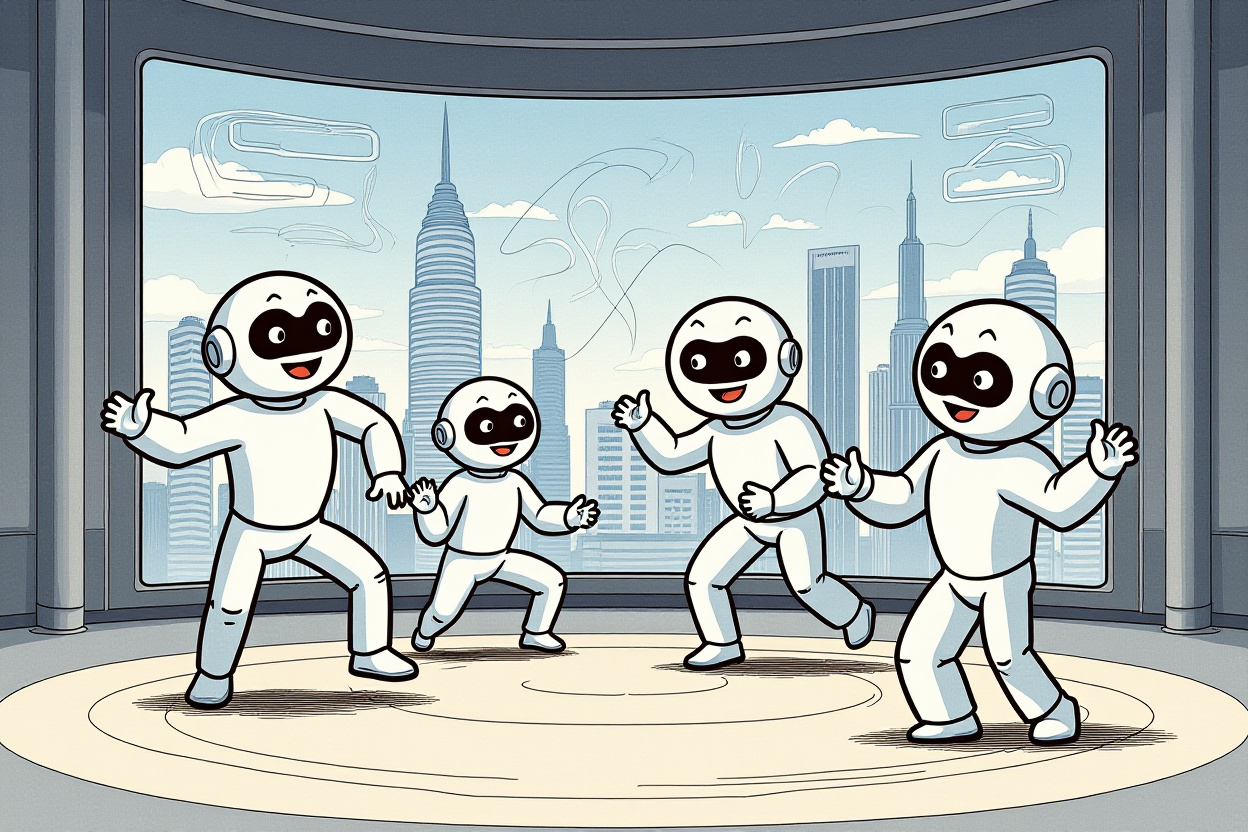
– The 2026 CCTV Spring Festival Gala featured a collective showcase of four leading Chinese embodied AI companies—Magic Atom (魔法原子), Galaxy General (银河通用), Unitree Technology (宇树科技), and Songyan Power (松延动力)—highlighting the sector’s rapid technological advancement.
– This national platform signals a pivotal transition from conceptual demonstrations to practical applications, with industrial manufacturing emerging as the immediate focus for commercialization and revenue generation.
– Market projections indicate explosive growth, with IDC forecasting China’s embodied AI robot user spending to reach $770 billion by 2030, driven by a 94% compound annual growth rate.
– Investors should closely monitor these companies’ ability to overcome real-world challenges in factory, commercial, and home environments, as the era of prioritizing funding over fundamentals gives way to a focus on scalable solutions and recurring revenue.
– The CCTV Spring Festival Gala serves as a critical validation milestone, but sustainable success hinges on solving reliability, cost, and adaptability issues beyond the stage.
As the confetti settles and the applause fades from the 2026 CCTV Spring Festival Gala, a profound shift is underway in China’s technology landscape. For decades, this iconic broadcast has served as a barometer for emerging trends, from 5G connectivity to virtual reality. This year, however, the spotlight firmly seized upon a sector poised to redefine productivity and daily life: embodied artificial intelligence. The CCTV Spring Festival Gala transformed from mere entertainment into the ultimate proving ground for humanoid robots, where concepts met mass perception and commercial viability began its earnest test. Four domestic champions—Magic Atom, Galaxy General, Unitree Technology, and Songyan Power—shared the stage, not just performing routines but symbolizing China’s ambitious push to lead the next wave of automation. For global investors and business professionals tracking Chinese equity markets, this moment transcends spectacle; it offers a rare, unfiltered look at the maturation of a high-stakes industry where technological prowess must now translate into tangible market value.
The CCTV Spring Festival Gala: A Competitive Arena for Robotics
The 2026 edition of the CCTV Spring Festival Gala will be remembered as the moment embodied AI moved from niche demonstrations to mainstream consciousness. Unlike previous years where technological elements were sprinkled as novelties, this gala presented a coordinated “corps” of humanoid robots, performing complex group dances, martial arts, and even comedic sketches alongside human stars.
A Collective Showcase of Chinese Innovation
The decision to feature four companies simultaneously was strategic, reflecting both the sector’s growth and the intense competition within it. Unitree Technology, building on its breakout performance in the 2025 gala, collaborated with the renowned Henan Tagou Martial Arts School for a program titled “武 BOT,” blending traditional wushu with robotic precision. Songyan Power appeared early in the lineup, partnering with comedians Cai Ming (蔡明) and Wang Tianfang (王天放) in the sketch “Grandma’s Favorite.” Magic Atom provided support for the song “Intelligent Creation of the Future,” while Galaxy General joined forces with popular actors Shen Teng (沈腾) and Ma Li (马丽) in the micro-film “My Most Unforgettable Tonight.” This ensemble approach allowed millions of viewers to witness varying capabilities, from dynamic mobility to interactive dialogue, setting a new benchmark for public demonstrations of AI hardware.
Decoding the Titles: Strategic Positioning Unveiled
When the Curtain Falls: The Real-World Examination BeginsThe brilliance of the CCTV Spring Festival Gala stage inevitably dims, and for the embodied AI industry, the transition from curated performance to unstructured reality represents its most formidable challenge. Industry insiders often state a blunt truth: robots cannot dance on stages forever. The applause and social media buzz generated by such events are ephemeral; enduring value is built in environments where machines must deliver consistent, cost-effective utility.
Conquering the Factory Floor: Reliability and Efficiency
The first and most immediate proving ground is industrial manufacturing. Factories offer the clearest path to monetization, with repetitive tasks like sorting, assembly, loading, inspection, and palletizing suffering from chronic labor shortages. However, the tolerance for error is zero. A production line demands stability, reliability, low cost, minimal downtime, and 24/7 operation. A misstep in a dance routine can be edited or forgiven; a minute of stoppage on an assembly line translates directly into financial loss. Many robots that excel in laboratory settings falter under the grease, vibration, and electromagnetic interference of a real factory. Success here requires robust mechanical design, advanced sensor fusion, and fail-safe software—a triad that separates viable products from prototypes.
– Key Applications: Precision assembly in electronics manufacturing, heavy-parts handling in automotive plants, quality inspection in semiconductor fabs.
– Investor Metric: Mean Time Between Failures (MTBF) and Total Cost of Ownership (TCO) compared to human labor or traditional automation.
Navigating Commercial Spaces: Adaptability and Interaction
The next tier of difficulty involves commercial service scenarios: retail stores, warehouses, hotels, and hospitals. These environments are semi-structured, featuring unpredictable human traffic, dynamic obstacles, and diverse task requirements. Robots must not only move but also perceive, plan, avoid collisions, and communicate effectively. Performing a scripted interaction with an actor on the CCTV Spring Festival Gala is fundamentally different from navigating a crowded supermarket aisle, responding to a lost customer’s query, or delivering supplies in a busy hospital corridor. This tests the integrated system—the embodiment of AI—where perception, cognition, and action must operate in seamless harmony. Companies that master this will tap into a vast market for service automation, but it requires significant advances in computer vision, natural language processing, and edge computing.
The Home Frontier: Safety, Intelligence, and Affordability
The ultimate, long-term vision for many in the industry is the domestic helper—a robot that integrates into the home. This is by far the most complex and unstructured environment, characterized by uneven floors, scattered toys, pet interference, variable lighting, and ambiguous commands. All the challenges avoided in industrial and commercial settings converge here. To achieve mass adoption, home robots must be exceptionally safe (incapable of harming children or pets), intelligent enough to handle novel situations, simple to use, and crucially, affordable. While this market represents the proverbial “blue ocean” with enormous potential, it remains a distant goal for most current technologies. Progress will be incremental, likely starting with specialized tasks like floor cleaning or elder companionship before evolving into general-purpose assistants.
Market Dynamics: From Capital Infusion to Revenue Generation
The spectacle of the CCTV Spring Festival Gala occurs against a backdrop of frenetic investment and ambitious forecasts. According to IDC data, user spending on embodied intelligent robots in China is projected to skyrocket to $770 billion by 2030, expanding at a compound annual growth rate of approximately 94%. This trajectory suggests a market doubling in size nearly every year, attracting venture capital, corporate investment, and government attention.