



Executive Summary
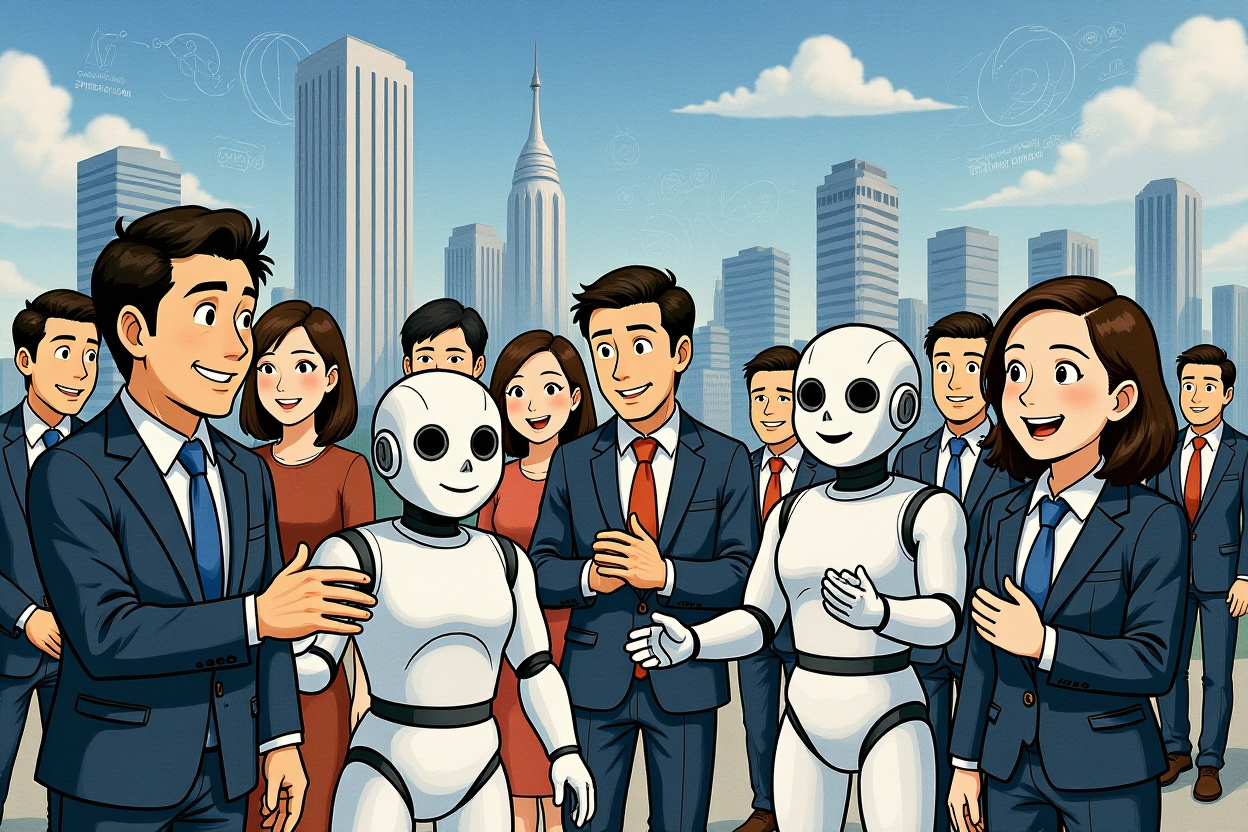
– The 2026 CCTV Spring Festival Gala served as a critical platform for four leading Chinese embodied AI firms—魔法原子 (Magic Atom), 银河通用 (Galaxy Universal), 宇树科技 (Yushu Technology), and 松延动力 (Songyan Power)—to showcase humanoid robots in a nationally televised event, marking a shift from lab concepts to real-world validation.
– This spotlight accelerates public acceptance and commercial endorsement, but the industry now faces a make-or-break phase with three key hurdles: industrial adoption, commercial deployment, and ultimate home integration.
– IDC projects China’s embodied AI robot user spending to hit $770 billion by 2030, with a 94% CAGR, highlighting a massive growth trajectory that investors cannot ignore.
– The event underscores a watershed moment where companies must transition from stage performances to scalable, revenue-generating applications, with 2026 poised as the year of reckoning for the sector.
– Global investors should monitor these developments closely, as success in this ultimate proving ground could redefine competitiveness in global robotics and AI markets.
The National Stage Meets Cutting-Edge Tech
For decades, the CCTV Spring Festival Gala has been more than just entertainment; it is China’s premier cultural and technological barometer, setting trends that ripple across industries. In 2026, the gala transformed into the ultimate proving ground for embodied artificial intelligence, a field where robots interact physically with the world. As millions tuned in, humanoid robots took center stage, not as novelties but as harbingers of a tech-driven future. This showcase wasn’t merely about spectacle—it was a strategic move to position China at the forefront of the global AI race. The focus phrase, ‘ultimate proving ground,’ encapsulates how this event tests the viability, reliability, and market readiness of embodied AI, pushing companies beyond theoretical limits into the harsh light of public and commercial scrutiny.
The 2026 Lineup: A Symphony of Silicon and Steel
The 2026 gala featured a coordinated display by four domestic embodied AI enterprises, each bringing unique capabilities to the fore. 宇树科技 (Yushu Technology), building on its 2025 breakthrough, partnered with the Henan Tagou Martial Arts School for a kung fu performance titled ‘武 BOT,’ demonstrating agility and precision. 松延动力 (Songyan Power) appeared in a comedy skit ‘奶奶的最爱’ with veterans Cai Ming (蔡明) and Wang Tianfang (王天放), highlighting interactive humor. 魔法原子 (Magic Atom) supported the song ‘智造未来’ with synchronized movements, while 银河通用 (Galaxy Universal) collaborated with stars Shen Teng (沈腾) and Ma Li (马丽) in a micro-film, showcasing narrative integration. This collective appearance marked a departure from past fragmented tech demos, signaling maturation in China’s embodied AI ecosystem. The variety of acts—from martial arts to comedy—proved that these robots could handle diverse, unstructured tasks, a key step toward real-world utility.
Decoding the Partnerships: Titles Reveal Strategic Divergence
A subtle yet telling detail emerged in the official designations for each company. 宇树科技 (Yushu Technology) was labeled the ‘Spring Festival Gala Robot Partner,’ 松延动力 (Songyan Power) as ‘Humanoid Robot Partner,’ 魔法原子 (Magic Atom) as ‘Intelligent Robot Strategic Partner,’ and 银河通用 (Galaxy Universal) as ‘Designated Embodied Large Model Robot.’ These nuanced titles reflect deeper strategic positioning: 宇树科技 (Yushu Technology) leans into broad robotics applications, 松延动力 (Songyan Power) emphasizes humanoid form factors, 魔法原子 (Magic Atom) targets intelligent systems integration, and 银河通用 (Galaxy Universal) focuses on AI model-driven capabilities. Such differentiation is crucial for investors tracking specialization within the embodied AI space, as it hints at future market niches and competitive edges. As these firms navigate the ultimate proving ground, their titles may evolve into brand identities that attract specific clientele, from manufacturing to entertainment.
Beyond the Spotlight: The Rush to Commercialization
While the Spring Festival Gala offers unparalleled visibility, the real challenge begins when the curtains close. The embodied AI sector is at an inflection point, where technological prowess must translate into economic value. The gala acts as a catalyst, but sustained success depends on overcoming commercialization barriers. Industry experts warn that without viable business models, even the most advanced robots risk becoming expensive toys. This phase is the true ultimate proving ground, where companies must demonstrate not just performance, but profitability and scalability. The transition from stage to market is fraught with obstacles, yet it’s here that the winners of China’s AI revolution will be decided.
IDC’s Rosy Forecast: A $770 Billion Opportunity by 2030
According to IDC data, China’s embodied AI robot user spending is projected to reach $770 billion by 2030, with an astonishing compound annual growth rate (CAGR) of 94%. This explosive growth trajectory underscores the sector’s potential, but it also raises stakes for companies to capture market share early. Key drivers include labor shortages in aging demographics, government initiatives like ‘Made in China 2025,’ and advancements in AI chips and sensors. For investors, this represents a golden opportunity, but due diligence is essential—focus on firms with clear paths to revenue, not just flashy demonstrations. The IDC report, accessible via IDC’s website, provides deeper insights into regional breakdowns and application segments, from industrial automation to consumer services.
The Gala’s Dual Mission: Public Education and Industry Endorsement
The Spring Festival Gala serves two critical functions in this context. First, it educates the masses, normalizing the presence of robots in daily life and reducing public skepticism. Second, it provides a stamp of approval from state media, boosting credibility with enterprise clients, investors, and supply chain partners. For embodied AI firms, this endorsement can unlock funding and partnerships, as seen with 宇树科技 (Yushu Technology)’s post-2025 surge in event bookings. However, this is just the starting line; the ultimate proving ground extends to factory floors and retail spaces, where reliability trumps entertainment value. Companies must leverage this exposure to secure pilot projects and long-term contracts, turning gala fame into tangible sales pipelines.
The Ultimate Proving Ground: Three Daunting Hurdles to Clear
As the gala’s glow fades, embodied AI companies face a triathlon of challenges that will determine their survival. This segment—the ultimate proving ground—demands solutions for real-world complexity, moving beyond scripted performances to adaptive functionality. Each hurdle represents a layer of market readiness, with increasing difficulty but corresponding rewards. Success here isn’t optional; it’s the price of admission to the next phase of industry growth.
Hurdle One: Conquering the Industrial Floor
Industrial applications offer the most immediate and lucrative market for embodied AI. Factories require robots for tasks like sorting, assembly, and quality inspection, where precision and uptime are non-negotiable. The ultimate proving ground here is harsh: environments with dust, noise, and continuous operation. A robot that dances flawlessly on stage might falter under the pressure of a production line, where a minute of downtime costs thousands. Companies like 松延动力 (Songyan Power) are targeting this space, but they must prove reliability through rigorous testing. Key metrics include mean time between failures (MTBF), energy efficiency, and integration with existing IoT systems. Early adopters in automotive and electronics manufacturing are watching closely, as successful deployments could trigger widespread adoption across China’s industrial base.
Hurdle Two: Navigating Dynamic Commercial Environments
Beyond factories, commercial settings like supermarkets, warehouses, and hospitals present a tougher challenge. These spaces are unstructured, with unpredictable human interactions and variable layouts. Robots must perceive obstacles, process voice commands, and execute tasks safely. For instance, a robot assisting in a hospital must navigate crowded corridors while adhering to hygiene protocols. The gala’s interactions, such as those with Shen Teng (沈腾) and Ma Li (马丽), were controlled; real-world scenarios are not. Companies need advanced computer vision, natural language processing, and edge computing capabilities. This is where 魔法原子 (Magic Atom)’s focus on intelligent systems could shine, but field trials are essential. Pilot programs in logistics hubs, like those run by Alibaba’s Cainiao, provide valuable data for refinement.
Hurdle Three: The Elusive Dream of Home Integration
The final frontier—household adoption—is the most demanding yet promising. Homes are chaotic: cluttered floors, pets, children, and diverse user preferences. Robots here must be affordable, safe, and intuitive, capable of tasks from cleaning to elderly care. While years away from mass adoption, progress in this area could unlock a multi-billion-dollar market. The ultimate proving ground for home robots involves extensive user testing and regulatory approvals for safety standards. Firms like 银河通用 (Galaxy Universal), with its large-model approach, aim to create adaptable AI that learns from home environments. However, cost remains a barrier; current prototypes are prohibitively expensive. Breakthroughs in component costs, driven by Chinese semiconductor initiatives, could accelerate this timeline, making the dream of robotic assistants a reality.
2026: The Watershed Moment for Embodied AI
The year 2026 is poised as a turning point for China’s embodied AI industry. After years of hype and fundraising, the focus shifts decisively to execution and revenue. The Spring Festival Gala’s spotlight has set high expectations, and companies must now deliver or risk obsolescence. This watershed moment is characterized by a maturation of the ecosystem, with increased mergers, acquisitions, and strategic pivots. Investors should brace for volatility but also opportunity, as leaders emerge from the pack. The ultimate proving ground will separate innovators from imitators, shaping the competitive landscape for years to come.
From Hype to Reality: The Shift in Valuation Metrics
Venture capital and public markets are recalibrating how they value embodied AI firms. Previously, metrics like funding rounds and prototype unveilings drove valuations; now, the emphasis is on recurring revenue, customer retention, and gross margins. For example, 宇树科技 (Yushu Technology)’s post-gala success in booking 12 major events and 7 robot competitions shows monetization potential, but sustainable growth requires industrial contracts. Analysts recommend scrutinizing order books and partnership announcements, such as those with state-owned enterprises or global manufacturers. This shift mirrors broader trends in tech investing, where profitability trumps potential, especially amid tightening monetary policies. Companies that fail to adapt may see down rounds or exits, while those with robust business models could attract follow-on investments from sovereign wealth funds or tech giants.
Regulatory Tailwinds and Investment Landscape
Chinese regulators are actively supporting embodied AI through policies like the ’14th Five-Year Plan for Robotics Industry Development,’ which prioritizes innovation in intelligent manufacturing. This creates a favorable environment, but compliance is key—data security, ethical AI use, and export controls are increasingly scrutinized. Investors should monitor announcements from bodies like the Ministry of Industry and Information Technology (MIIT) for guidance. Additionally, the ultimate proving ground extends to capital markets, with IPOs anticipated for top performers. For instance, 松延动力 (Songyan Power) might list on the STAR Market, leveraging its gala exposure. However, risks include overregulation or trade tensions affecting supply chains, so diversification across the ecosystem is prudent.
Global Implications for Investors and the Tech Race
China’s push into embodied AI has worldwide ramifications, challenging Western dominance in robotics and AI. The Spring Festival Gala’s showcase signals that Chinese firms are not just catching up but innovating in application-specific domains. For global investors, this represents both a threat and an opportunity—threat to incumbents like Boston Dynamics, but opportunity for those betting on China’s market growth. The ultimate proving ground here is international competitiveness, where cost-effectiveness and scalability could give Chinese robots an edge in emerging markets. As the industry evolves, cross-border collaborations may increase, but geopolitical factors will play a role in shaping alliances.
Spotting Leaders in China’s Embodied AI Ecosystem
To capitalize on this trend, investors should identify companies with clear technological moats and market traction. Key players to watch include:
– 宇树科技 (Yushu Technology): Strong in dynamic movement and event robotics, with potential expansion into logistics.
– 松延动力 (Songyan Power): Focused on humanoid forms for industrial and service roles, backed by partnerships with academic institutes.
– 魔法原子 (Magic Atom): Emphasizes AI integration for smart cities and retail, with pilot projects in major Chinese metros.
– 银河通用 (Galaxy Universal): Leverages large language models for adaptive learning, targeting high-end commercial applications.
Due diligence should involve reviewing patent portfolios, management backgrounds, and customer testimonials. Resources like the China Robot Industry Alliance offer reports and networking opportunities for deeper insights.
Risk Assessment: Technological, Regulatory, and Market Challenges
Investing in embodied AI carries inherent risks. Technologically, bottlenecks in sensor accuracy or battery life could delay adoption. Regulatorily, changes in data privacy laws, such as China’s Personal Information Protection Law (PIPL), may impact AI training. Market-wise, economic slowdowns could reduce corporate spending on automation. To mitigate these, investors should:
– Diversify across the value chain, from component suppliers to integrators.
– Stay updated on policy shifts via official channels like the National Development and Reform Commission (NDRC) website.
– Engage with industry conferences, such as the World Robot Conference in Beijing, for firsthand updates.
The ultimate proving ground will test not only companies but also investor patience and strategic acumen.
Navigating the Future of Embodied AI
The 2026 CCTV Spring Festival Gala has undeniably accelerated China’s embodied AI journey, transforming it into a public spectacle with profound commercial undertones. As the ultimate proving ground, this event has validated technological capabilities while exposing the arduous path ahead. Key takeaways include the importance of industrial adoption as a near-term revenue driver, the complexity of commercial deployments, and the long-term vision of home integration. For companies, the mandate is clear: pivot from performance to practicality, securing orders that ensure survival and growth. For investors, the time is ripe to engage with this sector, but with a disciplined focus on fundamentals rather than hype. The embodied AI race is just beginning, and those who master this ultimate proving ground will shape the future of automation worldwide.
Call to Action: Stay ahead of the curve by subscribing to specialized financial analysis on Chinese tech equities, attending webinars on AI investment strategies, and exploring direct partnerships with emerging embodied AI firms through venture platforms. The next breakthrough could be just around the corner—don’t miss the chance to be part of this transformative wave.