



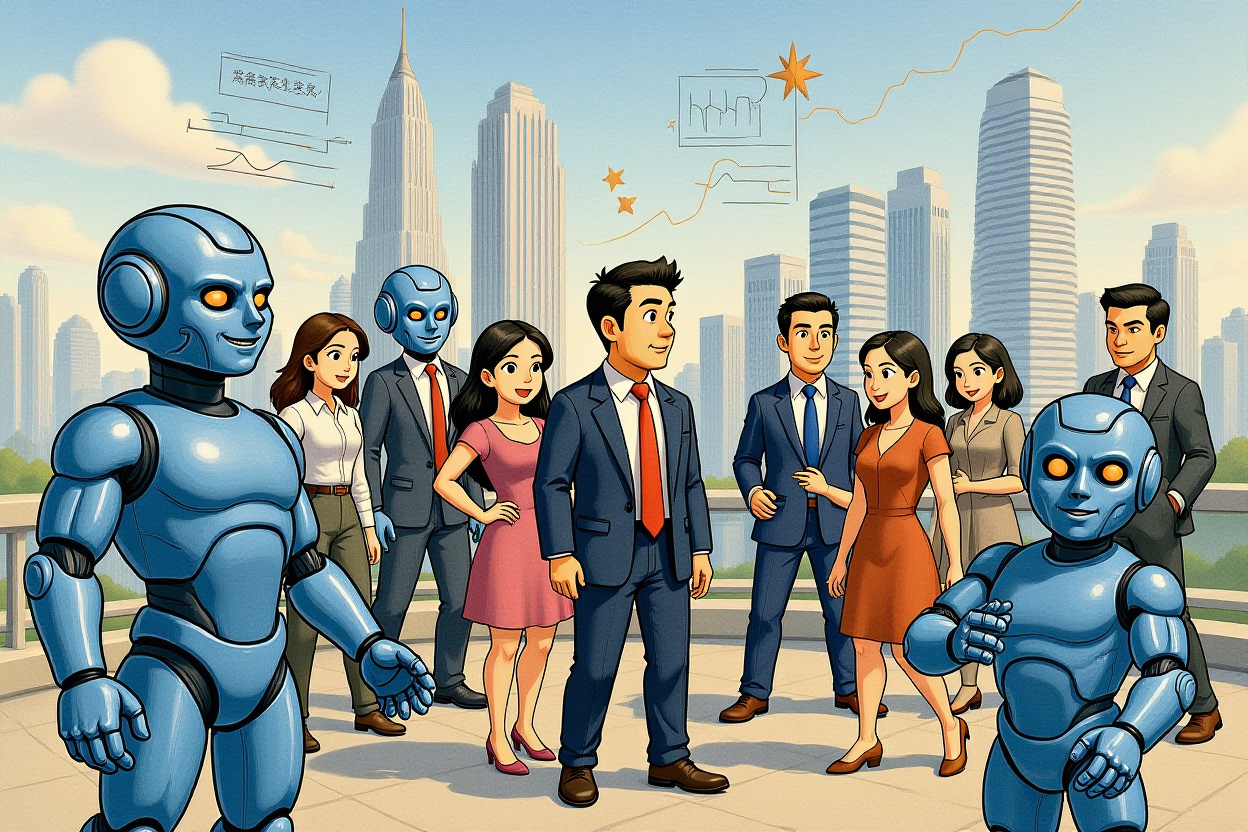
– The 2026 CCTV Spring Festival Gala served as a national showcase for four leading Chinese embodied AI companies: Magic Atom (魔法原子), Galaxy Universal (银河通用), Yushu Technology (宇树科技), and Songyan Power (松延动力). – This event marks a pivotal transition for the embodied AI industry, moving from laboratory demonstrations to real-world testing for commercial viability. – Key challenges ahead include achieving reliability in industrial settings, adaptability in dynamic commercial environments, and eventual integration into home use. – Market projections from IDC indicate China’s embodied AI robot user spending could reach $770 billion by 2030, with a 94% compound annual growth rate. – The year 2026 represents an inflection point, where industry focus shifts from fundraising and hype to tangible orders, customer adoption, and scalable revenue models. The glow of the stage lights has faded, but for China’s embodied AI sector, the real performance is just beginning. When humanoid robots from four domestic firms danced, performed martial arts, and acted alongside stars on the 2026 CCTV Spring Festival Gala—the most-watched television event on Earth—it wasn’t merely entertainment. It was a deliberate, high-stakes declaration of technological prowess aimed at billions of viewers worldwide. This showcase transforms the Gala into what industry insiders are calling the ‘ultimate testing ground’ for embodied AI, pushing these machines from controlled demonstrations into the harsh glare of public and commercial scrutiny. For global investors and business leaders tracking Chinese equity markets, this moment signals more than a tech novelty; it heralds a massive, fast-emerging market where validation on this stage could dictate future investment flows and competitive landscapes.
The Spring Festival Gala: A National Stage for Embodied AI
The CCTV Spring Festival Gala has long been a barometer for China’s technological ambitions, from 5G rollouts to AI advancements. In 2026, it became the definitive platform for embodied AI, featuring a coordinated display by four key players. This marked the first time such a ‘group army’ of domestic embodied AI enterprises shared a national spotlight, moving beyond fragmented tech exhibits to a consolidated statement of capability.
The 2026 Showcase: Four Pioneers Under the Spotlight
The four companies—Magic Atom (魔法原子), Galaxy Universal (银河通用), Yushu Technology (宇树科技), and Songyan Power (松延动力)—each played distinct roles. Yushu Technology, building on its breakout 2025 Gala appearance, partnered with the Henan Tagou Martial Arts School for a wushu performance titled ‘武 BOT.’ Songyan Power appeared in a comedy sketch ‘奶奶的最爱’ with veterans Cai Ming (蔡明) and Wang Tianfang (王天放). Magic Atom supported a song performance ‘智造未来,’ while Galaxy Universal featured in a micro-movie ‘我最难忘的今宵’ with popular actors Shen Teng (沈腾) and Ma Li (马丽). This curated presentation was designed to demonstrate versatility, from choreographed group movements to interactive, scenario-based tasks.
Decoding the Titles: Strategic Positioning in a Crowded Field
Notably, the official designations for each partner differed slightly: ‘Gala Robot Partner,’ ‘Gala Humanoid Robot Partner,’ ‘Gala Intelligent Robot Strategic Partner,’ and ‘Gala Designated Embodied Large Model Robot.’ This nuance reflects deliberate corporate positioning. Yushu Technology’s focus on robust, dynamic movement aligns with its ‘robot partner’ tag, suggesting broad applicability. Songyan Power’s ‘humanoid robot’ emphasis highlights biomimicry for social interaction. Magic Atom’s ‘strategic partner’ label may indicate deeper integration with Gala production systems, while Galaxy Universal’s ’embodied large model robot’ points to advanced AI-driven cognition. These distinctions underscore the diverse technological pathways within China’s embodied AI ecosystem, from hardware-centric agility to software-defined intelligence.
Beyond the Stage: The Commercial Imperative for Embodied AI
The Gala’s primary value extends far beyond temporary fame. It functions as a critical trust-building exercise for a nascent industry. By demonstrating reliability and sophistication on a live, error-intolerant broadcast, these companies aim to convince not just consumers, but more importantly, industrial buyers, enterprise clients, and institutional investors.
The IDC Forecast: A $770 Billion Opportunity by 2030
According to IDC data, China’s embodied AI robot user spending is projected to soar to $770 billion by 2030, expanding at a blistering 94% compound annual growth rate. This isn’t just a niche market; it’s a foundational element of China’s broader industrial automation and AI strategy. The Gala showcase serves as a catalyst, accelerating mainstream acceptance and potentially pulling forward adoption timelines across sectors. For a deeper dive into these projections, investors can review IDC’s latest reports on emerging technologies.
From Performance to Practicality: The Gala’s Dual Mission
The event carries two core missions for the embodied AI sector. First, it demystifies the technology for the general public, normalizing the idea of robots in everyday life. Second, and more crucially, it provides tangible proof points for B2B decision-makers. A robot that can perform complex martial arts sequences or comedic timing on live TV offers a compelling, albeit preliminary, testament to its sensor acuity, balance algorithms, and system integration. This ‘first display window’ is essential for bridging the gap between R&D and initial commercial pilot programs.
The Three Critical Barriers to Real-World Adoption
However, as the curtain falls, the embodied AI industry faces a triad of formidable challenges that will determine its ultimate success. The journey from stage to sustainable business model requires conquering environments far more demanding than a television studio.
Conquering the Factory Floor: Reliability and Efficiency
The most immediate and lucrative market for embodied AI lies in industrial automation. Factories demand solutions for sorting, assembly, loading, inspection, and transportation—tasks plagued by labor shortages and consistency issues. – Key Requirements: Stability, low cost, minimal downtime, and 24/7 operation in harsh conditions. – The Reality Check: A misstep on stage is a momentary blip; a failure on a production line means direct financial loss. Many robots that excel in labs struggle with real-world variables like dust, vibration, and electromagnetic interference. Success here hinges on passing extreme reliability tests, a hurdle where Gala performance is merely a first step.
Navigating Dynamic Commercial Environments
The next frontier includes service sectors like retail, logistics, hospitality, and healthcare. These settings introduce unpredictable elements: – High human traffic – Constantly changing layouts – Multimodal interaction needs (speech, gesture, navigation) A robot that follows a scripted Gala interaction may falter when a child runs unpredictably in a mall or a customer asks an unstructured question. This tests the full stack of embodied AI capabilities: computer vision, natural language processing, real-time path planning, and graceful failure recovery.
The Holy Grail: Integration into the Home
The final and most challenging barrier is the domestic sphere. Homes are unstructured, chaotic, and safety-critical. – Obstacles Include: Cluttered floors, pets, children, variable lighting, and ambiguous voice commands. – The Benchmark: Robots must be inherently safe, highly intelligent, user-friendly, and ultimately affordable. While this market represents the largest long-term opportunity—the true ‘star sea’ for the industry—it remains years away from mass adoption. Current Gala demonstrations show artistic potential, but not yet the ruggedized, fail-safe design required for daily coexistence with families.
The 2026 Inflection Point: From Hype to Hard Metrics
The year 2026 is poised to be a watershed for China’s embodied AI sector. The industry narrative is shifting decisively from speculative valuation based on demo reels and funding rounds to grounded evaluation based on commercial traction.
The Shift in Industry Focus: Orders Over Optics
Post-Gala, the competitive landscape will be defined by tangible business outcomes rather than stage time. Companies must transition from: – Showcasing at exhibitions to securing pilot contracts – Highlighting technical specs to demonstrating ROI for clients – Relying on venture capital to generating recurring revenue This maturation is healthy but demanding. It separates companies with robust, scalable technology from those built primarily for spectacle. The embodied AI firms that starred at the Gala now face the imperative to convert visibility into validated purchase orders.
Capital and Competition: The Funding Landscape Intensifies
While early-stage investment has been plentiful, the next phase will see capital become more selective. Investors, including those in Chinese equity markets, will increasingly scrutinize: – Paths to profitability in specific verticals (e.g., manufacturing, healthcare) – Proprietary technology moats (e.g., unique actuator designs, superior AI training datasets) – Strategic partnerships with major industrial conglomerates or tech platforms The pressure is on for firms like Yushu Technology, which leveraged its 2025 Gala fame into over a dozen major event appearances and seven dedicated robot competitions. Now, it must prove that this visibility translates into dominant market share in target industries.
Case Studies: How the Gala Stars are Faring Post-Show
Early indicators suggest the post-Gala journey is already underway, with each company pursuing distinct commercialization strategies.
Yushu Technology: From Viral Sensation to Market Leader?
Yushu Technology (宇树科技) has aggressively capitalized on its Gala-driven fame. According to industry reports, its robots have since featured in 12 large-scale events and 7 dedicated robot tournaments. This strategy builds brand equity but must now be coupled with industrial deployments. The company’s partnership with a martial arts school hints at potential applications in training, rehabilitation, or entertainment systems, yet its success will ultimately depend on securing contracts in logistics or manufacturing where the revenue is substantial and repeatable.
The Supporting Cast: Magic Atom, Galaxy Universal, and Songyan Power
– Magic Atom (魔法原子): Its ‘strategic partner’ title suggests ambitions beyond hardware, potentially offering AI platform services. Its performance in a song act emphasizes synchronization and auditory interaction, skills relevant for customer service or educational robots. – Galaxy Universal (银河通用): As the ’embodied large model robot,’ it likely bets on advanced AI to handle complex, reasoning-heavy tasks. Its micro-movie role required narrative understanding, a skill applicable to eldercare companionship or advanced retail assistants. – Songyan Power (松延动力): Partnering in a comedy sketch required nuanced human-robot interaction. This focus on social robotics could lead to early applications in guided tours, reception duties, or therapeutic settings. Each path underscores the diversity within embodied AI, but all converge on the same need: proving economic value in a real-world setting.
Regulatory and Economic Context: China’s Push for AI Dominance
The Gala showcase did not occur in a vacuum. It aligns with broader national strategies and has significant implications for global technology competition.
Government Policies Fueling the Embodied AI Drive
China’s ‘Made in China 2025’ initiative and subsequent AI development plans explicitly prioritize robotics and intelligent systems. – Support Mechanisms: Include tax incentives for R&D, state-guided investment funds, and procurement preferences for domestic tech in government projects. – Regulatory Framework: Agencies like the Ministry of Industry and Information Technology (MIIT, 工业和信息化部) are actively shaping standards for robot safety and interoperability, creating a more predictable environment for scaling. This policy tailwind reduces market risk for early adopters and encourages domestic supply chain development, from precision reducers to AI chips.
Global Implications for Investors and Technologists
For international investors, the rise of Chinese embodied AI presents both opportunity and challenge. – Opportunity: Access to one of the world’s fastest-growing automation markets, with companies potentially listing on exchanges like the STAR Market (科创板). – Challenge: Navigating a competitive landscape where domestic champions benefit from intense policy support, vast data pools, and integrated manufacturing ecosystems. The Gala performance is a potent symbol of this home-field advantage. It demonstrates not just technical skill, but the ability to execute complex, large-scale integrations—a capability that translates directly to industrial and commercial deployments. As such, global fund managers must look beyond the spectacle to assess which companies are building durable, export-ready technologies. The lights of the 2026 Spring Festival Gala have dimmed, but the illumination it provided for China’s embodied AI sector will resonate for years. The event successfully transitioned these technologies from obscurity to mainstream consciousness, setting the stage for the arduous work of commercialization. The key takeaway for business professionals and investors is clear: while stagecraft can launch a brand, only sustained, real-world utility can build an industry. The embodied AI companies that captivated a nation must now prove they can solve mundane but critical problems in factories, warehouses, and, eventually, living rooms. The ultimate testing ground is no longer a televised stage, but the global marketplace itself. For those tracking Chinese equities and technology trends, the call to action is to monitor quarterly filings, partnership announcements, and pilot project results from these firms. Look for evidence of recurring revenue, expanding gross margins, and depth in vertical market penetration. The era of judging embodied AI by its dance moves is over; the time to evaluate it by its balance sheet has begun.