



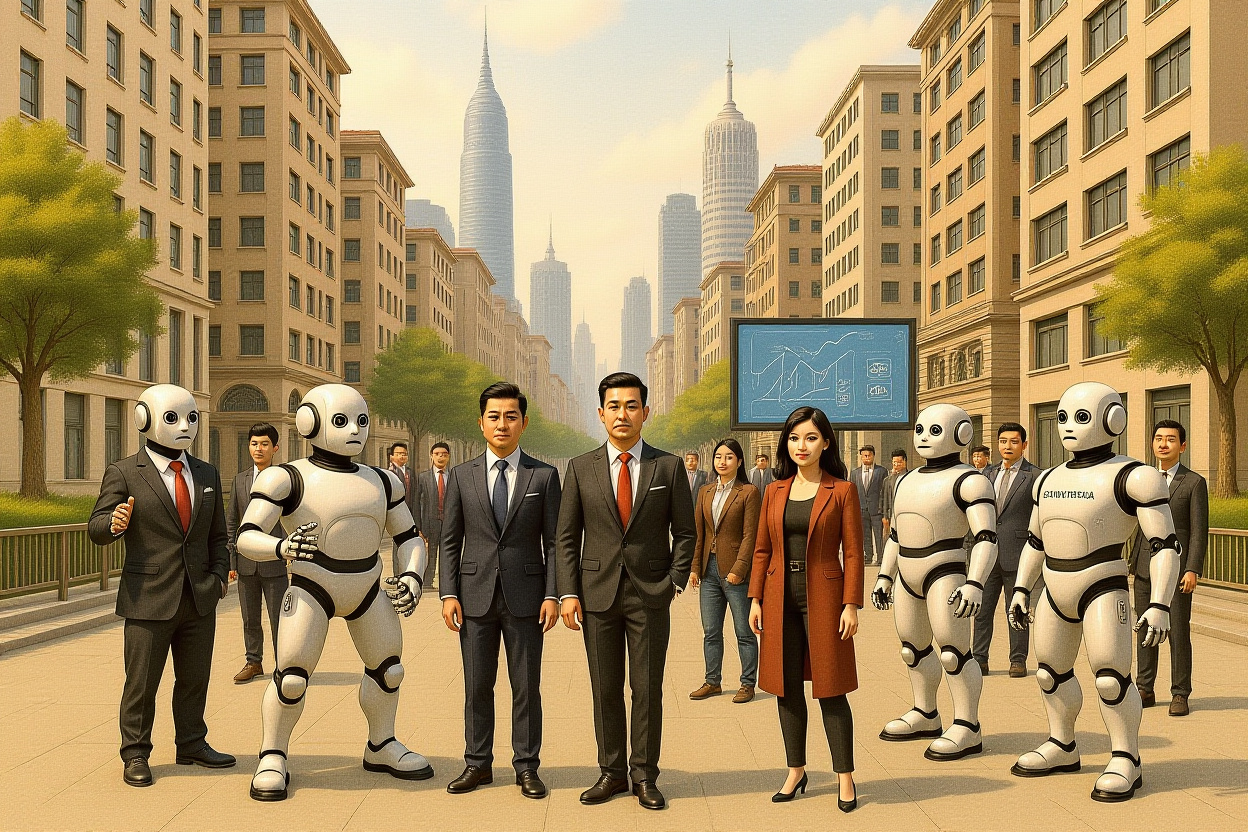
Executive Summary: Key Takeaways from the 2026 Spring Festival Gala Tech Showcase
– The 2026 CCTV Spring Festival Gala served as a national platform for four leading Chinese embodied AI companies – Magic Atom (魔法原子), Galaxy Universal (银河通用), Unitree Tech (宇树科技), and Songyan Power (松延动力) – marking a collective industry debut.
– Beyond entertainment, the event underscores a critical transition for embodied AI: from laboratory demonstrations and promotional hype to solving practical challenges in industrial, commercial, and domestic environments.
– Market analyst IDC projects explosive growth, forecasting China’s embodied AI robot user spending to reach $77 billion by 2030, fueled by a compound annual growth rate (CAGR) of 94%.
– The Gala’s spotlight acts as a double-edged sword: providing unparalleled visibility while raising the stakes for delivering reliable, scalable, and economically viable solutions.
– For investors and corporate executives, the post-Gala period demands a focus on deployment metrics, customer contracts, and supply chain maturity over technological spectacle.
When the iconic countdown concluded on the 2026 CCTV Spring Festival Gala, the most resonant applause may have been for a group of non-human performers. In a striking display of national technological ambition, the stage transformed into the ultimate test field for China’s burgeoning embodied artificial intelligence sector. This year’s edition moved beyond singular gadget reveals to feature a coordinated “group army” of humanoid robots from four domestic champions, signaling that embodied AI has graduated from research labs to the brink of mass-market consciousness. For global investors monitoring Chinese equity markets, particularly in the technology and advanced manufacturing sectors, this moment represents far more than a televised novelty. It encapsulates a pivotal inflection point where government endorsement, consumer exposure, and capital intensity converge, demanding a clear-eyed assessment of which firms can convert stagecraft into sustainable commerce. The CCTV Spring Festival Gala as the ultimate test field is not merely a metaphor; it is a live-fire exercise for an industry preparing to navigate the arduous path from prototype to profit.
The 2026 CCTV Spring Festival Gala: Embodied AI’s National Debut and Strategic Showcase
The CCTV Spring Festival Gala, with its unparalleled viewership exceeding hundreds of millions, has long served as a coveted launchpad for Chinese tech innovation. The 2026 iteration, however, marked a qualitative leap by dedicating significant segments to embodied AI, effectively anointing the sector with official cultural and technological validation. This was not a scattered display of isolated robots but a curated presentation of China’s industrial capabilities, designed to showcase diversity in technical approaches and market strategies.
A Collective Force: Analyzing the Four Contenders and Their Performances
The four selected companies each brought distinct capabilities to the stage, with their varying official partner titles hinting at deeper strategic positioning. Unitree Tech (宇树科技), labeled the “Gala Robot Partner,” reinforced its market-leading status by performing a sophisticated martial arts routine, “武 BOT,” in collaboration with the renowned Henan Tagou Martial Arts School. This followed its breakout appearance in the 2025 Gala, which catalyzed its rise as a consumer-facing brand. Songyan Power (松延动力), termed the “Gala Humanoid Robot Partner,” participated in a comedic sketch, demonstrating interactive and narrative potential. Magic Atom (魔法原子), the “Gala Intelligent Robot Strategic Partner,” supported a musical performance, while Galaxy Universal (银河通用), the “Gala Designated Embodied Large Model Robot,” featured in a micro-film, emphasizing its AI-brain capabilities. The nuanced terminology—partner, humanoid robot partner, strategic partner, designated model—reflects deliberate corporate messaging to differentiate their core competencies to investors and enterprise clients watching globally.
The Deeper Significance: From Public Awareness to Industrial Credibility
The Gala’s role extends far beyond generating viral moments. Its primary function in this context is twofold: mass education and industrial endorsement. First, it acclimatizes the Chinese public to the imminent presence of advanced robots in daily life, softening the ground for future commercial adoption. Second, and more critically for business professionals, it provides a state-sanctioned stamp of approval, offering tangible proof points to skeptical supply chain managers, manufacturing executives, and institutional investors. A successful performance on this stage mitigates perceived technology risk and can accelerate B2B sales conversations. The CCTV Spring Festival Gala as the ultimate test field thus serves as a critical credibility bridge between cutting-edge R&D and the pragmatic world of procurement orders.
Beyond the Stage Lights: The Three-Tiered Commercialization Challenge
While the Gala offers a glorious entrance, the industry’s sobering reality is that applause does not pay bills. As the lights dim, embodied AI companies must immediately confront a sequential series of commercial hurdles. The transition from a controlled, choreographed stage to the unstructured chaos of real-world environments is the true measure of technological and business maturity. This journey can be framed as three escalating gates of difficulty and market scale.
Gate One: Mastering the Industrial Domain
The first and most immediate opportunity lies in industrial automation. Factories present a structured environment with clear pain points: labor shortages in repetitive, hazardous, or precise tasks like sorting, assembly, palletizing, and quality inspection. The value proposition is straightforward—replace human labor with tireless, precise robotic systems. However, the tolerance for error is zero. A robot that dances flawlessly on stage may falter under the relentless, multi-shift demands of a production line where a minute of downtime can cost thousands of dollars. Success here hinges on achieving exceptional mean time between failures (MTBF), seamless integration with existing manufacturing execution systems (MES), and a compelling return on investment (ROI) that justifies the capital expenditure. Companies that secure anchor clients in automotive, electronics, or logistics warehousing will establish the revenue foundation and operational data necessary for further advancement.
Gate Two: Conquering Complex Commercial Environments
The next frontier encompasses commercial spaces like retail stores, hotels, hospitals, and warehouses. These scenarios introduce significant complexity: unpredictable human traffic, dynamic obstacles, and a need for natural interaction. A robot must demonstrate advanced perception, real-time path planning, and basic conversational AI to handle tasks like guidance, delivery, cleaning, or inventory scanning. The technical leap from a pre-programmed stage interaction to safely navigating a crowded supermarket aisle is substantial. It requires a robust fusion of sensors, algorithms, and mechanical reliability that functions consistently without direct supervision. Pilots in these settings are abundant, but the shift to paid, scaled deployments is where the CCTV Spring Festival Gala as the ultimate test field proves its worth—firms that shone under pressure must now prove their systems can handle the mundane, daily grind of service tasks.
Gate Three: The Distant Frontier of the Home
The final and most challenging arena is the domestic sphere. The home is the ultimate unstructured environment, filled with infinite variables: cluttered floors, pets, children, varying lighting, and ambiguous voice commands. It demands unprecedented levels of safety, affordability, simplicity, and general-purpose intelligence. While this represents the largest addressable market long-term, it remains years away from mainstream adoption due to these technical and cost barriers. Current efforts are more likely focused on specific assistive tasks for elderly care or education. The path to the home runs directly through success in industrial and commercial applications, which will drive down costs, improve reliability, and refine AI models through vast datasets collected in the field.
Market Dynamics and Investment Implications: From Hype to Hard Metrics
The compelling narrative showcased at the Gala is backed by bullish quantitative forecasts. According to IDC, China’s spending on embodied intelligent robots is projected to soar to $77 billion by 2030, expanding at a staggering 94% CAGR. This trajectory positions the sector as one of the fastest-growing within China’s broader technology and advanced manufacturing equity universe. For fund managers and institutional investors, this creates both significant opportunity and heightened due diligence requirements.
Decoding the Investment Thesis: Key Metrics for 2026 and Beyond
The post-Gala investment landscape is undergoing a fundamental shift. The era of valuation driven solely by technical demos, patent portfolios, and founder pedigrees is closing. The market is now entering a phase where hard commercial metrics take precedence. Savvy investors will prioritize tracking:
– Order Book and Contract Value: Recurring revenue from enterprise clients, especially in industrial automation.
– Deployment Scale: Number of robots operating in real customer environments and total operational hours logged.
– Unit Economics: Reduction in bill of materials (BOM) costs, service margins, and demonstrable ROI for end-users.
– Partnership Depth: Strategic alliances with major industrial conglomerates, logistics giants, or retail chains.
Firms like Unitree Tech (宇树科技) that have leveraged Gala fame into a pipeline of commercial engagements and event partnerships are exemplars of this transition. The focus phrase, the CCTV Spring Festival Gala as the ultimate test field, now evolves from a performance benchmark to a precursor for commercial vetting.
The Capital Cycle: Scaling Production and Navigating Consolidation
To meet the projected demand, embodied AI companies require immense capital for scaling production, refining proprietary actuators and sensors, and funding extensive R&D. This will likely trigger further rounds of private financing, potential SPAC mergers, and eventual IPO activity on exchanges like the STAR Market (科创板) or Hong Kong. However, the path will not be smooth for all. The industry is poised for consolidation as winners emerge based on execution capability. Investors must differentiate between companies with viable paths to gross margin positivity and those destined to remain perpetually in the development stage, reliant on dilutive funding rounds.
China’s Embodied AI Ambitions in a Global Competitive Context
China’s push in embodied AI is not occurring in a vacuum. It is a deliberate component of national strategies like “Made in China 2025” and the recent focus on developing “future industries.” The government provides substantial policy tailwinds through research grants, favorable regulatory sandboxes, and procurement programs. This ecosystem support is a critical competitive advantage, reducing time-to-market for domestic firms.
Policy Frameworks and Strategic Autonomy
Chinese regulatory bodies, including the Ministry of Industry and Information Technology (MIIT 工业和信息化部), have been actively formulating standards and development guidelines for the robotics industry. The goal is to cultivate a complete domestic supply chain, reducing dependency on foreign components for critical elements like precision reducers, servomotors, and advanced chips. Success in embodied AI contributes to broader technological self-sufficiency, a key geopolitical priority. For global investors, this means the sector enjoys a degree of insulation from international trade tensions and benefits from directed state capital, though it also faces the imperative of achieving technological parity with leading international players like Boston Dynamics or Tesla.
The Export Equation: From Domestic Dominance to Global Reach
The long-term growth story for leading Chinese embodied AI firms includes significant export potential. As companies prove their mettle in the demanding domestic market—the ultimate test field in its own right—they will be well-positioned to offer cost-competitive, reliable solutions to emerging markets and eventually compete globally. The ability to integrate seamlessly with China’s vast manufacturing ecosystem also presents a unique value proposition for multinational corporations operating production facilities within the country. Monitoring export licenses, international partnership announcements, and participation in global trade fairs will be key indicators of this expansion phase.
Synthesizing the Path Forward for Industry Stakeholders
The 2026 CCTV Spring Festival Gala will be remembered as the moment embodied AI in China stepped firmly into the national spotlight. However, the afterglow of this performance must now fuel the gritty, unglamorous work of engineering, sales, and supply chain management. The ultimate test field has validated the technology’s stage readiness; the ultimate market will judge its economic readiness. For corporate executives in manufacturing and logistics, the time is ripe to initiate pilot programs with the most promising firms, leveraging the Gala’s demonstration of capability as a starting point for serious dialogue. For institutional investors, due diligence must penetrate beyond the headline-grabbing videos to examine logistics networks, after-sales service models, and the durability of key components. The companies that thrive will be those that view the Gala not as a pinnacle, but as a springboard into the complex, rewarding, and unforgiving world of real-world application. The call to action is clear: shift your analysis from the spectacle of the stage to the substance of the shop floor, where the true revolution in Chinese embodied AI will be quantified not in viewer ratings, but in productivity gains, cost savings, and tangible enterprise value.