



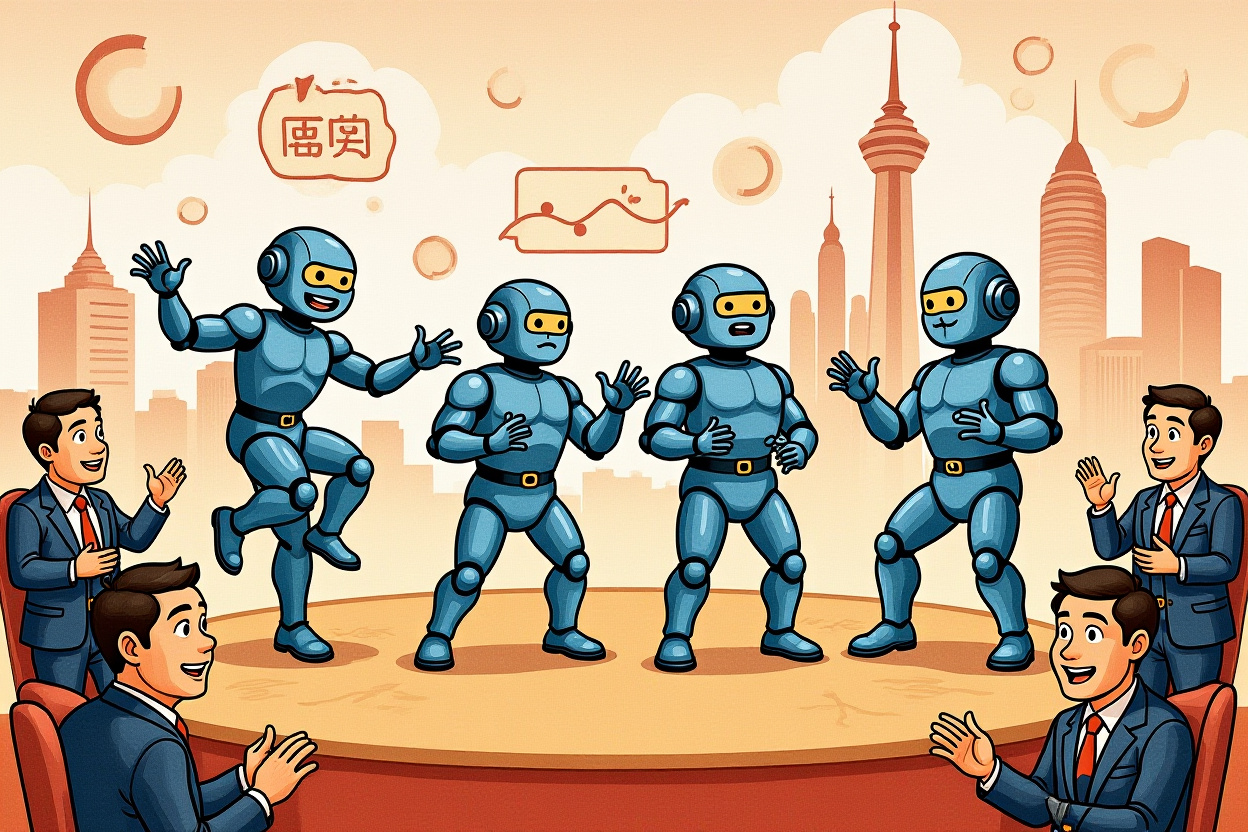
For decades, China’s CCTV Spring Festival Gala has been a barometer of societal trends and technological ambition. In 2026, the spotlight shifted decisively from celebrity performers to a new cast of stars: humanoid robots. The stage transformed into the industry’s most public and pressurized testing arena, a national platform where embodied intelligence moved from laboratory concept to mainstream consciousness. For investors tracking the explosive growth of China’s robotics sector, the Gala was far more than a spectacle; it was a critical milestone, offering a transparent, side-by-side comparison of the country’s leading contenders in a race projected to be worth hundreds of billions of dollars. This public debut on the ultimate proving ground marks a pivotal transition for the industry, shifting the battle from fundraising and R&D to the harsh realities of application, reliability, and commercial viability.
Executive Summary: Key Takeaways from the Gala’s Robotic Showcase
- The 2026 CCTV Gala served as a coordinated, national-level debut for China’s embodied AI sector, featuring four leading firms—Unitree Robotics (宇树科技), Magic Atom (魔法原子), Galaxy General (银河通用), and Songyan Power (松延动力)—in a high-stakes public performance.
- Subtle differences in official partnership titles (e.g., “Robot Partner” vs. “Embodied Large Model Robot”) reveal strategic divergences in technical pathways, product focus, and market positioning among the competitors.
- The event’s primary value extends beyond brand exposure; it acts as a crucial trust signal to the supply chain, enterprise clients, and capital markets, validating the functional maturity of domestic robotics technology.
- The real challenge begins post-Gala, as companies must navigate three sequential commercialization hurdles: industrial automation, complex commercial services, and ultimately, the unstructured home environment.
- 2026 is poised to be an industry inflection point, shifting the competitive metric from capital raised and demo reels to tangible customer orders, scalable revenue, and proven reliability in real-world settings.
The Gala Stage: From Cultural Icon to Technology’s Ultimate Proving Ground
The CCTV Spring Festival Gala is more than a television show; it is a cultural institution watched by nearly a billion people. Its role as a trendsetter has evolved with the times, progressively showcasing China’s technological advancements from 5G broadcasts to virtual reality segments. The 2026 edition, however, represented a quantum leap. It moved beyond featuring technology as a supporting tool to placing it center stage as the main act. This was not a scattered display of gadgets but a deliberate, curated presentation of China’s embodied AI “corps,” signaling state-level endorsement and a strategic push to accelerate public and commercial adoption.
By providing this unified platform, the Gala performed two vital functions for the burgeoning industry. First, it conducted mass public education and acceptance training. Demonstrating robots performing complex, culturally resonant tasks like martial arts alongside human partners makes the technology relatable and reduces public apprehension. Second, and more critically for the investment community, it served as a high-fidelity demonstration day. For enterprise buyers, supply chain partners, and institutional investors, seeing multiple robots perform live on a globally broadcast stage with near-zero tolerance for error offers a powerful proxy for technical robustness—a factor far more convincing than a controlled laboratory video.
A Side-by-Side Comparison of the Four Contenders
The Gala’s format allowed for a rare direct comparison of China’s robotic pioneers, each assigned to a different segment showcasing their capabilities:
- Unitree Robotics (宇树科技): Partnering with the renowned Tagou Martial Arts School (河南塔沟武术学校), Unitree performed in the martial arts program “Wu BOT.” This built on its breakout success from the 2025 Gala, cementing its reputation for dynamic motion control and stability—a capability directly transferable to industrial and logistics settings.
- Songyan Power (松延动力): Appearing in the sketch “Grandma’s Favorite” with comedians Cai Ming (蔡明) and Wang Tianfang (王天放), Songyan Power demonstrated social interaction and comedic timing, highlighting its focus on human-robot collaboration and service-oriented applications.
- Magic Atom (魔法原子): This firm supported the song “Intelligent Creation of the Future,” emphasizing its role in creative and performative contexts, potentially aligning with entertainment and educational verticals.
- Galaxy General (银河通用): Featured in the micro-film “My Most Memorable Tonight” with mega-stars Shen Teng (沈腾) and Ma Li (马丽), Galaxy General’s inclusion under the title “Gala Designated Embodied Large Model Robot” suggests a strong emphasis on AI cognitive capabilities and narrative interaction.
The nuanced variance in their official designations—”Robot Partner,” “Humanoid Robot Partner,” “Intelligent Robot Strategic Partner,” and “Designated Embodied Large Model Robot”—is not mere semantics. It reflects a strategic positioning chess game, indicating whether a company is marketing itself as a full-stack solution provider, a hardware specialist, an AI platform, or an integration expert. For savvy investors, these labels provide early clues to each firm’s target market and technological moat.
Beyond the Spotlight: The Formidable Path to Commercial Viability
While the Gala’s lights have dimmed, the intense scrutiny on these companies has only intensified. The industry adage, “Robots can’t dance on stage forever,” cuts to the core of the challenge. Performance art generates buzz, but sustainable business models are built on solving real-world problems with efficiency and reliability. The transition from the ultimate proving ground of the stage to the ultimate proving ground of the market involves conquering three progressively difficult frontiers, each with its own set of technical and economic demands.
The financial stakes are enormous. According to IDC data, China’s embodied intelligent robot user expenditure is forecast to reach $77 billion by 2030, representing a staggering compound annual growth rate (CAGR) of 94%. This hyper-growth trajectory has fueled a venture capital frenzy, but the post-2026 phase will separate the truly viable from the merely well-funded. Success will be measured by contract wins, pilot program expansions, and gross margins, not just social media impressions from a televised event.
Frontier One: Conquering the Factory Floor
The first and most immediate market is industrial automation. Factories present a structured, repetitive, and financially compelling environment for robots. Tasks like sorting, assembly, palletizing, quality inspection, and material handling are plagued by labor shortages, rising wages, and ergonomic concerns. The value proposition is clear: replace human labor in dull, dirty, and dangerous roles.
However, the factory floor is an unforgiving ultimate proving ground. It demands 99.9%+ uptime, millimeter precision, and the ability to operate 24/7 in environments with dust, vibration, and electromagnetic interference. A misstep on stage is a blooper; a misstep on a production line halts output and incurs direct costs. The key metrics here are Mean Time Between Failure (MTBF), cycle time, and total cost of ownership. Companies like Unitree, with their demonstrated prowess in precise, dynamic motion, may have an early edge in logistics and agile manufacturing, but they must prove their hardware can withstand years of continuous operation.
Frontier Two: Navigating Dynamic Commercial Spaces
The second frontier encompasses commercial service scenarios: hotels, hospitals, shopping malls, warehouses, and restaurants. These environments are semi-structured, introducing variables like human traffic, unpredictable obstacles, and diverse task requests. A robot here must integrate advanced capabilities: computer vision for navigation and object recognition, natural language processing for basic interaction, and sophisticated task planning.
Passing a Gala test with a pre-programmed interaction is fundamentally different from navigating a crowded airport terminal to guide a passenger or managing inventory in a busy retail backroom. This frontier tests the integrated “embodied intelligence” stack—the seamless fusion of a physical body with a capable AI “brain.” Firms like Galaxy General, which tout their large model capabilities, are targeting this space, where cognitive function is as important as physical dexterity. The business model shifts from capital equipment sales to Robotics-as-a-Service (RaaS), requiring robust software and fleet management platforms.
Frontier Three: The Distant Dream of the Home
The final and most challenging frontier is the mass consumer home. This is the ultimate unstructured environment: cluttered floors, unpredictable pets and children, variable lighting, and ambiguous user commands. The technical hurdles are immense, requiring breakthroughs in safety (both physical and data privacy), affordability, general-purpose AI, and intuitive user interfaces.
While the home represents the largest addressable market in the long term, it remains a distant goal for humanoid robotics. Current efforts are more likely to succeed first with single-purpose devices (like robotic vacuuses) or limited-mobility assistants before evolving into general-purpose humanoid helpers. The Gala performances make this future feel tangible, but the path from a scripted martial arts routine to reliably folding laundry in a random household is a journey of perhaps a decade or more, dependent on breakthroughs in AI, sensor cost reduction, and battery technology.
Strategic Implications for the Ecosystem and Global Investors
For the Supply Chain and Capital Markets
The Gala’s validation effect has ripple consequences. Tier-1 suppliers for critical components like harmonic drives, servo motors, force sensors, and high-energy-density batteries will see validated demand. The performance also de-risks investment for later-stage private equity and public market investors who have been cautious about the sector’s hype cycle. The narrative is shifting from “if” to “when” and “which player.” As the industry consolidates, M&A activity will likely increase, with stronger platforms acquiring niche specialists in vision, grasping, or AI.
Regulatory attention will also grow. As robots move into public spaces and workplaces, standards for safety, data security, and human-robot interaction will need to be developed. Proactive engagement with bodies like the Ministry of Industry and Information Technology (MIIT, 工业和信息化部) will be crucial for market leaders.
The Global Competitive Landscape
China’s concerted push, exemplified by the Gala’s platform, accelerates its competition with global leaders like Tesla (with its Optimus bot), Boston Dynamics, and Figure AI. China’s advantages include a massive domestic market for initial deployment, a world-class manufacturing ecosystem for rapid iteration and cost reduction, and strong government policy support under initiatives like “Made in China 2025.” The Gala demonstrates that Chinese firms are not merely copying but innovating, particularly in areas like cost-effective actuator design and AI applications tailored to local commercial scenarios.
For global investors, this means the embodied AI opportunity is not monolithic. Different leaders may emerge in different geographic or vertical markets. Tracking the post-Gala commercial traction of the four Chinese firms provides critical data points on the scalability of their respective models. The ultimate proving ground of global competition is just beginning.
From Stage Lights to Streetlights: The Road Ahead for Embodied AI
The 2026 CCTV Spring Festival Gala will be remembered as the moment embodied AI graduated from trade shows to the national mainstream. It provided a spectacular, yet serious, benchmark for the industry’s progress. The four featured companies have successfully leveraged this ultimate proving ground to build brand equity and demonstrate technical competence. However, the applause has faded, and the real work has begun. The coming 18-24 months will be decisive, as the industry moves from performing pre-choreographed routines to solving open-ended problems in noisy, unpredictable environments.
The key differentiator will be the ability to forge deep partnerships with lead customers in manufacturing, logistics, and commerce. Pilot projects must scale, and unit economics must become positive. Companies that fixated only on the spectacle risk becoming cautionary tales, while those that used the Gala as a springboard to secure pivotal enterprise contracts will define the next chapter. For market observers and investors, the critical task is to look beyond the stagecraft and monitor real-world deployment metrics, customer testimonials, and recurring revenue streams. The ultimate proving ground was televised to the world, but the final exam is being administered daily, in factories, warehouses, and commercial hubs across China and beyond.