



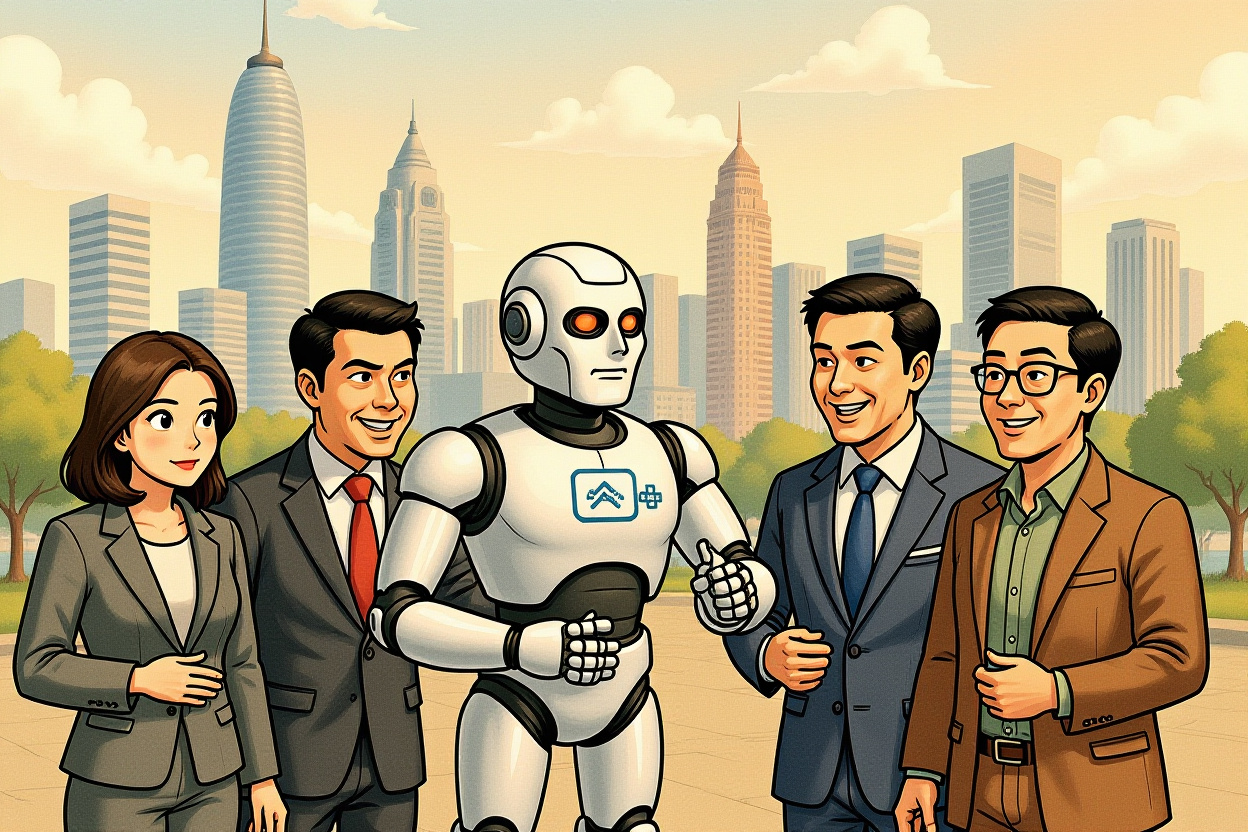
For decades, the CCTV Spring Festival Gala has served as a cultural barometer, reflecting societal values and national priorities. In recent years, it has increasingly become a high-stakes launchpad for China’s technological ambitions, showcasing everything from 5G infrastructure to satellite communications. The 2026 edition, however, may be remembered as the moment embodied intelligence moved from the fringes of R&D labs into the living rooms and consciousness of hundreds of millions. The gala’s stage transformed into a dynamic proving ground, not for pop stars, but for humanoid robots from four leading domestic firms: Magic Atom (魔法原子), Galaxy Universal (银河通用), Unitree Robotics (宇树科技), and Forward Dynamics (松延动力). Their synchronized dances and martial arts displays were more than just novelty acts; they signaled the opening bell of a fierce commercial race. The ultimate test for China’s embodied AI sector has begun, shifting the battleground from dazzling stage performances to the unforgiving realities of factory floors, retail spaces, and, eventually, homes.
Key Takeaways for Investors and Industry Observers
- The 2026 CCTV Gala served as a watershed moment, transitioning embodied AI from isolated demos to a coordinated, national-level showcase, validating the sector’s strategic importance.
- Nuanced official partner titles (e.g., “Strategic Partner” vs. “Specified Embodied AI Robot”) reveal critical differences in the four featured companies’ technical paths, product maturity, and commercial positioning.
- Post-gala, the industry faces a stark pivot: success will no longer be measured by funding rounds or stage appearances, but by conquering three sequential commercialization hurdles—industrial, commercial, and domestic adoption.
- With IDC forecasting China’s embodied AI robot user expenditure to hit $77 billion by 2030, the market potential is enormous, but 2026 marks the start of a Darwinian shakeout where real orders and reliable performance will separate winners from losers.
- For international investors, the gala underscores China’s determined push for leadership in next-generation robotics, highlighting both the rapid progress and the significant technical and economic challenges that remain before widespread adoption.
The Gala as the Ultimate Proving Ground for Embodied Intelligence
The inclusion of four embodied AI companies—Magic Atom, Galaxy Universal, Unitree Robotics, and Forward Dynamics—in the 2026 gala lineup was not a coincidence but a strategic orchestration. Unlike previous years where a single tech demo might be featured, this “group army” presentation signaled a mature, coordinated push by industry and state media to mainstream the concept of embodied intelligence. The gala, reaching an audience of nearly a billion, performed two critical functions beyond mere entertainment. First, it served as a massive public awareness campaign, acclimatizing the population to the imminent reality of advanced robots in daily life. Second, and more crucially for the business ecosystem, it provided a state-backed endorsement, offering domestic technology a credibility boost in the eyes of potential enterprise clients, supply chain partners, and global investors.
The performances themselves were carefully curated tests of core competencies. Unitree Robotics, building on its breakout 2025 gala appearance, partnered with the renowned Tagou Martial Arts School for a program titled “武 BOT,” demonstrating agility, balance, and complex choreography. Forward Dynamics participated in a comedy sketch, requiring basic interaction and comedic timing. Magic Atom supported a musical number, while Galaxy Universal featured in a micro-movie, testing narrative integration. Each segment pushed different aspects of embodied AI, from pure locomotion to environmental awareness and simple human-robot interaction. This staged environment, however controlled, acted as a high-pressure, real-time validation of system stability and performance under glaring lights and immense scrutiny—a prerequisite for any technology seeking widespread trust.
Decoding the Nuances: Partner Titles as Strategic Signals
A telling detail noted by industry observers was the variance in the official titles bestowed upon the four companies by CCTV. Unitree was named a “Gala Robot Partner,” Forward Dynamics a “Gala Humanoid Robot Partner,” Magic Atom a “Gala Intelligent Robot Strategic Partner,” and Galaxy Universal the “Gala Specified Embodied Large Model Robot.” These subtle distinctions are far from arbitrary; they telegraph distinct corporate strategies and technological focuses to a savvy audience.
- Unitree Robotics (宇树科技): Its simpler “Robot Partner” title belies its status as a market leader in consumer and agile robotics. Having performed at over a dozen major events and competitions since 2025, Unitree is betting on high-profile demonstrations to build brand recognition and showcase the athletic pinnacle of current hardware.
- Forward Dynamics (松延动力): The specific “Humanoid Robot” tag may indicate a focus on a generalized human form factor, potentially targeting service and interaction scenarios, as hinted by its sketch participation.
- Magic Atom (魔法原子): The “Strategic Partner” designation suggests a deeper, possibly more integrated or long-term collaboration with broadcasters or content creators, focusing on the “intelligent” and interactive aspects of its platforms.
- Galaxy Universal (银河通用): The most technically specific title, “Specified Embodied Large Model Robot,” highlights its core differentiator: the integration of a sophisticated large language model (LLM) or embodied AI model into its robotics stack. This points to a strategy centered on cognitive ability and task generalization rather than just physical prowess.
This differentiation underscores that there is no single path to success in embodied intelligence. The gala served as a public unveiling of these divergent philosophies, setting the stage for a multi-front competitive battle.
The $77 Billion Question: Scaling Beyond the Stage
The applause has faded, but the real work for China’s embodied AI sector is just beginning. As IDC analysts project, the Chinese market for embodied intelligent robots is poised for explosive growth, with user expenditure expected to reach $77 billion by 2030, representing a compound annual growth rate (CAGR) of 94%. This dazzling potential, however, is contingent on solving the fundamental equation of commercial viability. The industry adage, “Robots can’t dance on stage forever,” cuts to the core of the challenge. The gala was a magnificent marketing coup, but it was merely the entrance exam. The final examination—passing the tests of real-world utility, reliability, and cost-effectiveness—is now administered by the market itself.
Investor sentiment, once buoyed by visionary keynotes and viral video clips, is increasingly demanding tangible progress. “The narrative is shifting from ‘what could be’ to ‘what is shipping,'” notes a Shanghai-based tech analyst. “Quarterly reports will now be scrutinized for deployment numbers, average selling prices, and gross margins, not just R&D milestones.” The transition is from a capital-driven hype cycle to an execution-driven growth phase. Companies that leveraged the gala’s exposure to secure pilot projects with manufacturing giants or logistics leaders will have a crucial first-mover advantage. For others, the glow of the stage lights may fade quickly without a robust pipeline of commercial contracts to back it up.
The Three Gates of Commercialization: A Sequential Siege
The journey from gala stage to global ubiquity is not a sprint but a grueling marathon with three distinct, sequential barriers. Success in embodied intelligence requires conquering each in turn, as each presents a unique set of technical and economic constraints.
Gate One: Conquering the Industrial Domain
The first and most immediate market is industrial automation. Factories offer structured environments, repetitive tasks, and a clear economic rationale—replacing expensive, scarce, or hazardous human labor. Applications like precision assembly, palletizing, quality inspection, and machine tending are prime targets. However, the factory floor is merciless. It demands 99.9%+ uptime, millimeter precision, and robust operation in environments filled with dust, electromagnetic interference, and constant vibration. A robot that stumbles during a gala dance can reset; a robot that faults on an automotive assembly line can cost tens of thousands of dollars per minute in lost production.
Companies like Midea Group (美的集团) and Foxconn (富士康) are actively testing humanoid robots for electronics assembly and logistics. The challenge is achieving not just functional competence but superhuman reliability at a total cost of ownership that beats both traditional industrial arms and human workers. This gate tests the fundamental hardware durability, control system stability, and systems integration prowess of embodied AI firms.
Gate Two: Navigating the Complexities of Commercial Spaces
The second gate leads into commercial and public service scenarios: warehouses, hospitals, hotels, shopping malls, and restaurants. Here, the environment is semi-structured and dynamic. Tasks are more varied—guiding customers, delivering supplies, taking inventory, disinfecting rooms. The embodied intelligence system must integrate advanced perception (computer vision, LiDAR), dynamic path planning amidst moving people and objects, and natural, safe human-robot interaction.
Passing this gate requires moving beyond pre-programmed routines. A robot in a hospital corridor must distinguish between a doctor rushing by and a patient leaning against a wall. A hotel delivery robot must understand vague commands like “take this to room 512” and navigate unpredictable obstacles like luggage carts or children. Success here demonstrates a robot’s ability to handle uncertainty and complexity, leveraging AI for real-time decision-making. This is where the “large model” advantage touted by companies like Galaxy Universal becomes critical, enabling more adaptive and understandable behavior.
Gate Three: The Final Frontier – The Chaotic Home
The third and most distant gate is the consumer home—the purported “ultimate market” with the largest addressable audience but also the most formidable challenges. The home is a profoundly unstructured, cluttered, and unpredictable environment. Surfaces are uneven (carpets, thresholds), obstacles are random (toys, shoes), and “users” range from tech-savvy adults to curious toddlers and pets. Tasks are ill-defined: “tidy up the living room” or “help me cook.”
To penetrate the home, embodied intelligence must achieve an unprecedented level of safety, generalized intelligence, user-friendliness, and affordability. The cost must drop from tens or hundreds of thousands of dollars to a few thousand. The system must be fail-safe around children and pets. Its AI must understand context and infer intent from ambiguous requests. While this market represents the industry’s “star and sea,” it remains a long-term vision. Most industry experts believe scalable home adoption is a decade or more away, predicated on breakthroughs in AI, sensor fusion, battery technology, and manufacturing scale that drive costs down exponentially.
The 2026 Divide: From Hype to Hard Metrics
The year 2026 is poised to become a definitive watershed for China’s embodied AI industry. The sector is maturing from a technology demonstration phase, fueled by venture capital and competitive spirit, into a commercialization phase, driven by customer demand and unit economics. The metrics of success are undergoing a fundamental change.
The Old Metrics (Pre-2026): Amount of venture funding raised, number of patents filed, sophistication of technology demonstrations, social media virality of robot videos, size of R&D team.
The New Metrics (Post-2026 Gala): Number of paid pilot deployments, scale of follow-on orders, list of Fortune 500 enterprise clients, mean time between failures (MTBF) in field operations, gross margin per unit, annual recurring revenue (ARR) from software/services.
This shift will inevitably lead to industry consolidation. Companies that cannot transition from crafting captivating stage performances to delivering reliable, cost-effective solutions for defined business problems will struggle to secure further funding or attract partners. As Li Xiang (李想), founder of Li Auto (理想汽车), once remarked about the EV industry, “The first round is about the idea, the second is about the prototype, and the third is about mass production and delivery.” The embodied AI sector is now entering its own critical “mass production and delivery” phase.
Strategic Implications and the Road Ahead
The collective debut at the 2026 Spring Festival Gala was a triumphant statement of capability, but it was only the opening act. The path forward for China’s embodied intelligence leaders is now clearly charted, albeit fraught with difficulty. In the immediate term, the focus will be laser-like on the industrial sector, where the ROI is clearest and the environments most controllable. Partnerships with major manufacturers will be key, as will be adapting robot designs for specific, high-value vertical applications rather than pursuing a one-size-fits-all humanoid form.
For global investors and competitors, the gala is a clear signal that China is all-in on this next wave of automation and AI. The level of coordination between private enterprise and public platforms is a distinct competitive advantage in driving domestic adoption. However, the same rigorous market tests await Chinese firms as they do international players like Tesla with its Optimus bot or Figure AI. The ultimate winners will be those who master the unglamorous engineering challenges of durability, cost reduction, and system integration.
The embodied intelligence revolution is underway, and its initial battlelines were vividly drawn on one of the world’s most-watched stages. The performers have taken their bows. Now, they must roll up their sleeves and get to work in the warehouses, factories, and hospitals where the true value of their technology will be measured not in applause, but in productivity gains, operational savings, and solved human problems. The ultimate test for this generation of intelligent machines has moved from the dazzling, controlled environment of the CCTV stage to the messy, demanding, and economically unforgiving real world.