



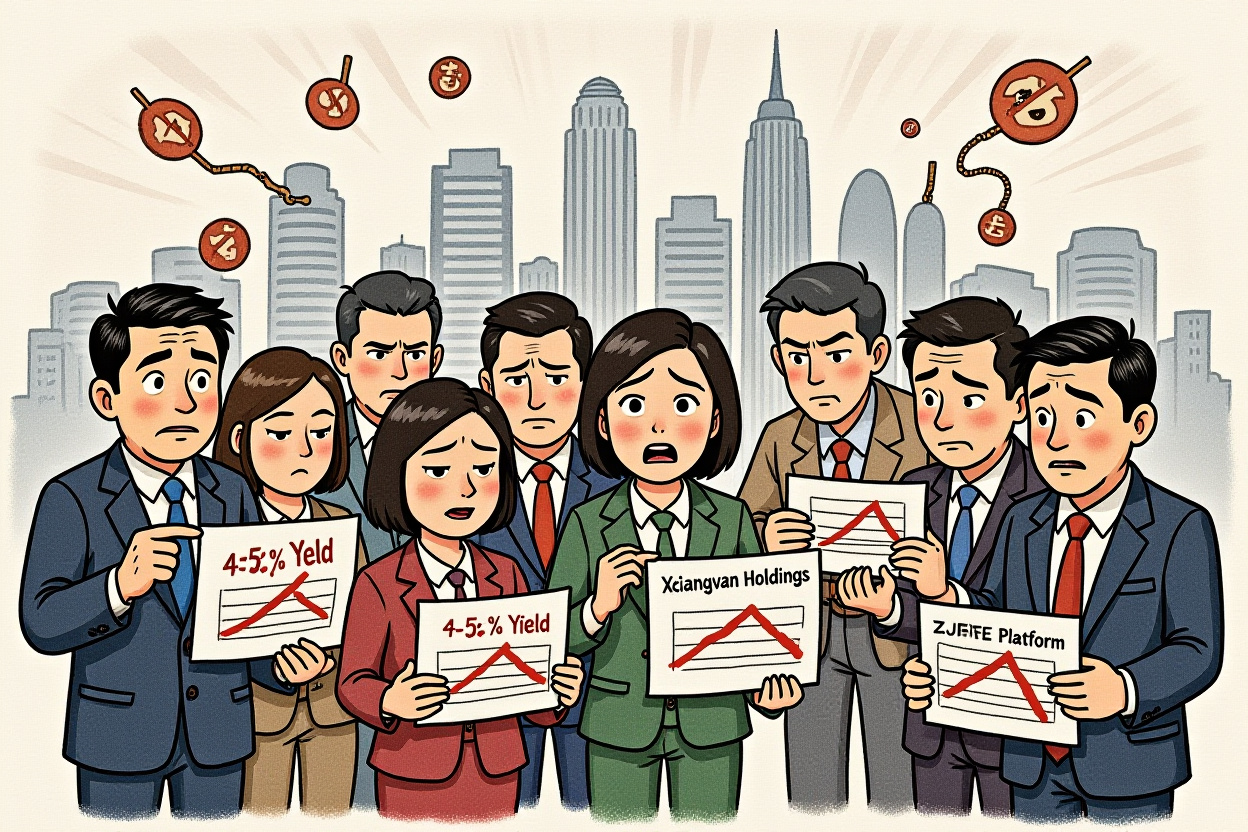
Executive Summary: A Financial Storm with Far-Reaching Implications
In late November 2025, a significant liquidity crisis shook China’s financial markets as a series of investment products, widely sold as secure and offering annualized returns of 4-5%, failed to make scheduled payments. This event is not an isolated incident but a symptom of deeper systemic issues. The case involves a major property developer, an obscure financial exchange platform, and billions in investor funds. The fallout provides critical lessons on the persistent risks within China’s shadow banking sector and the ongoing property market distress.
- A default crisis has hit multiple financial asset income right products linked to property developer Xiangyuan Holdings Group Co., Ltd. (祥源控股集团有限责任公司), with exposure estimated to exceed RMB 10 billion.
- The products, sold through the Zhejiang Zhejin Asset Operation Co., Ltd. (浙江浙金资产运营股份有限公司, formerly ZJFE) platform, were marketed as low-risk with 4-5% yields but were backed by real estate receivables from a financially strained developer.
- This incident highlights the enduring dangers of complex, non-standard financing arrangements, often involving “self-funding and self-guarantee” structures, within China’s financial ecosystem.
- Investors now face an uncertain recovery process as authorities step in, underscoring the critical need for deep due diligence beyond advertised yields and platform assurances.
- The crisis underscores the severe and ongoing liquidity pressures on Chinese property developers and the potential for contagion into broader financial markets.
The Unfolding Crisis: Billions in “Safe” Investments Turn Sour
The first signs of trouble emerged on November 28, 2025, when investors began reporting that expected interest payments on products purchased through the ZJFE platform had not arrived. The situation quickly escalated from delayed income to outright defaults on principal for products maturing from December 2025 through April 2026. The common thread linking these troubled investments was their underlying connection to Xiangyuan Holdings and its real estate projects.
Investor-organized documentation reviewed by financial media indicates the scope is vast, involving over 200 distinct product lines with a total transaction scale surpassing RMB 10 billion. These were not speculative instruments but products pitched to retail and professional investors alike as stable supplements to fixed-income portfolios. The promise of 4-5% annualized returns in a low-interest-rate environment proved an irresistible lure, masking the concentrated property sector risk festering beneath the surface.
Investor Plight and Communication Breakdown
Attempts by aggrieved investors to seek answers have been met with confusion and obstruction. A planned meeting on December 6 at Xiangyuan’s headquarters in Shaoxing was abruptly relocated, with investors only able to complete basic registration forms without meeting company executives. Individual stories, like that of an investor surnamed Li, highlight the erratic communication; after initially missing a payment, she was told by platform客服 that funds were “being processed urgently” and received the payment days later, only to be left in limbo regarding the safety of her principal.
The crisis of confidence deepened as investors scrutinized product documents. These revealed a common structure: the underlying assets were accounts receivable from Xiangyuan’s real estate projects across Anhui, Zhejiang, and Hunan provinces. The guarantor for these obligations was consistently Xiangyuan Holdings and its ultimate controller, billionaire Yu Faxiang (俞发祥). This setup created a classic case of circular risk, where the health of the investment was entirely dependent on the solvency of a single, now-struggling corporate group.
Deconstructing the Product: A Recipe for Concentrated Risk
To understand how this crisis occurred, one must dissect the anatomy of these so-called low-risk financial products with yields of 4-5%. The structure was a multi-layered arrangement designed to channel investor funds to a specific corporate borrower while presenting a facade of security and regulatory oversight.
The typical product, such as the “Financial Asset Income Right (Boyao Shaoxing) ZY20240301007,” followed a “factoring company transfer + financial exchange listing” model. In simplified terms: a factoring company would first acquire a claim (an account receivable) from a Xiangyuan project company. This claim was then packaged as a “financial asset income right” and listed for sale to investors on the ZJFE platform. The final step was the critical sales pitch: these products came with an “unconditional and irrevocable joint liability guarantee” from Xiangyuan’s chairman, Yu Faxiang, creating the perception of a safety net.
The “Self-Funding, Self-Guarantee” Trap
Legal experts point out the fundamental flaw in this design. “This non-standard financing arrangement belongs to a closed-loop of ‘self-funding and self-guarantee’不规范操作,” explained Xiao Jingren (肖敬仁), director of Beijing Sheng Han Law Firm. “It transfers internal group risk to external investors through the form of ‘wealth management products.’ Although credit enhancement was provided through guarantees, the financier, guarantor, and the underlying asset debtor all belong to the same actual controller. The raised funds circulate within the group, and the risk remains highly concentrated.”
In essence, investors were not diversifying their risk but providing a loan directly to Xiangyuan Holdings through an opaque intermediary chain. The promised 4-5% yield was funded by the developer’s ability to continually roll over debt and sell properties—a model that collapsed when both the property market and regulatory tolerance for such financing schemes soured simultaneously.
The Platform’s Role: ZJFE and the End of the “金交所” Era
A critical player in this drama is the platform that hosted these products: Zhejiang Zhejin Asset Operation Co., Ltd. (浙江浙金资产运营股份有限公司), commonly known as ZJFE or a “金交所” (Financial Asset Exchange). For years, these provincial-level exchanges operated in a regulatory gray area, facilitating the issuance of non-standard products like “定向融资计划” (Directed Financing Plans) that fell outside traditional bank and securities markets oversight.
ZJFE’s role, as it now emphatically states, was that of a transaction service platform. On December 8, it posted a risk notice on its website clarifying that it “does not bear any risks arising from product transactions, or the responsibility to replace the product listing and trading institution and/or the credit enhancer in履行履约责任.” However, its prior marketing and operational practices undoubtedly lent an air of legitimacy to the products listed on its platform.
Regulatory Wind-Down and Lingering Liabilities
The broader context is a nationwide crackdown. On October 31, 2024, the Zhejiang Provincial Local Financial监督管理局 (Financial Regulatory Bureau) announced it would no longer retain ZJFE’s financial asset trading business qualification. By January 2025, its business scope was officially amended, removing “engaging in various types of financial asset trading and related services.” This move was part of a systematic cleanup of a sector plagued by scandals.
Professor Wang Li (王立) of Hangzhou Normal University’s Shen Junru Law School noted, “Compared with other local financial organizations,金交所 have more public-involved businesses and theoretically require a more mature regulatory framework.” The era of loosely regulated金交所 is over, but, as this case shows, their legacy—trillions in存量业务 (outstanding business)—remains a ticking time bomb. The provincial regulator’s notice explicitly stated that the资质取消 (qualification cancellation) does not affect the company’s duty to lawfully undertake its legal responsibilities and continue to bear the main responsibility for disposing of outstanding business.
Xiangyuan’s Downward Spiral: From Empire Building to Firefighting
At the heart of the crisis is Xiangyuan Holdings, a conglomerate built by Yu Faxiang with interests spanning tourism, culture, and—most significantly—real estate. The company’s strategy revolved around creating large-scale “文旅城” (cultural-tourism cities), using tourist attractions to drive land value and property sales. This capital-intensive model relied heavily on continuous financing.
In a communication with investors on December 5, Xiangyuan’s Executive President Shen Baoshan (沈保山) laid bare the company’s predicament. He stated the group had total assets of approximately RMB 60 billion, which theoretically covered liabilities of RMB 40 billion. The fatal flaw was liquidity: RMB 30 billion worth of property inventory was unsellable in the stagnant market, and the closure of the ZJFE fundraising channel severed the vital “借新还旧” (borrow new to repay old) lifeline. The result was an immediate cash crunch.
On-the-Ground Evidence of Distress
Field visits by journalists to Xiangyuan projects confirm the severe operational slowdown. In Hefei, the 268-meter Xiangyuan Center, once touted as the tallest building in the city’s High-Tech Zone, stands with an unfinished exterior and no visible construction activity. A site watchman could only say construction proceeded sporadically “when there is money.”
In Fuyang, multiple projects tell a similar story. A tourism “small train” project is abandoned, with only rusty bridges and piers remaining. Residential projects show severely delayed construction timelines, with some plots lying fallow and used for vegetable gardens. The上海票据交易所 (Shanghai Commercial Paper Exchange) list of entities with持续逾期 (continuous overdue) commercial paper payments includes several Xiangyuan property subsidiaries, providing official corroboration of payment failures.
Asset Reality: What’s Left for Recovery?
For investors hoping to recoup their funds, the central question is the quality and accessibility of Xiangyuan’s remaining assets. The picture that emerges is one of an empire heavily leveraged, even at the holding company level.
Xiangyuan controls three listed companies: Xiangyuan Cultural Tourism (SH600576), Haichang Ocean Park (HK02255), and Jiaojian股份 (SH603815). While these entities have publicly distanced themselves from the product defaults, their shares are not immune. Disclosure documents show significant portions of the shares held by Yu Faxiang and related entities in Xiangyuan Cultural Tourism and Jiaojian股份 have been pledged as collateral for loans.
More alarmingly, even the crown jewel tourism assets within the listed Xiangyuan Cultural Tourism have been heavily mortgaged. The company’s 2025 interim report shows fixed assets, intangible assets, and subsidiary equity with a book value of over RMB 2 billion restricted due to bank loan抵押 (mortgages). This includes prime assets like the Bi Feng Xia scenic area and its 80% equity stake, the Qi Yun Shan hotel, and the Bai Long Tian Ti (Hundred Dragons Elevator) in Zhangjiajie.
Government Intervention: A Glimmer of Hope?
The scale of the crisis has prompted official action. On the evening of December 12, the Shaoxing City Working Group to Assist Xiangyuan Holdings Group announced it was进驻企业 (entering the enterprise). The工作组 stated its aim is to “dispose of related risks稳妥有序 (steadily and orderly) …深入了解企业生产经营中存在的困难 (deeply understand the difficulties in the company’s production and operation), and coordinate各方力量 (all parties’ strengths) to support the enterprise.” It also warned that any discovered clues of涉嫌违法犯罪 (suspected illegal crimes) would be transferred to public security authorities.
This intervention is a double-edged sword for investors. While it may improve coordination and prevent a chaotic collapse, it also signals the situation is severe enough to require government stewardship. Recovery will likely be a lengthy process involving complex negotiations, potential asset sales, and painful haircuts for creditors.
Lessons Learned and a Path Forward for Investors
The爆雷 (sudden collapse) of these low-risk financial products with yields of 4-5% serves as a stark, costly reminder of enduring truths in finance. In a yield-starved environment, returns that appear disproportionately attractive for the stated risk level are almost always too good to be true. This episode underscores that due diligence must pierce through marketing labels to examine the underlying asset, the ultimate borrower’s financial health, and the true nature of any guarantees.
The role of intermediary platforms like the former金交所 is also under scrutiny. Investors must recognize that a platform’s primary function as a “service provider” or “information publisher” often carries limited legal responsibility for the performance of listed products. Regulatory changes, such as the revocation of ZJFE’s business资质 (qualifications), are red flags that should prompt immediate portfolio review for anyone holding products from affected platforms.
Call to Action: Enhancing Financial Vigilance
For institutional and retail investors navigating China’s complex financial landscape, this crisis mandates a renewed commitment to rigorous analysis. First, scrutinize the underlying asset with skepticism—real estate receivables from a single developer represent concentrated sector risk, not diversification. Second, assess the guarantor independently of the issuer; a guarantee from a financially interconnected party offers little true protection. Third, stay informed on regulatory trends, especially the ongoing cleanup of非标融资 (non-standard financing) channels and the property sector’s regulatory outlook.
The saga of Xiangyuan and ZJFE is still unfolding, with the final recovery rate for the billions trapped in these products yet to be determined. However, its immediate lesson is clear: the pursuit of incremental yield in opaque structures can lead to catastrophic loss of capital. In today’s market, prudence and transparency must trump the allure of seemingly safe, high returns. Investors are advised to conduct thorough due diligence, demand clarity on ultimate risk bearers, and maintain a healthy skepticism towards任何 (any) product promising stable, generous returns in a turbulent economic climate.