



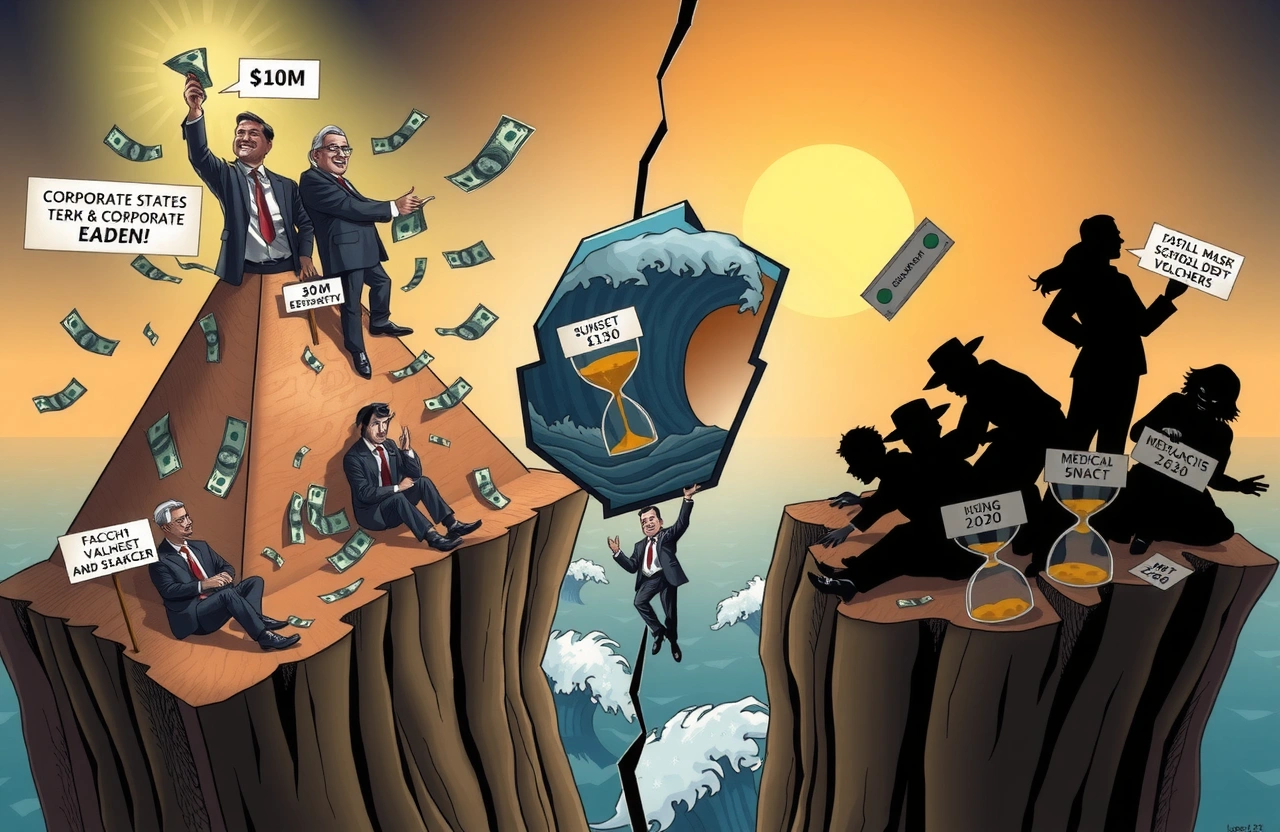
The Paradoxical Legacy
President Trump’s signing of the ‘Big and Beautiful Act’ represents more than tax reform—it reveals fundamental fractures in America’s economic and social fabric. This sweeping legislation, promising corporate revitalization through historic tax reductions while simultaneously dismantling social safety nets, creates competing realities for different segments of society. With permanent corporate tax cuts (35%→21%) alongside sunset clauses for middle-class benefits, the Act prioritizes short-term market gains over long-term stability, setting the stage for economic contradictions that will reshape America’s fiscal and social landscape for decades. The fractures run deeper than partisan politics, exposing systemic tensions between wealth concentration and inclusive growth that demand urgent policy reconciliation.
Key Implications
– The Act’s permanent corporate tax cuts (35%→21%) clash with temporary individual benefits, creating unequal economic trajectories
– Fiscal sustainability collapses under projected $4.5 trillion deficit growth despite $1.5 trillion spending cuts targeting social programs
– Wealth inequality accelerates as the top 5% gain $75K average tax breaks versus $1000 net loss for bottom-tier households
– Healthcare and food security systems face existential threats with Medicaid reductions impacting 11.8 million Americans
– The debt-to-GDP ratio risks surging to 125% by 2034, destabilizing dollar credibility amid historic borrowing expansion
Economic Mirage: Temporary Gains vs Structural Weaknesses
The ‘Big and Beautiful Act’ core proposition—that corporate tax liberation fuels sustainable growth—conceals fundamental tensions between immediate stimulus and enduring weaknesses. While the 14-point business tax reduction provides permanent cost relief to corporations, individual benefits wear expiration dates that undermine consumption stability:
The Sunset Economy
– Personal tax deductions terminate in 2030, abruptly reversing middle-class spending power
– Joint-filing boosts ($32K threshold) vanish after 2028 without legislative extension
– Tip/OT exemptions—covering just 12% of hourly workers—dissolve by 2028
– Corporations gain long-term predictability while households face fiscal cliffs
The Inflation Trap
Tariff-based revenue assumptions (projecting $3-7 trillion) collide with supply-chain realities as retaliatory trade measures constrict exports. Manufacturing input cost surges, compounded by canceled renewable energy credits, create inflationary pressures that erode tax savings. The Congressional Budget Office confirms this hydra effect: corporate savings get consumed by operational cost growth while households contend with shrinking purchasing power.
Fiscal Timebomb: Debt Expansion Masquerading as Deficit Control
The Act’s $1.5 trillion spending cut facade unravels under closer fiscal scrutiny. By disproportionately targeting social welfare while enabling unprecedented debt expansion, it exchanges temporary deficit relief for enduring financial instability:
The Debt Spiral
– Debt ceiling expansion by $5 trillion marks largest authorization in US history
– Net interest payments projected at $2.2 trillion annually by 2034—exceeding current defense spending
– Debt-to-GDP ratio climbs to 125% despite purported fiscal discipline
– Treasury auction risks escalate as foreign ownership declines to 30-year lows
Revenue Mirage
The Act gambles on tariff revenues offsetting tax losses—a bet undermined by global retaliation dynamics. While tariffs generated $86 billion FY2025 (59% YoY growth), the Tax Foundation estimates just $1.4 trillion cumulative gains through 2035—barely 31% of projected revenue needs. This shortfall forces either benefit rollbacks or deeper debt dependence, confirming CBO projections of unsustainable deficit growth.
Social Fracturing: Systemic Inequality Worsened by Design
Beneath fiscal arguments, the Act institutionalizes inequality through deliberate resource redistribution. By pairing corporate welfare with social program dismantling, it codifies divergent realities for economic elites versus vulnerable populations:
The Privilege Architecture
– Estate tax exemptions leap to $30M for couples—permanently shielding generational wealth
– Venture capital ‘qualified stock’ exemptions grant $10M tax-free windfalls to financiers
– Medicaid cuts exceed $1 trillion, disproportionately harming rural communities
– 1.8M children face school meal elimination alongside SNAP reductions
Mortality Economics
Yale’s Budget Lab projections expose the human cost: hospital closures and coverage losses may cause 51,000 annual deaths by 2034. Food assistance tightening removes 3.2 million from nutrition support—with elderly (64+ cutoff) and children bearing heaviest impacts. These policy choices consciously sacrifice vulnerable demographics to fund corporate and wealth tax concessions.
Governance Transformation: From Safety Nets to Security States
The Act accelerates America’s governance evolution—diverting resources from social infrastructure toward military-industrial priorities while centralizing policy control:
Power Shift Indicators
– Military/security spending increases despite overall budget cuts
– State preemption laws prohibit local regulation of AI/technology industries
– Federal social obligations shift to states (e.g., 5% food aid cost-share by 2028)
– Programs transition from universal access to privilege-based eligibility models
America’s Policy Reckoning
The ‘Big and Beautiful Act’ functions as societal x-ray—revealing fractures between stated objectives and measurable outcomes. By institutionalizing corporate advantages while weakening social foundations, it trades inclusive prosperity for concentrated wealth accumulation. Neither sustainable growth nor fiscal stability emerges from this equation—only deepened inequality and systemic fragility. For business leaders and policymakers, this demands course-correction: tax policies balancing corporate competitiveness with household stability, debt management preserving dollar credibility, and social investments maintaining workforce viability. The alternatives—widening fractures, eroding cohesion, and destabilizing finance—remain too costly for any society to endure. Stakeholders must advocate recalibration before these mirrored divisions become irreversible chasms.