



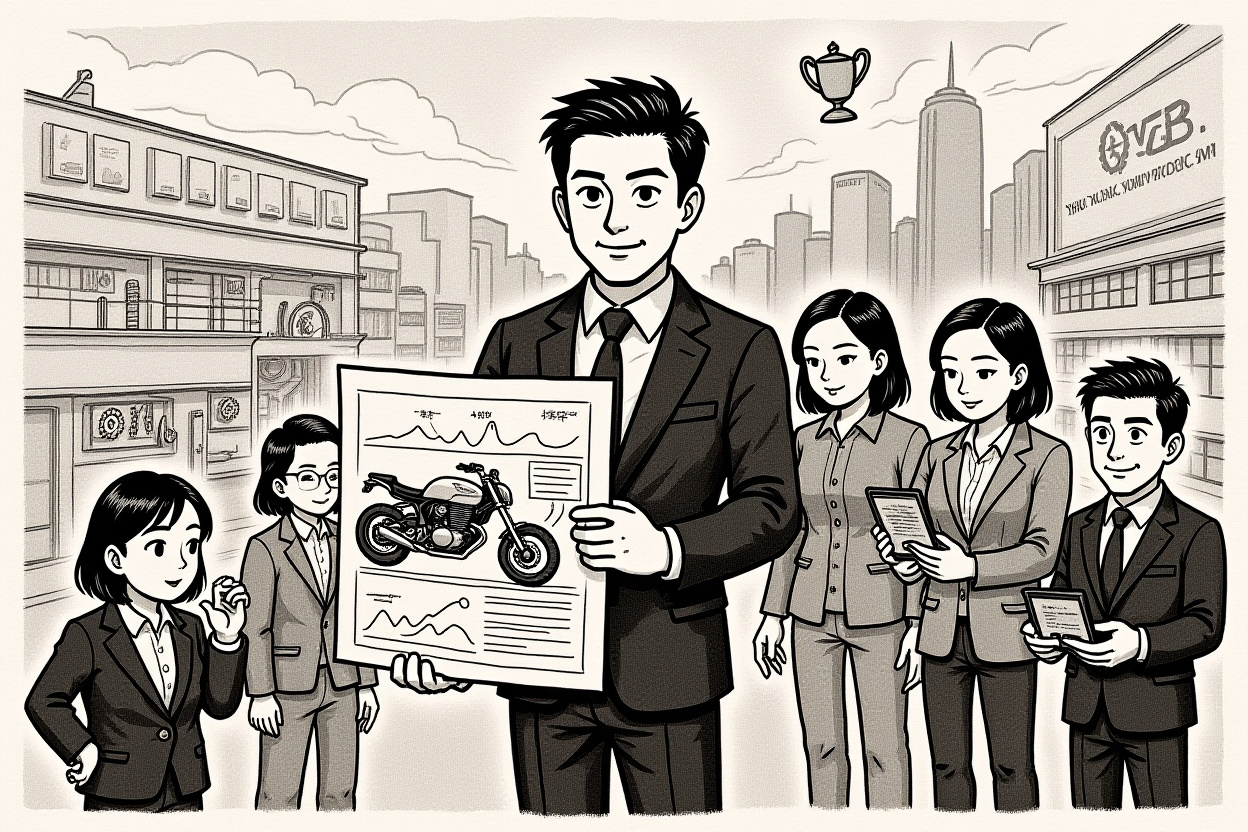
When a Chinese motorcycle, the Zhang Xue 820RRRS, clinched victory at the World Superbike Championship (WSBK) in Portugal, it was more than just a sporting triumph. It ignited a fierce and revealing battle for Zhang Xue Motorcycle among Chinese provinces, spotlighting the high-stakes competition to capture the future of advanced manufacturing. The battle for Zhang Xue Motorcycle is not merely about a single company; it is a proxy war over talent, technological prestige, and the next-generation industrial ecosystem. From Chongqing, the traditional ‘Motorcycle Capital,’ to the financially savvy Zhejiang and the hometown hopefuls in Hunan, regional governments are deploying capital and policy in a bid to secure a piece of this rising star and the high-value industrial chain it represents.
Executive Summary
- Post-Victory Surge: Zhang Xue Motorcycle’s historic WSBK win triggered a stock market rally for related companies and intensified a multi-province bidding war for the firm’s presence and future expansion plans.
- Strategic Capital Moves: Zhejiang’s state-backed venture capital firm, Zhejiang Venture Capital Group (浙创投), executed a prescient 90 million yuan ($12.4 million) investment just months before the championship, exemplifying the ‘invest-to-attract’ (以投带引) model of modern industrial policy.
- Beyond Subsidies: Founder Zhang Xue’s candid admission about receiving no direct government subsidies in Chongqing underscores that the real competition is about superior industrial ecosystems, deep supply chains, and synergistic city-enterprise growth.
- Global Manufacturing Shift: The battle for Zhang Xue Motorcycle reflects a broader national ambition to move Chinese manufacturing up the value chain, from competing on price to commanding technological premium in global markets like high-performance motorcycles.
From Racetrack Glory to Boardroom Battleground
The narrative of Zhang Xue Motorcycle reads like a script from a blockbuster. A founder, Zhang Xue (张雪), honed his craft in Zhejiang’s motorcycle industry before relocating to Chongqing to build his dream. His company, producing high-performance bikes at a fraction of the cost of European and Japanese rivals, then achieved the unthinkable on the world’s premier motorcycle racing stage. This victory was a seismic event for China’s manufacturing pride, proving domestic engineering could best established giants like Ducati and Yamaha.
Capital Markets React
The financial implications were immediate and potent. Hongchang Technology (宏昌科技), a listed company with an indirect stake in Zhang Xue Motorcycle, saw its stock price hit the 20% daily limit-up for two consecutive trading sessions. The entire motorcycle and parts sector experienced a bullish uplift. This market response validated the immense commercial and symbolic value now attached to the Zhang Xue brand. The win transformed the company from a promising startup into a coveted national champion, making the battle for Zhang Xue Motorcycle a priority for regional economic planners.
The Zhejiang Gambit: A Masterclass in Timing
Amid the celebration, a shrewd financial maneuver came to light. In January 2025, just two months before the Portugal victory, Zhejiang Venture Capital Group (ZVCG 浙创投), led by its general manager Cheng Junhua (程俊华), spearheaded Zhang Xue Motorcycle’s Series A funding round. ZVCG invested 90 million yuan for a combined 8.25% stake, valuing the company at 1.09 billion yuan. This ‘sniper investment’ positioned Zhejiang’s state capital as the primary financial beneficiary of the global triumph. As reported by the Zhejiang Daily, Cheng Junhua was transparent about his ambitions: “I certainly want to attract him to Zhejiang… What we can do is tell the Zhejiang story well, so that he is willing to come himself.” This episode highlights how sophisticated regional investors now operate, using venture capital not just for returns but as a strategic tool for industrial recruitment.
The Multi-Province Scramble: More Than Just Hometown Pride
The battle for Zhang Xue Motorcycle quickly escalated beyond a bilateral tussle. Multiple provinces with connections to the brand or the industry staked their claims, each highlighting a different facet of value they could offer.
Hunan’s Emotional Appeal and Cautious Courtship
Hunan, Zhang Xue’s home province, leveraged emotional and narrative capital. Local media openly speculated about the possibility of Zhang Xue Motorcycle expanding production “back to where the dream began—Hunan.” While not making a direct financial play at this stage, Hunan’s public courtship served to keep the province in the conversation, appealing to founder sentiment and positioning itself as a potential future base. It was a softer, identity-based approach in the battle for Zhang Xue Motorcycle.
Chongqing’s Defensive Play and Home-Turf Advantage
Faced with these overtures, Chongqing, where the company is physically headquartered, moved swiftly to solidify its position. On March 31, the Chongqing Liangjiang New Area administration officially announced it would provide Zhang Xue Motorcycle with nearly 200 mu (approximately 13 hectares) of land for a new production base. This was a clear defensive action in the battle for Zhang Xue Motorcycle, addressing the company’s immediate need for expansion space and demonstrating concrete support. It signaled that Chongqing was serious about retaining its champion.
The Real Prize: Industrial Ecosystems, Not Just Incentives
Beneath the headlines of land deals and investment rounds lies the fundamental question: what truly determines where a high-growth, technology-driven manufacturer like Zhang Xue Motorcycle thrives? The founder’s own words provide the clearest answer.
Zhang Xue’s Candid Assessment
In a now-viral interview at his Chongqing factory, when asked what policy, talent, or industrial chain support the local government provided, Zhang Xue replied bluntly, “To tell the truth? Nothing. Not a single cent.” However, he immediately followed this by explaining why he chose Chongqing in the first place: “The suppliers are all here.” He described how, upon arriving, he went to a motorcycle parts market akin to Shenhua’s Huaqiangbei, sourced components for 20,000 yuan, built a prototype, and used it to secure his initial funding. Later, when requiring ultra-precision engine parts, he found suppliers in Chongqing capable of meeting his exacting tolerances.
The Unbeatable Supply Chain
This reveals the core of the battle for Zhang Xue Motorcycle. Provinces are not just competing with subsidy packages; they are competing with the depth and resilience of their industrial ecosystems. Chongqing’s advantage is formidable: over 50 large-scale motorcycle assembly plants, more than 410 major component suppliers, and a local sourcing rate exceeding 80% for fuel-powered bikes. This dense network allows for rapid prototyping, cost-effective innovation, and agile production—critical factors for a disruptive startup. The ability to “embed the enterprise within the city’s industrial ecology” is what ultimately retains a ‘Zhang Xue.’
Beyond the Headlines: The Macro Backdrop of the Battle
The intense battle for Zhang Xue Motorcycle is a microcosm of larger trends reshaping China’s economy and its place in global manufacturing.
A Market at an Inflection Point
China’s motorcycle industry is at a crossroads. Domestic sales have entered a stage of存量竞争 (stock competition), necessitating a shift towards premium, intelligent products and aggressive expansion into overseas markets. Industry data for 2025 shows robust growth, with production and sales exceeding 22 million units. Crucially, exports surged 21.33% to 13.37 million units, valued at $8.85 billion. Brands like Zhang Xue, CFMoto (春风), QJMotor (钱江), and Kove (凯越) are leading the charge to convert China’s position as the world’s factory for volume into leadership in high-margin, high-performance segments.
The Vision of Technological Premium
Zhang Xue Motorcycle’s business model embodies this shift. Its civilian 820RR model sells for 43,800 yuan, roughly one-third the price of comparable imported bikes, yet delivers championship-proven performance. This breaks the longstanding paradigm of Chinese products competing solely on ‘cost-performance’ (性价比) and establishes a new basis of ‘技术溢价’ (technological premium). The company’s financials, revealed at a 2026 partners’ conference, show a commitment to this path: 2025 revenue of 750 million yuan was paired with R&D investment of 69.58 million yuan, a remarkable 9.33% of sales. Despite a net loss, the firm projects terminal sales to double in 2026 to 50,000 units, aiming for 200,000 by 2028. This growth trajectory is what regional governments are betting on.
Looking Ahead: The Future of China’s Advanced Manufacturing Competition
The battle for Zhang Xue Motorcycle is far from over. Zhejiang’s capital infusion and strategic courtship, Chongqing’s supply chain dominance and land grant, and Hunan’s sentimental appeal represent different phases and strategies in a long-term contest. The outcome will depend on which location can best support the company’s next evolution.
Will Zhang Xue Motorcycle establish a second production base in Zhejiang to be closer to its lead investor and the Yangtze River Delta’s advanced manufacturing and export logistics? Will it double down in Chongqing to deepen integration with the world’s most concentrated motorcycle supply chain? Or will a new player emerge with an unbeatable package? The company’s founder has set an audacious goal: “Within the next five years, we will take over 50% of the market share from international big brands.” The province that helps him achieve this will reap not only tax revenue and jobs but also the invaluable prestige of hosting a global industry leader.
Ultimately, the battle for Zhang Xue Motorcycle underscores a critical lesson for policymakers worldwide. In the race to cultivate champions of advanced manufacturing, victory is not secured by the largest subsidy, but by building the most innovative, responsive, and complete industrial ecosystem. The competition between Chongqing, Zhejiang, and others is a benchmark for how China is refining its industrial policy—moving from top-down planning to a more nuanced, investment-savvy, and ecosystem-focused approach. For global investors and corporate executives, understanding these dynamics is key to navigating the future landscape of Chinese and global manufacturing.
For investors tracking China’s industrial upgrade, the ongoing saga of Zhang Xue Motorcycle serves as a real-time case study. Monitor the company’s capacity expansion decisions, follow the capital flows from regional state-backed funds, and analyze the policy innovations emerging from this competition. The winners of this battle will likely set the template for the next decade of high-value manufacturing growth in China.