



Summary
– Over 30 major Chinese automakers have collapsed in the past decade, stranding millions of vehicle owners without official support or warranties, creating a vast population of ‘orphaned EVs.’
– Owners of brands like Neta, WM Motor, and HiPhi face broken promises, scarce parts, and soaring repair costs, leading to innovative self-repair communities and online knowledge-sharing networks.
– A secondary market has emerged with deeply discounted prices for these orphaned EVs, attracting bargain hunters despite risks, while regulatory gaps leave consumers vulnerable.
– The crisis is fostering a DIY car culture in China, with third-party specialists rising to fill service voids, highlighting lessons for the EV industry’s future stability.
The Unfolding Crisis of Orphaned EVs in China
In the whirlwind ascent of China’s electric vehicle (EV) market, a dark underbelly has emerged: the plight of millions of owners left behind by bankrupt manufacturers. These ‘orphaned EVs’—vehicles abandoned by defunct automakers—represent a growing consumer crisis. Over the past decade, more than 30 major car companies have folded in the brutal competition, from promising startups to established names, leaving a trail of broken warranties and logistical nightmares. As brands like 哪吒汽车 (Neta Auto), 威马汽车 (WM Motor), and 高合汽车 (HiPhi) enter bankruptcy or de facto shutdown, their sold vehicles remain on the road, forcing owners into uncharted territory of self-reliance and market chaos. This article explores the scale of the problem, the resourceful responses from stranded communities, and the broader implications for China’s automotive ecosystem and global investors watching this pivotal market.
The Scale of the Crisis: Millions of Orphaned EVs
The rapid churn in China’s EV sector has created a surplus of vehicles without a ‘home,’ with estimates suggesting over a million units affected. When a manufacturer collapses, the immediate aftermath for owners is a cascade of failures in support systems they once relied upon.
Case Studies: From Neta to HiPhi
Take 哪吒汽车 (Neta Auto), which by 2025 had accumulated debts of over RMB 26 billion and entered bankruptcy restructuring. Despite selling approximately 500,000 vehicles, owners quickly found their warranties void. For instance, a Beijing-based owner discovered her two-year-old Neta EV had severe battery degradation, slashing range by 60%. Upon seeking repairs at a former service center, she was told to pay out-of-pocket—over RMB 20,000 for battery pack fixes—because the defunct manufacturer no longer reimbursed costs. Similarly, 威马汽车 (WM Motor), with around 110,000 cumulative sales before its 2022 halt, saw nationwide connectivity cut off due to unpaid service fees, rendering smart features useless and voiding all warranties. For 高合汽车 (HiPhi), the luxury brand that delivered over 20,000 units, its complex designs like gull-wing doors and electronic mirrors became repair nightmares without specialized tools or parts. Even 恒驰汽车 (Hengchi Auto), which delivered only about 1,000 cars before its rapid demise, left owners with vehicles that are virtually unrepairable due to a non-existent service network. These orphaned EVs exemplify how quickly consumer assets can depreciate into liabilities.
The Immediate Fallout: Warranty Woes and Safety Risks
The collapse of these companies triggers a domino effect. First, official after-sales service evaporates, leaving owners to foot bills for repairs that were once covered. Battery issues are particularly dire; damaged cells can become safety hazards, with repairs costing upwards of RMB 70,000 for full replacements. Second, parts scarcity emerges as inventory dwindles. Simple components like window regulators or data collection devices become luxury items, with wait times stretching for months. Third, connectivity services fail as data centers shut down, disabling remote functions and basic vehicle information updates. Insurance companies exacerbate the problem by raising premiums or refusing coverage altogether, citing an inability to source parts for claims. This perfect storm transforms reliable transportation into a source of constant anxiety for owners of orphaned EVs.
From Despair to DIY: The Rise of Owner-Led Repair Networks
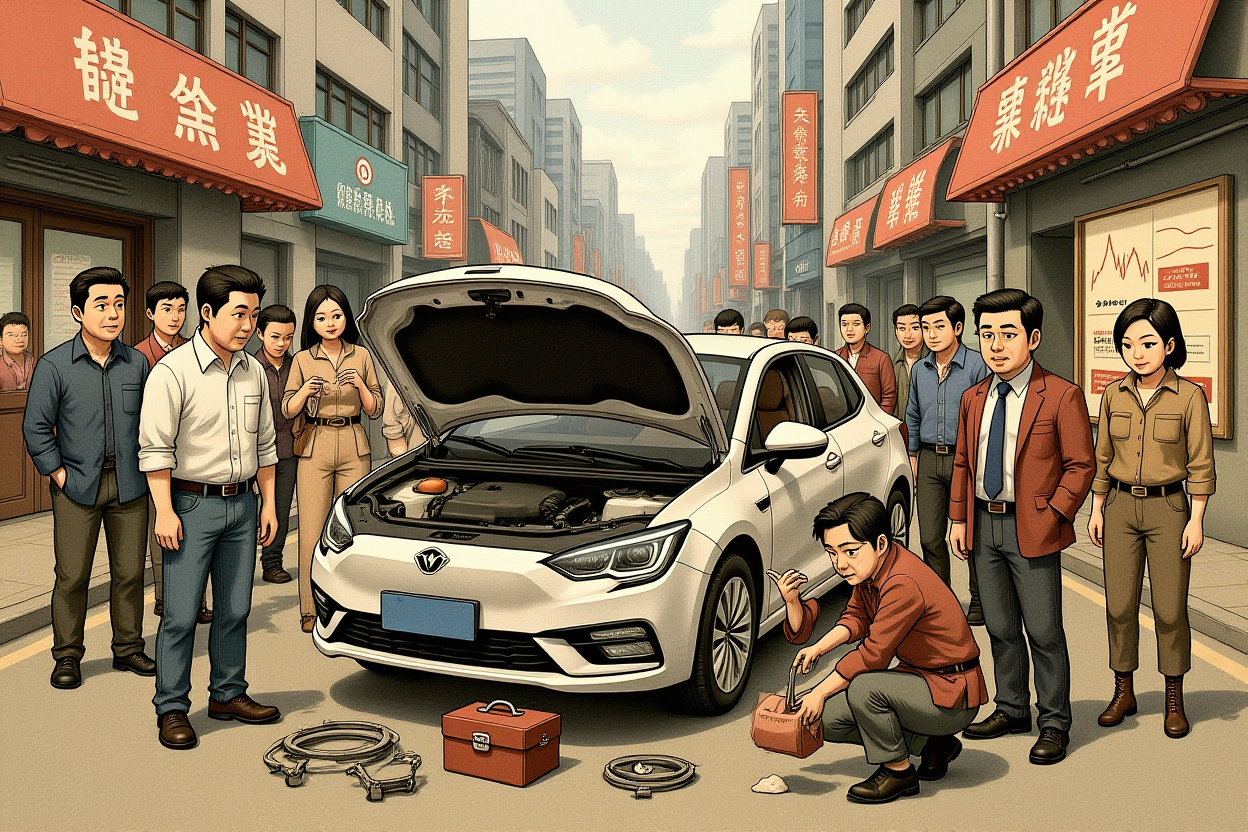
Faced with systemic abandonment, owners of orphaned EVs have turned to collective action, birthing a grassroots repair culture. This movement is not just about fixing cars—it’s about community resilience in the face of market failure.
Online Communities and Knowledge Sharing
Owners have formed dedicated social media groups and forums where tech-savvy individuals offer free guidance. These platforms feature tutorial videos for common fixes, from replacing air filters to manually resetting fault codes. Some experienced owners run ‘online clinics,’ diagnosing issues in comment sections and sharing repair outcomes to help others avoid pitfalls. For parts sourcing, owners scour platforms like 闲鱼 (Xianyu, a second-hand marketplace) and 陈田 (Chentian, a famous auto parts market in Guangzhou), hunting for salvaged components from wrecked or donor vehicles. Even test cars from manufacturers are being dismantled for parts, showcasing the desperate ingenuity driving this ecosystem. This knowledge-sharing ethos is empowering owners to tackle problems that would once require dealer expertise, effectively turning them into amateur mechanics.
The Emergence of Third-Party Specialists
As the void left by defunct automakers grows, entrepreneurial repair shops have stepped in. By acquiring former dealership equipment and hiring laid-off technicians, these third-party specialists now offer brand-specific services, such as ‘Neta-only repair’ or ‘WM Motor specialists.’ They cater to orphaned EV owners from across regions, turning a crisis into a business opportunity. This shift is ironic: while manufacturers were active, 4S dealerships monopolized service; after their collapse, a more diverse and competitive repair market has emerged. These specialists often provide more affordable and accessible options, though parts markups can be steep due to limited supply. Nonetheless, they represent a critical lifeline, ensuring that orphaned EVs remain operational longer than anticipated.
The Silver Lining: Bargain Hunters and the Secondary Market
Amidst the turmoil, a counterintuitive trend has surfaced: a booming secondary market for orphaned EVs. Deep discounts on these vehicles are attracting a new wave of buyers willing to gamble on short-term utility over long-term support.
Discounted Prices and New Demand
When automakers fail, unsold inventory and lightly used vehicles flood the market at rock-bottom prices. For example, 威马汽车 (WM Motor) models that originally cost over RMB 200,000 are now selling for as low as RMB 60,000 as new-old stock. 高合汽车 (HiPhi)’s luxury EVs, once priced at RMB 600,000, can be had for RMB 180,000 to 200,000. Even 极越汽车 (Jiyue Auto) vehicles, which struggled with low sales during operation, have seen increased visibility post-collapse due to fire sales. Dealers specializing in these orphaned EVs report strong demand, particularly from younger buyers seeking high-spec features at a fraction of the cost. The mantra among these bargain hunters is simple: at a low enough price, any car becomes a value proposition, transforming ‘industrial waste’ into ‘industrial miracles.’
Risks and Rewards for Buyers
Purchasers of orphaned EVs are acutely aware of the trade-offs. They accept that warranties are nonexistent, parts are scarce, and repairs may be DIY endeavors. However, for many, the allure of premium features—like advanced battery packs, luxurious interiors, or cutting-edge infotainment—outweighs the hassles. The calculation often involves using the vehicle for a few years to ‘break even’ on the low purchase price, then potentially salvaging it for parts if major issues arise. This pragmatic approach highlights a shift in consumer mentality: in a volatile market, some are willing to embrace risk for immediate gratification. Yet, it also underscores the precariousness of investing in orphaned EVs, as long-term viability remains uncertain without manufacturer backing.
Regulatory Gaps and the Path Forward for Orphaned EVs
The crisis of orphaned EVs exposes significant weaknesses in China’s automotive regulatory framework. While rules exist to protect consumers, enforcement often falters when companies dissolve, leaving owners in a legal limbo.
The 10-Year Spare Parts Rule and Its Enforcement
According to China’s 《汽车品牌销售管理实施办法》 (Automobile Brand Sales Management Measures), manufacturers are required to ensure at least 10 years of spare parts supply and after-sales service for discontinued models. In theory, this should prevent the orphaned EV phenomenon. However, in practice, bankrupt firms lack the funds or incentive to comply. As seen with Neta and WM Motor, when a company’s assets are tied up in debt repayment, fulfilling these obligations becomes a low priority. Regulatory bodies like the 国家市场监督管理总局 (State Administration for Market Regulation) have limited leverage to compel action from defunct entities, highlighting a need for stronger pre-emptive measures, such as mandatory escrow accounts for after-sales support or industry-wide insurance schemes.
Lessons for the EV Industry and Consumers
The rise of orphaned EVs offers critical lessons. For consumers, it underscores the importance of due diligence beyond price and features—assessing a manufacturer’s financial health and long-term viability is now essential. For the industry, it signals a need for more robust ecosystem planning, including standardizing parts across brands to ease aftermarket support. Investors and policymakers should note that the rapid innovation in China’s EV sector comes with stability risks; fostering consolidation or exit mechanisms that prioritize consumer protection could enhance market confidence. Additionally, the grassroots repair networks demonstrate that consumer adaptability can mitigate some harms, but systemic solutions are required to ensure a ‘graceful exit’ for failing automakers, preserving value for all stakeholders.
Navigating the Future of China’s EV Landscape
The saga of orphaned EVs is more than a tale of consumer woe—it’s a microcosm of China’s explosive yet turbulent automotive transition. From DIY repair communities to bargain-driven secondary markets, the responses to this crisis reveal both vulnerability and resilience. As the global EV race intensifies, the experiences of these stranded owners offer a cautionary note: innovation must be paired with accountability. For international investors and industry watchers, understanding these dynamics is key to navigating risks in Chinese equities. Moving forward, stakeholders must advocate for stronger regulatory enforcement, consumer education, and industry standards to prevent future generations of orphaned EVs. The call to action is clear: whether you’re a buyer, investor, or policymaker, prioritize sustainability over speculation to build a market where vehicles—and their owners—are never left behind.