



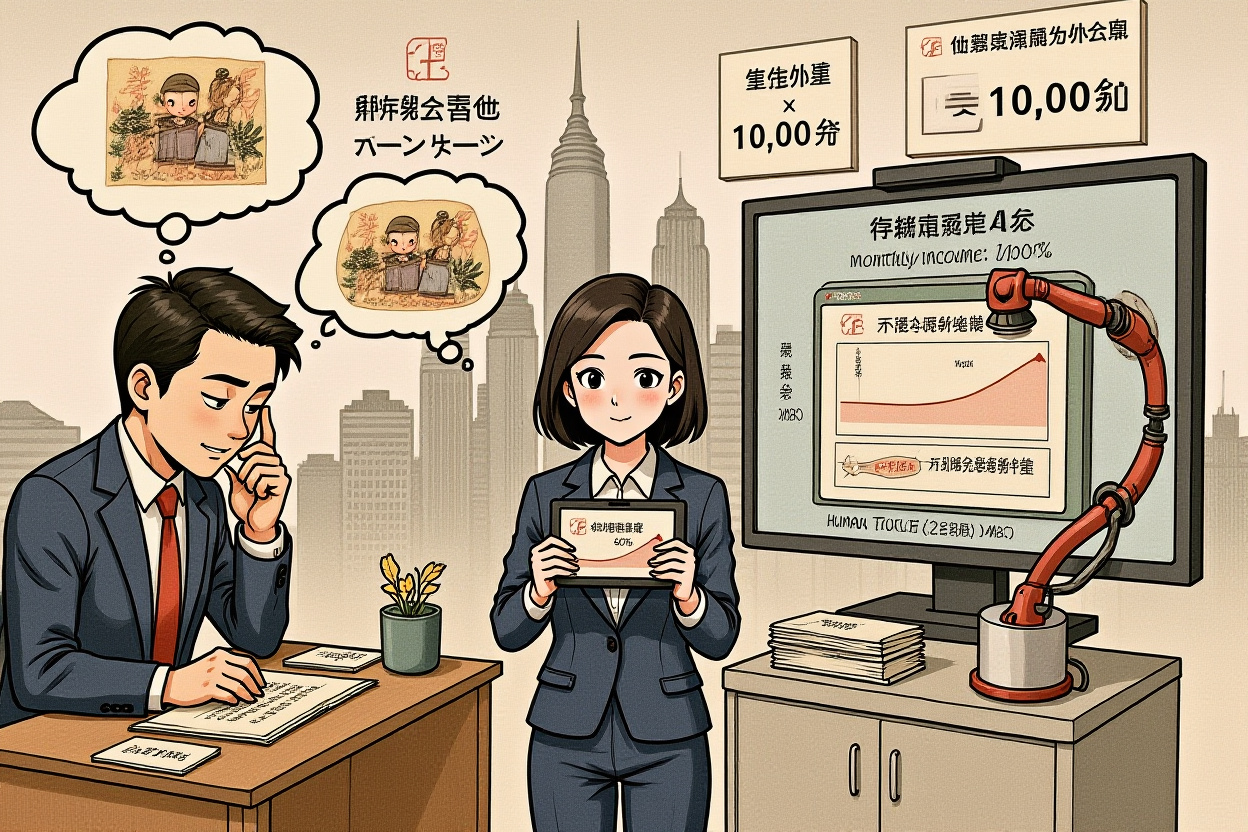
– AI-assisted writing is enabling some creators to earn significant monthly incomes, but widespread concerns persist over the lack of emotional depth and originality in machine-generated content.
– Major Chinese web novel platforms are implementing strict detection policies and AI usage guidelines to combat low-quality, mass-produced stories flooding the market.
– Veteran human authors and literary experts argue that AI cannot replicate the nuanced creativity, personal experience, and cultural context essential for compelling storytelling.
– The future trajectory of the industry hinges on whether AI will remain a supplemental tool or evolve into a primary creator, potentially reshaping reader preferences and economic models.
The digital shelves of China’s bustling web novel platforms are experiencing a silent invasion. Claims of “AI writers earning over 10,000 yuan monthly” flood social media, promising lucrative shortcuts to literary success. Yet, beneath the surface of this technological gold rush, a fundamental question echoes through the creative community: Can algorithms ever replicate the indispensable human touch that breathes life into stories? As generative artificial intelligence reshapes content production, the multi-billion dollar web novel industry stands at a crossroads, balancing efficiency gains against the soul of narrative art. This exploration delves into the real-world impact of AI authorship, from income disparities to platform policies, revealing how the quest for quantity threatens the very essence of literary connection.
The Booming Market of AI-Assisted Web Novel Writing
A new breed of content entrepreneur has emerged, leveraging large language models to tap into China’s voracious appetite for online fiction. Tutorials boasting “how to write a million-word novel with AI in under a day” garner tens of thousands of likes and shares, painting a picture of effortless prosperity. However, for seasoned creators like Wei Ying (魏颖), who began writing web novels part-time in university and now earns significant copyright income, these promises ring hollow. “After large models appeared, I considered using AI for creation,” she explains. “But most online tutorials are clickbait. More importantly, even with AI writing skills, the generated work often lacks a soul and is easily rejected by platforms.” Her success stems from a refusal to follow trends and a dedication to quality—a human touch that algorithms struggle to mimic.
From Hype to Reality: The Rise of AI Writing Studios
The phenomenon of “literary substitution” is quietly gaining momentum. As AI technology advances, numerous platforms have begun accepting AI-generated content, offering traffic support and income incentives. Simultaneously, a batch of specialized AI web novel studios has sprung up, aiming to surpass traditional authors through bulk production. Tang Aiping (唐爱平), an internet technology veteran, leads a team that developed the fully automated novel generation platform “Tangku.” He claims the platform can currently “generate a 500,000-word long novel in 48 hours.” Creators need only input a core setting or preliminary idea, and the platform automatically handles world-building, outline generation, chapter detailing, and text output. Over 6,000 authors now use it for daily creation, primarily for short-form content. This industrial approach challenges the very craft of storytelling, prioritizing scale over substance.
Efficiency vs. Quality: The AI Writing Challenge
In the competitive arena of web novels, word count has long been a key metric for success. Mao Zhihui (毛志慧), Vice Chairman of the Jiangxi Online Writers Association and a veteran author with over 16 million words to his name since 2014, knows this well. For established “gods” of the industry, daily stints of four to five or even eight to nine hours are standard. He recalls that writing a few thousand words daily was an achievement early in his career, later rising to eight or nine thousand—a pace once considered elite. “Now, in the increasingly fierce competition of online literature, many authors have broken through to ten thousand or even twenty thousand words per day,” Mao notes. Yet, this human endurance pales before tireless code. “AI is ‘rolling’ word count, generating tens of thousands of words in mere minutes. This efficiency is akin to industrial production,” he adds.
The Platform’s Dilemma: Floodgates of Content
This surge is rooted in the rise of generative AI. After the rapid development of large model capabilities last year, platforms like 番茄小说 (Tomato Novel), known for free web novels, grappled with an AI onslaught. The platform experienced a “sharp increase in the number of debut titles.” Industry insiders reveal that “debut” is a unique recommendation mechanism on Tomato Novel, where works gain traffic support after meeting platform rules. Data from “Web Novel Big Data” indicated that Tomato Novel’s daily debut data easily surpassed five thousand across the entire site, up from previous highs of over a thousand for male-oriented channels and five hundred for female-oriented ones—all within a single month. Facing this dimensional shift, some authors involved in AI writing tests lamented, “It feels like AI understands web novels better than humans. We are about to be eliminated.”
Detecting and Regulating AI Content on Platforms
Editors on the front lines are witnessing the influx firsthand. Qiao Huan (乔欢), a web novel editor at a relatively traditional platform, finds AI-polished works now account for 20-30% of the hundreds of submissions she receives weekly. These range from tens of thousands of short stories to hundred-thousand-word serials, with AI generation traces becoming increasingly obvious. Her platform maintains strict audits on the AI content ratio for contracted authors. It has introduced AI detection assistants to screen all submissions. If AI content is below 20%, it is not counted; but when the ratio hits 40%, these algorithmically assembled texts are directly rejected. “The platform’s attitude toward ‘high-concentration’ AI-generated works is extremely firm,” Qiao states. “Once discovered, they are blacklisted, rejected, and even advance payments are clawed back.” Editors rely on both technical tools and a “poisonous” eye to spot these “cyber products,” identifying fixed prompt traces, overly mechanical phrasing, and stark differences from human author expression styles.
Crackdowns and Policy Responses
Earlier this year, Tomato Novel issued an announcement stating that through platform monitoring, some accounts were found abusing AI technology for large-scale batch creation, producing大量粗糙、同质化严重、无可读性的低质水文 (a large amount of crude, seriously homogenized, and unreadable low-quality water-writing), with some even updating上百本作品 (over a hundred works) daily. Ultimately, through technical monitoring, manual review, reader reports, and other channels, the platform处置违规账号855个 (dealt with 855违规 accounts). Other platforms have taken a more conservative stance. 晋江文学城 (Jinjiang Literature City), one of China’s earliest web novel platforms founded in 2003, has explicitly added “AI-assisted writing related clauses” to its reporting center. Hu Huijuan (胡慧娟), Vice President of Beijing Jinjiang Original Network Technology Co., Ltd., recalls that after internal discussions in early 2023, the company published a trial operation announcement on AI辅助写作使用、判定 (AI-assisted writing use and判定). Jinjiang categorizes AI assistance into two major types, each with three levels: for textual assistance, only proofreading and polishing are allowed, with no narrative plots; for creative assistance, only naming and梗概汇总 (summary of concepts) are permitted, with no complete detailed outlines. “For a long time, Jinjiang will not consider directly introducing AI tools into the creative field,” Hu emphasizes. “Even if we later train a专属 ‘Jinjiang-style AI’, it will only be applied to审核 (review) and other website management tasks.”
The Creative Shortfall: Why AI Lacks the ‘Human Touch’
The core criticism of AI-generated literature is its inherent lack of emotional resonance and creative spark—a deficiency often described as missing the human touch. Mao Zhihui details his limited collaboration with AI: before writing, he constructs an extremely detailed world architecture,从主线大纲细分到每一章的剧情细纲 (from the main outline细分 to the plot details of each chapter), all反复推演 (repeatedly deduced) in his mind. “AI mostly承担总结性的辅助工作 (undertakes summary辅助 work). Wanting AI to凭空创造出打动人心的剧情 (create moving plots out of thin air) is completely impossible.” In specific情节设计 (plot design), such as common battle scenes, human creators consider the深层动机 (deep motivations), emotional bonds, and the impact on character growth. AI, however, often produces disappointingly clichéd outcomes. “The battle plots given by AI are of that extremely俗套的模式 (hackneyed模式),大概 (probably) from five or even ten years ago,旧套路 (old routines) long淘汰 by the market. AI doesn’t understand how to穿插展现人性博弈 (intersperse and展现 human博弈) in the clash of swords. It can only mechanically imitate action descriptions,堪称言之无物 (can be described as saying nothing substantial).”
Literary Perspectives on AI’s Limits
Esteemed authors echo this sentiment. Nobel laureate Mo Yan (莫言) shared his experience using AI to write poetry in a public article last year. He noted that while AI excels in information搜索 and文笔 (writing style), it lacks genuine thought and creativity. Mo Yan had AI imitate经典文学作品 (classic literary works) and his own style, finding it could quickly produce compliant texts, but the content often lacked depth and originality. He believes AI can be used as a tool, but literary创作应立足于现实生活和个人经验 (creation should be based on real life and personal experience), shaping characters with individuality and时代特征 (era characteristics). Similarly,科幻作家刘慈欣 (sci-fi author Liu Cixin) has publicly stated that given AI’s current development trend and speed, it is highly likely to replace human literary creation in the future, at least to a considerable proportion. While AI may not yet produce the顶尖作品 (top-tier works), in another 10 or 20 years, the outcome is unknown. Hu Huijuan of Jinjiang adds, “AI-created web novels can不断拆解和模仿已有样本 (continuously deconstruct and模仿 existing samples),批量生成几乎任何读者想要的内容 (batch generate almost any content readers want), quickly and conveniently满足读者的一切阅读喜好 (satisfying all reading preferences), but缺乏人类情感与智慧的真实表达 (lacking the true expression of human emotion and wisdom),无法引发读者心灵的震颤 (unable to引发 readers’心灵震颤), and也无法满足作者创作时、读者给予追更反馈时的情绪满足 (unable to satisfy the emotional fulfillment of authors during creation or readers giving feedback).”
Future Trajectories: AI as Tool or Replacement?
The web novel market is in a state of rapid iteration. Mao Zhihui observes that trends like the “废物退婚流” (waste退婚流) that swept the net years ago now draw reader嘲笑 (mockery) if written today; once-popular “圣母型主角” (圣母-type protagonists) have long been replaced by “利己型主角” (self-interest-type protagonists). “Readers’ tastes are like a永不满足的巨兽 (never-satisfied behemoth), constantly forcing authors to开创新的流派 (open up new genres).” AI’s continuous evolution fuels debates about its ultimate role. Tang Aiping is optimistic about “AI取代网文作者” (AI replacing web novel authors). “In terms of large frameworks, AI can胜任 (be competent), helping authors reduce workload. We also advise authors to关注网文平台热门排行榜上的作品 (pay attention to works on platform热门排行榜),创作什么流行就创作什么 (create whatever is popular).” However, the underlying logic of large AI models is based on概率预测 (probability prediction), calculating the next most likely word from massive corpora. This mechanism ensures its content is “工整、正确” (neat, correct) yet “平庸” (mediocre). Editor Qiao Huan形容这种阅读体验为 (describes this reading experience as): “It’s like tasting a dish. One bite and you immediately realize it’s not stir-fried by a chef, but a预制菜 (pre-made dish) from an assembly line.”
Market Shifts and Ethical Crossroads
Platforms face a critical choice: succumb to the temptation of short-term流量 (traffic) by allowing low-cost AI content to proliferate, or uphold the core value of human creators. Last year, Tomato小说 (Tomato Novel) quietly added an “AI训练补充协议” (AI training supplement agreement) to its签约协议 (signing agreement), requiring authors to consent to the platform using their works to train AI. This clause sparked industry-wide concern, with creators viewing it as turning their成果 (achievements) into “化肥” (fertilizer) for machines. The platform eventually让步 (让步), offering a channel to解除条款 (rescind the clause). Xu Miaomiao (许苗苗), Director of the Network Literature and Art Research Center at Capital Normal University, offers a nuanced view. She believes the notion that “AI让人人都能写小说” (AI enables everyone to write novels)违背了网络文学的创作精神 (violates the creative spirit of online literature). Current AI, based on数据算法 (data algorithms), can only替代平庸的作品 (replace mediocre works), unable to create truly literary masterpieces that超越常规作品 (surpass conventional works). She posits that the盈利模式 (profit model) of web novel platforms might change under AI’s impact, depending on consumer choice shifts. If AI web novels successfully吸引读者的注意力 (attract reader attention), the industry’s格局 (landscape) could transform. “Even if it doesn’t分流最出色的作者和知名IP (divert the most outstanding authors and知名 IP), for new authors, the difficulty of脱颖而出 (standing out) will be greater. Competitors will include not only同样平庸的作者 (similarly平庸 authors) but also ‘虽然平庸但产出量无限’的AI (‘though平庸 but with无限 output’ AI).”
The integration of AI into China’s web novel ecosystem presents a paradox of promise and peril. On one hand, it democratizes content production, offering income opportunities and efficiency gains; on the other, it risks homogenizing creativity and eroding the unique human touch that defines memorable storytelling. Platforms are navigating this terrain with mixed strategies, from stringent detection to cautious acceptance. For investors and industry stakeholders, the key insight is that while AI may reshape market dynamics and consumption patterns, the enduring value lies in narratives that connect on a profoundly human level. Authors who leverage AI as a辅助工具 (辅助 tool)—for research, editing, or ideation—without relinquishing creative control, are likely to thrive. Readers, ultimately, will vote with their attention and wallets, determining whether the future of web literature is crafted by hands or coded by machines. As this technological evolution accelerates, staying informed on platform policies, author adaptations, and quality benchmarks will be crucial for making savvy decisions in this rapidly changing literary marketplace.