



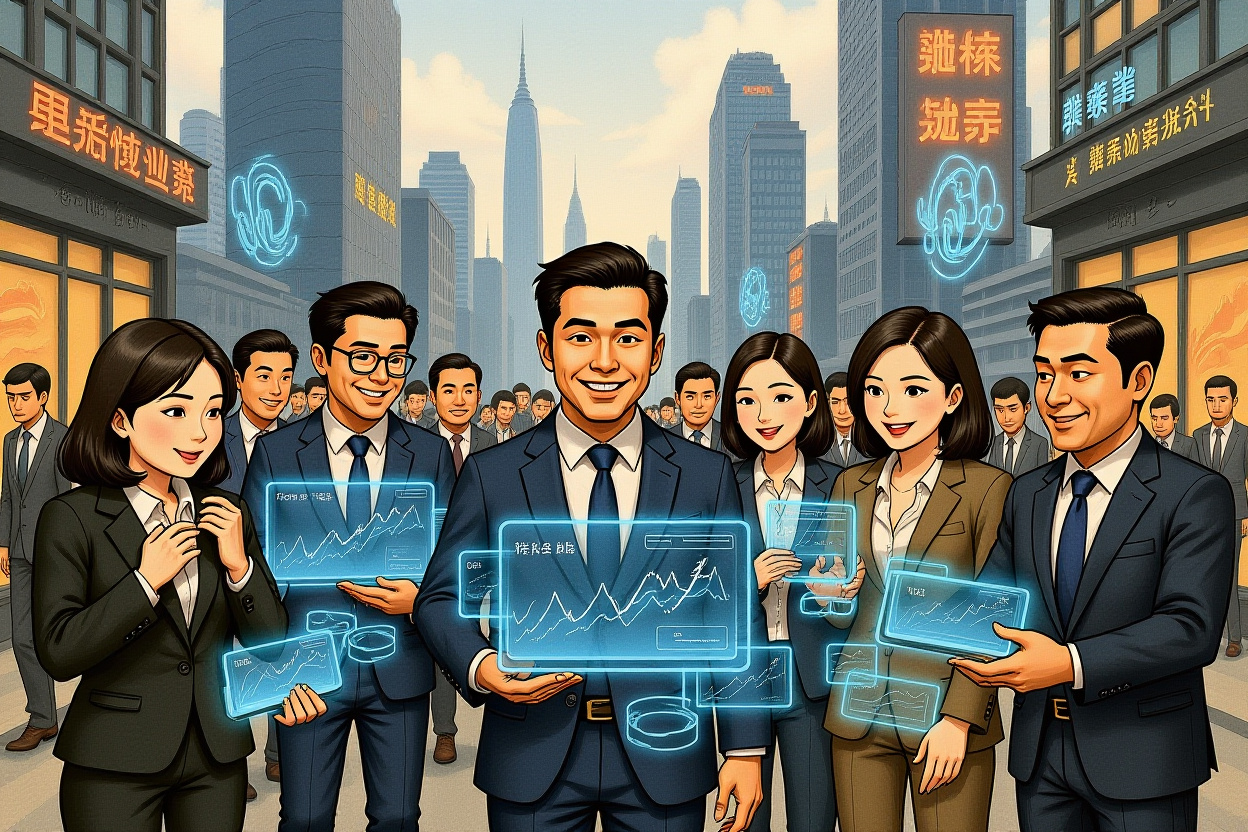
– AI is set to impact professions invented in the 20th century most severely, particularly white-collar roles, due to a historical reversal in skill replacement.
– Serious media outlets like The Atlantic have issued multiple warnings, highlighting rising unemployment among degree holders and the rise of autonomous AI agents.
– The vulnerability stems from AI’s proficiency in abstract information processing, making traditional office jobs more at risk than physical trades.
– Systemic blind spots among economists, corporate leaders, and politicians delay preparedness, with global implications extending to markets like China.
– Individuals can survive by pivoting to physical skills or mastering AI command, moving beyond intermediate information roles.
The tweet was succinct yet profound: “All professions invented in the 20th century cannot escape the impact of AI.” When Nassim Taleb, author of ‘The Black Swan’ and renowned for his incisive intellect, shared this thought, it reverberated across financial and tech circles. For professionals in Chinese equity markets and global investors, this isn’t mere speculation—it’s a seismic shift that threatens the very foundation of modern work. The AI impact on 20th-century professions is no longer a distant threat but an unfolding reality, with white-collar jobs at the epicenter. As capital flows into AI-driven innovations, understanding this disruption is crucial for investment strategies and career resilience. This article delves into why these roles are most vulnerable, backed by media alarms, data insights, and actionable guidance for navigating the impending transformation.
The Historical Reversal: AI Targets Modern Professions
The AI impact on 20th-century professions follows a counterintuitive pattern: skills developed most recently in human history are the first to fall. This phenomenon, which I term the “reverse evolution law of AI replacement,” suggests that abstract cognitive abilities—hallmarks of the 20th century—are more susceptible than ancient physical trades.
Nassim Taleb’s Warning and the Author’s Insight
Nassim Taleb’s tweet encapsulates a growing consensus among thought leaders. A year prior, I presented a similar view to my community: AI and robotics replace skills in reverse order of human development. Professions like financial analysis, coding, and middle management, which emerged in the 20th century, are poised for disruption because they rely on information processing—a domain where AI excels. This alignment with Taleb’s statement underscores a critical market insight: investments in sectors heavy with such roles may face volatility as automation accelerates.
The Reverse Evolution Law in Practice
Human skill evolution progressed from physical labor (e.g., agriculture) to industrial craftsmanship, and finally to abstract symbol manipulation in the 20th century. AI, however, inverts this trajectory. For instance, while a plumber’s hands-on expertise remains secure due to complex physical interaction, a data analyst’s report-writing can be automated swiftly. This law highlights why white-collar jobs, often perceived as advanced, are ironically the low-hanging fruit for AI adoption. Investors should note that companies leveraging AI to streamline these functions could see profit margins expand, but at the cost of structural employment shifts.
Media Alarms Signal Impending Disruption
When a venerable publication like The Atlantic—founded in 1857 and a Pulitzer Prize winner—dedicates multiple features to a topic, it’s a signal worth heeding. In a span of two weeks, it ran three lengthy articles on AI’s employment impact, each more urgent than the last, signaling that the AI impact on 20th-century professions is accelerating.
Three Alarming Perspectives from The Atlantic
First, “The U.S. Is Not Ready for AI’s Impact on Jobs” by Josh Tyrangiel reveals systemic failures in buffer mechanisms, with political systems ill-equipped for the shock. Second, “AI Agents Are Sweeping Through America” by Lila Shroff demonstrates how AI agents—autonomous tools—can outpace human efforts, such as journalists building a competitor to Monday.com in an hour, causing stock dips. Third, “The Worst Future for White-Collar Workers” by Annie Lowrey cites data showing bachelor’s degree holders comprising a quarter of U.S. unemployed, a historic high, with AI-automatable jobs seeing sharp unemployment spikes. These pieces, accessible via The Atlantic’s website, provide a stark warning for global markets: ignore these trends at your peril.
The Signal from a Serious Publication
The Atlantic’s shift from skepticism to alarm isn’t trend-chasing; it’s evidence-based reporting. For financial professionals, this media focus suggests heightened regulatory and market attention. As AI reshapes labor, sectors like tech, finance, and legal services may experience disruption, influencing stock valuations and investment flows. The AI impact on 20th-century professions is now a mainstream concern, demanding scrutiny in portfolio decisions.
The Silent Threat: Autonomous AI Agents
Beyond familiar chatbots like ChatGPT, a more profound danger lurks: AI agents. These are not passive tools but autonomous digital workers capable of planning, executing, and innovating without human intervention. This evolution represents a quantum leap in the AI impact on 20th-century professions, rendering traditional cognitive barriers obsolete.
The Two AI Universes
Most people inhabit one universe, using AI for basic tasks like drafting emails. But engineers and researchers live in another, where agents like Claude Code from Anthropic propose their own ideas and execute complex projects. For example, at Anthropic, 90% of code is AI-generated, showcasing efficiency gains that could ripple through software-driven industries. This divide means that while some dismiss AI threats, others are already compressing months of work into days, creating a competitive edge that could destabilize job markets.
From Tools to Colleagues: The Agentic Shift
AI agents possess “agentic” qualities—they set goals, search the web, write code, and collaborate. As Boris Power, an Anthropic employee, noted, “Claude is starting to have its own ideas and actively propose what to build.” When computers autonomously use computers, human skills like coding or analysis become commoditized. For investors, this signals opportunities in AI infrastructure firms but risks for companies reliant on human-centric processes. The AI impact on 20th-century professions is intensifying as agents transition from assistants to potential replacements.
White-Collar Jobs: The Epicenter of the Storm
The AI impact on 20th-century professions is most acute for white-collar roles, often dubbed the “invention” of the last century. Their vulnerability stems from a reliance on abstract information processing, which AI mimics with ease, unlike physical trades that require embodied interaction.
The Vulnerability of Abstract Skills
Skills like report analysis, contract drafting, and project management—honed through years of education—are precisely what AI excels at. Data from The Atlantic indicates that in the U.S., high school graduates now find jobs faster than college graduates, a reversal of historical trends. This underscores a market insight: industries with high concentrations of such roles, such as finance or consulting, may face downward pressure on wages and employment. For instance, a banker’s analytical tasks could be automated, while a technician’s repair work remains safe due to physical complexity.
Structural vs. Cyclical Unemployment
The crisis is structural, not cyclical. Past recessions saw temporary layoffs, but AI-driven displacement means jobs vanish permanently as firms optimize with AI workflows. Lowrey’s article warns of a “womblike security” vanishing for the educated class, with primary white-collar tasks like data entry or basic legal work being “zeroed out” first. This could trigger a cascade: lost incomes reduce consumer spending, impacting retail and real estate, and potentially leading to a deflationary spiral. For institutional investors, this necessitates a shift towards sectors resilient to automation, such as healthcare or skilled trades.
Systemic Blind Spots and Global Implications
Despite clear warnings, a false calm persists, driven by elite denial and economic lag. The AI impact on 20th-century professions is underestimated due to systemic failures, with global repercussions, including in Chinese markets.
Economists’ Lagging Indicators
Economists like Austan Goolsbee of the Chicago Fed admit that data shows no current erosion, but productivity spikes hint at unseen changes. Anton Korinek, a University of Virginia economist, critiques this as “driving by looking in the rearview mirror,” noting that AI’s self-propagating nature defies historical analogies. For market participants, this lag means traditional economic models may fail to predict shocks, requiring alternative metrics like AI adoption rates or corporate automation investments.
Corporate Silence and Political Inaction
CEOs from Anthropic’s Dario Amodei to Ford’s Jim Farley once openly discussed AI eliminating half of white-collar jobs, but now stay silent—a strategic move during “labor hoarding” phases. As interfaces with legacy systems improve, mass layoffs could follow. Politically, as Nick Clegg, former UK deputy prime minister, warns, democracies may struggle to keep pace with AI’s speed. In the U.S., lobbying by tech giants favors acceleration over regulation. For professionals worldwide, this implies minimal safety nets, urging proactive adaptation.
China’s Unique Vulnerabilities
The AI impact on 20th-century professions knows no borders; China’s markets are equally exposed. The myth of “white-collar security” is deeply ingrained in Chinese internet culture, yet AI agents are poised to disrupt roles in tech hubs like Shenzhen or Shanghai. With China’s emphasis on innovation and a vast workforce in information services, disruption could be swift. Investors should monitor Chinese AI policies and corporate responses, as sectors like e-commerce or fintech may see rapid transformation. Bridging the cognitive gap—understanding advanced AI tools—is key for survival in this global shift.
Future-Proofing Careers in the AI Age
To thrive amidst the AI impact on 20th-century professions, individuals must abandon outdated career paths and pivot strategically. The reverse evolution law offers a roadmap: move towards skills AI cannot replicate or master AI command itself.
Down to Earth: Embracing Physical Skills
– Pursue trades like plumbing, electrical work, or healthcare that require physical dexterity and real-world feedback.
– Offer high-touch services such as therapy or personalized coaching, where human empathy and connection are irreplaceable.
– For investors, this suggests opportunities in vocational training or industries reliant on manual expertise.
Upward Mobility: Commanding AI Forces
– Instead of competing with AI on tasks like coding, learn to orchestrate AI agents for complex projects, leveraging their efficiency.
– Develop top-tier skills in aesthetic judgment, strategic decision-making, and ambiguous problem-solving—areas where human nuance excels.
– In business, this means fostering innovation leadership roles that blend AI oversight with creative vision.
The AI impact on 20th-century professions is not a distant forecast but a present reality, with white-collar jobs facing unprecedented risks. From media warnings to economic data, the evidence points to a structural upheaval that demands vigilance from investors and professionals alike. As AI agents advance and systemic preparedness lags, the key to resilience lies in adaptive strategies: either grounding in physical realms or ascending to AI command. For those engaged in Chinese equities and global markets, staying informed and agile is paramount. Embrace this shift by exploring AI tools, diversifying skill sets, and advocating for balanced policies. The storm is here—navigate it with foresight and action.