



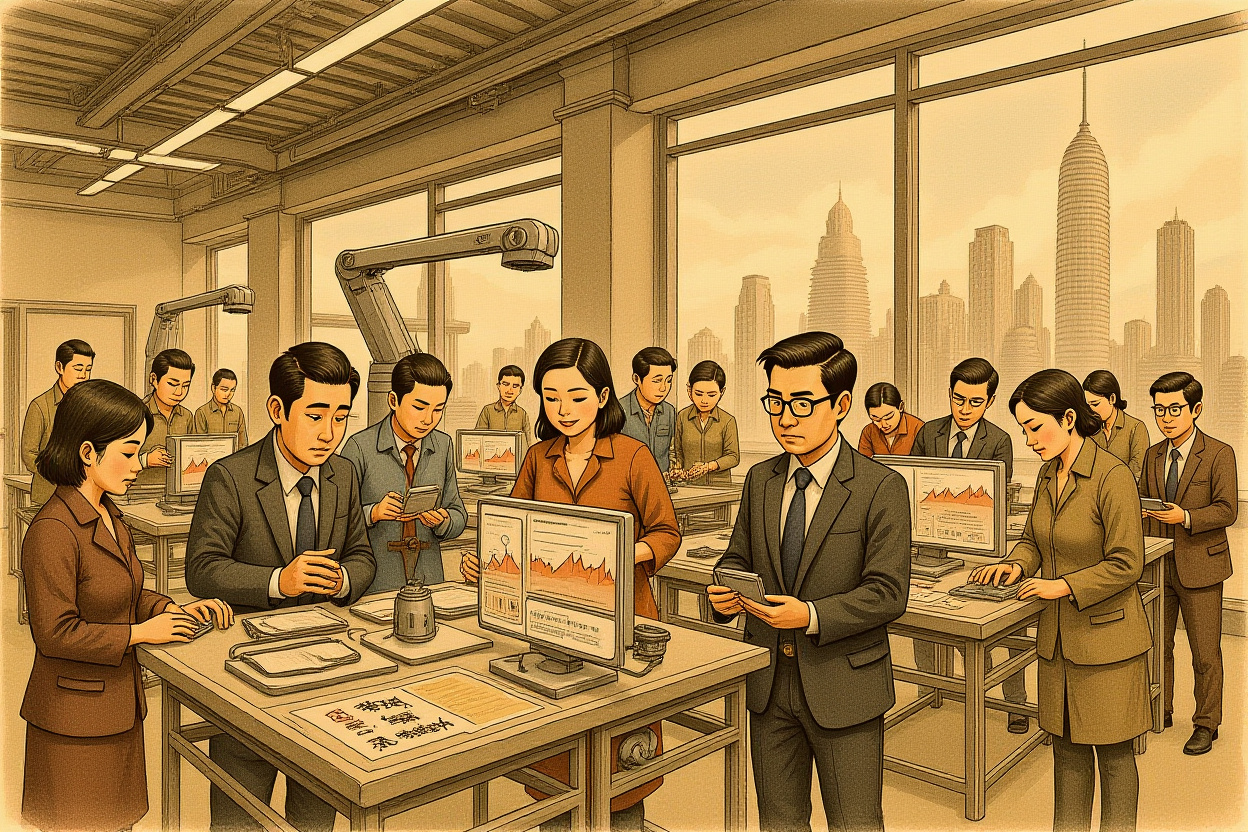
The relentless march of artificial intelligence is poised to redefine the very fabric of global manufacturing, and nowhere is this transformation more imminent or profound than in China. With a workforce of approximately 5 million individuals dedicated to manual quality inspection, the nation’s industrial heartland stands at a critical inflection point. The strategic integration of AI into core production processes represents both a monumental opportunity for efficiency and a formidable challenge for workforce adaptation. This shift, central to China’s “AI+” national strategy, is not merely about technological adoption; it is about securing future competitiveness in an increasingly automated world.
Executive Summary: Critical Takeaways
– AI-powered computer vision is already slashing defect rates by over 90% in advanced manufacturing lines, directly challenging the role of human inspectors.
– The primary hurdle is no longer technological capability but the difficult integration of AI into the core, knowledge-intensive heart of production processes.
– Safety concerns, including AI “hallucinations,” require rigorous risk management, guiding a cautious, phased deployment in critical industries.
– China is capitalizing on the global open-source AI trend, with its models now leading in global downloads, offering a distinct path to innovation.
– For enterprises and investors, the imperative is to bridge the gap between AI providers and factory floors through specialized digital transformation services.
The Scale of the Disruption: 5 Million Workers in the Crosshairs
The figure is staggering: an estimated 5 million workers in China rely on their eyesight and accumulated experience to spot product defects on assembly lines. From electronics to automotive parts, this human-centric system has been a pillar of the country’s manufacturing prowess. However, it is a system fraught with limitations—human fatigue, subjective judgment, and escalating labor costs. The integration of AI into core production begins here, at the quality inspection station, where the business case is becoming irresistible.
Why This Moment is Different: From AI 1.0 to Generative AI
The current wave of AI adoption marks a distinct departure from the previous era. The first wave, often termed AI 1.0, was defined by narrow applications like facial recognition. Deploying such technology required building custom models from scratch for each specific task, such as analyzing medical scans. Today, foundation models provide a versatile base. As Gong Ke (龚克), Executive Dean of the Chinese Institute for the New Generation Artificial Intelligence Development Strategy and former President of Nankai University, notes, enterprises can now fine-tune these pre-trained models for specialized domains at a fraction of the former cost and time. This democratization of access is a key driver behind the push for widespread AI integration into core production.
Proven Impact: AI’s Tangible Gains on the Factory Floor
Beyond theoretical potential, artificial intelligence is already delivering measurable, transformative results in key Chinese industries. The most mature application lies in leveraging computer vision for automated visual inspection (AVI).
Case Studies: Automotive and Battery Manufacturing Lead the Way
In automotive paint shops and assembly lines, AI systems are now scrutinizing welds, coatings, and fittings. Data from early adopters shows a dramatic reduction in leak rates—often exceeding 90%—while inspection times have been slashed. Perhaps more innovatively, AI is tackling cost centers previously thought immutable. In the booming electric vehicle sector, battery cell capacity testing traditionally involved a slow, energy-intensive charge-discharge cycle. Companies in Shenzhen are now using large models trained on production data, integrated with electro-chemical knowledge, to predict capacity with high accuracy. This AI integration into core production has cut testing time by roughly 80% and reduced energy consumption by over 50%, directly contributing to lower overall battery costs.
Quantifiable benefits from these pilots include:
– Defect detection accuracy improvements from 70-80% (human) to over 99.5% (AI).
– Inspection speed increases of 300-500% for certain components.
– Overall equipment effectiveness (OEE) gains of 10-15% on pilot lines.
The Core Challenge: Why AI Stops at the Factory Door
Despite these successes, a significant gap persists. Gong Ke (龚克) observes that the majority of current enterprise AI applications are confined to peripheral functions like logistics, finance, HR, and customer service. The true test—and the true value—lies in moving AI from support roles into the central, complex processes that define manufacturing. This is the frontier of AI integration into core production.
Bridging the Knowledge Chasm
The obstacle is not a lack of AI technology, but a profound disconnect in knowledge. AI companies possess deep algorithmic expertise but often lack the nuanced, tacit knowledge of specific industrial processes. Conversely, factory engineers understand their production lines intimately but may not grasp AI’s full potential or implementation pathways. This creates a mismatch: AI firms seek scalable, one-size-fits-all solutions, while each factory’s core production line is a unique ecosystem. The result is high customization costs and stalled projects. The solution, as highlighted in China’s 2025 Government Work Report, is cultivating a new breed of hybrid service providers—”service providers that understand both the industry and digitalization”—to act as essential intermediaries.
Mitigating Risk: Safety and Reliability in the Age of AI
Building a Framework for Safe AI DeploymentIndustry leaders advocate for a risk-stratified, phased approach to AI integration into core production. Pilot programs should begin in “closed-loop” or unmanned environments where the consequences of failure are contained. Examples include:
– Using AI to interpret fault codes and digital manuals in CNC machining, providing guidance without direct control.
– Deploying autonomous vehicles in deep-pit mining operations, removing humans from the most hazardous zones.
– Implementing AI for predictive maintenance on non-critical subsystems before touching core assembly robots.
Gong Ke (龚克) emphasizes that enterprises must establish clear risk boundaries and tolerateances before deployment. Concurrently, regulators must avoid a “one-size-fits-all” punitive stance, fostering an environment where controlled experimentation can proceed. China has proactively addressed governance with regulations like the “Interim Measures for the Management of Generative Artificial Intelligence Services” and the “Measures for the Labeling of AI-Generated Content,” demonstrating a balanced focus on innovation and security.
The Global Context: Policy, Open Source, and Competitive Advantage
The race for AI supremacy is not confined to laboratories; it is equally a contest of policies and ecosystems. Recent shifts in the US, characterized by executive orders aimed at maintaining leadership through deregulation, and a cautious relaxation in the EU, create a dynamic global landscape. China’s strategic response is crystallizing around a potent advantage: championing open-source innovation.
China’s Open-Source Ascent: A New Development Paradigm
While closed-source models from Western giants attract headlines, the engine of applied AI often runs on open-source foundations. In the past year, a pivotal shift occurred: Chinese open-source models, notably Qwen and DeepSeek, surpassed their American counterparts in global download volume, capturing 17.1% of the market versus 15.8% for the US. This is not just a technical milestone; it represents a fundamental shift in the innovation model. Open-source allows for a global “crowd-innovation” effort, where millions of developers can iterate, improve, and customize models. This aligns perfectly with China’s push for “higher-level opening up” and provides a scalable foundation for the AI integration into core production across diverse industries. The performance gap between open and closed-source models is narrowing rapidly, making this a sustainable and strategic path.
Strategic Pathways Forward for Enterprises and Investors
For corporate executives and institutional investors monitoring Chinese equities in the technology and industrial sectors, the AI transition presents clear imperatives. The journey from demonstration to deep integration requires a structured approach.
An Actionable Roadmap for AI Integration
Companies should prioritize the following steps to navigate this transformation effectively:
1. Conduct a Process Audit: Map your production value chain to identify inspection and decision points with high volume, high cost, or high error rates—these are prime initial targets for AI integration into core production.
2. Forge Strategic Partnerships: Seek out or help cultivate the hybrid AI-industrial service providers essential for translating generic AI tools into bespoke shop-floor solutions.
3. Start with a “Crawl, Walk, Run” Pilot: Begin with a non-safety-critical, high-ROI use case, such as visual inspection on a finished product line. Document metrics rigorously on defect rate, throughput, and cost savings.
4. Invest in Data Infrastructure: The fuel for AI is high-quality, structured data. Initiatives to digitize machine logs, standardize data formats, and implement IoT sensors will pay exponential dividends.
5. Upskill the Workforce: Transition planning for quality inspectors is crucial. Investment in reskilling programs for data annotation, AI system supervision, and maintenance can turn a potential crisis into an opportunity for workforce evolution.
For investors, the signal is clear: look beyond flashy consumer AI applications. Value will accrue to firms that solve the hard problems of industrial integration—companies providing industrial AI platforms, vision systems, and the critical integration services that bridge the knowledge gap.
The narrative of 5 million workers facing obsolescence is not a simple tale of displacement. It is the opening chapter of a broader industrial metamorphosis. The successful AI integration into core production will determine whether China’s manufacturing sector evolves into a leader of the smart economy or struggles with fragmented, superficial digitization. The policy framework from the State Council’s (国务院) “Opinions on Deepening the Implementation of the ‘AI+’ Action” provides the direction, setting clear targets for adoption by 2027 and 2030. The onus is now on enterprises to execute with precision, balancing aggressive innovation with meticulous risk management. The future belongs to those who can harness AI not just to see better, but to produce smarter, turning the potential crisis for quality inspectors into a cornerstone of next-generation manufacturing supremacy.