



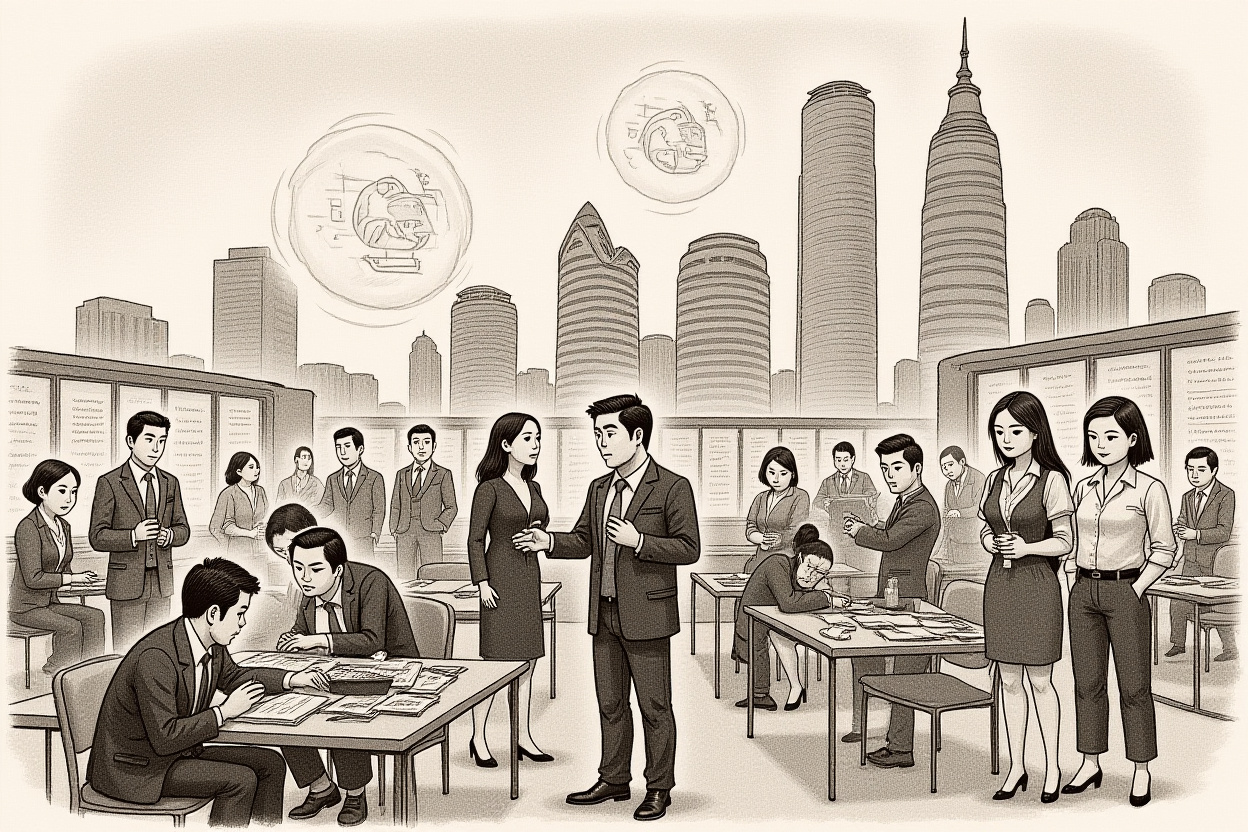
– AI is systematically targeting professions that emerged in the 20th century, with abstract, information-based white-collar roles being the most vulnerable to automation.
– A growing divide exists between public perception of AI as a chatbot tool and the reality of autonomous AI agents that can perform complex tasks without human intervention.
– Historical data suggests a reverse evolution: newer cognitive skills are falling first, while older physical trades retain a deeper moat against AI replacement.
– Systemic failures in economics, corporate strategy, and politics are masking the imminent threat, leading to a dangerous lag in preparedness for mass structural unemployment.
– Individuals must adapt by either mastering AI-immune physical skills or learning to command AI agents, as traditional career paths face obsolescence.
The Gathering Storm: AI’s Inevitable Impact on 20th-Century Professions
When Nassim Taleb (纳西姆·塔勒布), author of The Black Swan, recently tweeted that ‘all professions invented in the 20th century are inevitably impacted by AI,’ it resonated with a grim reality already unfolding in global labor markets. For sophisticated investors and professionals focused on Chinese equities, this isn’t mere speculation—it’s a structural shift that will redefine corporate efficiency, sector valuations, and economic stability. The AI’s inevitable impact on 20th-century professions is not a distant future scenario; it is a present-day calibration of risk that demands immediate attention. As capital flows towards automation-enabling technologies, understanding this dislocation is critical for anticipating market volatility and identifying resilient investment opportunities.
Media Alarms: From Skepticism to Urgent Warnings
The shift in narrative from tech hype to sober analysis is best exemplified by the coverage from long-established, serious publications. Within a two-week period, 大西洋月刊 (The Atlantic Monthly) published three major features dissecting AI’s labor market implications, signaling a profound concern that has moved from the fringe to the mainstream.
The Atlantic’s Triple-Barrel Warning
The first article, ‘America Isn’t Ready for AI’s Impact on Jobs’ by Josh Tyrangiel, argued that all traditional buffers—economic policy, retraining programs, political will—are failing. It highlighted interviews with Federal Reserve officials who admitted being data-blind to the early effects. The second, ‘AI Agents Are Sweeping Across America,’ demonstrated how non-engineers could use agentic tools to build software competitors in hours, directly impacting stock prices like that of Monday.com. The third and most damning, ‘The White-Collar Worker’s Worst Future’ by Annie Lowrey, presented hard data: bachelor’s degree holders now make up a quarter of the unemployed in the U.S., a historic high, while high school graduates are finding jobs faster. This trio of reports from a 165-year-old institution marks a pivotal moment in acknowledging the AI’s inevitable impact on 20th-century professions.
The Significance of the Pivot
This editorial pivot is crucial. The Atlantic had previously been skeptical of AI hype, suggesting a bubble. Their rapid, concentrated focus on employment threat indicates they are capturing a leading indicator of disruption, not chasing trends. For market participants, this media shift serves as a proxy for rising institutional awareness, which often precedes regulatory scrutiny and corporate strategy shifts that can roil specific sectors, especially in technology and services-heavy markets like China.
The Great AI Divide: Two Parallel Realities
A dangerous cognitive gap is widening. Most professionals, including many in management and finance, experience AI through consumer chatbots like ChatGPT—useful for drafting emails or generating ideas. However, a separate reality exists within engineering and research circles where autonomous AI agents are already radicalizing productivity.
Chatbots Versus Autonomous Agents
The fundamental difference is agency. A chatbot is reactive; it waits for a prompt. An AI agent is proactive; given a high-level goal, it can autonomously plan steps, search the web, write and execute code, run tests, and iterate—working for hours without human input. As Anthropic employee Boris Cerny described their coding AI, ‘Claude is starting to have ideas of its own and is proactively suggesting things to build.’ This transforms the tool from an assistant into a digital colleague, or soon, a supervisor. The AI’s inevitable impact on 20th-century professions is magnified here because these agents excel at the very abstract, symbolic tasks that define modern office work.
The Impending and Brutal Convergence
Currently, these powerful agents require technical know-how to deploy. But as they become more user-friendly and integrate into mainstream platforms like Microsoft 365 or Tencent’s (腾讯) enterprise suites, the two realities will collide. The convergence won’t be gentle; it will manifest as sudden obsolescence for roles centered on information processing. Early data points are emerging: within Anthropic, 90% of new code is already AI-generated. When this scale of efficiency hits general business software, the displacement will be swift and structural.
Historical Rewind: Why White-Collar Jobs Are the Prime Target
The vulnerability of post-20th-century professions isn’t random; it follows a predictable, inverse historical pattern. Human skill evolution moved from physical prowess (agriculture) to tool-based precision (industry) to abstract symbol manipulation (information work). AI invasion is doing a rewind, attacking the most recent layer first.
The Law of Reverse Replacement
This ‘AI替代的逆向历史演化定律’ (AI’s Reverse Historical Evolution Law) posits that skills developed later in human history are easier for AI to replicate. Ancient physical skills like plumbing, massage, or electrical work involve complex, embodied interaction with a messy physical world—a deep moat for AI. In contrast, tasks like financial analysis, legal document review, project management, and coding are essentially information sorting and pattern recognition, which are pure computational problems. Therefore, the AI’s inevitable impact on 20th-century professions is a function of their digital nature. Lowrey’s article notes the loss of ‘womblike security’ for the educated class—a decades-long assumption of safety that is now evaporating.
Data Confirming the Trend
Economic statistics are beginning to reflect this. In the U.S., for the first time, high school graduates are securing employment faster than college graduates. Jobs classified as ‘easily automatable’ are seeing unemployment spikes. In China, similar pressures are building. The rise of AI software from companies like Baidu (百度) in generative AI and 华为云 (Huawei Cloud) in enterprise solutions means that the vast cohort of Chinese university graduates entering finance, administration, and tech roles face a shrinking demand for their core skills. This structural shift threatens to hollow out the middle class, a key consumer base for many Chinese companies, potentially triggering a deflationary spiral as disposable income plummets.
The Calm Before the Storm: Systemic Failures in Perception
The apparent lack of mass unemployment today is not evidence of safety; it is a function of systemic lag and denial across key institutions. This creates a dangerous illusion of stability for investors and professionals.
Economists Driving by Rearview Mirror
As highlighted in The Atlantic, economists like Chicago Fed President Austan Goolsbee admit they are data-constrained, seeing no clear signs yet in employment figures. However, this is a diagnostic failure. Anton Korinek, a University of Virginia economist and member of Anthropic’s economic advisory board, criticizes his peers for using historical analogies like electricity, which spread slowly because machines were dumb. ‘Now they [AIs] are smarter than us, they can self-deploy,’ he notes. API calls can automate tasks overnight, not over decades. Economists’ models, built for cyclical changes, are ill-equipped for this structural tsunami, leaving policymakers flying blind.
Corporate Silence and Strategic Labor Hoarding
In early 2025, CEOs like Anthropic’s Dario Amodei (达里奥·阿莫戴伊) and Ford’s Jim Farley openly discussed AI eliminating swathes of white-collar jobs. That candor has vanished. Major corporations, from Walmart to Meta to Chinese tech giants, are now silent. This isn’t a change of heart; it’s a tactical pause. Companies are in a phase of ‘labor hoarding’—retaining workers while they retrofit archaic legacy systems (mainframes, ERP software) to integrate AI agents. Once this technical debt is cleared, the layoffs will be rapid and decisive. The AI’s inevitable impact on 20th-century professions is being delayed, not prevented, by these integration timelines.
Political Paralysis and the Illusion of Safety Nets
The political apparatus, both in the West and in China, is lagging. In the U.S., tech lobbyists pour billions into advocating for a hands-off ‘accelerationist’ approach. Proposed solutions like universal basic income (UBI) are untested at scale and face fierce resistance from corporate interests who would bear the tax burden. More critically, traditional tools like unemployment insurance and retraining programs are designed for cyclical downturns. Research cited by Lowrey shows such programs often have ‘net negative value.’ For China, where the social contract emphasizes stability, the challenge is monumental. The 中华人民共和国人力资源和社会保障部 (Ministry of Human Resources and Social Security) may find its policies overwhelmed by the speed of this change, as the AI’s inevitable impact on 20th-century professions renders millions of skills obsolete faster than any retraining initiative can respond.
Global Implications: No Haven from AI’s Reach
This disruption respects no borders. While the initial data points are American, the dynamics are universal. Software scales globally instantaneously. China’s market, with its deep reliance on technology sectors and a cultural premium on white-collar education, faces acute vulnerabilities.
China’s Unique Exposure
The narrative of ‘白领安全’ (white-collar safety) is perhaps even more entrenched in China’s aspirational society. Millions of families have invested heavily in university education as a ticket to secure office jobs. However, companies like 阿里巴巴集团 (Alibaba Group) and 腾讯 (Tencent) are at the forefront of deploying AI for efficiency. As these tools proliferate, the entry-level analyst, content moderator, or junior developer positions that once absorbed graduates will diminish. This threatens not just individual livelihoods but also the consumption-driven growth model of the Chinese economy, with direct implications for equity markets focused on consumer discretionary and technology stocks.
Bridging the Cognitive Gap
The most immediate risk for professionals is informational. Those who dismiss AI’s threat based on experiences with basic chatbots are living in a different universe from those commanding agent swarms. The new divide is not urban versus rural or degree versus no-degree; it is between those who understand the capability horizon of agentic AI and those who do not. For investors, this gap represents both risk and opportunity—companies that leverage AI effectively will see margin expansion, while those with large, automate-able workforces may face severe compression.
Navigating the Onslaught: Survival Strategies for the AI Era
Accepting the AI’s inevitable impact on 20th-century professions is the first step. The next is strategic adaptation. The ‘reverse evolution’ law itself points the way: move towards skills AI cannot easily replicate or learn to orchestrate AI itself.
Downward Rooting: Mastering the Physical and Emotional
– Skilled Trades: Professions requiring dexterity, situational adaptability, and physical presence—surgery, advanced repair, custom craftsmanship—will remain valuable. In China, this could mean a revaluation of vocational training paths.
– High-Touch Services: Roles demanding deep emotional intelligence, trust, and complex human interaction, such as psychotherapy, elite coaching, or bespoke consulting, offer a moat. AI can provide information, but not genuine empathy or nuanced relationship management.
Upward Breakthrough: Becoming an AI Commander
The most powerful strategy is not to compete with AI but to direct it. This involves developing meta-skills:
– Complex Judgment and Aesthetic Sense: The ability to make decisions in ambiguous environments, set strategic vision, and judge quality in creative or ethical domains where AI lacks context.
– Orchestration and Prompt Engineering: Learning to frame problems, manage multiple AI agents, and synthesize their outputs into coherent outcomes. This turns the individual into a force multiplier.
– Entrepreneurial Leverage: Using AI agents to build and run businesses with minimal human staff, as Sam Altman (萨姆·奥特曼) predicted. This requires skills in system design, resource allocation, and risk-taking.
The Path Forward in a Reshaped World
The evidence is clear: the professions that defined the 20th century’s economic rise are in the crosshairs of a technology that excels at their core functions. The lag in unemployment data is a temporary artifact, not a denial of the trend. For the global investment community, particularly those engaged with Chinese markets, this necessitates a rigorous reassessment of long-term sector bets, corporate valuations based on human capital efficiency, and macroeconomic forecasts. The call to action is urgent. Professionals must audit their own roles for automation potential and pivot accordingly. Investors must scrutinize portfolio companies for their AI adaptation strategy—are they poised to be disruptors or the disrupted? The storm is no longer on the horizon; it is already testing the levees. Proactive adaptation is the only viable defense against the coming wave of creative destruction.