



Executive Summary
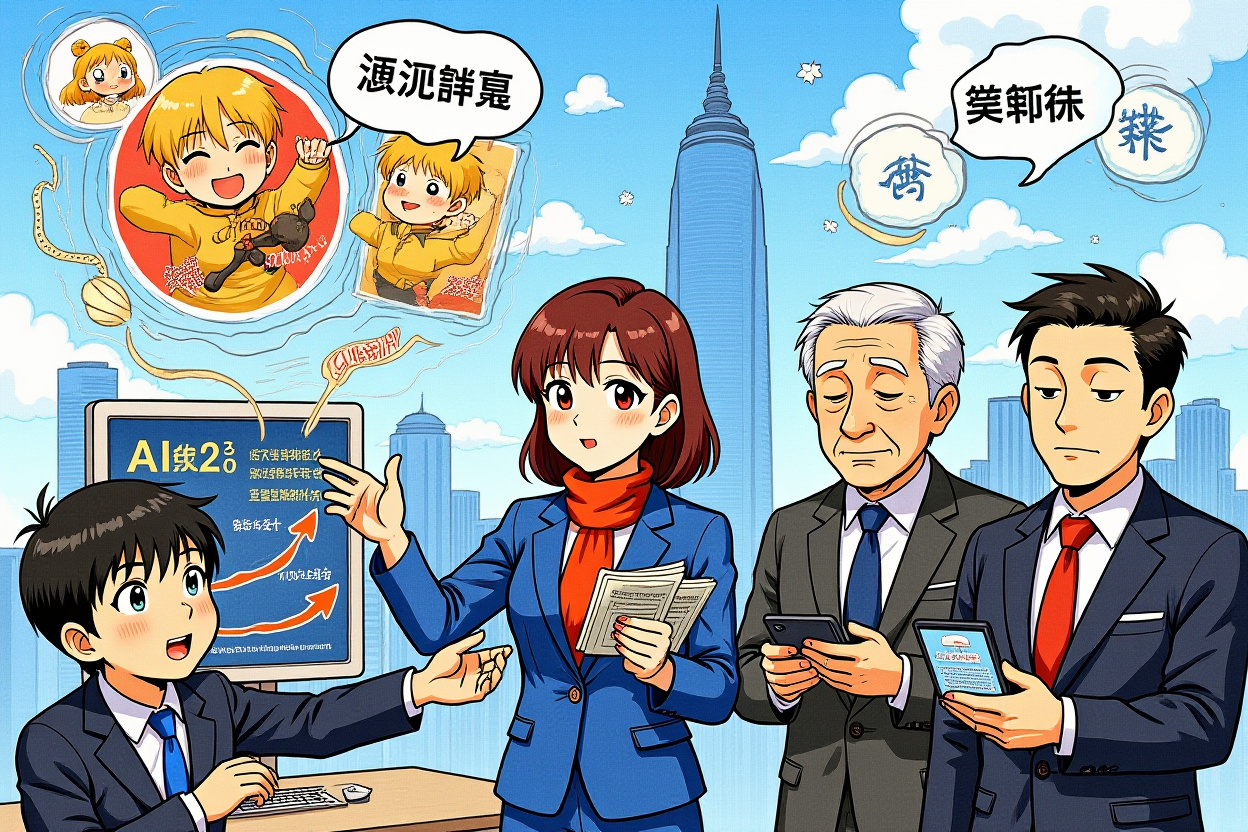
This article delves into the explosive growth of AI-generated manga series, a disruptive force in China’s digital content market. Here are the key takeaways:
– AI-generated manga series have emerged as a multi-billion yuan industry, enabled by advancements in multimodal AI models like Seedance2.0, reducing production costs from thousands to hundreds of yuan per minute.
– Traditional short video companies are pivoting to AI content to survive, with platforms like ByteDance’s Hongguo leading adoption, creating both opportunities and risks for investors.
– The sector relies on low-cost labor from vocational graduates, earning around 3000 yuan monthly, challenging the role of elite film school directors and prompting workforce restructuring.
– Rapid technological迭代 is accelerating content cycles, with AI-generated manga series evolving from粗糙沙雕漫 to sophisticated AI仿真人剧, but sustainability depends on content quality over quantity.
– For investors, understanding platform strategies, regulatory shifts, and content IP is crucial to capitalizing on this volatile yet high-growth segment of China’s equity markets.
The Dawn of a Content Revolution: AI-Generated Manga Series Reshape Entertainment
In the blink of an eye, a new content paradigm has taken hold in China’s digital landscape. AI-generated manga series, once a niche experiment, have ballooned into a sprawling industry, challenging traditional filmmaking and redefining market dynamics. For financial professionals monitoring Chinese equity markets, this shift represents more than just a cultural trend—it’s a seismic disruption with profound implications for investment strategies, corporate valuations, and regulatory frameworks. The rise of AI-generated manga series underscores how technological innovation can democratize content creation, enabling individuals with minimal formal training to compete with established elites. As platforms scramble to capitalize on this wave, understanding the mechanics behind AI-generated manga series is essential for identifying growth opportunities and mitigating risks in an increasingly volatile sector.
This transformation is fueled by the convergence of affordable AI tools and scalable business models. Originally emerging from the ashes of struggling short video companies, AI-generated manga series have quickly gained traction, with monthly revenues for top producers like Jiang You Dong Man (酱油动漫) exceeding 50 million yuan. The focus phrase, AI-generated manga series, encapsulates this revolution, where algorithms replace traditional导演, and vocational school graduates become the new creative workforce. For institutional investors, the rapid adoption signals a potential re-rating of content-related stocks, from technology providers to platform operators. However, the speed of change also introduces uncertainty, making it critical to analyze underlying drivers, from AI model advancements to shifting consumer preferences.
The Emergence of AI-Generated Manga Series: From Fringe to Mainstream
The story of AI-generated manga series begins with the decline of traditional真人短剧. By early 2025, over 90% of short video companies faced losses, as market saturation and rising costs squeezed margins. Into this void stepped AI-powered content, offering a lifeline to desperate entrepreneurs. Huang Haonan (黄浩南), founder of Jiang You Dong Man (酱油动漫), epitomizes this shift. With a background in vocational education and no family support, he leveraged AI to build a empire, demonstrating how AI-generated manga series can enable rapid scale and profitability. His company’s monthly output surged from 10 to over 100 series, targeting a goal of 1,000 by year-end—a testament to the scalability of this model.
Key to this growth was the early validation from major platforms. ByteDance’s Hongguo Manga Series Platform (红果漫剧) saw its daily active users (DAU)突破 10 million within months, highlighting robust demand. Data from DataEye-ADX reveals that in September and October 2025, AI-generated manga series上线量 exceeded 13,000 monthly, nearing the annual output of traditional short videos. This explosive adoption was driven by several factors:
– Cost Efficiency: Production costs plummeted from 8,000-10,000 yuan per minute for traditional动态漫 to as low as 600 yuan per minute for AI-generated manga series, enabling mass production.
– Platform Incentives: Companies like ByteDance actively收购 content, offering favorable分成系数 to stimulate supply, as seen with their番茄系 ecosystem under executive Zhang Chao (张超).
– Technological Accessibility: Tools like Seedance2.0 simplified video generation, allowing even novices to produce watchable content, thus lowering entry barriers.
For investors, this phase represents a land grab opportunity. Companies that quickly scaled产能, such as Jiang You Dong Man (酱油动漫) and Ming Lu Animation (鸣鹿动画), secured early-mover advantages, attracting platform partnerships and funding. However, the reliance on投流 for 80% of revenue mirrors the volatile economics of short videos, necessitating careful analysis of unit economics and cash flow sustainability.
Technological Enablers: How Multimodal AI Models Fuel the Boom
At the heart of the AI-generated manga series revolution are advancements in multimodal AI models. The launch of Seedance2.0 in early 2026 marked a pivotal moment, enabling the generation of 10-second videos with coherent dialogue,分镜, and character consistency from minimal prompts. Jiang Yigi (姜奕祺), former AI expert at Alibaba Damo Academy (阿里达摩院) and CEO of San Sheng Qing Ying (三生清影), notes that such models have made音画同步 and long-form video generation feasible, dramatically reducing the need for human intervention. This technological leap has compressed production timelines, allowing teams to pivot from weeks to days per series.
The competitive landscape among AI providers has further driven down costs. For instance, the price of using models like Keling (可灵) dropped from 1 yuan per second to 0.5 yuan per second within a year, enhancing affordability for producers. Key developments include:
– Video Generation Breakthroughs: Models like Google DeepMind’s Veo3 and Seedance1.0, released in 2025, laid the groundwork by improving visual consistency and reducing恐怖谷效应 in AI仿真人剧.
– Tool Proliferation: ByteDance’s剪映推出小云雀Agent in March 2026, offering C端 users an alternative to crowded platforms, though排队 issues persist, indicating high demand.
– API Accessibility: Companies like He Ya Manga Series (鹤芽漫剧) signed annual contracts with火山引擎 for 10 million yuan to secure API access, showcasing the strategic importance of reliable AI infrastructure.
For technology investors, this underscores the value of backing AI model developers and cloud service providers. The rapid迭代 means that staying ahead requires continuous R&D investment, with companies like ByteDance and百度 gaining edge through vertical integration. However, the risk of obsolescence is high, as newer models can quickly outdated existing workflows, impacting the valuation of tool-dependent producers.
Market Dynamics and Business Models: Profitability in a Fast-Changing Arena
The business model of AI-generated manga series closely mirrors that of真人短剧, with投流 accounting for the lion’s share of expenses. However, the低门槛 of AI production has democratized participation, leading to a flood of content and intensified competition. Early success stories, such as the AI-generated series 兴安岭诡事, which garnered over 50 million views and rumored revenues in the tens of millions, sparked a gold rush. Yet, as supply surged,平台 tightened quality standards, shifting from quantity-driven to精品化 strategies.
Platforms play a crucial role in shaping the market. ByteDance’s Hongguo Manga Series Platform (红果漫剧) has been particularly aggressive, adjusting分成系数 to favor high-quality AI仿真人剧 and acquiring 120-minute non-episodic content to capture长视频 market share. This move, as noted by industry insider Xiao Chuan (小川), reflects a strategic pivot to diversify beyond short-form content and appeal to下沉市场 audiences. Other players like Tencent (腾讯),百度, and快手 have followed suit, creating a competitive bidding environment for top-tier AI-generated manga series.
Investment implications are multifaceted:
– Content Acquisition: Platforms are预订产能 months in advance, locking in supply and driving up valuations for proficient producers. For example, He Ya Manga Series (鹤芽漫剧) secured orders filling its pipeline for a year, indicating stable revenue streams.
– Monetization Strategies: While投流 dominates, natural流收入 has dwindled, as Huang Haonan (黄浩南) observed, dropping from thousands to mere hundreds of yuan per series, pushing companies to optimize marketing spend and explore alternative revenue like IP licensing.
– Risk Factors: The industry’s reliance on platform policies introduces volatility. Reductions in保底政策, as seen with Hongguo’s adjustments, have led to the collapse of marginal players, highlighting the need for diversified client bases.
For fund managers, this suggests a focus on companies with strong platform relationships and operational flexibility. The ability to quickly adapt to changing algorithms and content trends—such as the shift from沙雕漫 to AI仿真人剧—is a key differentiator. Additionally, monitoring platform financials, like ByteDance’s investment in AI tools, can provide early signals of market shifts.
Human Capital Transformation: Low-Cost Labor Meets High-Tech Innovation
A paradoxical aspect of AI-generated manga series is their reliance on劳动密集型 processes, despite being powered by cutting-edge AI. Companies like Jiang You Dong Man (酱油动漫) expanded their workforce to over 1,200 employees in late 2025, primarily hiring vocational graduates with salaries averaging 3,000-4,000 yuan monthly. This model capitalizes on China’s vast pool of underutilized talent, turning them into抽卡师—workers who generate video content via AI prompts. As Huang Haonan (黄浩南) bluntly stated, recruitment criteria are minimal: anyone over 18 without intellectual disabilities can be trained in days using proprietary tools.
This trend has significant implications for labor markets and corporate efficiency:
– Workforce Restructuring: The advent of Seedance2.0 has rendered some roles obsolete. For instance, He Ya Manga Series (鹤芽漫剧)裁掉分镜导演 after the model’s launch, as AI could produce better分镜 automatically, reducing team sizes from 8-10 to 3 per series.
– Skill Displacement: Traditional film professionals, including Beijing Film Academy (北影) graduates, face displacement. As Liu Wei (刘伟) of Ming Lu Animation (鸣鹿动画) noted, these学院派 often dismissed AI-generated manga series, but their reluctance to adapt accelerated their irrelevance in the new ecosystem.
– Cost Advantages: By leveraging low-wage labor and AI efficiency, producers achieve降本增效, with some reporting profit margins up to 60% on successful series like 盘丝洞素锦传, which achieved a 3x ROI without投流.
For corporate executives and HR professionals, this highlights a shift towards hybrid human-AI workflows. Investing in培训 programs for existing staff to upskill in AI tool usage can mitigate displacement risks. Moreover, the rise of AI-generated manga series underscores the importance of agility in talent management, as technological advancements continually redefine job requirements.
Challenges and Future Outlook: Navigating Rapid Obsolescence
The breakneck pace of change in AI-generated manga series presents both opportunities and perils. Technological迭代 occurs so quickly that content formats can become obsolete within months, as seen with沙雕漫’s three-month popularity window. This velocity demands constant innovation from producers, who must balance quantity with quality to stay relevant. Feng Ji (冯骥), producer of Black Myth: Wukong (黑神话:悟空), remarked that with Seedance2.0, the childhood era of AIGC has ended, implying that奇观 is now廉价, pushing the industry towards more nuanced storytelling.
Key challenges include:
– Content Saturation: As月上线量 soars, differentiating products becomes harder. Platforms increasingly favor精品化 AI仿真人剧, forcing producers to invest in better scripts and production values, as evidenced by Huang Haonan (黄浩南) allocating 80% of capacity to this sub-genre.
– Investment Uncertainty: Venture capitalists have grown cautious due to the rapid变化. Entrepreneur You You (悠悠) found fundraising challenging, as investors seek defensible moats beyond technology, such as proprietary IP or unique content ecosystems.
– Regulatory Scrutiny: China’s regulatory environment for digital content is evolving, with potential crackdowns on低俗 or misleading AI-generated manga series. Monitoring announcements from bodies like the National Radio and Television Administration (国家广播电视总局) is essential for compliance.
Looking ahead, the future of AI-generated manga series may hinge on content innovation rather than technological prowess. Historical parallels from Hollywood’s response to television in the mid-20th century suggest that industries can thrive by focusing on narrative depth, as seen with movements like the French New Wave. For investors, this means evaluating companies based on their creative capabilities and IP portfolios, not just their AI toolkits. Platforms that curate high-quality content, like ByteDance’s Hongguo, are likely to sustain growth, while pure-play producers may face consolidation.
Strategic Implications for Investors and Market Participants
For sophisticated investors in Chinese equity markets, the rise of AI-generated manga series offers a compelling case study in disruptive innovation. To capitalize on this trend, consider the following actionable insights:
– Diversify Across the Value Chain: Invest not only in content producers but also in AI technology firms, cloud infrastructure providers, and platforms with strong monetization models. Companies like ByteDance (字节跳动) and百度, with their integrated ecosystems, present diversified exposure.
– Monitor Platform Policies: Stay updated on分成系数 changes and acquisition strategies from major platforms, as these directly impact producer revenues. Engage with management during earnings calls to gauge their adaptation to AI-generated manga series trends.
– Assess Content IP Potential: Look for producers developing franchise-worthy AI-generated manga series with cross-media potential, such as adaptations into games or merchandise, which can provide long-term revenue streams beyond投流.
– Evaluate Regulatory Risks: Keep abreast of guidelines from Chinese authorities on AI-generated content, as stricter regulations could affect production volumes and platform operations, influencing stock performance.
Furthermore, the global perspective is crucial. As AI tools become more accessible worldwide, the lessons from China’s AI-generated manga series boom could inform investments in other emerging markets, where similar dynamics may unfold. For instance, trends in Southeast Asia or India might mirror China’s early adoption phases, offering first-mover advantages.
Synthesizing the AI-Generated Manga Series Revolution: Key Takeaways and Forward Guidance
The transformation driven by AI-generated manga series is a testament to how technology can reshape entire industries, creating winners and losers at an unprecedented pace. From enabling vocational graduates to challenge elite directors to forcing traditional media companies to innovate, this sector exemplifies the dynamic nature of China’s digital economy. For financial professionals, the key takeaway is that adaptability and deep market insight are paramount. The focus phrase, AI-generated manga series, represents not just a content format but a broader shift towards AI-driven creativity, with ripple effects across entertainment, technology, and labor markets.
As the industry matures, expect increased mergers and acquisitions, as larger players consolidate top talent and IP. Platforms will likely double down on AI integration, using tools like Seedance2.0 to further streamline production and enhance user engagement. For those looking to invest, prioritize companies with robust technological moats, scalable operations, and strategic platform alliances. Meanwhile, traditional film professionals should embrace upskilling, leveraging AI to augment rather than replace their creative roles.
In conclusion, the story of AI-generated manga series is far from over. It serves as a powerful reminder that in today’s fast-paced markets, staying informed and agile is the best strategy. Dive deeper into market reports, engage with industry experts, and consider allocating resources to monitor this evolving space—it might just be the next big opportunity in your portfolio.