



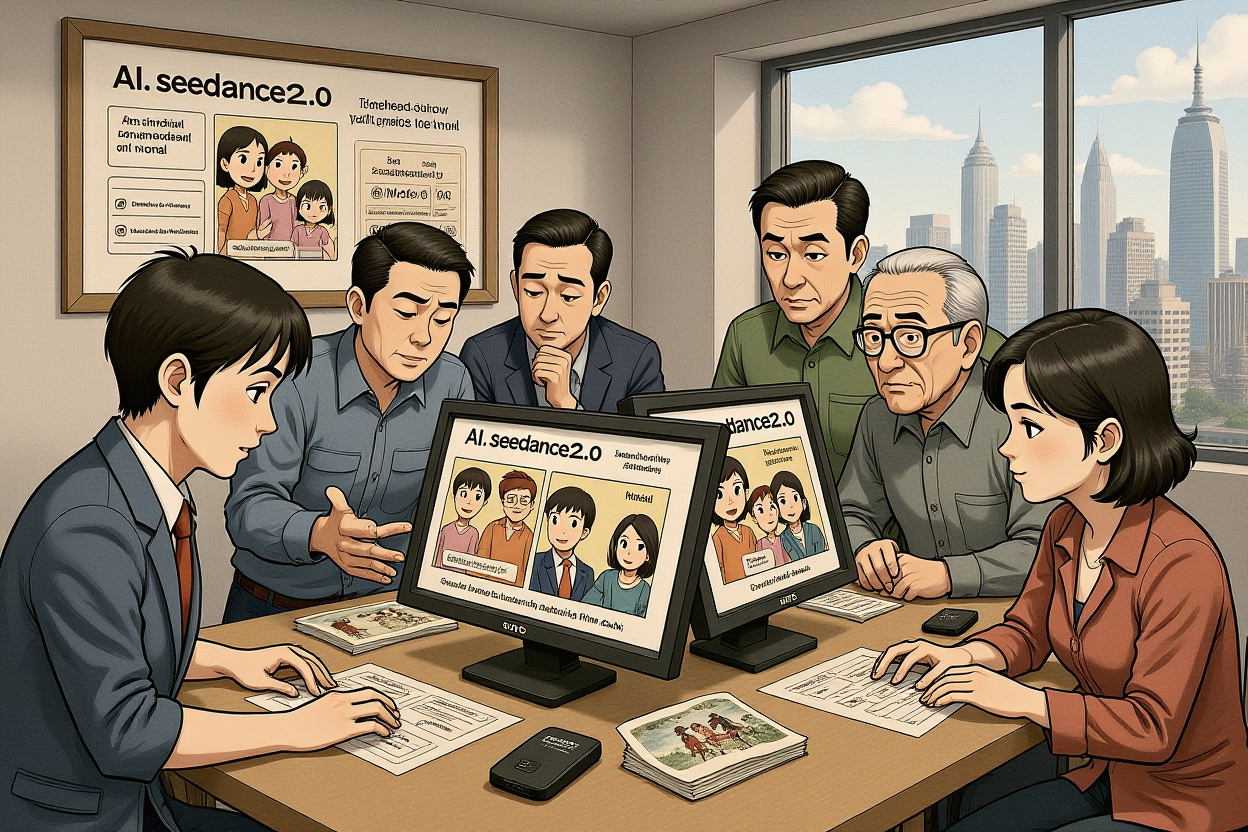
Executive Summary
Before delving into the details, here are the key takeaways from this analysis of China’s AI-generated comic drama revolution:
- AI-generated comic dramas (AI漫剧) have emerged as a disruptive force in digital content, enabling low-cost, high-volume production that challenges traditional film and television workflows.
- Vocational school graduates and former factory workers, often earning monthly salaries around 3,000 yuan ($420), form the core workforce, leveraging AI tools to create content that garners billions of views.
- Technological advancements, particularly multimodal AI models like ByteDance’s Seedance2.0, are accelerating industry growth while rendering specialized roles such as division directors obsolete.
- Major platforms including ByteDance (字节跳动), Tencent (腾讯), and Baidu (百度) are aggressively investing, creating a hyper-competitive market that mirrors the earlier boom in真人短剧 (live-action short dramas).
- The rapid evolution underscores a broader trend: AI is democratizing content creation, but sustainability may hinge on a return to content quality over pure technological novelty.
The Digital Content Landscape Is Being Rewritten
The countdown to disruption in China’s entertainment industry has already begun. In a startling reversal of traditional hierarchies, graduates from vocational schools, commanding salaries as low as 3,000 yuan per month, are now producing content that rivals and often surpasses the output of directors from prestigious institutions like the Beijing Film Academy (北京电影学院). This revolution is fueled by the explosive growth of AI-generated comic dramas, a content format that blends comic aesthetics with dynamic video, driven entirely by artificial intelligence. For global investors and market watchers, this shift represents more than a cultural curiosity; it signals a fundamental change in content production economics, talent valuation, and platform strategy within one of the world’s most dynamic digital markets.
The story begins with entrepreneurs like Huang Haonan (黄浩南), founder of Jiangyou Anime (酱油动漫). A vocational school graduate with no family backing, Huang epitomizes the new breed of content moguls. His belief that “you’ll never get rich by working for someone else” led him through successive internet booms—web novels, short dramas—before he struck gold with AI漫剧. By November 2025, his company was generating monthly revenues exceeding 50 million yuan, cementing its position as a sector leader. Jiangyou Anime’s official ambition is stark: “to become the nation’s largest AI影像集团 (AI imaging group).” This is not an isolated case. Platforms like ByteDance’s Hongguo Manju (红果漫剧) have seen their daily active users (DAU) surge past 10 million in just over three months, according to exclusive data from 36Kr. The AI-generated comic dramas sector, born from the maturation of multimodal large models, has swiftly become a content windfall estimated to be worth over 20 billion yuan.
The Meteoric Ascent of AI-Generated Comic Dramas
The rise of AI-generated comic dramas is a testament to how quickly technology can birth and scale an entire industry. By the second half of 2025, profiting from this niche was an open secret, attracting everyone from opportunistic individuals to well-capitalized entities.
From Obscurity to Market Dominance: The Gold Rush Mentality
Early movers capitalized on a supply-demand imbalance. One practitioner described a wealthy individual in Changsha who rented an entire building, hired over 200 people, and churned out low-cost AI漫剧 at 600 yuan per minute to meet voracious platform demand. Another, a former mini-game developer known as Baize (白泽), produced nearly 30 AI dynamic comics solo in six months, selling them to distributors for dozens of yuan per minute and netting hundreds of thousands of yuan on an investment of less than 1,000 yuan. The influx of “new money” triggered fierce competition for talent. In January 2026, Huang Haonan publicly accused Baidu (百度) employees of poaching his staff during a company visit, offering tenfold salaries—a drama that was quickly resolved but highlighted the sector’s fever pitch. This gold rush stood in stark contrast to the concurrent contraction in the真人短剧 (live-action short drama) market, where by early 2025, over 90% of companies faced losses, leading to layoffs and a talent pool ripe for recruitment by emerging AI漫剧 studios.
Technological Enablers: The Multimodal AI Foundation
The advent of AI-generated comic dramas is intrinsically linked to the rapid deployment of multimodal large models. While Artificial General Intelligence (AGI) remains on the horizon, tools for generating images and video have become commercially viable and affordable. The year 2025 saw the widespread落地 (landing) of video generation models like Google DeepMind’s Veo3, Kling 2.0, and notably, the early version of Seedance. These tools addressed initial challenges in音画同步 (audio-visual synchronization), generating longer video clips, and maintaining character consistency. However, the true game-changer arrived in February 2026: Seedance2.0. Dubbed a “blockbuster” release, it allows users to generate a coherent 10-second video with dialogue,分镜 (storyboarding), background music, and consistent characters from a sub-20-word prompt for about ten yuan. Jiang Yiyi (姜奕祺), former AI expert at Alibaba DAMO Academy (阿里达摩院) and now CEO of Sansheng Qingying (三生清影), noted that as model capabilities improved, the cost of computing power procurement simultaneously fell. For instance, the price for generating video with Kling dropped from 1 yuan per second in early 2025 to 0.5 yuan per second later that year. This dual trend of improving capability and declining cost created a perfect storm for the AI-generated comic dramas explosion.
A Labor-Intensive Paradox: High-Tech Tools, Low-Cost Labor
Ironically, this industry born from cutting-edge AI has quickly adopted characteristics of a labor-intensive operation. To scale and capture market share, companies embarked on aggressive hiring sprees, but with a focus on low-wage, readily trainable personnel rather than traditional creative elites.
Building an Army of “AI Operators”
Scaling Production and the Pursuit of Volume
Huang Haonan of Jiangyou Anime executed a radical expansion, growing his team from dozens to over 1,200 employees in less than half a year. The hiring criteria were minimal: adults over 18 without intellectual disabilities. Huang openly stated that the highest educational qualification in his company was a bachelor’s degree. With proprietary tools, new hires could be trained and operational within two to three days. Correspondingly, the average salary hovered between 3,000 to 4,000 yuan per month. This created a surreal scene: vocational graduates or former factory workers, seated in modern office buildings, feeding爽文 (wish-fulfillment fiction) plots into AI models representing the pinnacle of technological advancement, thereby producing content viewed hundreds of millions of times. Concurrently, companies invested heavily in core resources, paying up to 100,000 yuan per script and offering million-yuan annual salaries to chief editors to secure quality IP. The focus was squarely on产能 (production capacity). Jiangyou Anime’s monthly output skyrocketed from over 10 titles to 60, then surpassed 100 by January 2026. Huang aimed for 1,000 titles per month by year-end—equivalent to one-third of the entire live-action short drama industry’s monthly output. As Jiang Yiyi pointed out, when access to底层模型 (underlying models) is equalized, core competitiveness often devolves to产能和成本 (production capacity and cost).
Market Dynamics: Platform Wars and the Speed Imperative
The AI-generated comic dramas market is being shaped and accelerated by the strategic moves of major internet platforms, with ByteDance taking a particularly dominant and proactive role.
ByteDance’s Aggressive Playbook
ByteDance’s reaction to the AI-generated comic dramas trend was swift and decisive. The content, which initially gained traction on Douyin (抖音), was quickly placed under the purview of the Short Drama Copyright Center established in May 2025, reporting to Zhang Chao (张超), head of the Tomato Novel (番茄小说) and Hongguo Short Drama (红果短剧) ecosystem. This centralized structure leveraged existing expertise from successfully scaling Hongguo Short Drama. When AI仿真人剧 (AI simulacra dramas)—a more polished sub-genre aiming for photorealism—began gaining traction, the Tomato series promptly adjusted revenue-sharing coefficients and acquired premium content. This speed forced the entire industry to accelerate. Multiple production partners described the Tomato team as exceptionally efficient and assertive, using electronic contracts finalized within days, unlike other platforms that relied on slower, paper-based processes. In a sector where trends can shift every three months, such速度 (speed)本身就是门槛 (is itself a barrier to entry). Beyond ByteDance, other giants like Tencent, Baidu, and Kuaishou (快手) have also entered the fray,预订 (pre-booking) production capacity from top studios for up to a year to secure market position.
The Relentless Pursuit of the Next Trend: From沙雕漫 to Simulation
The lifecycle of content formats within the AI-generated comic dramas sphere is brutally short.粗糙 (Crude) early formats like沙雕漫 (silly comics) had their heyday for less than three months before being supplanted. The current vanguard is AI仿真人剧, which represents the technical ceiling and a move towards精品化 (premiumization) desired by platforms. Yang Hao (杨浩), founder of Heya Manju (鹤芽漫剧), saw the potential early. Despite initial technical glitches like unsynced dialogue and the “uncanny valley” effect in微表情 (micro-expressions), he逆向而行 (moved against the trend). A visit to the team behind the hit “兴安岭诡事” (Strange Affairs in the Greater Khingan Range), which reportedly earned nearly 600,000 yuan in profit, convinced him. His company’s first AI simulacra drama, “盘丝洞素锦传” (Legend of Sujin in the Cobweb Cave), achieved a 3x return on investment (ROI) without paid promotion, attracting investment and orders. The velocity of technological change is such that problems deemed insurmountable one month become trivial the next. As one从业者 (practitioner) said, if you encounter a technical hurdle in producing AI-generated comic dramas, just wait—it will likely be solved soon.
Technological Disruption and the Human Cost
The advancement of AI tools is a double-edged sword, creating unprecedented efficiencies while systematically dismantling traditional creative roles and hierarchies.
The Obsolescence of Specialized Expertise
The launch of Seedance2.0 in February 2026 was a watershed moment. Yang Hao made an immediate decision: to lay off the division directors responsible for storyboarding, retaining only one chief镜头导演 (shot director). The directors he had hired, some graduates of the Beijing Film Academy, were “academic purists” who often looked down on AI漫剧 and hadn’t personally used the generative tools. Their overly critical approach slowed production, and Seedance2.0’s ability to generate superior分镜 made them redundant. Similarly, at Minglu Animation (鸣鹿动画), an AI platform employee worked through the night in dismay upon realizing that work which previously required meticulous craftsmanship could now be replicated by novices. The team decided to discard a week’s worth of work, as the cost of further refinement exceeded regenerating it with the new model. The role of the “抽卡师” (card drawer)—a new job title for those prompting AI models to generate video—was also transformed. Previously, this was a tedious, unpredictable process laden with玄学 (superstition). Post-Seedance2.0, one抽卡师 noted that desired videos could be generated in almost one attempt, making the job far less labor-intensive but also reducing the need for a large workforce. Huang Haonan and Yang Hao both stated that team sizes per production could be reduced from 8-10 people to around 3.
Contrasting Fortunes: AI Boom vs. Traditional Short Drama Bust
While the AI-generated comic dramas sector hums with activity, the traditional真人短剧 industry is undergoing a severe shakeout. Platforms like Hongguo have tightened保底 (minimum guarantee) policies, pushing many production companies operating on thin margins into closure. Even leading live-action short drama companies like Tinghuadao (听花岛), behind hits such as “十八岁太奶奶驾到,重整家族荣耀” (The 18-Year-Old Great-Grandmother Arrives, Reclaiming Family Glory), have begun布局 (laying out plans) for AI漫剧, driven by FOMO (Fear Of Missing Out). This dichotomy highlights the disruptive pressure AI imposes on adjacent content sectors. The efficiency gains from AI-generated comic dramas are not just incremental; they are restructuring the entire value chain of digital storytelling.
Looking Ahead: When Technology Plateaus, Content Reigns
The history of media technology offers a sobering perspective on today’s frenzy. In the late 1940s and 1950s, the rise of television threatened Hollywood, leading to a wave of technological gimmicks like 3D films and Smell-O-Vision in a failed bid to win back audiences. While television prevailed, cinema did not die; instead, it gave rise to movements like the French New Wave and New German Cinema, which focused on narrative depth and artistic expression. This historical parallel suggests that for AI-generated comic dramas, the initial rush based on technological novelty and cost advantage may eventually give way to a phase where content quality and storytelling prowess determine long-term winners.
Some industry insiders are already positioning for this shift. Xiaochuan (小川), a former head of short drama operations at a major internet company, is planning a startup that balances content production with patience for the industry to cool down. “I intend to do content production while waiting for the entire industry to return to a relatively calm state,” he said. “At that time, perhaps the industry’s attention will refocus on content itself.” For investors, the current landscape presents both high-reward opportunities and significant risk due to blistering pace of change. Entrepreneurs like Youyou (悠悠), seeking funding post-Chinese New Year, found investors increasingly cautious, demanding a “reason they must invest” in an era of technological parity. The forward-looking guidance for market participants is clear: monitor the technological arms race, but increasingly scrutinize the underlying IP, creative direction, and brand-building capabilities of companies in the AI-generated comic dramas space. As the tools become ubiquitous, the true differentiator will once again be the story being told.
The rise of AI-generated comic dramas is more than a passing trend; it is a case study in how AI democratizes production, redefines talent, and forces entire industries to adapt at breakneck speed. For global investors eyeing China’s tech and entertainment sectors, understanding this dynamic is crucial. The call to action is to look beyond the hype, identify companies that are building durable creative infrastructures alongside technical prowess, and prepare for the next evolution where content, not just code, will crown the kings of this new digital frontier.