



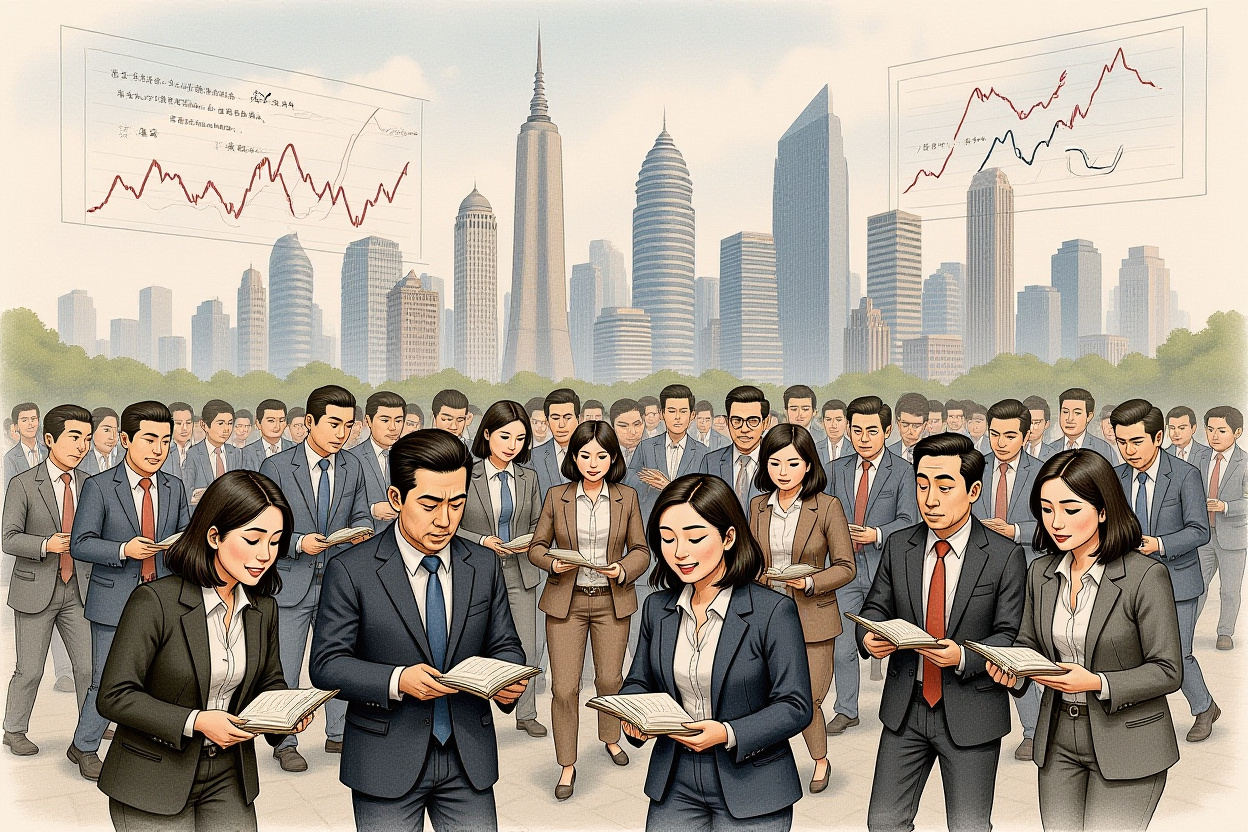
Executive Summary: Key Takeaways on AI’s Job Market Impact
This article delves into the profound transformation driven by artificial intelligence, specifically focusing on its disruption of white-collar professions. Based on analysis from leading sources and market trends, here are the critical insights:
– AI’s impact on employment follows a reverse historical pattern, where newer, abstract cognitive skills from the 20th century are being automated first, while older physical skills remain resilient.
– Serious media outlets like The Atlantic have issued multiple warnings, highlighting data such as rising unemployment among college graduates and the explosive growth of autonomous AI agents.
– A significant perception gap exists: while many view AI as a basic tool, advanced users leverage AI agents that can independently execute complex tasks, threatening traditional white-collar roles.
– Systemic failures in economics, corporate strategy, and politics leave societies unprepared for the structural unemployment AI will cause, unlike past cyclical downturns.
– Individuals must adapt by developing physical-world skills or becoming AI commanders to navigate the upcoming job market upheaval, with global implications including in China.
The Looming Storm: AI’s Disruption of White-Collar Jobs Begins
When Nassim Taleb (纳西姆·塔勒布), author of ‘The Black Swan,’ recently tweeted that ‘all professions invented in the 20th century will not escape the impact of AI,’ it resonated deeply within financial and tech circles. This isn’t mere speculation; it’s a forecast rooted in observable trends. AI’s disruption of white-collar jobs is accelerating, and the calm before the storm is deceiving. For investors and professionals in Chinese equity markets, understanding this shift is crucial, as it will reshape industries, corporate valuations, and employment landscapes globally. The focus on AI’s impact on white-collar jobs reveals a stark reality: the very skills that fueled economic growth in recent decades are now prime targets for automation.
Serious Media Raises the Alarm: Data Points to a Crisis
In the past weeks, The Atlantic (大西洋月刊), a venerable publication founded in 1857, has published three in-depth articles analyzing AI’s threat to employment. This concerted focus from a serious media outlet signals that the AI disruption of white-collar jobs is transitioning from theory to reality.
The Atlantic’s Triple Threat: From Warnings to Hard Data
The first article, ‘America Isn’t Ready for AI’s Impact on Jobs’ by Josh Tyrangiel (乔什·泰兰吉尔), argues that political and economic buffers are failing. It cites interviews with economists and officials who admit that existing tools can’t handle the impending shock. The second, ‘AI Agents Are Sweeping Through America’ by Lila Shroff (里拉·什罗夫), describes how AI agents—autonomous digital workers—enable rapid software development, exemplified by journalists creating a competitor to Monday.com in hours, causing stock volatility. The third, ‘The Worst-Case Scenario for White-Collar Workers’ by Annie Lowrey (安妮·劳里), presents alarming data: college graduates now account for a quarter of U.S. unemployment, a historic high, and jobs susceptible to AI automation show spiking unemployment rates. These pieces, accessible via The Atlantic’s website [https://www.theatlantic.com/], underscore that AI’s disruption of white-collar jobs isn’t a distant threat but a present danger.
Economic Indicators and the Perception Gap
Lowrey’s analysis introduces the concept of ‘womblike security’ for educated workers, a safety net that’s vanishing. She notes that high school graduates are finding jobs faster than college graduates, a reversal of historical trends. This data points to AI’s disproportionate impact on information-processing roles, core to white-collar work. For financial professionals, this implies sectors heavy in administrative, analytical, or managerial functions—such as finance, law, and tech—face heightened risk, potentially affecting stock performance and investment strategies in Chinese markets where similar trends may emerge.
The Hidden Divide: Two AI Universes and Autonomous Agents
Many professionals underestimate AI’s capabilities, living in what Shroff calls ‘two parallel AI universes.’ One universe sees AI as chatbots like ChatGPT, useful for drafting emails or answering queries. The other, inhabited by engineers and researchers, uses AI agents—tools with ‘agentic’ properties that can plan, execute, and learn independently.
From Chatbots to Autonomous Digital Employees
AI agents, such as those developed by Anthropic, represent a leap beyond passive chatbots. As Boris Cerny from Anthropic noted, Claude Code ‘starts to come up with its own ideas and is actively proposing what to build.’ These agents can tackle complex tasks like coding, data analysis, and project management without human intervention, operating for hours autonomously. This evolution means that AI’s disruption of white-collar jobs is accelerating because agents can replace not just tasks but entire job functions. For example, in software development, where error tolerance is low, AI now generates 90% of code at Anthropic, showcasing efficiency gains that threaten human roles.
The Cognitive Barrier Crumbles
The ability of AI agents to use computers autonomously erodes the cognitive advantages that white-collar workers rely on. Skills like report-writing, legal drafting, or financial analysis—honed through years of education—are precisely what AI excels at. This creates a vulnerability where professionals who dismiss AI as a tool may soon be outpaced by those leveraging agents to compress months of work into days. In Chinese markets, where tech adoption is rapid, this divide could widen, impacting sectors from banking to e-commerce.
Historical Rewind: Why White-Collar Jobs Are Most Vulnerable
The concept of ‘AI replacement’s reverse historical evolution law’ explains why AI’s disruption of white-collar jobs is imminent. Human skill development progressed from physical abilities (e.g., farming) to industrial craftsmanship, and finally to abstract cognitive tasks in the 20th century. AI reverses this order, automating newer, information-based skills first.
The Reverse Evolution of Skill Replacement
Ancient skills involving physical interaction—like plumbing, electrical work, or hairdressing—require embodied presence and real-world feedback, making them harder for AI to replicate. In contrast, white-collar tasks such as accounting, project management, or data analysis involve symbol manipulation and information processing, which AI handles effortlessly. This ‘rewind’ effect means that the AI disruption of white-collar jobs is structural, not cyclical. Once companies integrate AI workflows, positions may vanish permanently, unlike temporary layoffs during economic downturns.
Structural Unemployment: A Deeper Threat
Historical analogies fail here. The ‘rust belt’ decline from mechanical automation in the 1970s or job losses from globalization involved cyclical shifts where jobs eventually returned. AI-induced structural unemployment means demand for certain roles disappears forever. Lowrey emphasizes that tools like unemployment insurance or retraining programs, designed for cyclical shocks, are ineffective against this. For instance, U.S. retraining programs have shown ‘net negative value,’ and proposals like universal basic income (UBI) face funding and political hurdles. In China, where white-collar employment has boomed, similar structural risks could destabilize consumer markets and economic growth, affecting equity valuations.
Systemic Failures: Why the Calm Before the Storm Persists
The absence of mass unemployment so far doesn’t negate the threat; it highlights systemic blind spots. Economists, corporations, and politicians are ill-equipped to respond, creating a dangerous lag in awareness and action.
Economists’ Blind Spots and ‘Rearview Mirror’ Driving
Economists like Austan Goolsbee (奥斯坦·古尔斯比) of the Chicago Fed acknowledge that data shows no current labor market erosion from AI, but they struggle to explain high productivity figures. Anton Korinek (安东·科里内克), an economist at the University of Virginia, criticizes this approach: ‘Machines used to be stupid, so rollout took time. Now they’re smarter than us and can ‘roll themselves out.” By relying on historical precedents like electricity or the internet, economists miss AI’s unique speed and scalability. Korinek, who advises Anthropic, adds that tech insiders ‘feel fear,’ indicating that those closest to AI see the risks firsthand.
Corporate Silence and Capital Strategy
Early in 2025, CEOs like Dario Amodei (达里奥·阿莫戴伊) of Anthropic and Sam Altman (萨姆·奥特曼) of OpenAI openly predicted AI would eliminate half of entry-level white-collar jobs. Now, they’ve gone silent. Tyrangiel’s reporting reveals that executives from Walmart, Amazon, and AI firms decline interviews, suggesting a ‘labor hoarding’ phase where companies optimize AI integration before cutting jobs. This corporate ‘阳谋’ (open secret) means that when legacy systems interface with AI, layoffs could be swift and severe. For investors, this implies potential volatility in stocks of companies with high white-collar overhead, as efficiency gains may not immediately translate to stability.
Political Inaction and Broken Safety Nets
Political systems are paralyzed. In the U.S., tech lobbying has pushed for minimal regulation, while tools like fiscal stimulus assume cyclical recovery. Nick Clegg (尼克·克莱格), former UK deputy prime minister, warns that ‘democratic governments may not pass this test’ if they drift into this era unprepared. The AI disruption of white-collar jobs requires new policies, but gridlock prevails. In China, where government plays a stronger role, responses may differ, but the global nature of AI means no country is immune. The lack of preparedness exacerbates risks for financial markets, as sudden job losses could trigger deflationary spirals.
Global Implications: AI’s Borderless Impact and China’s Position
AI’s disruption of white-collar jobs knows no borders; it’s a software-driven phenomenon that will affect economies worldwide, including China. The perception of ‘white-collar security’ is even more entrenched in Chinese internet culture, making the shift potentially more disruptive.
China’s Unique Vulnerabilities and Opportunities
China’s rapid tech adoption and large white-collar sector in cities like Shanghai and Shenzhen increase exposure to AI automation. However, the cognitive divide—where many professionals underestimate AI agents—persists here too. As autonomous tools become more accessible, jobs in finance, law, and management face similar threats. Yet, China’s focus on physical infrastructure and manufacturing might offer buffers, as older skills remain relevant. For international investors, this means monitoring Chinese companies’ AI integration strategies and labor trends, as they could signal broader market shifts.
Survival Strategies: Navigating the AI Job Market
To survive the AI disruption of white-collar jobs, individuals must pivot based on the reverse evolution law. Here are actionable strategies:
– Downward Rooting: Develop skills in complex physical environments, such as skilled trades (e.g., HVAC technician, electrician) or high-touch services (e.g., therapy, personalized coaching) that require emotional intelligence and real-world interaction.
– Upward Commanding: Instead of competing with AI on tasks like data crunching, learn to orchestrate AI agents. Enhance skills in strategic decision-making, creative direction, and ethical oversight—areas where human judgment excels.
– Continuous Learning: Stay informed about AI advancements through resources like industry reports or platforms such as arXiv [https://arxiv.org/] for tech insights. This cognitive agility will be key in a fluid job market.
Preparing for the Inevitable: A Call to Action
The AI disruption of white-collar jobs is not a speculative future; it’s unfolding now, with data and expert warnings confirming its trajectory. For financial professionals and investors, this means reassessing portfolios to favor companies embracing AI for efficiency while mitigating social risks. On a personal level, abandoning the ‘white-collar myth’ and diversifying skill sets is essential. As Taleb’s insight suggests, the 20th-century professional model is obsolete. The storm is already at sea—ignoring it won’t make it vanish. Proactive adaptation, both in career choices and investment strategies, will define success in the coming era. Start by evaluating your own role’s vulnerability, exploring AI tools firsthand, and advocating for sensible policies that balance innovation with workforce stability. The time to act is before the ice fully cracks.