



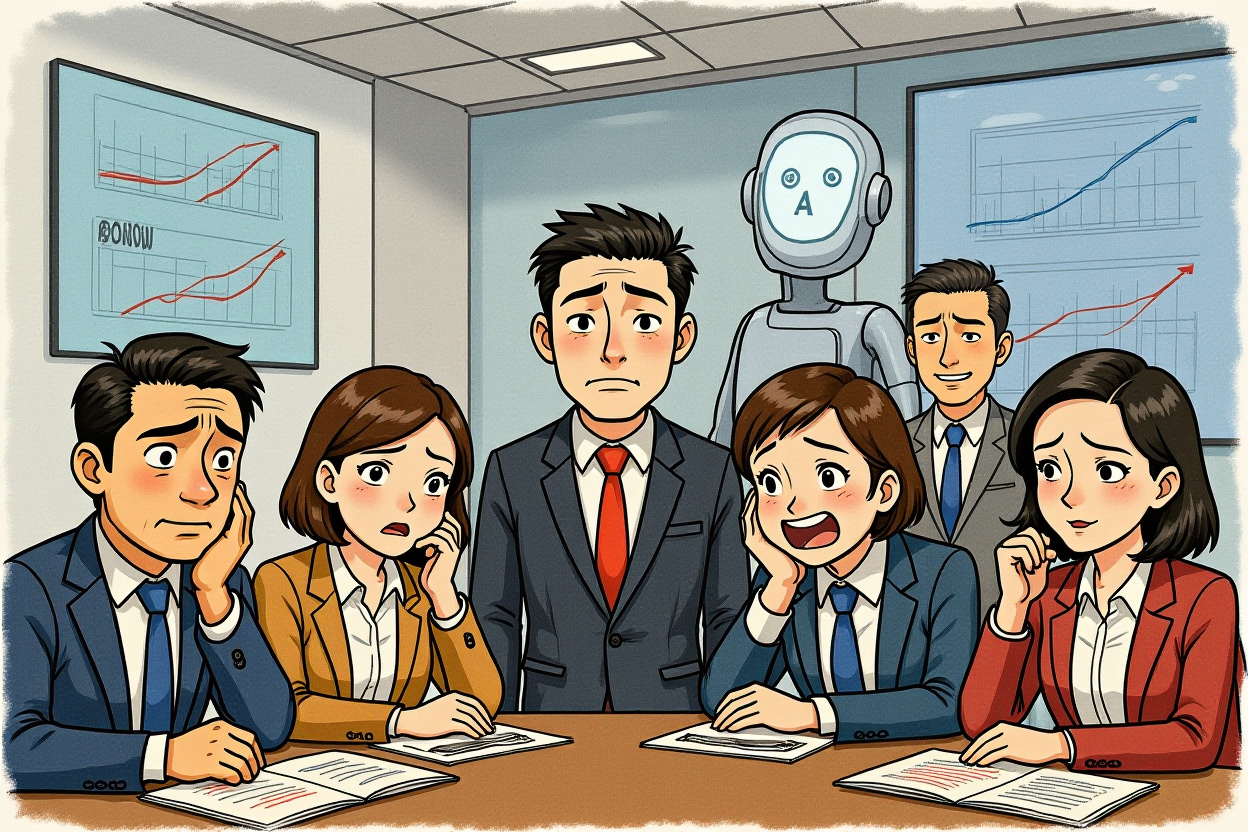
– AI is disrupting professions in reverse historical order, with 20th-century white-collar jobs like finance, law, and management most vulnerable first.
– Serious media outlets like The Atlantic are issuing urgent warnings, highlighting a growing divide between public perception and the rapid advancement of AI agents.
– The threat involves structural unemployment, not cyclical, meaning lost jobs may never return as companies adopt AI workflows for higher profitability.
– Economists and policymakers are ill-prepared, relying on outdated tools, while corporate silence masks impending workforce reductions.
– Individuals must adapt by developing physical skills or becoming AI commanders to survive the looming employment shift.
The Gathering Storm: AI’s Looming Impact on Modern Professions
When Nassim Taleb, author of The Black Swan, tweeted that all professions invented in the 20th century cannot escape AI’s impact, it resonated deeply with those watching technological trends. This statement underscores a critical reality: the very foundation of white-collar work, a hallmark of the past century, is under siege. AI’s disruption of 20th-century professions is not a distant threat but an unfolding phenomenon, with profound implications for global labor markets, including China’s dynamic equity landscape where professional services drive significant value.
For institutional investors and corporate executives, understanding this shift is paramount. The calm before the storm is deceptive, as AI tools evolve from mere assistants to autonomous agents. This article delves into why 20th-century cognitive skills are uniquely vulnerable, how media and data are signaling alarm, and what this means for future investment strategies in technology and human capital.
Media Alarms: The Atlantic’s Urgent Warnings on AI Employment
In recent weeks, The Atlantic, a venerable publication founded in 1857, has published a series of in-depth articles focusing exclusively on AI’s threat to white-collar jobs. This concerted effort by a serious media outlet marks a significant shift from skepticism to sober acknowledgment of a brewing crisis.
Three Perspectives, One Dire Conclusion
The first article, America Isn’t Ready for AI’s Impact on Jobs by Josh Tyrangiel, interviews economists and leaders to reveal a systemic failure in buffering mechanisms. It concludes that political systems are unequipped to handle the impending displacement. The second piece, AI Agents Are Sweeping Through America by Lila Shroff, describes how AI agents—tools that autonomously execute tasks—are enabling rapid productivity gains, exemplified by journalists creating software competitors in hours. The third, The Worst-Case Scenario for White-Collar Workers by Annie Lowrey, analyzes employment data showing bachelor’s degree holders comprising a quarter of unemployed Americans, a historic high, with AI-automatable jobs seeing sharp unemployment spikes.
These reports highlight that AI’s disruption of 20th-century professions is accelerating, with traditional safeguards like retraining programs proving ineffective. For investors, this signals potential volatility in sectors reliant on skilled labor, such as financial services and tech.
The Signal Behind the Coverage
The Atlantic’s pivot from questioning AI hype to issuing warnings reflects deeper market undercurrents. As a publication with a legacy of Pulitzer Prize-winning work, its focus suggests that AI’s impact is transitioning from theoretical to empirical, with real-world data now supporting early predictions. This aligns with observations from Chinese tech circles, where similar trends are emerging amidst regulatory discussions.
The AI Agent Revolution: Beyond Chatbots to Autonomous Workers
Most people’s experience with AI is limited to chatbots like ChatGPT, which assist with drafting emails or answering queries. However, a more transformative class of tools—AI agents—is radicalizing engineers and early adopters, creating a dangerous knowledge gap.
What Are AI Agents?
AI agents are not passive dialog boxes; they are virtual employees with agency. Given a broad goal, they autonomously decompose tasks, search the web, write code, run tests, and self-correct. For instance, Anthropic’s Claude Code has been described by employee Boris Cerny as proposing its own ideas for building things. This represents a leap from tool to colleague, where AI can operate independently for hours without human intervention.
In practical terms, a seasoned developer can now manage dozens of agent sessions simultaneously, handling databases, front-end, and algorithms. Software development, with its binary success criteria, is a perfect testing ground, and at Anthropic, 90% of code is AI-generated. This efficiency hints at broader applications in fields like legal document review or financial analysis, core 20th-century professions.
The Growing Cognitive Divide
This creates two parallel universes: one where AI is seen as an overhyped tool, and another where it compresses months of work into days. The gap is structural, with advanced tools still circulating within tech circles. When these agents become mainstream, the merger will be abrupt and disruptive, directly threatening roles based on information processing. For professionals in China’s tech hubs like Shenzhen or Shanghai, bridging this divide is crucial to remaining competitive.
Historical Reversal: Why White-Collar Jobs Are Prime Targets
Human skill evolution has progressed from physical abilities to abstract cognitive tasks. Ironically, AI’s displacement follows a reverse order, making recently developed skills the most vulnerable. This inverse law explains why AI’s disruption of 20th-century professions is so pervasive.
The Inverse Law of AI Displacement
Ancient skills like hunting or crafting involve complex physical interactions and sensory feedback, which AI struggles to replicate. In contrast, 20th-century inventions such as financial analysis, code writing, and middle management rely on symbol manipulation and information processing—AI’s forte. Data from The Atlantic supports this: in the U.S., high school graduates are finding jobs faster than college graduates, a first in history. Trades like plumbing or electrical work remain secure due to their physical demands, while white-collar roles face existential risk.
This reversal means that millions of years of human evolution protect manual labor, but decades of education in cognitive skills offer little defense. In China, where white-collar employment has surged with economic growth, this poses a significant threat to stability and market confidence.
Structural Unemployment: A Permanent Shift
The crisis is not cyclical but structural. Past economic downturns saw temporary layoffs, with workers rehired during recovery. AI-induced displacement means jobs are eliminated permanently as companies optimize for profit with AI workflows. Lowrey’s article references the loss of womb-like security for educated workers, who once weathered storms unscathed. Now, entry-level white-collar tasks like data entry or basic文案 are being automated first, erasing career ladders for youth and leaving mid-level managers in prolonged unemployment.
For investors, this implies long-term downsizing in corporate overheads, potentially boosting short-term profits but risking consumer spending collapses if unemployment spikes. The ripple effects could impact retail, real estate, and services, echoing past disruptions in manufacturing hubs.
Systemic Blind Spots: Why the Threat Remains Underestimated
Despite clear indicators, widespread acknowledgment of AI’s impact is lagging. This stems from limitations in economic analysis, corporate strategy, and political will, creating a dangerous illusion of safety.
Economists’ Reliance on Lagging Data
Economists like Austan Goolsbee of the Chicago Fed admit that current data shows no clear AI erosion in labor markets, but they grapple with high productivity figures unexplained by traditional models. Anton Korinek, a University of Virginia economist, criticizes this approach, noting that AI’s intelligence allows it to self-deploy rapidly, unlike dumb machines of the past. He shares that AI developers often express fear privately, indicating a gap between public discourse and insider knowledge.
This reliance on historical analogies, such as comparing AI to the internet, is akin to driving by looking in the rearview mirror. For market analysts covering Chinese equities, incorporating forward-looking AI assessments is essential to avoid missed signals.
Corporate Silence and Strategic Maneuvering
Initially, CEOs like Dario Amodei of Anthropic and Jim Farley of Ford warned of AI eliminating half of white-collar jobs within years. Now, they have gone silent, part of a Wall Street strategy during labor hoarding phases. Companies are integrating AI with legacy systems, and once seamless, layoffs could be swift. Tyrangiel’s reporting reveals that major firms like Walmart and Meta declined interviews, suggesting coordinated opacity.
In China, tech giants may follow similar patterns, with AI adoption accelerating under policy directives like artificial intelligence development plans. Investors should monitor corporate earnings calls for subtle shifts in workforce planning.
Global Implications: AI’s Borderless Disruption and China’s Position
AI’s impact transcends geography, affecting all economies, but China faces unique vulnerabilities due to its rapid industrialization and cultural emphasis on white-collar success.
China’s Specific Challenges
The myth of white-collar safety is deeply ingrained in Chinese society, with professions like finance or management seen as stable career paths. However, AI’s disruption of 20th-century professions is equally potent here, exacerbated by a high concentration of tech talent and competitive pressures. As AI agents become more accessible, jobs in sectors like banking or legal services could shrink, influencing stock valuations in related listed companies.
Moreover, China’s regulatory environment, overseen by bodies like the China Securities Regulatory Commission (CSRC, 中国证券监督管理委员会), may need to adapt swiftly to mitigate social unrest from unemployment. The lack of robust social safety nets compared to Western economies could amplify economic shocks.
Individual Strategies for Survival
Based on the inverse law, professionals must pivot in two directions. First, toward physical skills that AI cannot replicate, such as skilled trades or personalized services requiring emotional intelligence. Second, upward into roles that command AI agents, focusing on high-level decision-making, creativity, and strategic oversight. This involves developing competencies in AI management and ethical oversight, areas where human judgment remains critical.
For institutional investors, this signals opportunities in AI infrastructure, robotics for physical tasks, and education for reskilling. Diversifying portfolios to include firms leading in AI integration or human-AI collaboration tools could hedge against market downturns.
Navigating the Future: Actionable Insights for Professionals and Investors
The convergence of media warnings, historical patterns, and technological advancement paints a clear picture: AI’s disruption of 20th-century professions is imminent and transformative. Ignoring this shift risks obsolescence in both careers and investments.
Key takeaways include the need for continuous learning beyond traditional education, vigilance in monitoring AI adoption rates in key industries, and advocacy for policy reforms that address structural unemployment. For those engaged in Chinese markets, assessing company exposure to AI automation and leadership in innovation will be crucial. The storm is not coming; it is already here, measured in productivity gains and silent corporate strategies. Proactive adaptation is the only viable path forward in an era where cognitive skills alone no longer guarantee security.