



Executive Summary
- – A new content format called AI-generated anime drama (AI漫剧, AI man ju) has exploded in China, creating a market estimated at over RMB 20 billion in less than a year.
- – Leveraging multimodal AI models, production costs have plummeted from thousands to mere hundreds of RMB per minute, enabling mass production by companies hiring low-wage vocational school graduates.
- – The industry is dominated by former live-action short drama companies that failed to reach the top tier, now using their marketing and distribution expertise to scale AI content.
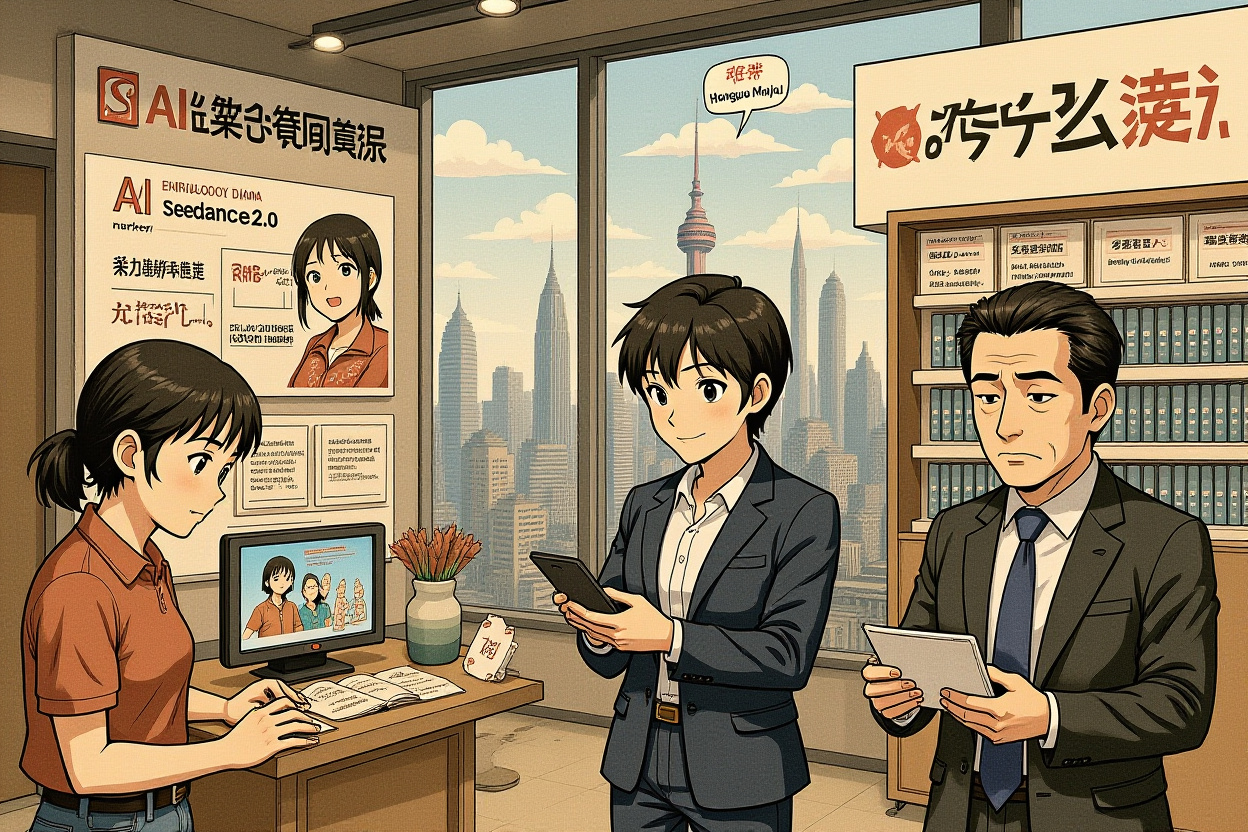
- – Breakthroughs like ByteDance’s Seedance2.0 are rapidly automating core creative roles, such as storyboard directors, leading to workforce displacement and fears of accelerated obsolescence.
- – Major platforms like ByteDance’s Hongguo (红果漫剧) are aggressively investing to shape and grow the market, signaling a significant, long-term shift in China’s digital content landscape.
The New Gold Rush: From Factory Floors to Content Studios
“If you weren’t born with a Rolls-Royce, you likely never will have one.” This is a mantra held close by Huang Haonan (黄浩南), founder of Soy Sauce Anime (酱油动漫). A graduate of a technical secondary school with no family backing, Huang believed that a traditional job would never bring wealth—only catching the right trend could. He has surfed successive waves in online literature and live-action short dramas. But it was in the roaring tide of AI-generated anime drama that his company, Soy Sauce Anime, truly broke through, achieving monthly revenues exceeding RMB 50 million by last November and declaring its ambition to become “the nation’s largest AI imaging group.”
This is not an isolated success story. The entire ecosystem is booming. ByteDance’s dedicated platform for the format, Hongguo Manju (红果漫剧), reportedly surpassed 10 million daily active users in just over three months. The sudden emergence of this AI-generated anime drama sector is fundamentally a story of technological democratization. Over the past year, the widespread application of multimodal large language models has made it possible to generate dynamic, emotive character images and videos at a radically low cost. While the path to Artificial General Intelligence (AGI) remains unclear, these “emoticon engines” have spawned a content gold rush.
The Core of the Revolution: Drastic Cost Reduction
The most disruptive impact of AI on anime drama production is the collapse of cost barriers. Traditional 2D or 2.5D animation is notoriously labor-intensive and expensive. An industry insider, Xiao Chuan (小川), a former head of short drama operations at a top internet firm, noted that just a year ago, the cost for traditional dynamic comics (a precursor format) was stubbornly high at RMB 8,000-10,000 per minute, with fewer than 100 teams in China capable of producing it.
AI has shattered this ceiling. The process is now streamlined: write a script, use text-to-image models for storyboards, employ image-to-video models to animate, and finally add voiceovers and edit. This has slashed production costs to a range of RMB 600 to just tens of RMB per minute for the lowest-tier content. This economic shift has opened the floodgates, allowing a massive influx of new entrants and enabling an unprecedented scale of production.
From Short Drama Bust to AI Anime Drama Boom
The current landscape of AI anime drama is inextricably linked to the preceding cycle of China’s live-action short drama frenzy. By the first half of 2025, a stark reality had set in for that industry: over 90% of companies were reportedly facing losses. The market had consolidated around giants like ByteDance’s Hongguo platform and top studios such as Tinghuadao (听花岛). Many latecomers found themselves struggling on thin margins, leading to widespread layoffs, particularly among the once highly-paid advertising specialists, or “投手” (tou shou).
It was these struggling short drama companies that first pivoted to AI-generated anime drama, seeing it as a lifeline. Liu Wei (刘伟), founder of Minglu Animation (鸣鹿动画), which now focuses on premium AI anime drama, recalls that period: “Aside from the very top tier, every notable short drama company had layoffs last year.” His own company benefited, hiring talented ad specialists at salaries below budget. The head of one nearly-defunct short drama company reportedly embraced the new format with desperation, welcoming all inquiries and even exaggerating profits, hoping to attract more players to grow the market.
A Familiar Playbook with an AI Twist
Consequently, the leading companies in AI anime drama today are overwhelmingly those live-action short drama firms that missed the first tier. They brought with them a proven, if brutal, business model: allocate 80% or more of revenue to performance-based advertising (投流, tou liu) to acquire users. The content formula—fast-paced, wish-fulfillment narratives adapted from online novels—was already battle-tested.
The early boom mirrored the short drama craze. In February 2025, rumors swirled that an AI-generated work titled “兴安岭诡事” (Xing’an Ling Gui Shi) garnered over 50 million views on Douyin and earned tens of millions in RMB. By July 2025, with Douyin’s traffic support, the daily advertising spend on AI anime drama broke through the RMB 10 million threshold. The gold rush was officially on.
The AI-Powered Assembly Line: High Tech Meets Low-Cost Labor
In a paradoxical twist, companies have turned this technologically advanced field into a labor-intensive assembly line. To dominate through sheer volume, aggressive hiring became the norm. Huang Haonan of Soy Sauce Anime embarked on a radical expansion, growing his team from dozens to over 1,200 employees in under six months.
The hiring strategy focused on minimizing barriers. Huang stated that anyone over 18 without an intellectual disability could apply, boasting that the highest educational level in his company was an undergraduate degree. With proprietary tools, new hires could be trained and productive in just two to three days. Correspondingly, the average monthly salary hovered around a mere RMB 3,000-4,000. This created a surreal scene: recent vocational school graduates or former factory workers, sitting in modern office buildings, feeding troves of pulp fiction plots into cutting-edge AI models to produce content viewed hundreds of millions of times.
Yet, companies also splurged on core creative talent, paying RMB 100,000 for scripts and offering million-RMB annual salaries to chief editors to secure premium story IP. This two-tiered approach—mass low-wage production staff and high-cost creative anchors—defined the scaling phase.
Racing for Capacity and the Platform Advantage
In this nascent market, speed and scale were everything. The first to ramp up production could capture early traffic红利 (hong li,红利) and secure favorable platform deals. Soy Sauce Anime’s monthly output soared from over 10 titles to 60, surpassing 100 by January. Huang aims for 1,000 titles per month by year-end—one-third of the entire live-action short drama industry’s current output.
Platforms, especially ByteDance, played a decisive role in accelerating the industry. According to Xiao Chuan, while all platforms noticed the trend of crude AI anime drama, ByteDance acted fastest. It quickly integrated the new format under its established short drama版权中心 (ban quan zhong xin, copyright center), led by Zhang Chao (张超), who had already successfully scaled the Hongguo short drama platform. This team moved with remarkable efficiency, using standardized electronic contracts that locked deals in days, not weeks. Their swift adjustments to revenue-sharing models and aggressive acquisition of quality content often caught producers off guard, rapidly turning niche opportunities into industry-wide standards.
The Relentless Pace of Iteration: From Crude Comics to Simulated Reality
The lifecycle of each subtype within the AI anime drama trend is breathtakingly short. The initial, crudely animated “沙雕漫” (sha diao man, silly comics) had a hype cycle of less than three months. One coal tycoon, investing millions in the format at its tail end, reportedly lost everything.
The industry rapidly evolved towards “AI仿真人剧” (AI fang zhen ren ju, AI simulated-human drama), which represents the current pinnacle of quality and technical ambition. These works feature highly realistic, near-photorealistic characters and aim to capture a segment of the long-form video market. Yang Hao (杨浩), founder of Heya Manju (鹤芽漫剧), was an early believer. Despite initial technical hurdles like unsynced lip movements and the “uncanny valley” effect, he pursued it after confirming the profitability of early hits. His first simulated-human drama, “盘丝洞素锦传” (Pan Si Dong Su Jin Zhuan), achieved a 3x Return on Investment (ROI) without any paid promotion, attracting both investment and platform orders.
The Seedance2.0 Earthquake
Just as the simulated-human drama trend solidified, a technological earthquake hit. In February 2026, ByteDance’s video generation model, Seedance2.0, was released. It allows users to generate a coherent 10-second video clip with dialogue, consistent characters, and logical scene progression from a sub-20-word prompt, at a cost of around ten RMB. “The childhood era of AIGC is over,” declared Feng Ji (冯骥), producer of the video game “Black Myth: Wukong.”
The impact was immediate and profound for AI anime drama studios. Yang Hao made the decision on launch day to lay off his team of storyboard directors, retaining only one chief镜头导演 (jing tou dao yan,镜头导演). These directors, some graduates of the prestigious Beijing Film Academy, were deemed obsolete as Seedance2.0 could generate professionally composed shots autonomously. At Minglu Animation, the AI team worked through the night in disbelief; the cost of polishing their existing work now exceeded regenerating it entirely with the new model.
The role of the “抽卡师” (chou ka shi, gacha master)—operators who spent hours generating and selecting usable video clips from unpredictable AI models—was also rendered far less critical. What was once a tedious, almost mystical process became straightforward, reducing team sizes from 8-10 people per project to just 2-3. The displacement that began with storyboard artists is likely just the start.
Broader Implications: Creative Disruption and the Search for Enduring Value
The rise of AI-generated anime drama presents a stark case study in creative disruption. It demonstrates how technology can not only create new markets but also accelerate their maturation and consolidation at a dizzying pace. For traditional film and drama professionals, especially those in technical and directorial roles, it poses an existential threat, summarized by the article’s provocative Chinese title: “Vocational school graduates earning RMB 3,000 a month are ‘taking out’ Beijing Film Academy directors.”
This dynamic creates intense FOMO (Fear Of Missing Out) across the entertainment sector. Even leading live-action short drama studios like Tinghuadao are now exploring AI anime drama. Meanwhile, traditional short drama faces a brutal squeeze, with platforms tightening guarantees and pushing marginal producers out of business.
History offers a parallel. In the mid-20th century, the rise of television threatened Hollywood, which responded with technological gimmicks like 3D and smell-o-vision. While it initially lost the battle, cinema later regained ground through powerful, content-driven movements like the French New Wave.
This historical lesson points to the potential future of AI-generated content. As Jiang Yiqi (姜奕祺), former AI expert at Alibaba DAMO Academy and now CEO of Sansheng Qingying (三生清影), noted, when you cannot access the underlying models, the核心竞争力 (he xin jing zheng li, core competitiveness) shifts to产能 (chan neng, production capacity) and cost. However, as technology becomes increasingly commoditized and “flat,” the ultimate enduring value may indeed circle back to what it has always been: truly exceptional storytelling, creative vision, and brand.
Navigating the New Landscape
For investors and executives monitoring China’s tech and entertainment sectors, the AI anime drama phenomenon offers critical insights. First, it underscores the blistering speed of AI application in content-savvy markets like China. Second, it highlights the strategic importance of platform partnerships and distribution clout, often outweighing pure technological advantage in the short term. Third, it signals a permanent shift in the cost structure of visual content production, with downstream effects expected across gaming, advertising, and education.
The call to action for industry participants is clear: embrace the efficiency and scale enabled by AI, but do not mistake the current tools for the final destination. As entrepreneurs like Xiao Chuan plan their next moves, waiting for the “industry to return to a relatively calm state,” the focus will inevitably return to content itself. Building a company or investment thesis on a specific model or transient cost advantage is risky. The sustainable edge will belong to those who can master the new tools not just for volume, but for forging unique intellectual property, cultivating direct audience relationships, and delivering narratives that resonate on a human level, regardless of how they are generated.