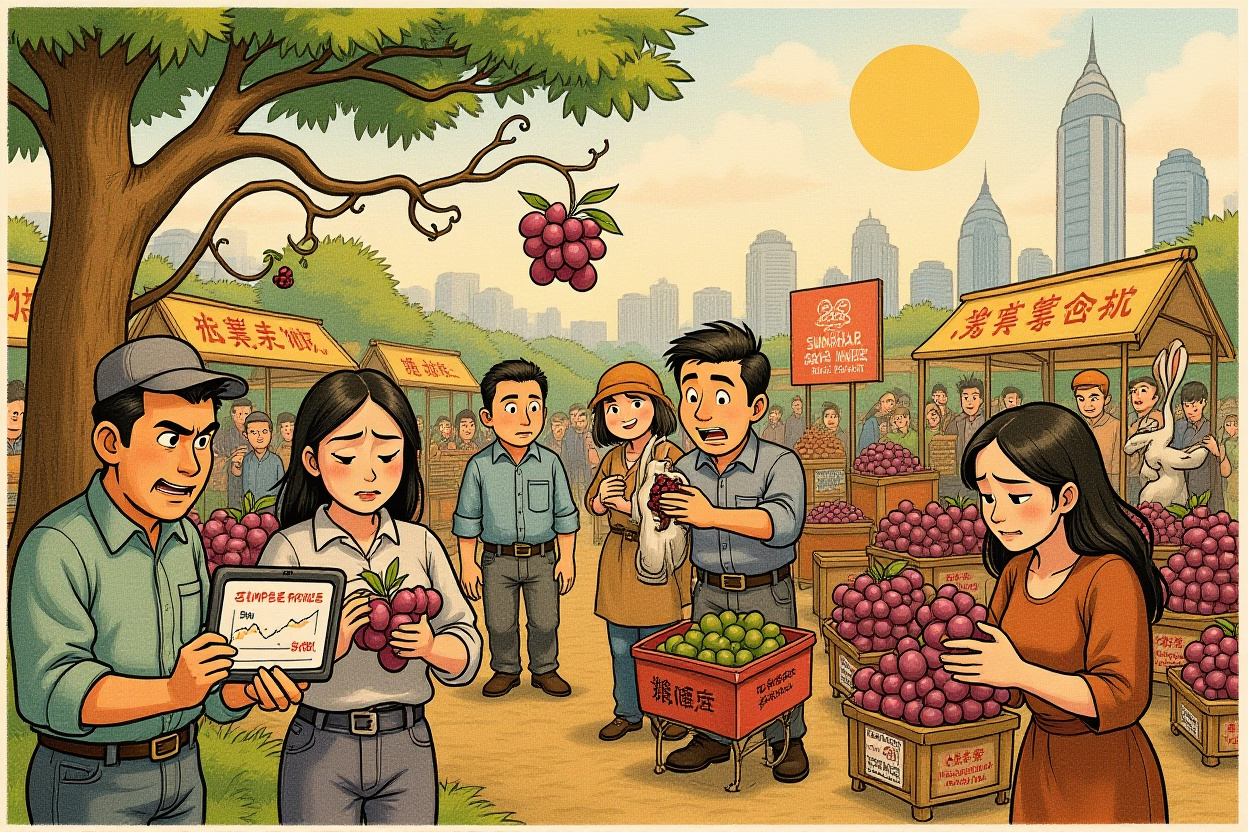
The once-exclusive Sunshine Rose grape, celebrated as the Hermès of fruits, now sells for mere pennies at farm gates across China. What was once a luxury item fetching hundreds of dollars per bunch has become a common market fruit, with prices plummeting to unprecedented lows while maintaining premium positioning in high-end retail outlets. This dramatic transformation reveals much about China’s agricultural markets, consumer trends, and the dangers of rapid crop expansion without quality control. The Sunshine Rose grape market presents a fascinating case study of how luxury products can become commoditized—and how quality differentiation creates extreme price variations within the same product category. The Meteoric Rise and Dramatic Fall of Sunshine Rose Grapes Sunshine Rose grapes entered China around 2006 from Japan, initially limited to small-scale cultivation due to technical challenges. The variety’s exceptional sweetness, crisp texture, and distinctive rose aroma quickly captured consumer interest. By 2016, improved cultivation techniques sparked nationwide planting frenzy across major grape regions. Wei Min (韦敏), a Sunshine Rose grower from Liujiang District in Liuzhou City, Guangxi, recalls better times: ‘Last year, we could sell for 5-7 yuan per斤. Now prices fluctuate between 1-3 yuan per斤 with market instability.’ The peak saw premium-quality grapes commanding wholesale prices of 10-100 yuan per斤, with retail prices reaching hundreds of yuan per bunch for domestic varieties and astonishing 1,000 yuan for imported premium specimens. National Expansion Creates Oversupply The cultivation expansion created massive oversupply. Major production regions now include: – Yunnan – Sichuan – Hunan – Hubei – Jiangsu – Zhejiang – Shandong – Liaoning As Sichuan’s harvest peaks in August, growers nationwide face intensified competition. The volume surge has transformed market dynamics fundamentally, with wholesale markets reporting prices as low as 3 yuan per斤 for standard quality fruit. Current Market Reality: Extreme Price Disparity Today’s Sunshine Rose market exhibits astonishing price variations reflecting quality differences and distribution channel strategies. At Guangzhou’s Jiangnan Fruit and Vegetable Wholesale Market—one of Asia’s largest produce markets—wholesale prices typically range from 4.5-7 yuan per斤, with premium quality reaching 20 yuan per斤. Merchant A Zhong (阿忠) reports Sichuan-sourced fruit now selling at 3 yuan per斤, compared to 8-9 yuan last year. Meanwhile, merchant A Qiang (阿强) maintains higher prices for Yunnan fruit, citing superior quality from the region’s ideal growing conditions with abundant sunshine, significant day-night temperature variation, and low rainfall. Retail Price Spectrum: From Street Stalls to Luxury Supermarkets The retail landscape shows even greater disparity: – Street vendors: 10 yuan for 3斤 (approximately $0.15 per pound) – Delivery platforms: Approximately 10 yuan per斤 with promotional items as low as 0.01 yuan for half斤 – Hema Fresh: 19.9 yuan for 500g boxes – Ole’ Premium Supermarket: 99 yuan for 800g boxes This price differentiation demonstrates how marketing channels and perceived quality create vastly different consumer experiences and pricing structures for the same product category. Quality Crisis: The Root Cause of Price Collapse Chen Rong (陈蓉), a Sunshine Rose grower from Chengdu with eleven years’ experience, identifies quality inconsistency as the primary market challenge: ‘Price下降的原因,大多是因为市场上品质参差不齐 (The reason for price decline is mostly because of uneven quality in the market).’ She cites three core issues: excessive planting acreage, market saturation, and quality variations. A senior procurement specialist from premium fruit chain Pagoda Company notes that Sunshine Rose planting area has exceeded 1.5 million mu (approximately 100,000 hectares), accounting for over 40% of China’s fresh grape production. This output surge naturally depressed prices across the market. The Technical Challenges of Quality Cultivation Unlike conventional grape varieties, Sunshine Rose requires sophisticated cultivation techniques. Li Ming (李明), a grape cultivation expert, explains: ‘病虫害的防治、土壤肥力的管理、灌溉和施肥的时机等,都会影响阳光玫瑰葡萄的品质和产量 (Pest control, soil fertility management, irrigation and fertilization timing all affect Sunshine Rose quality and yield).’ Many farmers lack technical expertise, resulting in inferior fruit that fails to meet consumer expectations for the variety’s characteristic rose aroma and crisp sweetness. The industry has developed grading standards based on multiple factors: – Bunch shape and weight – Berry weight – Skin color – Seedlessness – Hollow berry rate Premium fruit meeting top-grade standards still commands respectable prices at both wholesale and retail levels, demonstrating that quality differentiation remains possible despite market oversupply. Market Rumors and Consumer Perception Challenges The Sunshine Rose market faces additional challenges from widespread rumors about cultivation practices. Consumers express concerns about: – Excessive pesticide application – Sweetener additives to enhance sweetness – Expansion agents to increase berry size – Preservatives to extend shelf life Industry professionals acknowledge some pesticide use issues but consider many rumors exaggerated. Wang Qiang (王强), a scientist with China’s grape industry technology system, addressed these concerns in 2023 media appearances, noting that Sunshine Rose typically requires 5-10 pesticide applications per growth cycle, but proper application timing and half-life considerations make residue超标问题 (exceeding standards) unlikely. He also clarified that the variety’s natural high sugar content (typically 20%, up to 26%) and firm texture that enables month-long storage under proper conditions are innate characteristics, not results of chemical additives. The Impact of Rumors on Market Demand Grower Wei Min acknowledges that ‘大量喷洒农药’ (heavy pesticide spraying) rumors have reduced consumer demand: ‘This is one reason for Sunshine Rose sales decline.’ She estimates current purchasing power at approximately 80% of last year’s level. Beyond rumor impacts, quality issues stem from deeper industry problems, particularly yield-focused cultivation practices that sacrifice flavor profile. Some producers prioritize quantity over quality, increasing亩产量 (per-mu yield) beyond optimal levels, resulting in diluted flavor and loss of the variety’s signature rose aroma. Broader Context: Not the First Agricultural Boom-Bust Cycle Sunshine Rose follows a familiar pattern in Chinese agriculture: luxury products experiencing rapid expansion followed price collapse. In 2021, the trendy drink ‘霸气玉油柑’ (Superior Olive) sparked an olive cultivation boom after being promoted by premium tea brands including Nayuki and Heytea. Olive purchase prices skyrocketed from 4-5 yuan per斤 to over 40 yuan, prompting widespread planting expansion. However, the fleeting nature of beverage trends caused the market to collapse by 2022, with prices crashing to approximately 1.5 yuan per斤. Blueberries, another former luxury fruit, have similarly seen prices decline from 20-30 yuan per box to 10-15 yuan, with some products reaching single-digit pricing. The 2025 China International Small Berry Industry Technology Conference reported blueberry cultivation area reached 1.44 million mu (96,000 hectares) in 2024, a 44.38% increase from 2020, with production reaching 780,000 tons—a 197% increase from 2020. Market Resilience and Future Outlook Despite current challenges, Sunshine Rose remains commercially viable. At Jiangnan Market, nearly every grape stall continues carrying the variety, with some specializing exclusively in Sunshine Rose. The fundamental market logic remains sound: even at lower prices, it remains one of China’s best-selling grape varieties. Grower Wei Min confirms that while prices have declined, her produce still finds buyers. However, she acknowledges reduced purchasing power across the market. Industry professionals express concern about the variety’s future. The Pagoda Company procurement specialist believes the low-price environment may persist short-term, with price recovery depending on two factors: significant production reduction in major growing regions and continued consumer upgrade trends. Cultivation expert Li Ming suggests that while widespread price increases appear unlikely next year, premium quality fruit from specific regions might experience structural price recovery. Navigating the New Reality of Sunshine Rose Grapes The Sunshine Rose market transformation offers important lessons for agricultural development. The price collapse ultimately stems from rapid expansion without corresponding quality control and market planning. Supply has vastly exceeded demand, while many growers lack technical expertise to produce quality fruit meeting consumer expectations. The market has responded with extreme price differentiation based on quality tiers, creating opportunities for premium producers while squeezing marginal growers. The future will likely see continued market segmentation between mass-market and premium products, with quality becoming the primary determinant of commercial success. For consumers, the situation offers both challenges and opportunities—while needing to navigate quality variations, they can now access previously exclusive fruit at affordable prices. For the industry, the path forward requires focusing on quality over quantity, technical improvement, and brand differentiation. The Sunshine Rose story continues evolving, reminding us that even the most exclusive products eventually face market realities when supply and demand dynamics shift dramatically. The question remains whether producers can adapt to this new reality while maintaining the qualities that made this variety special in the first place.
From Luxury to Budget: The Dramatic Price Collapse of Sunshine Rose Grapes in China’s Market