



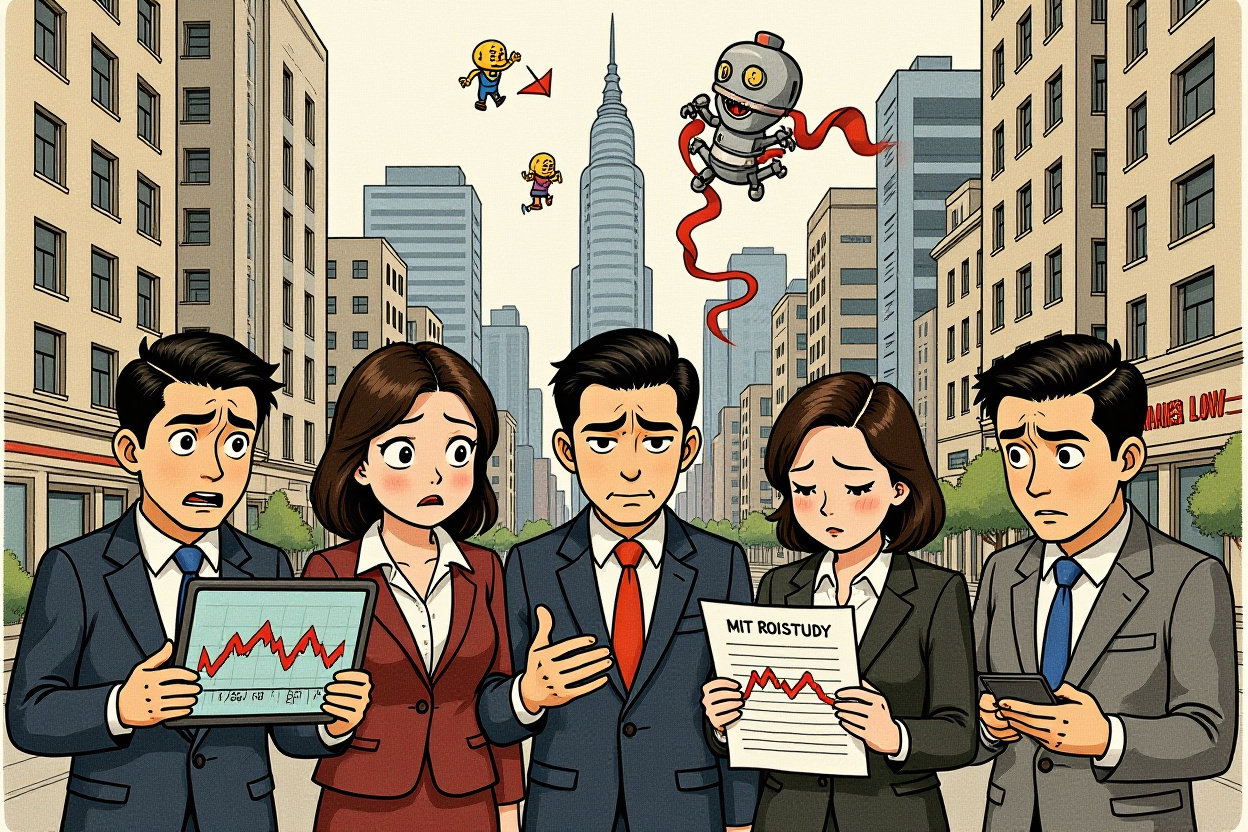
The AI Rally Hits a Speed Bump
A sudden wave of selling pressure washed over US tech stocks, with market darling NVIDIA leading the decline. The catalyst wasn’t a missed earnings report or a product delay, but rather a sobering research paper from the Massachusetts Institute of Technology that cast doubt on the very foundation of the artificial intelligence investment frenzy. This report served as a cold splash of reality for a market that had been running hot on AI optimism, directly contributing to NVIDIA’s sharp decline and pulling down the entire Nasdaq composite index. The timing was striking, arriving alongside cautionary comments from OpenAI’s Sam Altman about a potential AI bubble, creating a powerful one-two punch that gave investors pause.
Understanding the Market’s Reaction: A Sector-Wide Sell-Off
The trading session on Tuesday, August 19th, 2025, was a brutal one for investors heavily exposed to the artificial intelligence theme. The sell-off was broad and deep, affecting companies across the AI value chain.
Key Losers in the AI Rout
– NVIDIA: The undisputed “picks and shovels” supplier of the AI gold rush saw its shares fall 3.5%. As the leading manufacturer of the GPUs that power complex AI models, its fortunes are directly tied to continued, expansive investment in the technology.– Palantir: Often dubbed the “AI military stock,” its shares cratered by 9.4%. The company’s business model relies on large enterprises and governments adopting its AI-driven data analytics platforms.– Arm Holdings: The chip design firm, whose architecture is crucial for AI processing in everything from smartphones to data centers, dropped 5%.– Other Major Declines: The selling wasn’t limited to pure-play AI firms. Oracle and AMD, both of which have been major beneficiaries of AI infrastructure spending, fell 5.9% and 5.4% respectively. The broader indices felt the pain, with the Nasdaq dropping 1.4% and the S&P 500 falling 0.7%.This widespread reaction indicates that the MIT report wasn’t seen as an isolated data point but as a fundamental challenge to the narrative that has driven valuations higher for months.
Deconstructing the MIT Report: The “GenAI Gap”
The report, titled “The Generative AI Gap: The State of Business AI in 2025,” provided a data-driven reality check. Its central, alarming finding was that despite corporations pouring an estimated $300-$400 billion into generative AI initiatives, a staggering 95% have yet to see any measurable commercial return on that investment. The research identified a clear chasm—dubbed the “GenAI Gap”—between the hype and tangible business outcomes. The study was comprehensive, built on interviews with 150 corporate leaders, surveys of 350 employees, and analysis of 300 public AI deployments.Aditya Challapally, a contributor to the MIT NANDA project, highlighted the dichotomy. He noted that a small cohort, about 5%, is seeing phenomenal success. “Some large companies’ pilot projects and young startups are indeed excelling in generative AI,” he stated. He pointed to startups run by young founders achieving $20 million in revenue within a year by focusing on a specific pain point and executing flawlessly. However, for the vast majority, the story is one of stagnation and wasted resources. The core issue, according to the researchers, isn’t the quality of the AI models themselves from companies like OpenAI or Google, but a critical “learning gap” within the organizations trying to implement them.
The Real Problem: Implementation, Not Innovation
Challapally explained a key nuance: tools like ChatGPT excel in personal use due to their flexibility, but they often fail in rigid corporate environments because they cannot learn from or adapt to specific proprietary workflows. This points to a massive integration problem. Furthermore, the report uncovered a significant misallocation of resources. Over half of all generative AI budgets are currently funneled into sales and marketing tools, yet the highest return on investment actually comes from back-office automation—areas like streamlining operations, reducing outsourcing costs, and eliminating manual processes.
The Blueprint for Successful AI Deployment
If 95% are failing, what are the 5% doing right? The MIT report provided crucial insights into the strategies that separate successful AI deployments from costly failures. The most significant finding related to development strategy. Companies that purchased AI tools from specialized vendors and established deep partnerships with them saw a success rate of approximately 67%. In stark contrast, companies that chose to build their own proprietary AI systems in-house had a success rate of only about 22%—one-third of the former.
The Partnership Advantage
This data presents a serious dilemma, especially for firms in highly regulated industries like finance or healthcare, where the impulse to build custom, in-house solutions for security and control is strong. The report suggests this instinct may be leading them astray. Challapally noted that companies are often reluctant to admit their internal projects have failed, creating a false perception that building is the safer bet when the data strongly argues for buying and partnering. This strategic insight is a critical lesson for any executive overseeing a digital transformation budget.
Broader Implications: Workforce and Market Sensitivity
The impact of this AI investment boom and bust cycle extends beyond stock prices and into the labor market. The MIT report confirmed that AI-driven disruption is already underway, particularly in roles centered around customer support and administrative tasks. However, the change is manifesting not as large-scale layoffs, but as a “quiet contraction” where companies simply choose not to refill positions once they become vacant. This shift is most concentrated in tasks that were previously outsourced and deemed lower value, indicating a fundamental restructuring of operational costs.The report’s impact was also amplified by the market’s psychological state. It landed at a time when concerns about stretched tech valuations were already growing. The AI trade had become crowded, and the market became hypersensitive to any negative news, no matter how nuanced. This phenomenon was previously observed in January 2025 when the rise of China’s DeepSeek AI model caused volatility, proving that the market’s confidence in the AI narrative was fragile. Tuesday’s sell-off confirmed that after months of AI-driven euphoria, any evidence questioning its immediate commercial viability could trigger a sharp correction.
Navigating the New AI Reality
The events triggered by the MIT report are more than a one-day market event; they represent a necessary maturation of the AI investment theme. It signals a shift from blind euphoria to a more discerning, ROI-focused approach. For companies, the lesson is clear: a successful AI strategy is less about having the most powerful model and more about seamless integration, strategic partnerships, and focusing on high-impact areas like operational automation. For investors, it underscores the importance of looking beyond the hype and scrutinizing which companies have a realistic and executable path to monetizing AI.The era of easy money in AI might be over, but the era of smart money is just beginning. The market’s reaction to the MIT report on AI’s ROI problem is a wake-up call. It’s a reminder that sustainable growth is built on tangible value, not just technological promise. As the industry digests these findings, the focus will inevitably shift to quality of execution over quantity of investment. Now is the time for investors and executives alike to critically evaluate their AI strategies, prioritize measurable outcomes, and prepare for a more rational, and potentially more rewarding, phase of the AI revolution.