



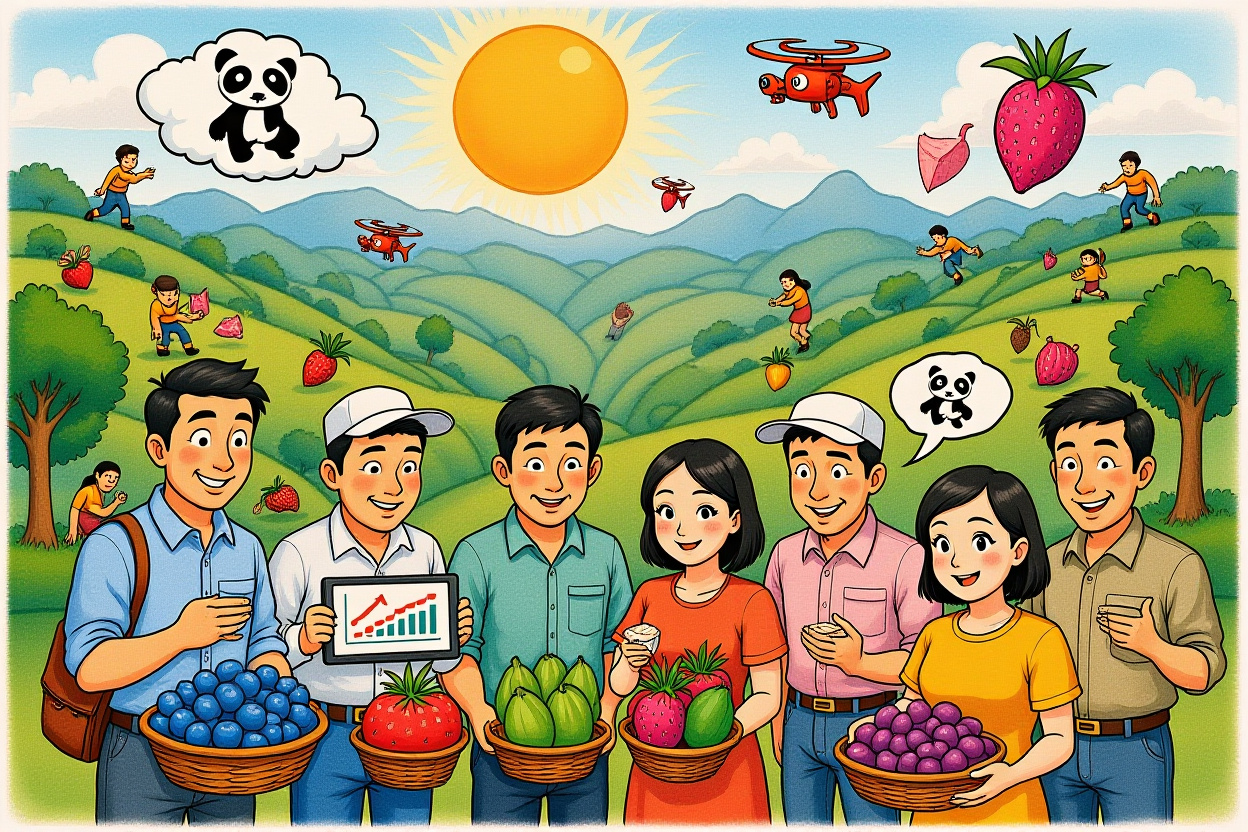
The Superfruit Revolution: From Luxury to Mainstream
In 2004, the term ‘superfruit’ emerged, revolutionizing the food and beverage industry. For Chinese consumers, these fruits represented more than just nutrition—they symbolized status, health, and modernity. Packaged in elegant boxes and sold at premium prices, fruits like blueberries, pomegranates, and kiwis were once reserved for special occasions or gifted as luxuries.
Jin Yan, a post-95s consumer, recalls childhood visits to fruit stores where sales staff would showcase meticulously packaged imported fruits. The script was always the same: emphasize novelty, highlight health benefits, mention foreign origins, and conclude with a staggering price tag that justified its ‘premium’ status.
This marketing strategy aligned perfectly with the superfruit definition: visually appealing, novel, convenient, supply-controlled, and backed by potential health claims. Imported goods, especially from Western countries, carried an aura of sophistication that Chinese consumers eagerly embraced.
But something changed over the past decade. Those same fruits that once commanded triple-digit prices began appearing in regular supermarkets at affordable rates. What seemed like personal economic advancement was actually Yunnan’s agricultural transformation making these luxuries accessible to all.
Yunnan’s role in making premium fruits affordable cannot be overstated. Through strategic cultivation, climate advantage utilization, and scaled production, this southwestern province has fundamentally altered China’s fruit consumption patterns.
The Psychology of Premium Fruit Marketing
Superfruit marketing capitalized on several psychological triggers: scarcity perception, health aspiration, and social status signaling. Imported fruits weren’t just food—they were lifestyle statements that conveyed sophistication and worldly awareness.
Chinese consumers initially associated high prices with quality, creating a market where exotic fruits maintained artificial price barriers. This perception began shifting as domestic production increased, demonstrating that quality wasn’t necessarily tied to origin but to cultivation methods and freshness.
Yunnan’s Fruit Portfolio: From Blueberries to Dragon Fruit
Search for ‘Yunnan’ on any major fresh produce platform, and you’ll encounter an astonishing variety: familiar staples like blueberries and kiwis, recent favorites like sunshine grapes and jasmine-scented grapes, and exotic options like passion fruit and pepino melons—all bearing the Yunnan origin label.
The province has become China’s primary testing ground for domesticating imported fruits. Avocados, once exclusively associated with Peruvian imports, now thrive in Yunnan’s Menglian county. Between 2015 and 2023, China’s avocado imports surged from 10,000 tons to 65,600 tons, but 2024 saw a 12% reduction as domestic production increased.
Despite decreased imports, consumption continues growing. During 2024’s Singles’ Day shopping festival, avocado sales on Taobao and Tmall grew 98.2% year-over-year. Menglian avocados ranked first on JD.com’s hot-seller list, with orders exceeding 100,000 units. Through top livestream channels like Dongfang Zhenxuan and Yu Hui Tongxing, single sessions sold over 500,000 avocados.
Beyond imported varieties, Yunnan’s native fruits gain increasing recognition through e-commerce and social media promotion. Chu oranges, sour papayas, Zhaotong apples, and Mangshi dragon fruits now reach national audiences who previously had limited access to these regional specialties.
Traditional Fruit Dominance
Yunnan excels beyond exotic fruits. National Bureau of Statistics data shows the province ranks among China’s top 10 producers for citrus, bananas, grapes, pears, apples, pineapples, persimmons, and strawberries. With 133 fruit varieties currently cultivated, approximately 60% of China’s fruit species now grow in Yunnan.
The Price Revolution: How Yunnan Made Luxury Fruits Affordable
Basic economics dictates that supply and demand determine pricing. As Yunnan’s production scaled, once-prohibitive fruit prices became consumer-friendly, mirroring the ancient poetic description of ‘swallows from wealthy homes now nesting in common households.’
Blueberries exemplify this transformation. When first commercially cultivated around the millennium, these tiny blue gems retailed for 300-500 RMB/kg ($42-70/kg) as imported luxuries. Considering average urban monthly wages then were approximately 780 RMB ($109), 125g packages costing 40 RMB ($5.60) represented significant extravagance.
Today, as China’s primary blueberry producer, Yunnan drives both volume and price changes. 2024’s production reached 780,000 tons, reducing 125g package prices to around 15 RMB ($2.10), with clearance sales sometimes dropping to 9.9 RMB ($1.40).
Similarly, Japanese sunshine grapes once dubbed ‘Hermès of fruits’ reached 500 RMB/kg ($70/kg), with individual grapes costing 10 RMB ($1.40). After widespread domestic cultivation beginning around 2015, China’s planting area exceeded 1.2 million acres by 2023. That same year, prices plummeted to approximately 10 RMB for 1.5kg. In April 2024, Yunnan’s early harvest commanded slightly higher prices due to off-season availability but remained substantially below historical peaks.
Avocados, synonymous with middle-class lifestyles, also became budget-friendly. Before Menglian’s scaled production in 2024, premium imported avocados cost up to 35 RMB ($4.90) each. Domestic availability now offers singles for 6-9 RMB ($0.84-1.26)—a dramatic reduction that exemplifies Yunnan’s role in making premium fruits affordable.
Consumer Benefits Beyond Pricing
Beyond cost savings, domestic production ensures freshness, reduces food miles, and supports local economies. Consumers enjoy riper fruit with longer shelf lives while contributing to sustainable agricultural development in China’s southwestern regions.
Why Yunnan? The Geographical Advantage
Yunnan’s fruit success stems from unparalleled geographical diversity. The province spans tropical, subtropical, and temperate zones with varying altitudes creating microclimates suitable for virtually any fruit cultivation.
Contrary to common assumptions, even typically southern fruits like lychees thrive in Yunnan. Xishuangbanna’s tropical rainforest environment, free from pollution, combined with low latitude and high altitude, creates ideal growing conditions. Morning sun exposure and significant day-night temperature variations promote sugar accumulation, producing exceptionally sweet fruits. Wild lychee trees still grow in Xishuangbanna’s forests, demonstrating natural suitability.
Yunnan’s climate variations enable extended growing seasons. Yuxi’s March Red lychees mature approximately one month earlier than Guangdong and Guangxi varieties, while Dehong’s late-harvest lychees remain available until early September.
Similarly, temperate fruits like pears benefit from Yunnan’s conditions. While Liaoning’s early crisp pears typically mature in early August, and Hebei snow pears and Anhui Dangshan pears ripen in September, Kunming’s versions frequently enter markets one month earlier.
High-altitude mountainous regions with short autumns and early temperature drops delay maturation for some temperate fruits, effectively creating year-round harvest cycles. As farmer Da Meng notes, ‘It’s not that Yunnan chose fruits—fruits chose Yunnan.’
Case Study: Menglian Avocados
Da Meng, who began avocado cultivation in Menglian in 2021, explains why this region excels: ‘The world’s avocado capital is in Michoacán, Mexico’s Uruapan city, which shares almost the identical latitude with Menglian. The conditions here are uniquely suited for avocado cultivation.’
After four years of farming, Da Meng understands avocados require specific conditions: consistent climate without frost, snow, or sudden temperature changes—even during winter. Additionally, shallow root systems make plants vulnerable to typhoons and heavy rainfall, requiring well-drained slopes rather than flat terrain.
Menglian’s current planting area spans 120,700 acres, with 25,700 acres productive during the 2024-2025 season yielding an estimated 19,500 tons—representing over 80% of China’s domestic avocado supply.
Challenges and Future Directions
Despite natural advantages, Yunnan faces significant challenges. Price reductions through scaled production create new pressures around quality maintenance, sustainable farming practices, and market competition.
The province must transition from quantity-focused production to quality-differentiated offerings. As consumers become more discerning, Yunnan’s growers need to develop branding that emphasizes not just affordability but superior taste, organic certification, and unique varieties.
Climate change presents additional concerns. Altered rainfall patterns, temperature fluctuations, and extreme weather events could disrupt the delicate balance that makes Yunnan ideally suited for diverse fruit cultivation. Investment in irrigation systems, greenhouse technologies, and climate-resilient varieties becomes increasingly important.
Market saturation is another consideration. As more farmers shift to high-value fruits, oversupply could drive prices below sustainable levels. Coordinated planning through agricultural cooperatives and government guidance can help balance supply with demand.
Technology Integration
Future success requires embracing agricultural technology. Precision farming, drone monitoring, soil sensors, and data analytics can optimize yields while reducing environmental impact. Partnerships with research institutions like Yunnan Agricultural University can drive innovation in cultivation techniques and disease resistance.
Transforming Consumption Patterns Nationwide
Yunnan’s agricultural transformation extends beyond provincial borders, influencing eating habits across China. Previously exotic fruits now appear in school lunchboxes, office snacks, and daily family meals—nutritional upgrades that were unimaginable two decades ago.
This democratization of premium nutrition represents one of China’s most significant quiet revolutions. While consumer brands often receive credit for lifestyle changes, the real heroes are farmers, agricultural researchers, and supply chain innovators who made quality produce accessible and affordable.
The psychological impact cannot be overlooked either. When luxury becomes commonplace, it reshapes consumer expectations and self-perception. The confidence that comes from accessing what was previously exclusive contributes to broader societal development beyond mere nutrition.
Yunnan’s role in making premium fruits affordable demonstrates how agricultural innovation can drive tangible improvements in everyday life. This model offers lessons for other regions seeking to enhance food security while improving consumer access to diverse, nutritious options.
Embracing the Fruitful Future
Yunnan’s journey from agricultural follower to innovation leader offers inspiration beyond fruit cultivation. It demonstrates how leveraging natural advantages, embracing technology, and focusing on consumer needs can transform entire market categories.
The province’s success with avocados, blueberries, and specialty grapes provides a template for other agricultural regions: identify market opportunities, adapt cultivation techniques to local conditions, scale production strategically, and build brands that resonate with modern consumers.
For consumers, the message is clear: explore Yunnan’s diverse fruit offerings, support domestic agriculture when possible, and appreciate the journey behind each piece of fruit. Behind lower prices lie years of research, experimentation, and dedication from countless individuals committed to making quality nutrition accessible.
As you select fruits for your next meal, remember that your choices support agricultural communities and contribute to sustainable food systems. Choose diversity, appreciate seasonality, and savor the flavors that Yunnan’s unique environment makes possible—all while enjoying prices that make daily indulgence feasible.