



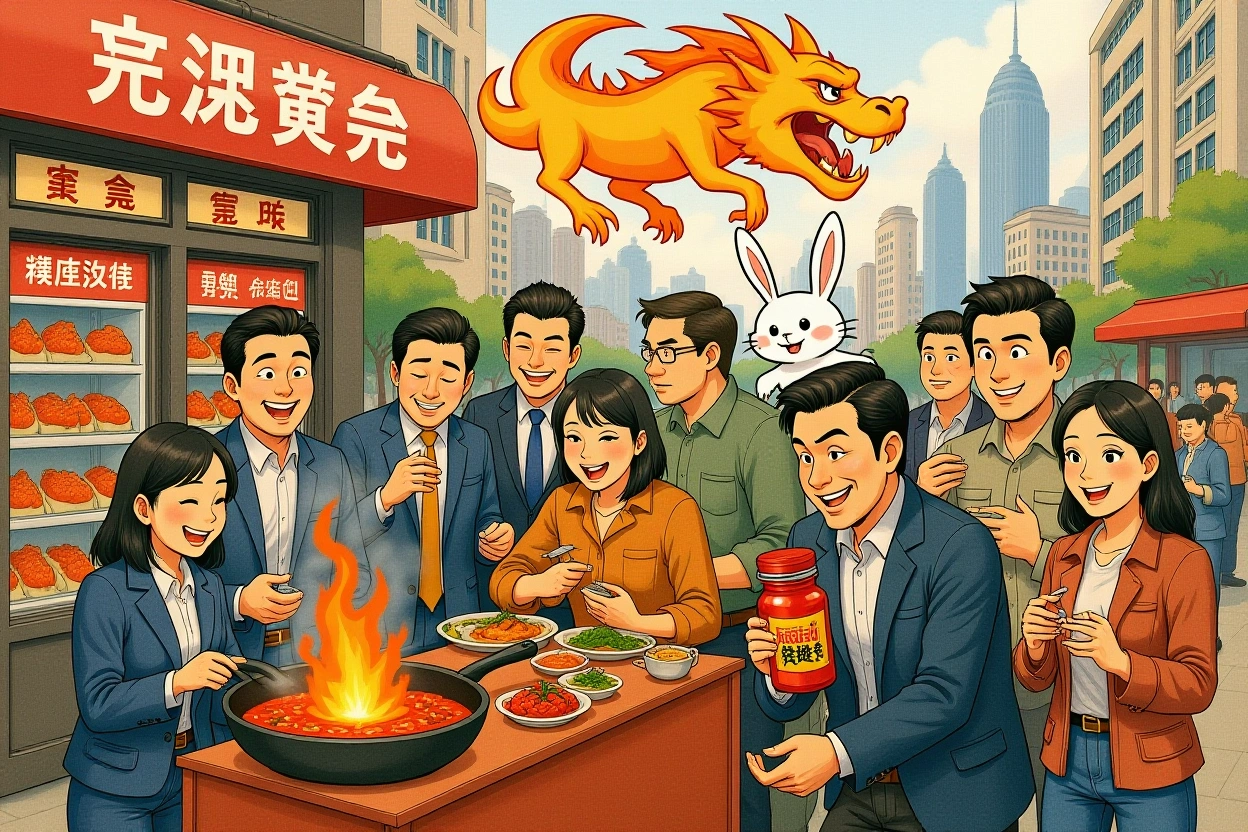
The Unlikely Culinary Champion
Across China’s office parks and industrial zones, millions of workers face a daily dilemma: finding affordable meals that don’t sacrifice flavor or freshness. While tech giants like JD.com launched 7Fresh Kitchens to combat unlicensed food vendors, and Meituan developed DuckFind—an ad-free review platform—their efforts pale against an unexpected winner. Enter Jiangxi Stir-Fry, the spicy sensation conquering lunchboxes from Shanghai skyscrapers to Shenzhen factories. This humble cuisine has achieved what corporate initiatives couldn’t: uniting white-collar professionals and blue-collar workers through sizzling woks and chili-laden dishes. By July 2025, over 46,000 outlets served this worker-approved fare, expanding at 800+ monthly locations.
Key developments driving this phenomenon:
- Explosive 400% nationwide growth in Jiangxi Stir-Fry outlets during 2024
- Chain brands like Xiaojiangxi and Tiangengji opening 100+ locations annually
- 37 billion views on Douyin under #江西小炒 highlighting cultural penetration
- Workers prioritizing fresh-cooked meals over预制菜 (pre-made dishes)
- Regional governments actively promoting culinary entrepreneurship
From Provincial Obscurity to National Dominance
Jiangxi province—often dubbed China’s “invisible” region—has staged a culinary revolution through its migrant workers. In Zhejiang province alone, nearly 3 million Jiangxi natives created demand for hometown flavors, sparking the initial restaurant boom. The cuisine’s true breakthrough emerged when it transcended its diasporic roots to captivate local populations.
Workers’ Lifeline in Economic Powerhouses
During Chinese New Year when Jiangxi chefs returned home, desperate Shanghai office workers resorted to eating KFC for 20 consecutive days. Some even called restaurants begging for early reopenings, while extreme fans traveled to Nanchang just for a taste. The cuisine’s stronghold remains strongest in manufacturing hubs like Yiwu, where nearly 1,000 outlets cluster around factories. What began as comfort food for homesick migrants has become the standard lunch break ritual—evidenced when Zhejiang music festival crowds unanimously shouted “江西小炒!” when asked about local specialties.
Unstoppable Expansion Metrics
By mid-2025, Jiangxi Stir-Fry’s nationwide footprint demonstrated extraordinary scalability:
- 600% transaction growth since 2023, outperforming all regional cuisines
- 200+ outlets opening monthly across Beijing-Tianjin-Hebei region
- 50+ stores surrounding single Shanghai subway stations like East Nanjing Road
- Dominating business districts: 68% of DuckFind’s Beijing CBD recommendations feature Jiangxi Stir-Fry
Culinary Disruption: Outflanking Established Giants
While Sichuan and Hunan cuisines previously dominated China’s spicy food landscape, their standardization created an opening for disruption. Jiangxi Stir-Fry’s ascent represents a textbook case of challenger-brand strategy—turning established players’ strengths into weaknesses.
The Anti-Standardization Advantage
Unlike Sichuan cuisine—where 68% of restaurants serve identical dishes like pickled fish—authentic Jiangxi Stir-Fry thrives on variability. The signature ingredient selection method involves customers choosing from refrigerated displays of that morning’s market purchases. As chef Zhang Bingsheng (张兵生) explains: “Our regulars sometimes request off-menu items—we’ll literally bicycle to buy special ingredients.” This creates an omakase-style experience at ¥20-50 price points, with chains differentiating through regional specialties:
- Xiaojiangxi: Wild mountain vegetables from Jinggangshan region
- Shazhouba: Authentic Ganzhou-style claypot techniques
- Blue Bowl: Wok hei mastery with Nanchang rice wines
Precision Counter-Pricing Strategy
Jiangxi Stir-Fry systematically undercuts premium Hunan competitors while maintaining quality. Consider Shanghai pricing comparisons:
- Hunan’s Feidachu辣椒炒肉: ¥68
- Sichuan’s Taier酸菜鱼: ¥98
- Jiangxi Stir-Fry三菜一汤 combo: ¥48
This affordability stems from extreme operational efficiency. Kitchen workflows maximize wok usage through sequential cooking—one outlet’s chef can handle 200+ covers during lunch rush. “We achieve 10 table turns hourly,” notes Hangzhou franchise owner Li Ming (李明). “Dishes hit tables within 8 minutes of ordering through optimized mise en place.”
Scalability Challenges and Ingenious Solutions
The cuisine’s explosive growth exposes critical vulnerabilities in supply chains and talent pipelines. Unlike Sichuan cuisine’s industrialized peppercorn distribution or Hunan’s preserved ingredient networks, Jiangxi’s fresh-focused model faces geographical constraints.
Bottleneck 1: Regional Ingredient Dependencies
Signature items like Leping garlic chives and Poyang Lake silver fish resist mass distribution. Outside Jiangxi, ingredient costs inflate by 40-60% according to China Cuisine Association reports. Chains combat this through:
- Xiaojiangxi’s contracted farms in 23 provinces
- Government-supported Jiangxi Agricultural Direct Supply initiatives
- Preservation R&D for items like Gan County pickled peppers
Bottleneck 2: The Wok Master Shortage
True Jiangxi Stir-Fry demands wok hei (breath of wok) mastery—a skill requiring years of training. With fewer than 5,000 certified Jiangxi chefs nationally, chains implement creative solutions:
- Apprentice programs: 3-month intensive training (40% graduate retention)
- “Wok stations”: Standardized BTU outputs and timing sensors
- Regional sauce bases: Central kitchens supply 70% flavor foundations
Community Ecosystem: The Invisible Growth Engine
Beyond commercial strategy, Jiangxi Stir-Fry’s success stems from deep-rooted kinship networks mirroring the province’s bakery tycoon phenomenon. In Jiangxi’s bread capital Zixi County (资溪), population 130,000 created 4600 millionaires through communal business models—a blueprint adapted for restaurants.
Relatives Recruiting Relatives
Established restaurateurs actively mentor newcomers through:
- Free apprenticeships including room and board
- Assistance securing discounted leases for failed restaurants
- Cross-province equipment shipping networks
Zhang Bingsheng’s original Nanchang shop trained 300+ chefs who launched outlets from Anhui to Tibet. “We consider every new Jiangxi restaurant free advertising,” he states. This organic expansion created a 50,000-strong entrepreneur network generating ¥5 billion annually.
Government Catalyzation
Provincial authorities turbocharged growth through structured initiatives:
- 2020 “Gan Cuisine Outbound” industrial policy
- Leping City’s specialized Jiangxi Stir-Fry Development Office
- Standardized branding kits with unified signage and menus
- First Jiangxi Stir-Fry Competition (2024) broadcast nationally
Jiangxi Commerce Department Director Chen Tao (陈涛) personally promoted the cuisine on CCTV after its Zhejiang breakthrough, declaring: “This is our edible business card to China.”
Future Trajectory: Becoming the Next Culinary Institution
Industry analysts see Jiangxi Stir-Fry evolving beyond a trend into permanent infrastructure. With average meal prices 30-50% below competitors, it fills the gap between upscale restaurants and unsanitary street food. Its scalability potential mirrors Sha County Snacks’ journey—from Fujian specialty to 88,000+ global locations.
Major chains now target transportation hubs and commercial centers:
- Blue Bowl’s Beijing South Railway Station location serving 1,200+ daily
- Tiangengji’s Shenzhen Tencent Campus outlet with corporate meal plans
- Xiaojiangxi expansion into Southeast Asian markets
Yet sustainable growth requires balancing standardization with authenticity. As celebrity chef Chen Xiaoqing (陈晓卿) notes: “The magic happens when you see flames leaping from the wok—preserve that theatre.”
For today’s cost-conscious workers, this spicy underdog delivers what tech platforms couldn’t: freshly cooked, affordable meals with communal warmth. Its triumph proves that in China’s culinary wars, authenticity and adaptability trump algorithms. Find your nearest Jiangxi Stir-Fry this lunch hour—join the millions discovering that satisfaction needn’t come with premium pricing.