



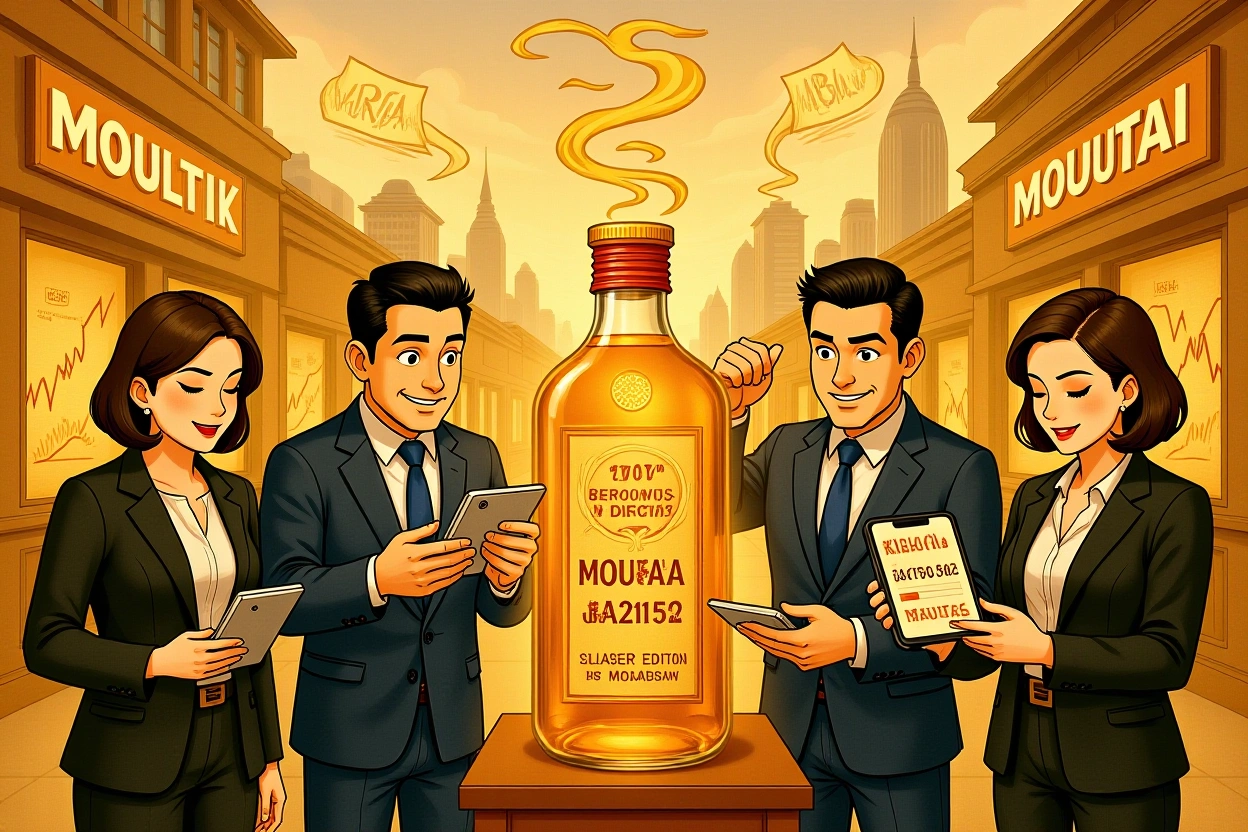
– Kweichow Moutai’s 70th anniversary bottle priced at 7,000 yuan ($1,000) sold 25,568 units in under 2 minutes
– Each bottle featured unique date-specific serial numbers from 1954-2024, driving collector frenzy
– Secondary market markups reached 1,000+ yuan immediately after sales
– Event generated 179 million yuan revenue amid rising premium baijiu demand
– Packaging blended 1950s retro design with sustainable materials
The Record-Breaking Launch
At precisely 9:00 AM on August 8, 2025, Kweichow Moutai unleashed pandemonium on its i Moutai digital platform. The state-owned liquor giant released just 25,568 bottles of its ultra-premium 70th Anniversary Edition – each carrying a staggering 7,000 yuan price tag – only to see inventory vanish within 120 seconds. This 7,000-yuan Moutai release shattered previous luxury sales records, generating approximately 179 million yuan ($25 million) in revenue before most consumers even refreshed their apps.
Anatomy of a Feeding Frenzy
The astronomical demand for this 7,000-yuan Moutai stems from three critical factors:
– Scarcity engineering: With only 255 bottles allocated per year across the 70-year commemorative cycle
– Personalization: Each bottle featured laser-etched date codes (19540501-20240430), enabling buyers to acquire their birthdate
– Digital bottlenecks: i Moutai’s platform struggled under 8.2 million concurrent users according to internal metrics
Social media exploded with frustrated posts like “Impossible to get!” and “Thirty minutes of clicking – nothing” from users like Weibo commentator @SpiritCollector. Yet lucky buyer Chen Wei (陈伟) told China Fund News: “Snagging my birthdate bottle felt like winning the lottery – this is heritage in a bottle.”
Decoding the 7,000-Yuan Phenomenon
This 7,000-yuan Moutai represents more than liquid – it’s a masterclass in luxury marketing. Priced 350% above Moutai’s standard premium offering, the anniversary edition transforms consumption into cultural artifact.
Heritage in a Bottle
The design meticulously resurrects 1954’s Golden Wheel Moutai aesthetic while incorporating contemporary sustainability:
– Glass “three-section” bottle replicating Mao-era contours
– Wooden crate using traditional “Lu Ban Lock” joinery requiring puzzle-like assembly
– Forest Stewardship Council-certified timber with plant-based lacquers
Master distiller Li Xiaowei (李晓伟) emphasized: “We’ve bottled seven decades of craftsmanship – from Guizhou’s red-soil sorghum to the 30-step fermentation process unchanged since the First Five-Year Plan period.”
Secondary Market Wildfire
Within hours of the sellout, speculative trading erupted. Xianyu (China’s largest secondhand marketplace) showed:
– 300-1,000 yuan premiums for most date codes
– Key historical dates (19890604, 19970701) fetching 12,000-15,000 yuan
– 19540501 (first serial) listed at 28,888 yuan by Shanghai dealer ‘VintageSpirits’
This 7,000-yuan Moutai arbitrage mirrors broader luxury trends: Rare 2019 Moutai Zodiac bottles now command 400% markups at Sotheby’s auctions.
The Authentication Arms Race
With counterfeits flooding markets, buyers deploy:
– Blockchain verification via Moutai’s proprietary app
– UV-light detection of hidden bottle engravings
– Professional authenticators charging 500 yuan per inspection
As Beijing collector Zhang Lei (张磊) warned: “That ‘birthyear bottle’ could be fake – profit margins drive incredible forgery innovation.”
Market Ripple Effects
The 7,000-yuan Moutai frenzy immediately impacted broader markets:
– 25-Year Flying Moutai prices rose 5 yuan to 1,910 yuan/bottle
– Kweichow Moutai (SHA:600519) shares gained 2.1% to close at 1,420.97 yuan
– Competitors Wuliangye and Luzhou Laojiao announced limited editions within 72 hours
Institutional Endorsement
CITIC Securities’ analysis suggests this 7,000-yuan Moutai release signals industry transformation:
“Premium baijiu is transitioning from gift economy to cultural investment,” noted lead analyst Wang Jing (王静). “Post-pandemic, experiential luxury and scarcity drive growth – successful players will dominate both liquid production and mythmaking.”
Data supports this: Bain & Company reports Chinese luxury spending will hit 1.2 trillion yuan by 2027, with collectible spirits comprising 18%.
The New Collector Psychology
This 7,000-yuan Moutai phenomenon reveals shifting consumer motivations:
– 62% purchase for investment (2024 Hurun Report)
– 28% seek “cultural connection” through commemorative editions
– Only 10% primarily intend consumption
Shanghai psychologist Dr. Wu Min (吴敏) observes: “Owning serialized history provides identity anchoring in turbulent times – that bottle isn’t liquor, it’s temporal real estate.”
Strategic Implications
Moutai’s record-shattering drop demonstrates three critical luxury strategies:
Digital-First Distribution
i Moutai’s platform now boasts 45 million users by prioritizing:
– Lottery draws for high-demand releases
– Geofenced purchasing preventing bulk buys
– Blockchain transfer records enabling aftermarket control
Generational Bridging
By pairing 1950s aesthetics with Instagrammable unboxing experiences, Moutai achieves:
– 38% sales growth among 25-35 year-olds (company data)
– Doubled social media engagement versus 2022 releases
Secondary Market Cultivation</h3
The deliberate scarcity of this 7,000-yuan Moutai creates:
– Aftermarket price benchmarks justifying future premiums
– Free marketing through resale spectacle
– Collector communities driving repeat purchases
Beyond the Hype
While the 7,000-yuan Moutai sellout made headlines, sustainable luxury requires balancing hype with heritage. As the baijiu market consolidates, brands must:
– Maintain rigorous quality despite production scaling
– Develop transparent secondary market policies
– Preserve cultural authenticity amid commercial pressures
Investors should monitor Moutai’s Q3 artisanal output metrics – any dip could signal dangerous prioritization of limited editions over core quality.
This 7,000-yuan Moutai phenomenon offers more than a consumption story – it’s a masterclass in modern luxury alchemy. For collectors, verify authenticity before paying premiums; for investors, analyze whether limited editions strengthen or dilute brand equity; for competitors, recognize that in today’s market, scarcity engineering trumps traditional marketing. The bottles may be empty, but the lessons overflow.