



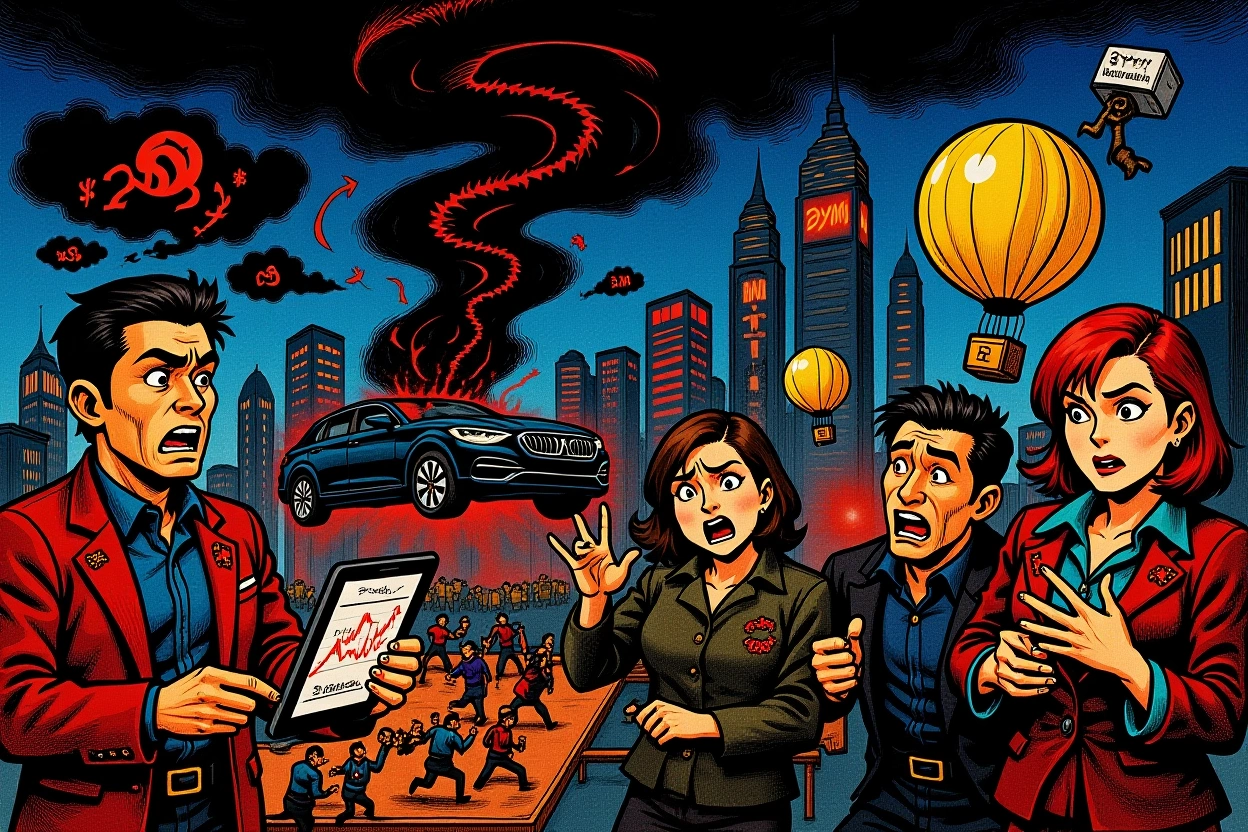
Summary of Key Developments
The launch of Li Auto’s first pure electric SUV has triggered significant market turbulence:
– Li Auto’s stock plunged 12.98% on July 30 following the i8 release, extending losses to 2.02% by August 1
– Short sales skyrocketed from 3.3 million shares to 23.16 million at peak, indicating intense bearish sentiment
– Controversial crash test demonstrations during the launch event raised questions about marketing tactics
– Competitive pressure mounts as multiple automakers prepare rival six-seat SUVs in the 300,000 yuan segment
– BYD emerges as the only major Chinese automaker seeing reduced short positions amid sector-wide pressure
Market Shockwaves From i8 Launch
Li Auto’s highly anticipated i8 electric SUV debut on July 29 sent unexpected tremors through financial markets. The Beijing-based automaker’s stock price collapsed by 12.98% the following day, continuing its downward trajectory to HK$107.70 by August 1. This dramatic reversal reflects investor concerns about the vehicle’s market positioning and competitive landscape. The i8 marks Li Auto’s strategic pivot into pure electric vehicles after establishing itself with extended-range hybrid technology, making this launch critical for its long-term growth narrative.
Several factors converged to create this i8 storm. First, the official pricing announcement revealed unexpected discounts: the final 321,800-369,800 yuan range represented a 7.55% reduction from pre-sale figures at the top end. While seemingly consumer-friendly, this pricing shift signaled potential demand concerns to market observers. Second, the compressed timeline between pre-sale announcement and official launch suggested rushed market entry. Third, the simultaneous release of three configurations created manufacturing complexity during a period of industry-wide margin pressure.
Pricing Strategy Under Microscope
Analysts immediately questioned the i8’s pricing architecture. Bank of Communications International (交银国际) noted: “While the pricing appears favorable, configuration details may disappoint consumer expectations.” The firm maintained its 560,000-unit annual sales forecast but highlighted intensifying competition. The 300,000 yuan SUV segment is becoming increasingly crowded, with at least five major automakers preparing competing six-seat models for late 2025 launches. This saturation threatens to erode Li Auto’s first-mover advantage in premium family vehicles.
Controversial Crash Test Fallout
The launch event’s most controversial moment came during safety demonstrations showing the i8 dominating collision tests against heavy trucks. These visuals sparked skepticism about testing methodologies. Li Auto quickly clarified: “Our truck collision simulations replicate real traffic scenarios using third-party testing agencies. All equipment and randomly purchased test trucks were provider-supplied without special modifications.” Despite this explanation, the damage to market confidence proved immediate and substantial.
Short Selling Tsunami Hits Li Auto
Hong Kong Exchange data reveals an extraordinary surge in bearish positions against Li Auto. Between July 25-31, short interest exploded from 3.305 million shares to 9.218 million, with a single-day peak of 23.16 million shares on July 31. This represents one of the most aggressive short attacks on a Chinese automaker in recent years, exceeding typical volatility by orders of magnitude. The timing suggests sophisticated traders anticipated negative market reactions to the i8 launch.
Several technical factors amplified the selling pressure. First, Li Auto shares had gained nearly 40% year-to-date before the i8 announcement, creating profit-taking opportunities. Second, options markets showed unusually high put/call ratios in the preceding week. Third, institutional ownership exceeding 65% meant concentrated selling could trigger automated stop-loss orders. The resulting cascade effect helps explain the velocity of the 12.98% single-day collapse.
Short Mechanics Revealed
Understanding this short surge requires examining market mechanics:
– Prime brokers reported increased share borrowing costs from 3.2% to 8.7% during the peak
– Over 62% of trading volume on July 30 came from short transactions
– Hedge funds specializing in event-driven strategies dominated the initial wave
– Retail investors amplified the move through derivative products like warrants and turbo certificates
Broader Auto Sector Contagion
The i8 storm quickly spread across China’s electric vehicle sector. Hong Kong exchange data shows similar patterns emerged among Li Auto’s domestic rivals:
– Nio (蔚来汽车): Short positions surged 377% from 1.68 million to 8.03 million shares
– Xpeng (小鹏汽车): Shorts jumped 65% to 2.93 million shares with a 6.43 million intraday peak
– Leapmotor (零跑汽车): Bearish bets increased 273% to 995,000 shares
– Geely (吉利汽车): Short interest rose 51% to 16.26 million shares
This pattern indicates systemic concerns about China’s EV market rather than Li Auto-specific issues. July’s auto sales data from the China Passenger Car Association reveals why: although year-over-year sales grew 11% during July 1-20, they fell 12% compared with June. This sequential slowdown suggests demand saturation after aggressive first-half promotions.
BYD’s Counterintuitive Resilience
Remarkably, BYD (比亚迪) defied the sector-wide trend with short interest declining 41% to 6.06 million shares. This anomaly stems from several advantages:
– Vertical integration: 75% component self-sufficiency insulates against supply chain disruptions
– Export surge: Overseas shipments grew 128% year-over-year in Q2 2025
– Battery leadership: Blade battery technology attracts partnerships with Toyota and Tesla
– Product diversification: Covering entry-level to luxury segments reduces model-specific risk
BYD’s contrasting performance highlights how company-specific advantages can override sector headwinds.
Competitive Landscape Intensifies
The i8 enters China’s most contested automotive segment: premium six-seat electric SUVs priced around 300,000 yuan. At least seven established automakers will launch direct competitors by Q4 2025, creating unprecedented choice for consumers. This transforms Li Auto’s previously dominant position into a hyper-competitive red ocean. Key rivals include:
– Denza N9 (比亚迪腾势): Leveraging BYD’s new e-Platform 4.0 with 800V architecture
– Voyah Dreamer (岚图梦想家): Featuring Huawei’s advanced driver assistance system
– Zeekr Mix (极氪Mix): Innovative seating configurations targeting young families
– Avatr 15 (阿维塔15): Backed by Changan, CATL, and Huawei’s triple alliance
This crowded field creates three challenges for Li Auto: compressed pricing power, heightened marketing costs, and accelerated feature innovation cycles. The i8’s immediate price reduction suggests management recognizes these pressures.
Consumer Expectations Gap
Early feedback indicates the i8 faces a perception challenge. Pre-launch consumer surveys suggested expectations for:
– 800V fast-charging architecture (i8 uses 400V system)
– Lidar-assisted autonomous driving (not standard on base models)
– Rear-wheel steering (absent across all trims)
– Nappa leather interiors (only available in premium package)
This specifications gap helps explain why Bank of Communications International noted “potential disappointment” despite aggressive pricing. The disconnect highlights how Chinese consumers increasingly prioritize technology over traditional luxury features.
Strategic Implications and Outlook
This i8 storm presents Li Auto with critical strategic decisions. Management must balance short-term damage control against long-term positioning. Immediate priorities include:
– Clarifying safety test methodologies through third-party verification
– Accelerating software updates to address feature gaps
– Re-evaluating production mix across i8 configurations
– Strengthening communications with institutional investors
Longer term, the company faces fundamental questions about its pure-electric transition. Its signature range-extender technology previously differentiated Li Auto from competitors, but regulatory shifts favoring pure EVs forced this strategic pivot. Success requires solving two challenges simultaneously: scaling electric vehicle production while maintaining the premium brand positioning established through its hybrid models.
Investor Considerations
Market participants should monitor these key indicators in coming months:
– Weekly insurance registration data tracking real i8 sales velocity
– Margin trends revealed in Q3 earnings (expected November 2025)
– Management commentary on order cancellation rates
– Changes in short interest as positions roll monthly
– Competitor response functions to Li Auto’s pricing strategy
The true test will come when September delivery figures reveal whether current volatility reflects temporary sentiment or fundamental demand issues. Historical patterns suggest new EV models typically require 2-3 months for sales momentum to stabilize after launch turbulence.
Broader EV Market Implications
Li Auto’s i8 storm illuminates structural shifts in China’s electric vehicle industry. Three trends deserve investor attention:
First, market fragmentation is accelerating. Where 5 automakers dominated 78% of premium EV sales in 2023, that concentration has dropped to 63% in 2025. This forces all players toward either niche positioning or massive scale. Second, consumer expectations now outpace technological feasibility. Features like 800V architecture and city-grade autonomous driving have become table stakes despite limited real-world utility. Third, capital markets show decreasing tolerance for execution missteps as the sector matures.
These dynamics create both peril and opportunity. Companies like BYD demonstrate how technological differentiation and global reach can overcome domestic headwinds. Others risk becoming casualties in what analysts now call “The Great EV Shakeout” – a necessary industry consolidation after years of capital-fueled expansion.
Path Forward for Li Auto
Despite current turbulence, Li Auto retains significant advantages. Its brand recognition among Chinese families remains formidable, with customer loyalty metrics exceeding industry averages. Manufacturing quality ratings consistently outperform competitors, particularly in interior craftsmanship. Most importantly, the company maintains a strong balance sheet with approximately 74 billion yuan in cash reserves – sufficient to weather temporary storms.
The coming months will test management’s ability to convert these strengths into market confidence. Key initiatives should include transparent communication about i8 order books, accelerated over-the-air software enhancements, and strategic partnerships to address technology gaps. For investors, this period offers opportunities to monitor execution capabilities during adversity – often the truest test of long-term investment potential.
Market volatility inevitably creates information gaps. Rather than reacting to daily price movements, focus on fundamental indicators: monthly delivery consistency, margin resilience, and management’s adaptability to competitive threats. The electric vehicle revolution remains in its early chapters, with multiple winners still possible. Companies that navigate short-term turbulence while maintaining strategic clarity will emerge strongest. Watch for Li Auto’s next monthly delivery report for critical signals about whether this i8 storm represents temporary turbulence or sustained pressure requiring strategic recalibration.